
APPLICATION SCENARIO
Server Power Supply in Cloud Platforms
The Role of Server Power Supplies in Cloud Platforms
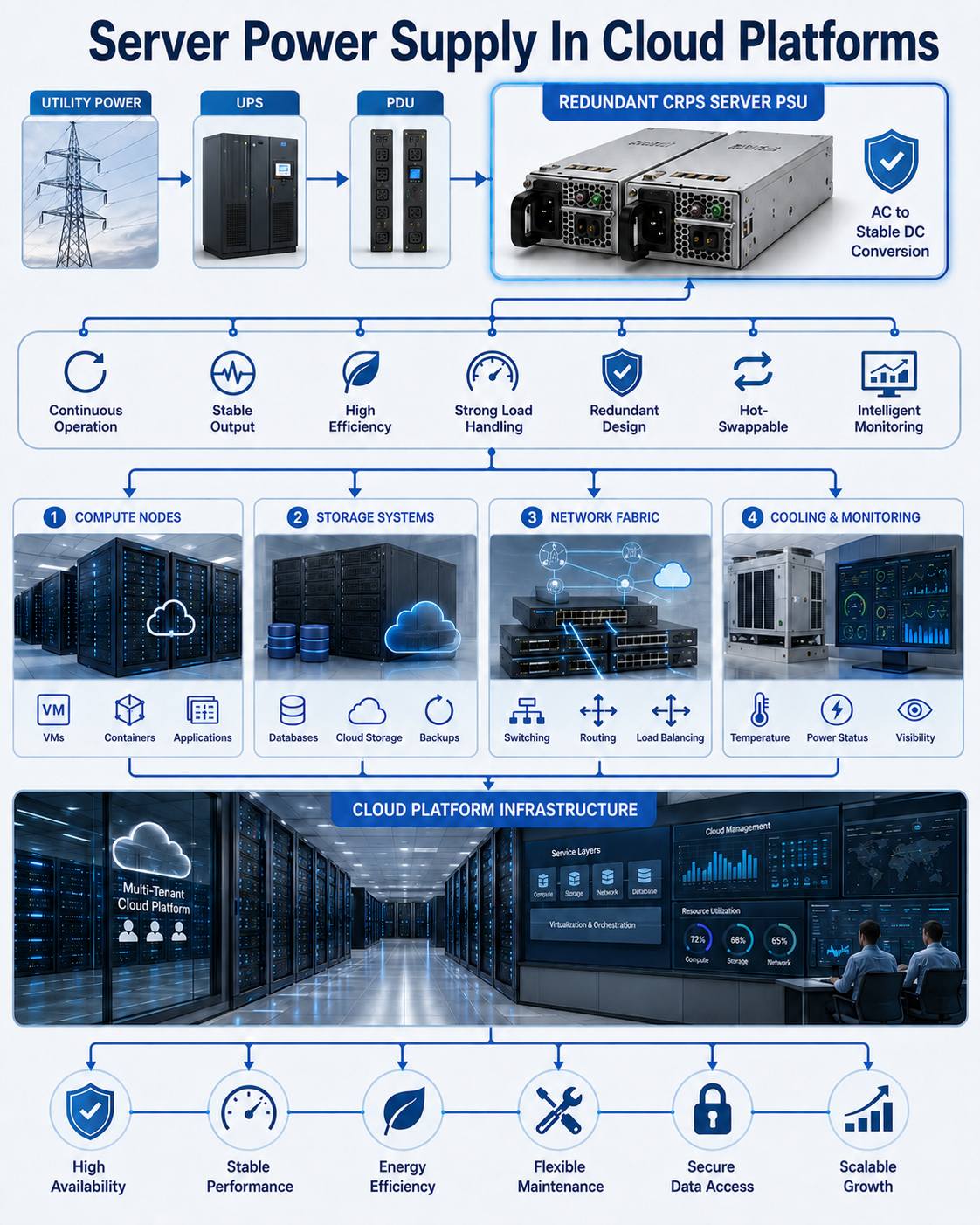
In cloud platform environments, server power supplies provide the stable power foundation behind virtual machines, databases, applications, analytics services, network resources, and user-facing cloud workloads. Power first enters the cloud infrastructure through utility power or UPS systems, then passes through redundant server PSUs where incoming AC power is converted into stable DC output for servers and supporting equipment. This regulated power allows cloud systems to run continuously across compute nodes, storage systems, network devices, cooling equipment, and monitoring platforms. Because cloud platforms often serve many users, applications, and business services at the same time, stable PSU performance is essential for maintaining service availability, workload continuity, and reliable access.
Key Power Requirements for Cloud Infrastructure
Cloud infrastructure requires server power supplies that can support continuous operation, changing workload demand, high equipment density, and scalable service delivery. As users access virtual machines, databases, web applications, analytics tools, and cloud storage, the underlying hardware may experience frequent load changes. A reliable server PSU must provide stable voltage output, high-efficiency conversion, strong load handling, redundancy, and intelligent monitoring to keep these systems running smoothly. Hot-swappable PSU design is also important because cloud operators often need to maintain or replace power modules without interrupting active services. For cloud platforms, power stability directly affects uptime, service performance, data access, and the user experience.
Power Distribution Across Cloud Platform Layers
After power is converted by redundant server PSUs, it is distributed across the main infrastructure layers that support cloud service delivery. Server racks and compute nodes depend on stable power to run virtual machines, containers, applications, and processing workloads. Storage systems require continuous power for databases, cloud storage, backup services, and persistent data access. Network equipment relies on reliable power to support switching, routing, load balancing, and communication between cloud resources. Cooling and monitoring systems also need stable power to manage temperature, airflow, equipment health, power status, and infrastructure visibility. Together, these systems form the physical foundation that allows cloud services to be delivered to business users, remote teams, and online applications.
Benefits for Cloud Hosting, Virtualization, and Scalable Service Delivery
A well-designed server power supply helps cloud platforms achieve stronger availability, better energy efficiency, smoother workload scaling, and more reliable service delivery. By delivering stable power to compute nodes, storage systems, network fabric, cooling equipment, and monitoring platforms, the PSU helps reduce the risk of service interruption, workload failure, voltage instability, and unexpected downtime. High-efficiency power conversion also helps reduce energy loss and heat generation, which is especially important in cloud environments where large numbers of servers operate continuously. Redundant and hot-swappable PSU architecture improves maintenance flexibility by allowing power modules to be serviced with minimal disruption. For cloud hosting providers, private cloud operators, managed service providers, and enterprise cloud platforms, reliable server power supplies provide the foundation for stable virtual machines, secure data access, responsive applications, efficient infrastructure operation, and long-term cloud service growth.