
APPLICATION SCENARIO
Server Power Supply in Data Centers
The Role of Server Power Supplies in Data Centers
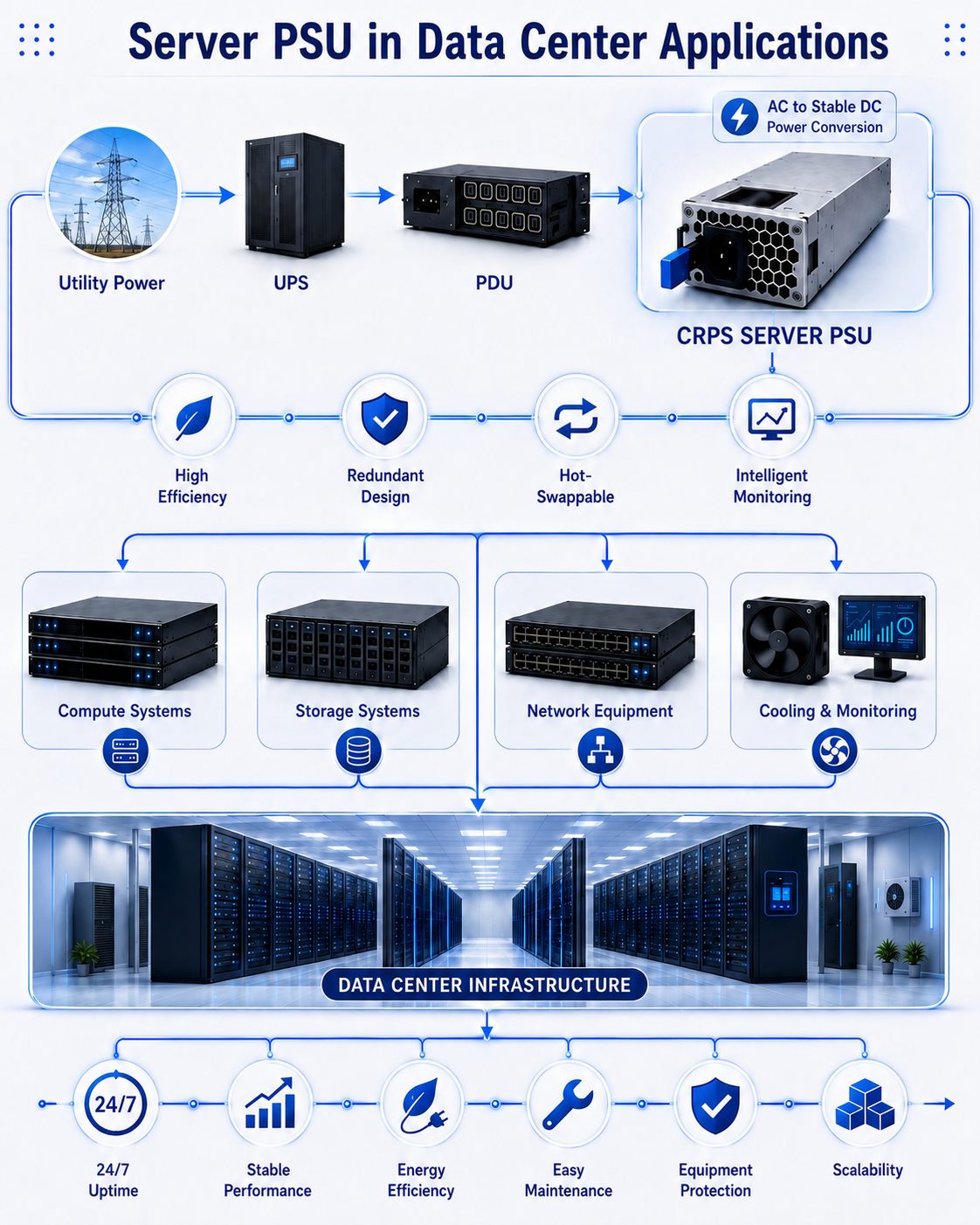
In data center environments, server power supplies serve as the core conversion point between incoming electrical power and the critical IT systems that depend on stable DC output. Power enters the facility through the main power input, but before it can support servers, storage, networking, cooling, and monitoring equipment, it must be converted and regulated through a reliable PSU architecture.
A CRPS server PSU helps transform AC input into controlled DC power with high efficiency and consistent output performance. This allows data center equipment to operate continuously under demanding workloads, where even a short power interruption may affect service availability, system stability, and business continuity.
Key Power Requirements for Data Center Applications
Data center applications require power supplies that can support continuous operation, high load density, and long-term reliability. A server PSU must provide stable voltage output, efficient power conversion, strong load handling, and dependable performance across changing computing demands.
In modern server environments, CPUs, GPUs, memory modules, storage controllers, and network devices may all draw power dynamically, especially during peak workloads. This makes power stability and conversion efficiency essential. Features such as redundancy, hot-swappable design, high efficiency, and intelligent monitoring help data center operators maintain stable power delivery while reducing downtime risk and improving maintenance flexibility.
Power Distribution Across Critical Data Center Systems
After power is converted by the CRPS server PSU, it is distributed across multiple critical systems inside the data center. Compute servers depend on stable power to support CPUs, GPUs, memory, and other high-performance components.
Storage systems require consistent power for drives, controllers, and storage arrays to protect data access and system continuity. Network equipment, including switches, routers, and communication infrastructure, also relies on reliable power to maintain data transmission and connectivity.
At the same time, cooling and monitoring systems need continuous power to manage airflow, temperature, equipment status, and operational visibility. Together, these systems form the foundation of daily data center operation.
Adequate PSU headroom supports future compute, storage, and network expansion.
Benefits for Data Center Performance and Reliability
A well-designed server power supply improves data center reliability by supporting stable power delivery across compute, storage, network, cooling, and monitoring infrastructure. By converting incoming power efficiently and distributing it to critical systems, the PSU helps reduce the risk of voltage instability, unexpected shutdowns, and performance interruptions.
High-efficiency conversion also reduces energy loss and heat generation, which is especially important in high-density environments where power consumption and thermal management directly affect operating costs.
Redundant and hot-swappable PSU designs further improve service continuity by allowing maintenance or replacement with minimal disruption to system operation. For data center operators, this means stronger uptime protection, easier maintenance planning, better energy utilization, and greater infrastructure resilience.
As facilities continue to expand for cloud computing, AI workloads, enterprise applications, and large-scale data storage, reliable server power supplies provide the foundation for continuous uptime, stable performance, and long-term infrastructure growth.