
APPLICATION SCENARIO
Server Power Supply in Enterprise IT
The Role of Server Power Supplies in Enterprise IT
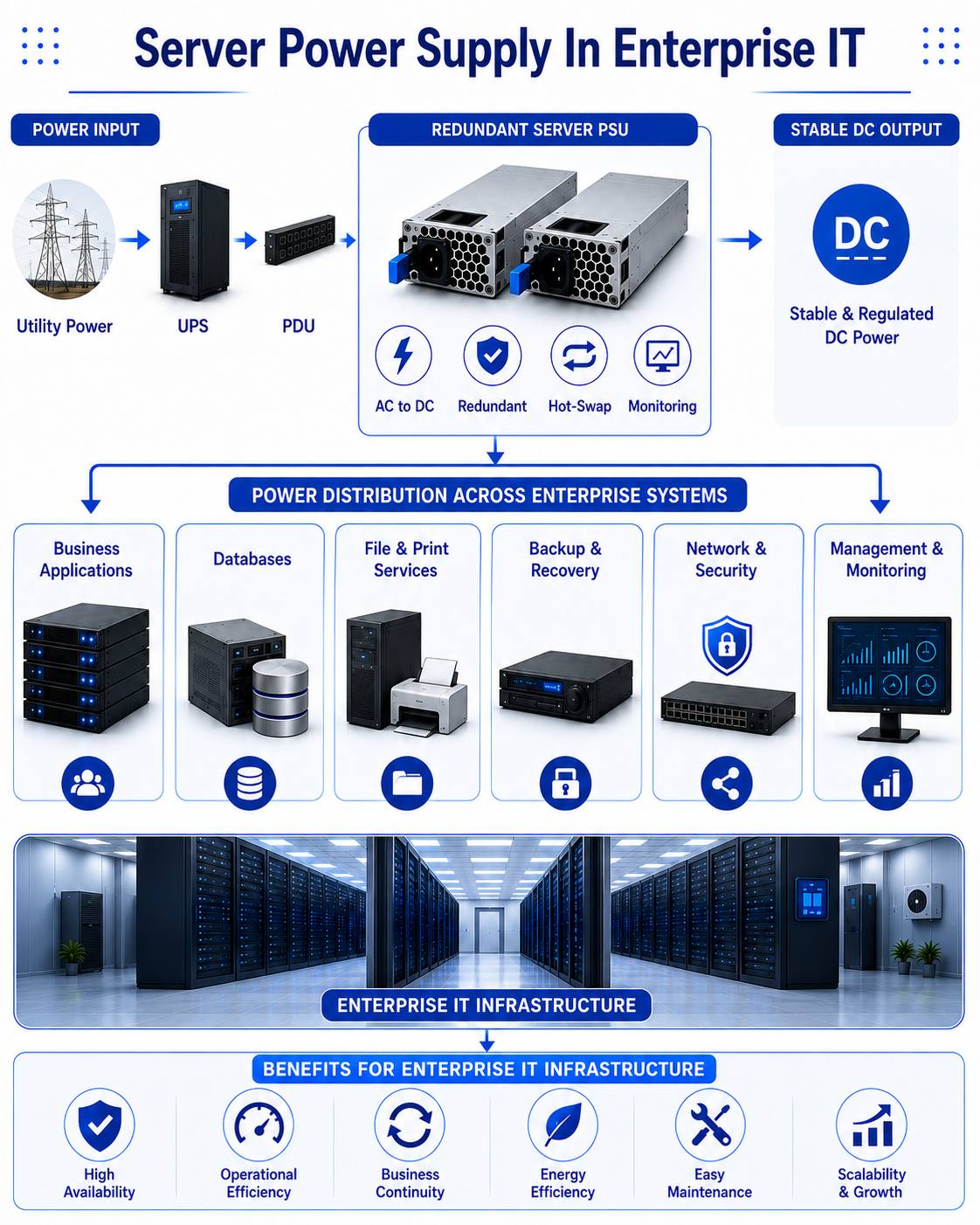
In enterprise IT environments, server power supplies provide the stable power foundation required to support daily business operations, internal applications, data processing, network services, and infrastructure management. Power enters through utility power, UPS systems, or PDU distribution, then passes through redundant server PSUs where it is converted into stable DC output for enterprise servers and connected systems. Because enterprise IT infrastructure often supports business-critical workloads such as ERP, CRM, databases, file services, backup systems, and network security, reliable power delivery is essential for maintaining productivity and service continuity. A well-designed server PSU helps ensure that internal IT systems remain stable, available, and ready to support business operations.
Key Power Requirements for Enterprise IT Systems
Enterprise IT systems require server power supplies that combine reliability, efficiency, stable output, and easy maintenance. Unlike temporary or non-critical equipment, enterprise servers often run continuously to support business applications, user access, data storage, and security services. This means the PSU must provide consistent voltage output, high-efficiency power conversion, and dependable performance across different workloads. Redundant power architecture helps reduce the risk of service interruption, while hot-swappable PSU design allows maintenance or replacement without shutting down critical systems. Intelligent monitoring also gives IT teams better visibility into power status, helping them manage infrastructure health and prevent unexpected failures.
Power Distribution Across Enterprise Systems
After power is converted by redundant server PSUs, it is distributed across multiple enterprise IT systems. Business application servers depend on stable power to support CRM, ERP, HR systems, application workloads, and internal business platforms. Database systems require consistent power for SQL, Oracle, MySQL, transaction processing, and data operations. File and print services also rely on dependable power for file servers, NAS devices, document storage, and office resource sharing. Backup and disaster recovery systems need continuous power to protect business data and maintain recovery readiness. At the same time, network and security equipment such as switches, routers, firewalls, and UTM devices require stable power to maintain secure connectivity. Management and monitoring systems also depend on reliable power for system visibility, IT management, and performance analytics.
For enterprise IT teams, a consistent server power strategy also simplifies standardization across departments and locations. Selecting compatible PSU platforms for application servers, databases, storage appliances, and network systems helps reduce spare-part complexity and makes maintenance planning more predictable. Adequate power headroom supports future memory, drive, and processor upgrades, while redundancy protects essential services during module replacement or unexpected faults. Together, these measures help organizations maintain business continuity as internal workloads, user demand, and digital services continue to expand.
Benefits for Enterprise IT Infrastructure
A reliable server power supply helps enterprise IT infrastructure achieve higher availability, better operational efficiency, stronger business continuity, and lower long-term operating risk. By delivering stable power to business applications, database systems, file services, backup platforms, network security devices, and monitoring tools, the PSU helps reduce unexpected downtime and supports continuous access to critical business systems. High-efficiency power conversion also helps lower energy loss and reduce heat generation, which can improve overall equipment performance and reduce operating costs in server rooms, enterprise racks, and corporate IT facilities.
Redundant and hot-swappable PSU designs make infrastructure maintenance easier by allowing IT teams to replace or service power modules with minimal disruption. This is especially valuable for organizations that rely on internal systems for daily operations, customer service, data access, security protection, and compliance-related workloads. With intelligent monitoring, enterprise IT teams can track power conditions, identify potential issues earlier, and improve infrastructure management. As businesses expand their application environments, storage capacity, security systems, and digital workflows, dependable server power supplies provide the foundation for productivity, security, business continuity, lower total cost of ownership, and scalable IT growth.