
APPLICATION SCENARIO
Server Power Supply in HPC Systems
The Role of Server Power Supplies in HPC Systems
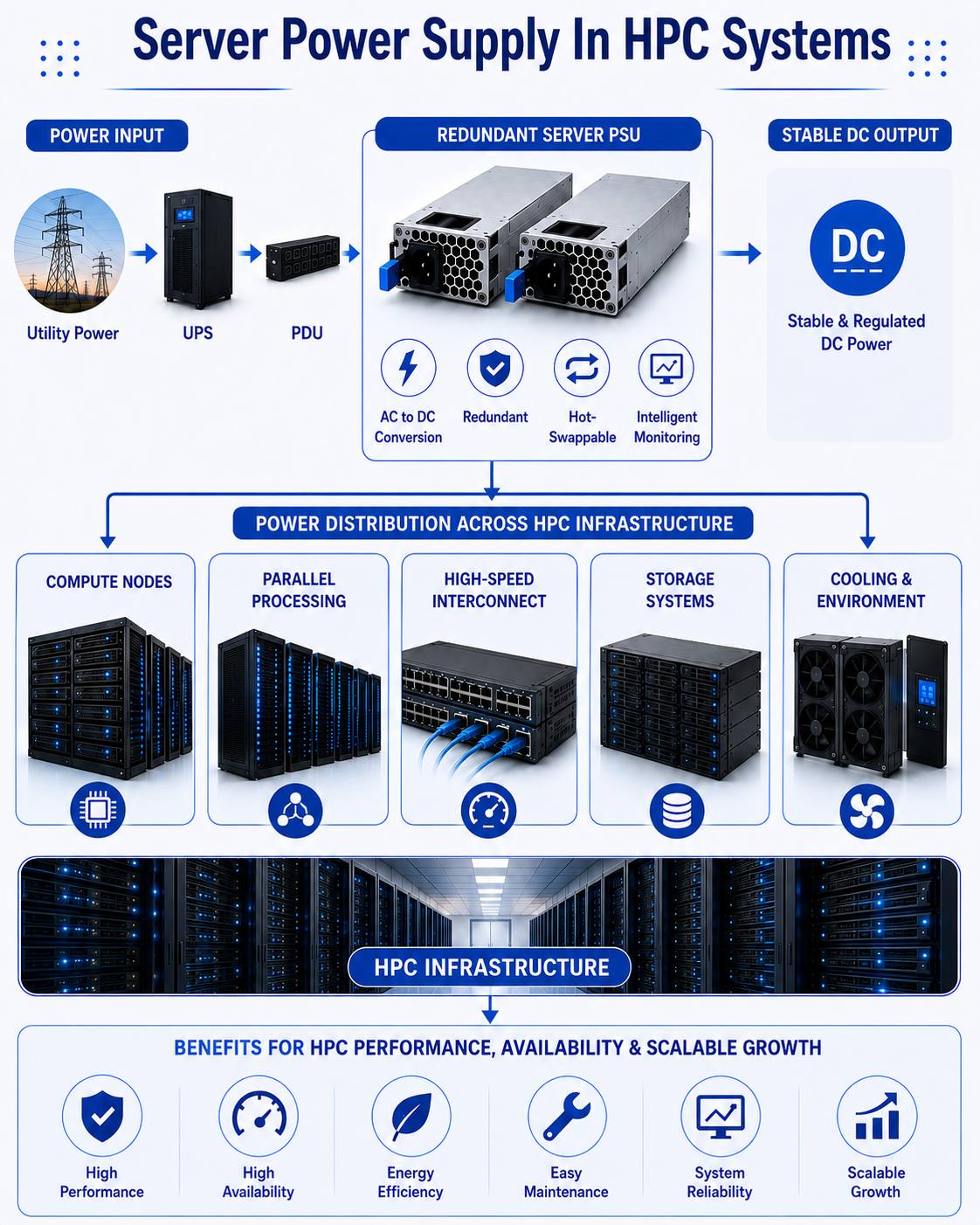
In HPC systems, server power supplies provide the stable power foundation required for complex simulations, scientific computing, data modeling, and high-throughput workloads. Power enters through utility power, UPS systems, or PDU distribution, then passes through redundant server PSUs where it is converted into stable DC output for high-performance computing infrastructure. Because HPC environments often rely on large numbers of servers working together, consistent and efficient power delivery is essential for maintaining computing accuracy, workload continuity, and system reliability. A well-designed server PSU helps ensure that compute nodes, interconnect equipment, storage systems, and cooling infrastructure can operate continuously under intensive processing conditions.
Key Power Requirements for High-Performance Computing
HPC workloads require server power supplies that can support high-density servers, multi-core CPUs, parallel processing tasks, and continuous high-load operation. Unlike standard enterprise workloads, HPC applications may run large-scale simulations, distributed computing jobs, and scientific calculations for extended periods without interruption. This means the PSU must provide stable voltage output, high conversion efficiency, strong load handling, and reliable operation across changing system demands. Redundant PSU architecture helps protect against power-related downtime, while hot-swappable design allows maintenance without stopping critical workloads. Intelligent monitoring is also important for tracking power status, detecting abnormal conditions, and supporting stable operation in performance-sensitive computing environments.
Power Distribution Across HPC Infrastructure
After power is converted by redundant server PSUs, it is distributed across the major components of the HPC system. Compute nodes depend on stable power to support multi-core CPUs, high-density servers, parallel computing tasks, and intensive workloads. Parallel processing environments require continuous power across multiple nodes to support MPI, OpenMP, distributed computing, large-scale simulations, and high-throughput operations. High-speed interconnect equipment also relies on dependable power to maintain InfiniBand, Ethernet, low-latency networking, high bandwidth, and data synchronization between computing nodes. Storage systems need consistent power for parallel file systems, high-performance storage, large-capacity data access, and fast data movement. Cooling and environmental systems also require stable power to manage precision cooling, temperature control, airflow management, and reliable operation across the full HPC environment.
HPC power planning must also consider how clusters grow over time. Additional compute nodes, accelerators, high-speed fabrics, and storage capacity can quickly increase rack-level demand. Providing suitable PSU headroom allows technical teams to expand processing capacity without introducing avoidable power constraints. Coordinating power capacity with cooling, redundancy, and monitoring also supports more predictable operation during long simulations and batch workloads. This is particularly valuable for research, engineering, scientific modeling, and other environments where interrupted jobs can waste significant computing time and resources. Standardizing compatible power modules and keeping suitable replacements available can further reduce recovery time, simplify service procedures, and help large clusters return to full capacity quickly after maintenance or component faults.
Benefits for HPC Performance, Availability, and Scalable Growth
A reliable server power supply helps HPC systems achieve maximum performance, high availability, energy efficiency, and scalable infrastructure growth. By delivering stable power to compute nodes, parallel processing clusters, high-speed interconnects, storage systems, and cooling infrastructure, the PSU helps reduce the risk of workload interruption, system instability, and unexpected downtime. This is especially important for HPC workloads such as scientific research, engineering simulation, weather modeling, financial analysis, AI-assisted computation, and large-scale data processing, where long-running tasks may depend on continuous operation across many servers and networked resources.
High-efficiency power conversion also reduces energy loss and heat generation, helping operators manage operating costs and thermal pressure in dense computing environments. Redundant and hot-swappable PSU designs improve serviceability by allowing power modules to be replaced or maintained with minimal disruption to active workloads. Intelligent monitoring can further support infrastructure visibility by helping technical teams track power conditions, identify potential faults, and maintain stable operation across complex HPC systems. As research centers, laboratories, universities, cloud HPC providers, and enterprise engineering teams continue to expand computing capacity, dependable server power supplies provide the foundation for complex simulations, scientific computing, breakthrough performance, and long-term scalable growth.