
APPLICATION SCENARIO
Server Power Supply in Storage Systems
The Role of Server Power Supplies in Storage Systems
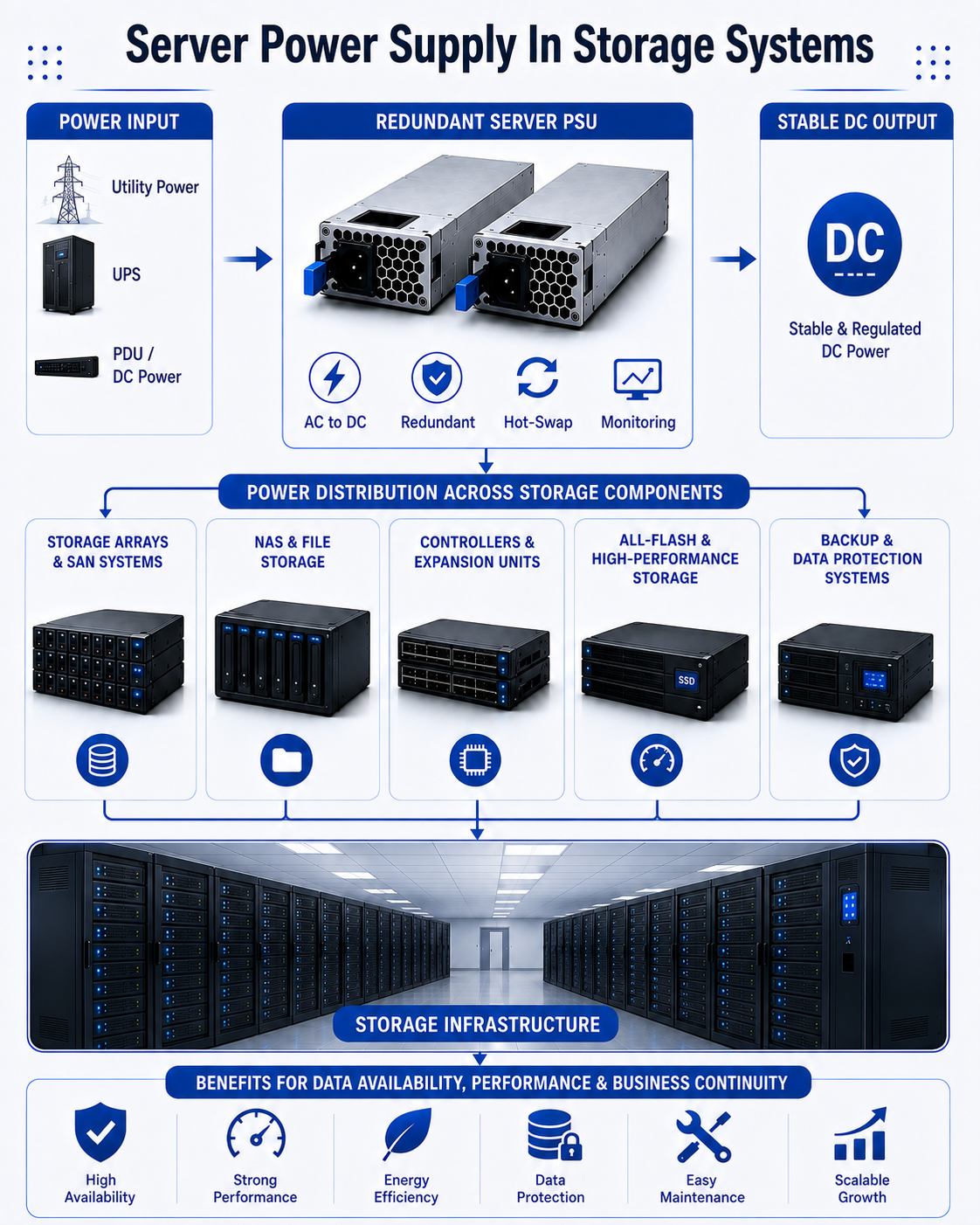
In storage systems, server power supplies provide the stable power foundation required to support continuous data access, storage performance, and business continuity. Power enters through utility power, UPS systems, PDU distribution, or DC power systems, then passes through redundant server PSUs where it is converted into stable and regulated output for storage infrastructure. Because storage environments often support critical business data, shared files, databases, backups, and high-performance workloads, reliable power delivery is essential for preventing service interruption and protecting data availability. A well-designed server PSU helps ensure that storage arrays, NAS systems, controllers, expansion units, flash storage, and backup platforms can operate continuously with stable performance.
Key Power Requirements for Storage Infrastructure
Storage infrastructure requires server power supplies with high reliability, high efficiency, stable output, hot-swappable design, and intelligent monitoring. Unlike ordinary computing systems, storage platforms must maintain continuous access to data while supporting drives, controllers, RAID systems, cache modules, and expansion units. Any power instability may affect data transactions, system availability, backup processes, or storage performance. Redundant PSU architecture helps reduce the risk of downtime, while hot-swappable power modules allow maintenance without interrupting active storage services. High-efficiency conversion also helps lower energy loss and heat generation, which is important for dense storage racks and long-running data systems.
Power Distribution Across Storage System Components
After power is converted by redundant server PSUs, it is distributed across multiple storage system components. Storage arrays and SAN systems require stable power for enterprise storage, Fibre Channel, iSCSI, high availability, and continuous operation. NAS and file storage systems depend on reliable power to support file sharing, data protection, easy scalability, and shared access across business environments. Storage controllers and expansion units require consistent power for RAID controllers, JBOD expansion, high throughput, and stable performance. All-flash and high-performance storage platforms rely on dependable power to support low latency, high IOPS, and maximum performance. Backup and data protection systems also need continuous power for backup appliances, replication, disaster recovery, and long-term data security.
Storage power requirements often increase as organizations add drives, controllers, cache, and higher-performance networking. Planning sufficient PSU capacity from the beginning gives storage teams room to expand without compromising stability or redesigning the platform. Consistent power modules also simplify replacement inventory and maintenance across primary storage, backup appliances, and disaster-recovery systems. When capacity planning is coordinated with redundancy, cooling, and monitoring, storage infrastructure can maintain dependable data access while supporting continued growth in databases, virtual machines, analytics workloads, and long-term retention. This coordinated design also makes future capacity upgrades easier to schedule without placing active data services at unnecessary risk.
Benefits for Data Availability, Performance, and Business Continuity
A reliable server power supply helps storage infrastructure achieve high availability, strong data performance, energy efficiency, data protection, and scalable growth. By delivering stable power to storage arrays, SAN systems, NAS platforms, controllers, expansion units, all-flash storage, and backup appliances, the PSU helps reduce the risk of data access interruption, storage instability, system downtime, and backup failure. This is especially important for enterprises, data centers, cloud platforms, financial systems, healthcare systems, media storage, and backup environments where data must remain available and protected at all times.
High-efficiency power conversion helps reduce energy loss and heat output, improving operating efficiency in dense storage racks where many drives and controllers run continuously. Redundant and hot-swappable PSU designs also improve serviceability by allowing maintenance or replacement with minimal disruption to active storage workloads. Intelligent monitoring further helps technical teams track power conditions, detect abnormal status, and improve system reliability before issues affect data services. As storage demand continues to grow across enterprise applications, cloud services, AI datasets, backup systems, and digital operations, dependable server power supplies provide the foundation for reliable data availability, fast storage performance, strong data protection, and long-term infrastructure expansion.