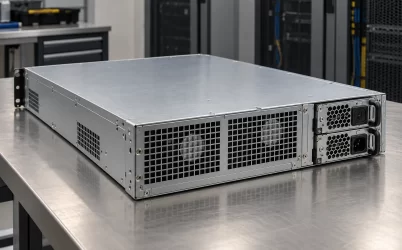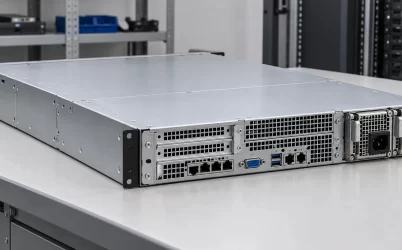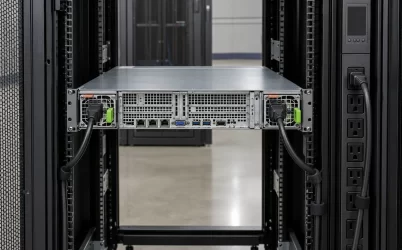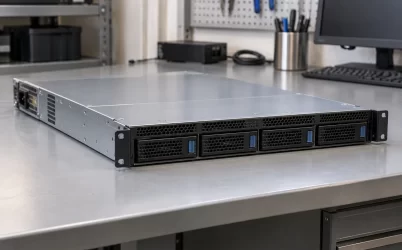
CRPS2200D2 is Great Wall’s 2200 W CRPS module in a 185 × 73.5 × 40 mm enclosure. A buyer considering it as a replacement or a shared spare should start with the exact model identity, then check the host power path and the operating condition behind its published 12 V current entries. The manufacturer lists 91 A, 164 A, and 181 A, but its public catalog does not assign each value to an input range. That omission matters: a 2200 W label and a familiar CRPS outline do not establish that a module can sustain a particular server load on every permitted input, or that it mates with a particular backplane.
This article treats CRPS2200D2 as a service and procurement identification problem. The question is whether the module can replace an installed unit without changing the server’s electrical, mechanical, or operational assumptions. It also explains what a 2200 W rating does and does not imply when the nearby CRPS2000N3 and CRPS2400D2 entries appear in the same product search.
Start with the identity on the removed module
The first useful artifact is the complete label on the original PSU, photographed so the model suffix and revision remain legible. “CRPS” describes a class of compact redundant power supplies, not a universal interchangeable interface. The D2 suffix is part of this module’s identity. A purchasing record that stops at “2200 W CRPS” can return another unit with a similar outline but a different connector arrangement, control behavior, latch position, or host approval status. Record the server manufacturer and chassis model as well, because a service spare is selected for a host, not for a wattage category.
Great Wall’s CRPS product listing identifies CRPS2200D2 at 2200 W, with 90–264 Vac or 180–320 Vdc input, a 185 × 73.5 × 40 mm body, FR airflow, a 0–55 °C listed operating range, Platinum efficiency designation, a +12 V standby output at 3 A, and three +12 V main-output current entries: 91 A, 164 A, and 181 A. Those are catalog facts. They are not a complete host integration specification. In particular, the listing does not publish a model-specific pin map, connector drawing, revision cross-reference, or the input condition assigned to each current entry.
A 12 V entry of 181 A corresponds arithmetically to 2172 W on that rail; rounding, rail setpoint, and standby allowance can help explain why a catalog describes the unit as 2200 W. This calculation does not reveal the test condition or grant 181 A across the entire input range. The three entries should be read as alternative published operating ratings, not as three additive 12 V rails. Ask for the exact datasheet and label revision before converting any of them into a server power budget.
What a 2200 W spare adds between the neighboring ratings
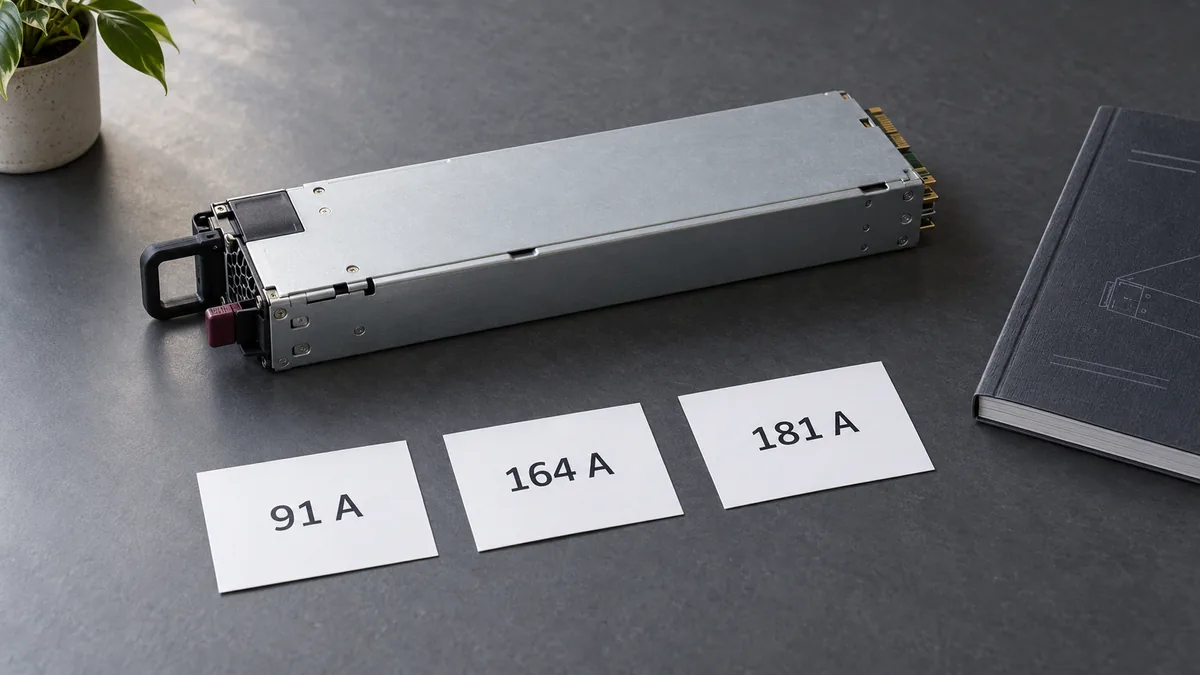
CRPS2200D2 sits between Great Wall’s listed 2000 W CRPS2000N3 and 2400 W CRPS2400D2 in nominal output. All three catalog entries share the same published 185 × 73.5 × 40 mm envelope, input families, FR airflow notation, and 0–55 °C range. Their listed main-output currents differ: CRPS2000N3 shows 65.6 A, 148 A, and 164 A; CRPS2200D2 shows 91 A, 164 A, and 181 A; CRPS2400D2 shows 91 A, 181 A, and 197 A. These values make the 2200 W model a plausible candidate for a capacity increment, but the catalog alone does not authorize substitutions among them.
Ask why the original module was selected. If a fleet uses CRPS2000N3 because its host vendor qualified that exact revision, an extra 200 W printed on another unit has no value until the host accepts its connector, management, control timing, and cooling direction. If a server has been upgraded and its documented peak load exceeds the incumbent module’s allowed operating envelope, a higher rated module may be worth evaluating, but changing one module in a redundant pair can introduce sharing or identification issues. Conversely, a 2400 W model is not automatically the safer purchase merely because its nameplate is higher. The host may impose the limiting power cap, and a different approved-parts list may apply.
For inventory planning, keep a distinct stock code for the exact model and revision. A shared spare bin labeled only “185 mm CRPS” invites a wrong-part installation during a service event. The physical outline is useful for narrowing candidates; it is insufficient for releasing them to field technicians. Where a server vendor provides a field-replaceable unit number, use that number as the operational identifier and retain CRPS2200D2 as the component cross-reference.
Separate input acceptance from available output
The listed AC and high-voltage DC ranges say that the model family accepts those input types. They do not say that full 2200 W output is available at every point inside either range. At lower AC voltage, delivering the same input power requires more input current. A supply may therefore have a reduced output limit in some conditions to remain within its input-stage or connector limits. The three published 12 V current entries are consistent with condition-dependent ratings, but their precise mapping is not supplied in Great Wall’s public list. Treat a guessed mapping as a procurement risk, especially for sites with 100–127 Vac distribution or high-voltage DC feeds.
Consider an illustrative server that needs 150 A from its 12 V bus during a defined peak. The 164 A and 181 A catalog entries exceed that current, while 91 A does not. That observation can identify a question for the manufacturer; it cannot establish that the intended facility input qualifies for either higher entry. Obtain the rated-current table for the exact CRPS2200D2 revision and input condition, including any temperature or altitude qualification. Only then compare the site’s actual voltage at the PSU inlet with the applicable entry. Voltage at the upstream PDU is not necessarily the same as voltage at the module during a high-current event.
For a dual-feed server, make the comparison separately for each feed. A high-voltage primary feed and a low-line secondary feed may have different allowable output after one path fails. In a 1+1 arrangement, the server must fit inside the surviving single module’s applicable rating if uninterrupted operation after a module loss is required. Two installed 2200 W modules do not create 4400 W of redundant capacity under that objective. A load that is comfortable with both modules sharing may exceed one module’s condition-specific limit. The same distinction applies when a service technician removes one module under load.
Do not turn the catalog’s “Platinum” designation into an assumed wall-plug efficiency percentage for a particular load, voltage, or ambient temperature. It identifies an efficiency class in the listing, while a numerical operating-cost or heat calculation needs measured efficiency under the relevant test condition. Likewise, the published 0–55 °C range is not a promise of full output at 55 °C without a model-specific derating statement. These two limitations matter when estimating rack heat or selecting a spare for a warm equipment room.
Keep the replacement decision attached to the host

The 185 × 73.5 × 40 mm envelope is an excellent first physical screen. Measure the existing module and inspect the rail and latch arrangement, but preserve the distinction between an enclosure dimension and an installation drawing. The host may require a particular insertion depth to seat its connector and secure the latch. Nearby chassis metal, cable dressing, or a rear door can obstruct extraction even when the bare PSU body fits. A replacement must also follow the host’s intended airflow direction. The manufacturer calls the CRPS2200D2 direction “FR”; confirm what that notation means for the actual part and compare it with the server’s air path before approving a spare.
The backplane or power distribution board is the next boundary. Compare the mating connector drawing, power contacts, standby contacts, control pins, and mechanical keying against the original approved unit. The public CRPS2200D2 listing does not supply enough information to state a pinout here. In a server, the standby output may support controller functions before the main rail turns on, so its listed +12VSB / 3 A figure is relevant; it still does not prove that the standby pin position or sequencing matches another module. A photo of the contacts can help catch obvious differences, but an approved drawing or host service document is stronger evidence.
Management behavior is another host-specific matter. Some systems identify installed PSUs, apply power caps, log faults, or coordinate sharing through management signals. The presence of CRPS terminology does not establish that CRPS2200D2 uses a particular PMBus command set, address, telemetry accuracy, or firmware handshake. A candidate replacement may deliver power in a bench fixture yet produce a persistent host alarm or fail a redundancy policy in the actual chassis. Check the server vendor’s compatibility list or obtain a written engineering cross-reference for the exact server and PSU revisions.
Where the unit is intended as a spare for a mixed fleet, test the inventory assumption before buying in volume. One server family might accept the component while another with the same physical bay requires a different assembly number. A small compatibility matrix organized by host model, backplane revision, approved PSU part number, and facility input is more useful than a single “2200 W CRPS compatible” note. It tells purchasing which stocking opportunities are real and tells service staff when to stop.
Use the available evidence without overreading it
The public record supports a narrow, concrete description: CRPS2200D2 is a 2200 W Great Wall CRPS unit with the listed input ranges, envelope, airflow notation, operating-temperature range, efficiency designation, and output entries. Powernexu’s CRPS2200D2 product page presents the same model and can be used to identify the commercial part. Neither page, by itself, proves a cross-model replacement, the current-to-input mapping, full-load operation at an endpoint temperature, or compatibility with a particular server.
When requesting a quote or engineering approval, send the original label photo and host identifiers together. Ask the supplier to identify the exact revision offered, the current rating for the intended AC or DC input, the connector and pin assignment, the airflow direction, and the host qualification basis. For a redundant installation, include the load expected after one module is removed or one feed is lost. This is a compact request because each answer resolves a specific uncertainty left by the catalog, rather than a generic demand for “more specifications.”
If the vendor cannot document the relevant current condition, avoid assuming that the middle or highest 12 V entry applies. If the connector or host approval cannot be established, the physical fit is not enough to release the unit as a service spare. If the host requires a capacity increase, determine whether the change is supported as a matched pair, whether the backplane and input path carry the new load, and whether the system power cap changes. These are separate decisions; the 2200 W marking resolves none of them alone.
Where the 2200 W model belongs in the service record
CRPS2200D2 earns its own entry in a spare-parts plan because its nominal rating and three listed current values differ from the neighboring 2000 W and 2400 W products, even though their published envelopes look alike. Record it as a specific, condition-dependent power component, paired with the host assemblies that actually approve it. That record should preserve the facility-input condition, the installed revision, the approved mating interface, and the surviving-load requirement. A technician can then identify a valid replacement quickly without treating a shared CRPS outline as proof of electrical interchangeability.
The unresolved public detail is the mapping of 91 A, 164 A, and 181 A to operating conditions. A model-specific datasheet or written manufacturer confirmation closes that gap. Until it is available, the safest useful conclusion is limited: the public evidence identifies the product and its published rating ladder, but it does not establish which rung applies to a given server inlet. Keeping that boundary visible is what turns a 2200 W product listing into a reliable service decision.