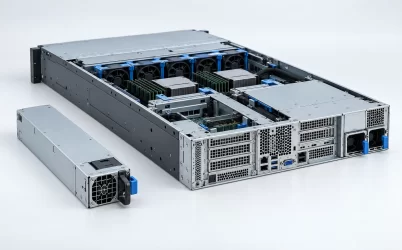
A 2U redundant 700W power supply can be part of a server that spins its chassis fans but produces no display. That symptom does not prove the converter is defective, and it does not prove the motherboard has completed startup. In one documented legacy Supermicro combination, the manufacturer’s support answer identified the power distribution board revision as a possible compatibility issue. The relevant purchase was therefore not simply another 700W cartridge.
The specific combination was an X8DTH-6F motherboard and an SC825TQ-R700LPB chassis. The case is useful for maintaining or evaluating that legacy hardware, and for understanding why an apparently complete redundant power assembly can still need a revision check. It is not a diagnosis for every server with spinning fans or permission to experiment with an unidentified live power system.
The documented case stops short of declaring a failed PSU
Supermicro’s SC825 chassis manual, revision 2.0a dated December 9, 2013, identifies the family as 2U and lists SC825TQ-R700LPB with a 700W redundant supply. That establishes the case’s height and power category from manufacturer documentation rather than decoding the model name. The manual is preserved in a supplier archive.
In Supermicro FAQ 9504, the owner described a newly assembled X8DTH-6F and SC825TQ-R700LPB with spinning chassis fans and no display. The manufacturer’s answer proposed a CMOS clear and comparison with a different supply model. If that comparison allowed startup, the answer said the motherboard and PDB-PT825 distribution board could have a compatibility issue. It directed the owner to identify the PDB revision and contact the RMA department about a newer revision for X8.
That is a conditional support answer. It does not say that every SC825TQ-R700LPB contains an incompatible board, that every X8 motherboard needs the same change, or that every no-display symptom has this cause. It also supplies no numerical minimum PDB revision. A buyer cannot fill that missing revision field by guessing from a photograph or adopting a number mentioned in an unrelated listing.
The distinction between could be and is matters here. A successful comparison can direct attention toward a compatibility boundary without proving the exact electronic mechanism. The FAQ does not disclose a failed component, a timing measurement, or a contact-level explanation. The useful verified fact is narrower: the manufacturer recognized the board revision as relevant to that named combination and described a support route for resolving it.
The instructions remain historical context for that exact case. Any physical diagnostics, configuration resets, or supply changes must follow the applicable equipment procedure and qualified service practice. This article does not turn the short support answer into a universal startup procedure.
A fan observation describes one function, not the whole startup
A rotating chassis fan establishes that the fan’s operating conditions have been reached sufficiently for it to move. It does not independently establish valid processor power, a completed reset sequence, initialized memory, working graphics, or a successful boot. Those functions occupy different parts of the server. Calling the machine powered because a fan moves compresses several unobserved conditions into one conclusion.
Similarly, no display describes an output observation rather than the identity of a faulty part. A server might fail before initialization reaches video, or it might run while the selected display path is unavailable. The phrase alone does not distinguish those situations. Platform-specific indications and service documentation are needed before the team labels the symptom a no-POST condition or assigns it to the PSU.
This leaves two opposite assumptions unsupported. It is premature to condemn the 700W modules merely because there is no picture. It is equally premature to clear the entire power assembly because fans are spinning. The observed functions should remain separate until evidence connects them. In the Supermicro case, the support answer did exactly that by considering an intermediate distribution component instead of treating the fan state as a complete power-health report.
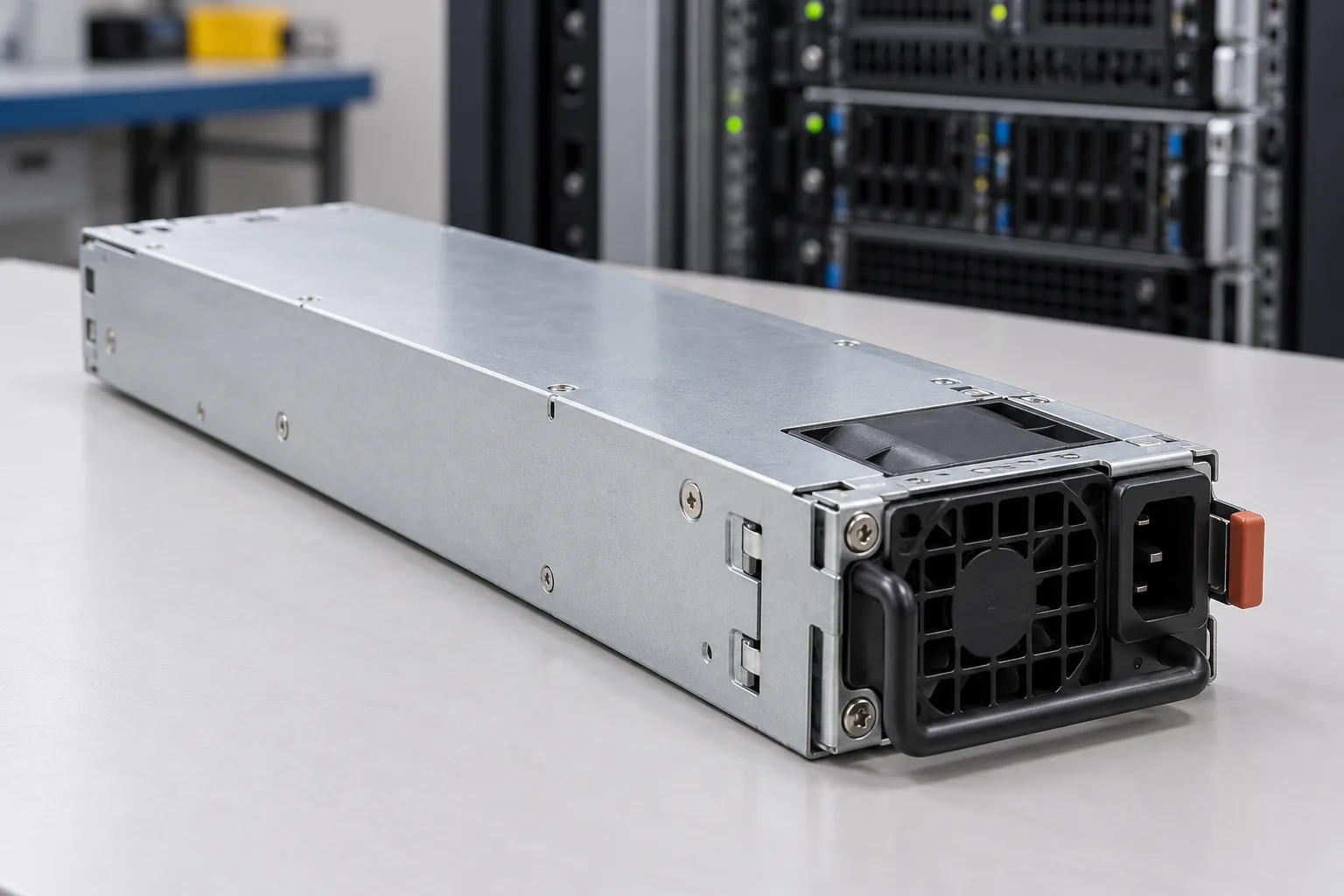
For a refurbished server sale, that distinction changes the demonstration being offered. A photograph of powered fans shows less than a documented startup into the expected firmware or operating environment. The seller may be accurately describing what was observed while the buyer assumes a stronger result. Describing the actual demonstrated state prevents that mismatch without inventing a diagnostic conclusion.
The distribution board belongs between the cartridge and motherboard
A removable power module is not necessarily the complete electrical interface seen by the motherboard. A chassis distribution assembly can sit between the modules and host connectors. Its role is determined by its actual design: routing power, presenting connections, and supporting the relationships expected by the attached hardware. The manufacturer’s mention of PDB-PT825 puts that intermediate component inside the compatibility question for this case.
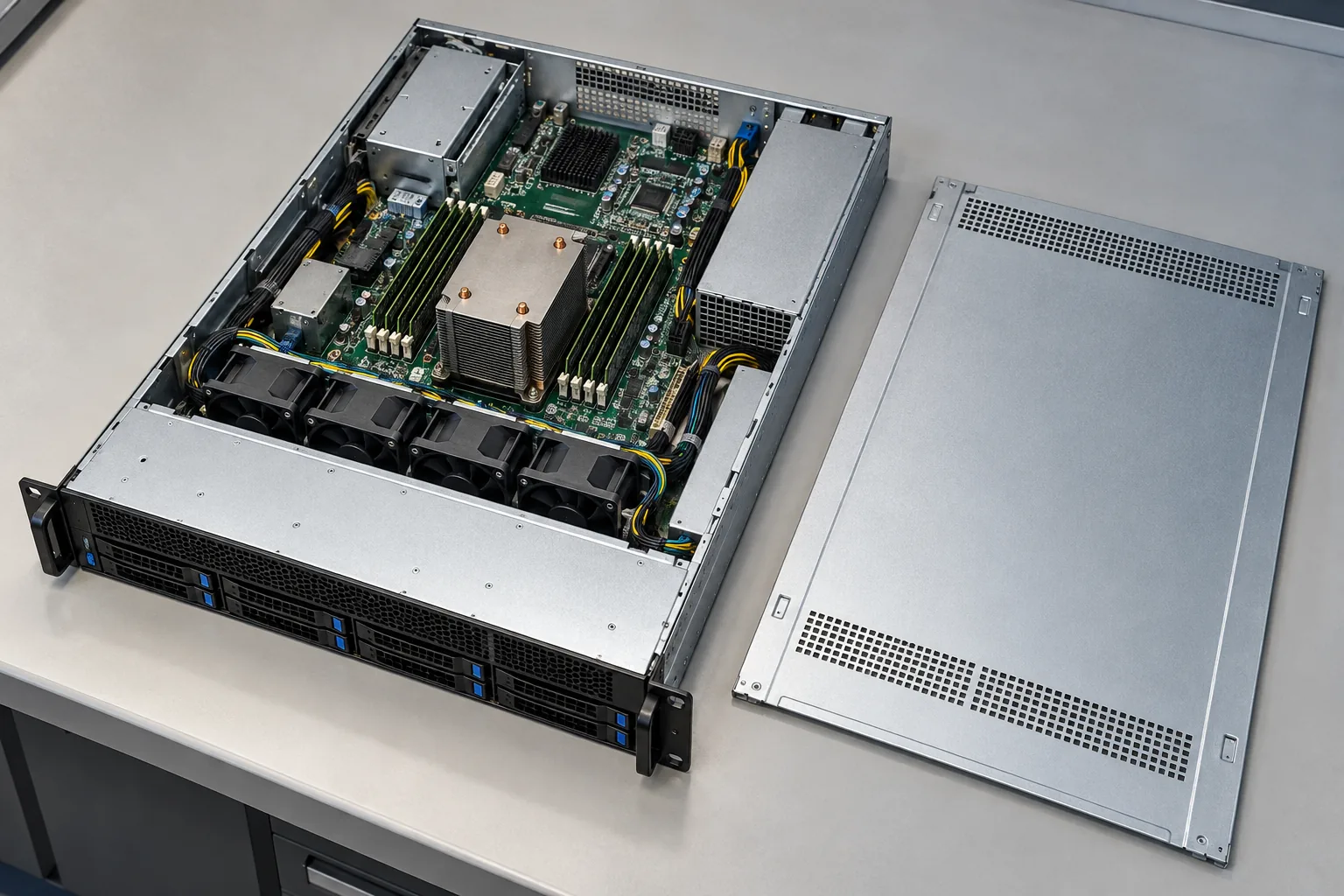
It would be misleading to describe the board as irrelevant wiring simply because the modules carry the visible wattage labels. Conversely, the FAQ does not establish that this PDB performs a particular voltage conversion or implements a particular control protocol. The correct level of explanation is architectural: the motherboard receives power through more than the replaceable converter, so compatibility can depend on another assembly in that route.
Consider an illustrative rebuild using an existing chassis and replacement motherboard. The removable modules can remain unchanged while the receiving board changes. That alteration creates a new pairing at the distribution boundary. A supply that worked in the original server has not thereby demonstrated that every later board is supported through the same PDB revision. This is a logical compatibility issue, not evidence that the old supply has lost output capacity.
The opposite change is also possible: a replacement distribution board can retain a familiar family name while differing in revision. Physical resemblance alone cannot establish whether the installed board is the version covered by the support answer. This is why the RMA direction asked for the revision rather than simply another cartridge bearing the same power rating.
A different-supply comparison answers a limited question
The historical answer’s proposed comparison is useful to interpret even when the reader is not performing it. If a motherboard starts with another supported power arrangement but not with the original chassis assembly, the difference directs attention toward what changed between those arrangements. It does not automatically identify one defective converter. The comparison might alter the source, distribution path, connections, or configuration together.
A hypothetical result illustrates the limitation. Suppose the board reaches its expected startup state with one arrangement and has only spinning fans with another. That establishes a difference in observed behavior under the recorded conditions. To attribute the difference specifically to the PDB revision, the responsible service team still needs the component identities and manufacturer’s guidance. Otherwise, several changed variables remain bundled into the same result.
If the board does not start under the comparison arrangement either, that does not prove the original PDB is compatible or incompatible. It means the proposed comparison has not produced the conditional result described in the FAQ. Other unresolved conditions remain possible. Turning a negative result into a positive PDB diagnosis would go beyond the manufacturer’s answer.
The comparison therefore belongs in a controlled service context, not a recommendation to attach any spare supply whose plugs appear to fit. It is especially important to avoid improvised harness adapters, uncertain pin assignments, or internal measurements on energized equipment. An explanatory case can clarify what evidence means without providing a handling procedure for high-energy server connections.
The missing revision number is a fact to obtain, not invent
A part family and a revision describe different levels of identity. PDB-PT825 names the distribution-board family mentioned in the answer. Its installed revision is the additional fact the manufacturer requested. The chassis identifier alone does not settle that revision, particularly after years of repairs, refurbishment, or component substitutions.
The same caution applies to the chassis name. SC825TQ-R700LPB is the name in this support case. A similarly written SC825MTQ model is a different identifier and should not silently replace it in a repair record. Common text fragments and the same 700W description cannot establish that the two systems share every board, harness, or compatibility condition.
An adequate support record can distinguish what is known from what remains unresolved. It can identify the motherboard exactly, preserve the complete chassis model, record the installed distribution-board identity and revision through an authorized inspection, and describe the observed startup state. The responsible support channel can then assess the actual pairing rather than infer it from a generic 2U redundant power description.
The historical direction to contact RMA also does not promise that a replacement is currently available or that a legacy unit remains under warranty. Those are present commercial questions. The lasting engineering point is that the required revision has to come from an applicable supported relationship, not from an assumed chronological ranking in which any larger revision number must be suitable.
More wattage would answer a different question
A higher-output PSU can address an established capacity shortage when the host supports it and the relevant path remains within its limits. It cannot be assumed to correct the compatibility issue described in FAQ 9504. The manufacturer’s answer did not identify excessive operating demand or recommend a larger output rating. Buying more watts without resolving the revision question would change the purchase while leaving the documented uncertainty intact.
Two installed modules likewise do not make an incompatible distribution arrangement compatible. Redundant sources protect a defined operating path against specified failures; they do not duplicate every downstream relationship. Both modules can meet the same shared assembly. The presence of a pair therefore tells the buyer little about whether a reused motherboard and an older PDB revision form a supported combination.
Nor is 2U a distribution-board specification. It identifies a rack-height class, while the actual chassis decides which power assembly and motherboard installation it accommodates. A PS2-format redundant supply found in the same search results is another packaging category, not evidence of suitability for this 2U chassis. Similar power ratings and rack-related descriptions should not collapse those distinct objects into a common spare.
The practical consequence is to separate capacity evidence from pairing evidence. A documented load that fits the approved surviving supply addresses available output. A supported motherboard, distribution board, chassis, and revision relationship addresses whether the intended arrangement can function correctly. Passing one comparison cannot be substituted for the other.
A useful repair scope follows the identified incompatibility
If manufacturer assessment confirms a distribution-board revision issue in the named combination, the repair scope concerns that supported assembly and its required version. Replacing a healthy cartridge solely because it is the most visible power component can leave the startup symptom unchanged. Replacing a motherboard without checking the intermediate assembly can make the same mistake at the other end of the path.
If the evidence instead identifies a different fault, the historical case should not override it. A familiar symptom is not a mandate to order the part mentioned in an old FAQ. The source gives a specific conditional branch, not an exhaustive fault tree or a diagnosis for an unexamined machine. Maintaining that boundary keeps a useful legacy support record from becoming an unreliable universal remedy.
For this 2U redundant 700W question, the worthwhile next identifier is therefore sometimes the distribution-board revision rather than another wattage label. The Supermicro example explains why: fan motion can coexist with an unresolved startup relationship, and the supported repair may lie between the removable modules and the motherboard. Naming that intermediate assembly makes the purchase and service discussion more precise.