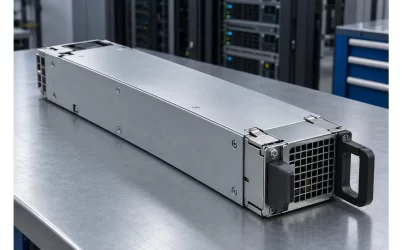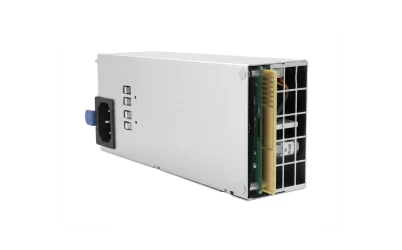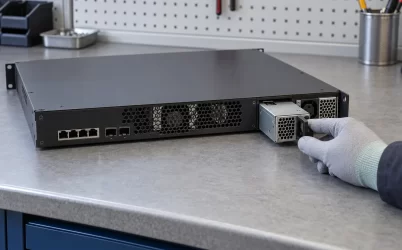
A search for a 1400 watt server power supply returns several different purchases: a replacement module for an installed server, a refurbished OEM part, or a supply bundled with cables for another application. These offers should not be treated as interchangeable. The legacy HPE 720620-B21 Flex Slot Platinum Plus kit illustrates the distinction. Its part identity, supported host configuration, and input requirement are more useful than a seller’s broad “1400W server PSU” description. This article explains how to read that particular family of listings without turning one HPE example into a specification for every 1400W supply.
Start with the machine being repaired and the identifier on its existing module. If the purchase is for a new platform, begin with that platform’s approved options instead. A familiar legacy HPE part appearing in a search result does not establish that it belongs in a newer server, and a complete-looking accessory bundle does not establish support for a different load.
One purchase can carry several legitimate part numbers
HPE’s official PartSurfer record identifies 720620-B21 as a 1400W Flex Slot Platinum Plus hot-plug power supply kit and lists 754383-001 as its power supply component. The distinction matters in refurbished inventory. One seller may index the option kit; another may advertise the replaceable module. Different identifiers can refer to different levels of the same purchase rather than prove that one advertisement is wrong.
That observation is a starting point for reconciliation, not permission to match loosely. Ask for a readable photograph of the actual unit’s label and compare it with the installed hardware and host documentation. A stock photo can show a related model while the warehouse contains a different suffix or revision. Keep the seller’s item identifier separate from the manufacturer’s identifiers so that a quotation, delivery note, and received unit can be traced without relying on the title alone.
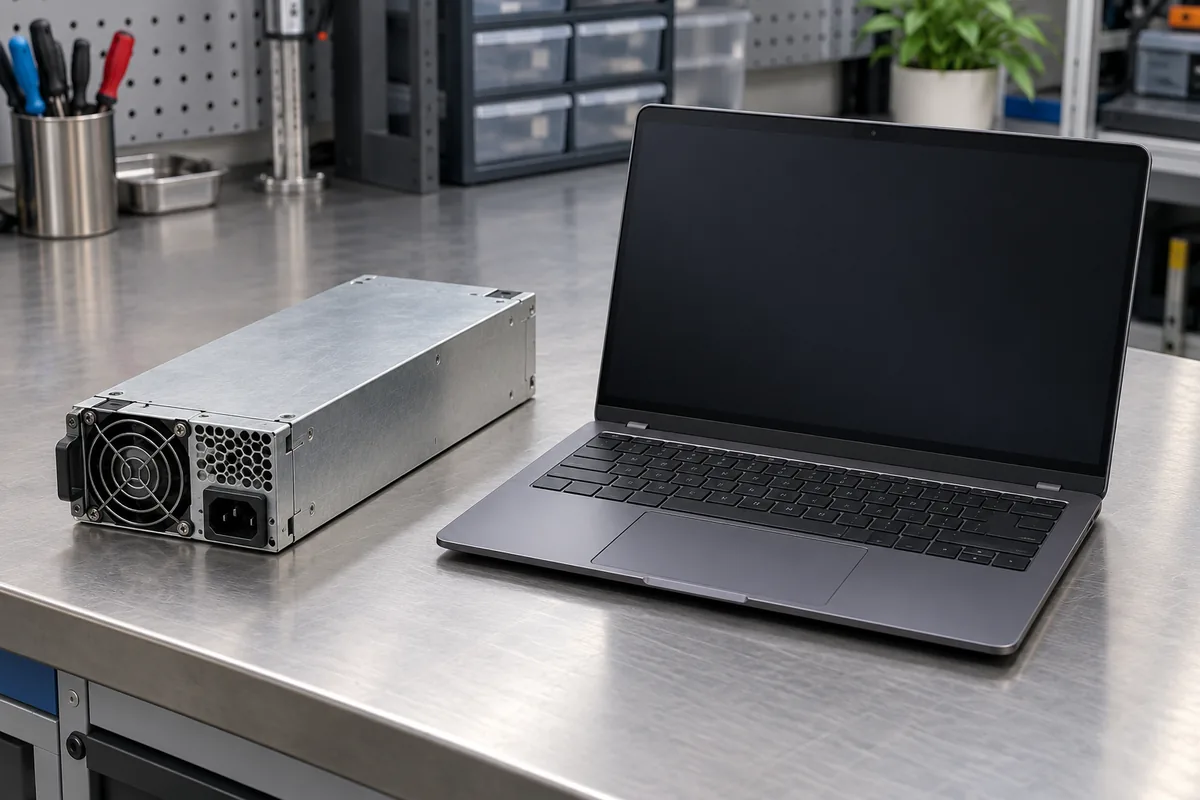
An order for a kit also raises a practical packaging question. Does the offer include the module alone, a jumper cord, or other accessories? A secondhand seller can use an original kit number to describe a bare module. The buyer should record the delivered contents explicitly. That avoids discovering during a maintenance window that the existing cord was damaged or that the order assumed an accessory which the supplier did not include.
Do not reverse this reasoning into a general cross-reference service. A regulatory identifier, assembly number, spare number, and option number can serve different purposes. A verified relationship between two numbers does not establish relationships to every number appearing in marketplace advertisements. Resolve each proposed alternative through manufacturer records for the actual item. When a seller cannot explain an alternate number, leave the substitution unresolved rather than treating a matching enclosure as sufficient evidence.
The server generation belongs in the replacement description
“Flex Slot” identifies an HPE power-supply family, but a shared family name does not replace the server’s supported-option list. HPE’s Flexible Slot Power Supplies QuickSpecs separates generation-specific options and points readers to the appropriate server QuickSpecs for compatibility. The document also contains restrictions for particular generations and part numbers. Reading a family overview as a universal interchangeability statement discards those restrictions.
For an installed legacy server, record its full product designation and generation before looking for a replacement. “DL380” without its generation is an incomplete host description. The power options for one generation cannot be assumed to apply to every machine sharing that platform name. Where the host documentation lists the requested option, retain the relevant document revision with the purchase record. Where it does not, a supplier’s claim needs further evidence rather than an inference from the family name.
This is particularly relevant when a newer part is proposed as an upgrade because its wattage is higher or its efficiency description sounds better. A power supply is an interface to a host’s power distribution and management functions. A mechanically plausible replacement may still fall outside the supported configuration. Conversely, an older module does not become inappropriate solely because it is older if the installed system explicitly supports it and the service requirements remain satisfied.
A useful quotation therefore names the host as well as the part. For example, an instruction to supply an exact replacement for an identified installed module is more precise than an instruction to supply any HPE 1400W unit. If the aim is a platform upgrade, treat it as a different job: establish the new host configuration and its approved power options first. Mixing those two purchasing purposes is how replacement orders turn into unplanned engineering changes.
This HPE example requires high-line AC
The verified HPE 720620-B21 kit record specifies 200–240VAC at 50/60Hz for its listed power supply. Do not interpret that as a promise of reduced output from a regular 120V source. For this purchase, the immediate issue is whether the intended source is inside the documented input range. A plug adapter cannot convert the available voltage, and a new cord does not change the supply’s electrical requirements.
Check the source at the point where the server will operate, including any UPS and rack PDU between it and the facility supply. A site can contain several voltage arrangements. An old rack description or a photograph of a receptacle is weaker evidence than the installation’s actual electrical documentation. If a server is moving between rooms or facilities, carry its input requirement into the move plan rather than assuming the replacement PSU will work wherever another server previously operated.
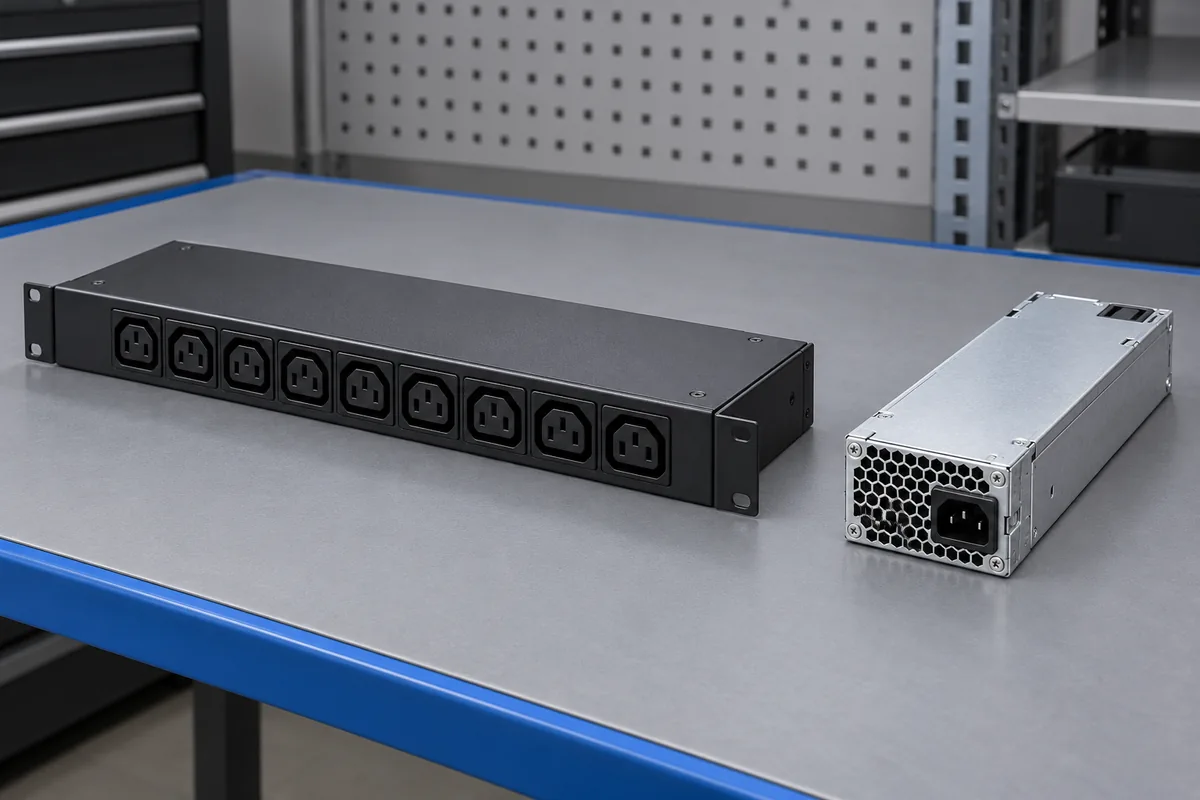
The 1400W number describes rated DC output, not an instruction that the module continuously draws 1400W from the AC source. Actual input depends on the load and conversion losses. Equally, a lightly loaded server does not justify operating a supply outside its documented input envelope. These are different questions: how much power the server currently uses, and whether the source is permitted for that module.
Keep this distinction concise in the purchase request: identify the exact input requirement alongside the exact module. There is no need to infer a low-line derating curve for a model whose verified record requires high-line AC. If the installation needs 120V operation, return to the host’s supported options and their exact specifications instead of asking the seller to reinterpret this part’s rating.
A spare must preserve the installed pairing
The PartSurfer description for the listed 754383-001 component calls for multiple supplies in the server to have the same model number. HPE’s family QuickSpecs separately warns that mixing different supplies can restrict power features, including redundancy. For this legacy replacement case, matching the intended population is a stronger basis for a spare order than matching only the 1400W headline.
A seller may offer another supply as “equivalent” because it has the same advertised output. Ask what equivalence means. It might mean a verified service replacement, a similar electrical rating, a similar exterior, or simply an alternative item the supplier has in stock. Those statements carry different implications. Document the proposed substitution and its manufacturer support before accepting it into a server with another installed module.
Spare strategy also affects what gets purchased. A rack serving one documented configuration can maintain a narrowly identified spare. A room containing several server generations may need several spare identities even where the modules look similar. Cataloging them under one generic “1400W HPE” bin label invites a later technician to erase distinctions that the purchasing team originally checked.
Label the stored spare with the verified part relationship, the host configurations for which it was purchased, and the receiving inspection record. This is an inventory-control measure rather than a claim that a spare is restricted to only one machine. Additional supported uses can be added when verified. What matters is that the service technician sees evidence of intended use rather than a broad wattage label and an assumption.
Platinum Plus and Power Discovery describe different promises
Efficiency language and rack-management features can become blended in reseller titles. HPE associates Power Discovery Services with the Gen9 1400W Platinum Plus option and describes communication of identification, location, and power information to optional intelligent rack PDUs. That is a specific documented ecosystem feature, not a consequence of a 1400W rating and not proof that every installation will expose the same information.
A buyer replacing a module in a managed legacy rack should ask whether those functions are actually used. If they are, preserve the relevant configuration and accessory requirements during the replacement review. If they are not, do not pay for an assumed monitoring benefit that the existing rack cannot use. A capability in a manufacturer description is different from an enabled service in the deployed installation.
The term Platinum Plus should also not be used as a constant operating efficiency in an energy calculation. A peak efficiency description does not provide the complete load curve, and an older unit’s condition is not established by repeating its original marketing label. Compare energy consumption using applicable evidence for the intended operating point when that comparison materially affects the purchase. For a straightforward service replacement, supported identity and condition may be more decisive than a speculative annual savings figure.
This separates three promises that often appear in one advertisement: the module’s rated capacity, its efficiency classification or description, and an optional management function. Each answers a different question. A headline combining all three can still omit the server generation, actual delivered contents, and condition of the unit being sold.
A mining bundle is a different product transaction
Search results also include 1400W supplies sold with breakout boards and multiple load cables. Such a bundle is not automatically an OEM server replacement package. It adds an interface between the original module and another application. The presence of cables, a power switch, or a wattage claim does not establish the bundle’s electrical suitability, protection behavior, or support for the intended equipment.
If the task is to repair a supported HPE server, keep the order focused on that task. Buying an unrelated bundle because it contains a visually similar supply adds uncertainty without solving the host-identification problem. If the task is to power another application, evaluate that complete product on its own documented terms. The HPE host specification cannot certify a third-party breakout assembly or define the ratings of its cables and connectors.
Modification videos create another category entirely. Instructions to raise voltage or bypass protection do not demonstrate that an unmodified replacement will serve an OEM host, and they are not a basis for accepting a used unit. Ask whether the offered module has been altered. A claimed bench output establishes only the observed condition of that test; it does not establish intact protection, supported server behavior, or suitability for sustained service.
The useful outcome of this search is therefore a resolved item identity: the documented legacy HPE option or spare, intended for a named supported host, supplied in a stated condition with stated contents and a permitted source. If the offer instead describes an adapter-based assembly, a newer unverified substitute, or a modified module, it represents a different purchase. Recognizing that difference before ordering is more valuable than comparing several identical-looking 1400W headlines.