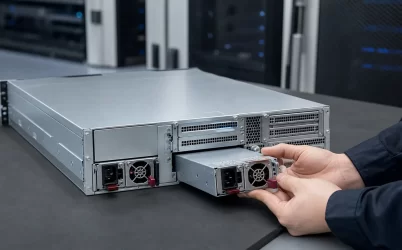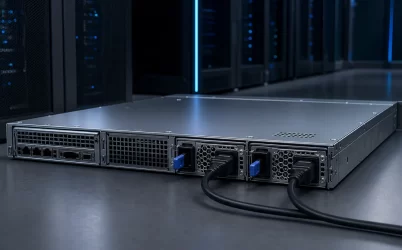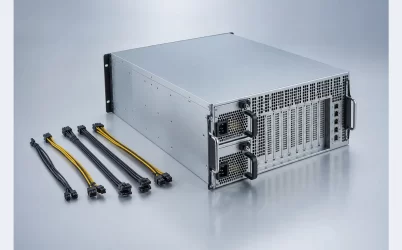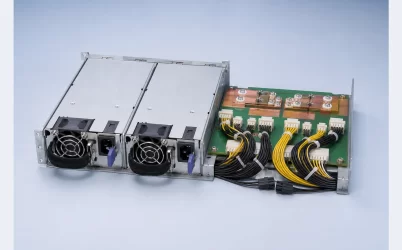
A 1600W redundant server power supply is ready to purchase only when the quotation identifies the exact module and provides evidence that the target server supports it. The 1600W label does not establish mechanical fit, PDB compatibility, control signaling, firmware support, hot-swap behavior, or the output available under the intended input and cooling conditions. Before approving an order, determine whether the seller is offering one module, a host-approved redundant pair, or a complete assembly containing the cage, PDB, harnesses, and required accessories.
This distinction matters because product-heavy search results often place different 1600W supplies beside one another as though wattage were a replacement identifier. It is not. Two modules can share a nominal rating while differing in enclosure dimensions, blind-mate interfaces, airflow direction, output architecture, management behavior, or supported server platforms. The purchase objective is therefore not to find any 1600W unit; it is to establish traceability from the quoted part to the qualified host configuration.
First resolve what the 1600W line item contains
The phrase “1600W redundant server power supply” can describe several commercially different deliverables. A photograph showing two modules does not necessarily mean that two are included, and a module advertised for redundant use may be unusable without a compatible cage and PDB already installed in the server.
| Possible deliverable | What may be included | What remains unresolved |
|---|---|---|
| Individual PSU module | One removable power-supply unit | Required quantity, supported companion module, host approval, PDB, cage, output harness, and power cord |
| Redundant module pair | Two units represented as a supported combination | Whether the pair is approved in the target server, whether revisions may be mixed, and whether shared hardware is included |
| PSU and PDB set | Modules plus a distribution board | Cage, chassis mounting, host wiring, management connection, downstream connectors, and airflow provisions |
| Complete redundant assembly | Defined modules, cage, PDB, harnesses, and possibly input accessories | Exact host compatibility, firmware requirements, environmental limits, and installation responsibility |
A useful quotation states the quantity and part number of every supplied item. “Complete redundant assembly” should not be accepted as a sufficient description unless the bill of materials defines what complete means. If the server already has a qualified PDB and cage, the buyer may need only an approved replacement module. A new chassis integration generally requires much more evidence than a module-only spare purchase.
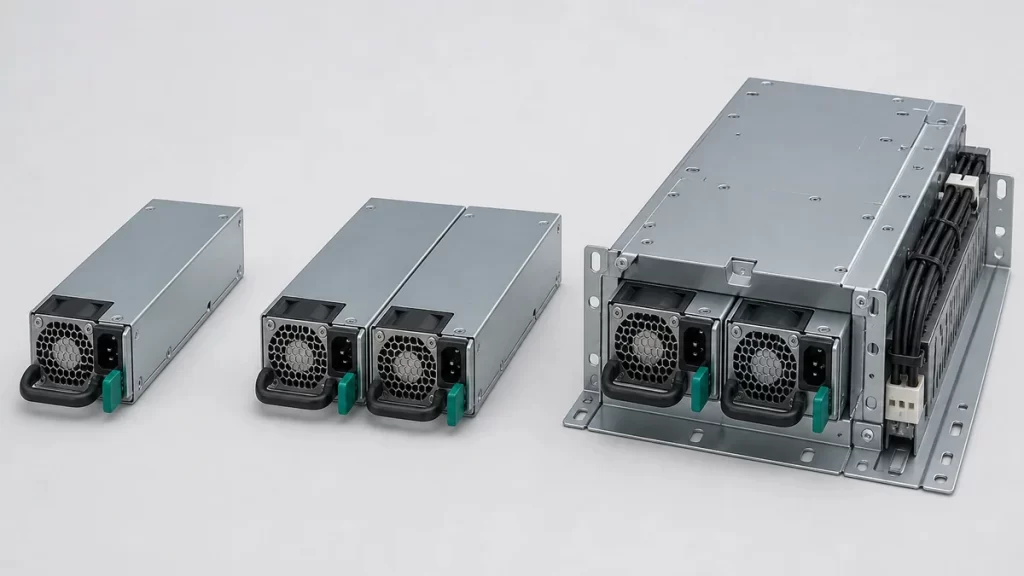
Compatibility evidence should trace back to the host
The strongest evidence is an exact host-platform approval, spare-parts record, or manufacturer configuration document naming the PSU part number and, where relevant, its permitted revision. This connects the module to the server rather than merely showing that the module is capable of producing power.
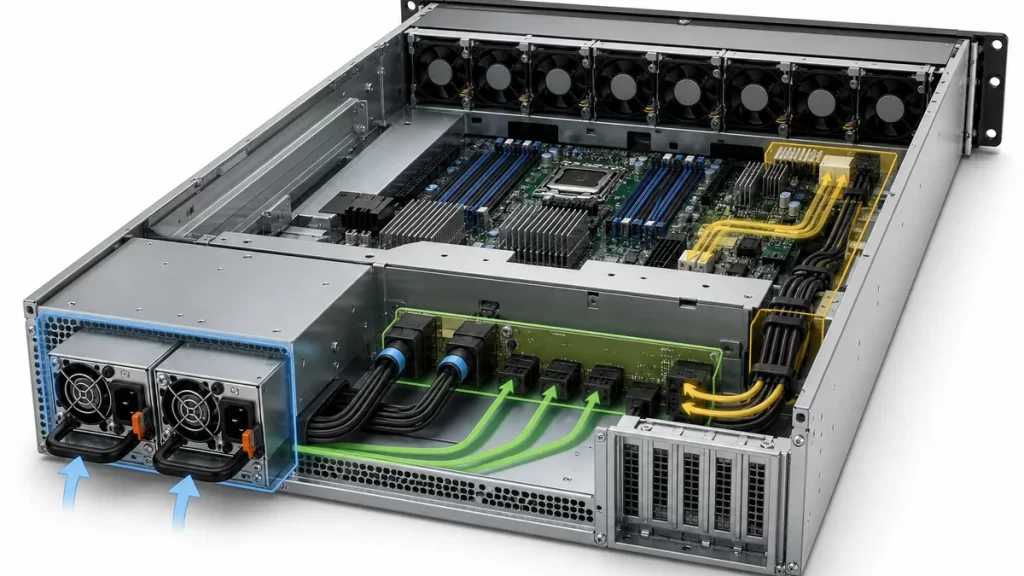
When exact host approval is unavailable, the evidence burden moves to the assembly interfaces. The supplier should document the module, cage, PDB, mechanical envelope, insertion depth, retention method, blind-mate connector, main output, standby supply, control signals, management bus, airflow direction, and supported operating behavior. A drawing that proves physical fit does not prove electrical or firmware compatibility.
Evidence can be considered in the following order:
- Exact host approval: the server manufacturer or system integrator identifies the module as supported for the specified platform and configuration.
- Qualified assembly record: controlled documentation links the PSU model and revision to a specific PDB, cage, harness, motherboard, BMC firmware, and operating mode.
- Interface-level documentation: drawings, data sheets, signal definitions, thermal requirements, and management information permit a complete engineering comparison.
- Seller assertion: phrases such as “compatible with,” “equivalent to,” or “replacement for” appear without the records needed to substantiate the claim.
The fourth level may justify a request for more information, but it should not be treated as proof. Even modules belonging to a common form-factor family are not automatically interchangeable. The CRPS and PDB assembly boundaries explain why mechanics, high-current paths, signaling, management, and host wiring have to align as one installation.
The 1600W rating is a conditional specification
A quoted output rating must be tied to its operating conditions. Request the manufacturer documentation that states the supported AC input, output configuration, airflow assumptions, inlet-temperature limits, altitude or other environmental derating, and any restrictions that change available power. Do not infer that the headline rating remains available across every input or thermal condition.
Input-dependent output is particularly important when a replacement is purchased for a site with a different mains environment from the system in which the PSU was originally qualified. The module may physically start while offering a different documented output envelope, or the host may apply a power limit. The relevant question is not simply whether the unit accepts the available voltage, but whether it supports the required output and redundancy state at that voltage.
Efficiency claims also belong to an exact product and test condition. For example, Lite-On publishes a manufacturer page for a named 1600W Titanium CRPS product. That documentation supports claims about the product it identifies; it does not establish that every 1600W module has the same efficiency level, interface, or server compatibility. A quotation should name the model whose efficiency documentation is being supplied.
Redundancy needs equally precise language. If the target platform uses 1+1 operation, the permitted server load normally has to remain within the surviving module’s supported output after its partner becomes unavailable. An N+1 arrangement has a different module count and capacity rule. The existing article on the 1600W dual hot-plug operating envelope covers that system behavior in detail; the purchasing task here is to obtain evidence that the quoted hardware is approved to deliver the intended mode in the specified host.
Compare quotations through an evidence ledger
Price comparisons become misleading when one offer contains a bare module and another includes a qualified pair, cage, PDB, harnesses, and technical support. Normalize each quotation against the same evidence fields before comparing cost or lead time.
| Quotation field | Evidence to request | Ambiguity to avoid |
|---|---|---|
| Manufacturer and model | Exact manufacturer name and full part number | “1600W server PSU” without identity |
| Revision status | Hardware revision, firmware level where applicable, and approved alternates | “Current revision” with no change policy |
| Quantity and pairing | Number of modules and documented rules for mixed models or revisions | A pair shown in images but one unit priced |
| Host support | Supported server model, configuration record, or integration evidence | Compatibility inferred from wattage or appearance |
| Shared assembly | PDB, cage, harness, mounting hardware, and downstream connector list | “Kit” without a controlled bill of materials |
| Available output | Rating under the intended input, temperature, airflow, and altitude | Maximum headline output detached from conditions |
| Redundancy behavior | Supported 1+1, N+1, or other mode and permitted module combinations | “Redundant capable” without a host configuration |
| Live service | Host-supported removal and insertion procedure | Assuming a removable handle proves hot-swap approval |
| Management | Required signals, telemetry support, firmware dependencies, and BMC behavior | Physical operation accepted despite alarms or missing control functions |
| Efficiency and approvals | Documents tied to the exact ordered part and applicable conditions | Family-level claims applied to an unidentified variant |
This ledger also exposes where engineering work remains. An alternate module may be technically usable even without a pre-existing host approval, but proving that requires deliberate integration and testing. It should be quoted and scheduled as an engineering change, not silently represented as a drop-in spare.
A substitution is a configuration change, not a purchasing shortcut
Substitution risk is highest when the original part is obsolete, constrained, or available only through secondary channels. A seller may offer another 1600W unit based on a similar exterior, connector family, or claimed cross-reference. Those similarities narrow the investigation but do not complete it.
A proposed substitute should identify every departure from the qualified baseline. Relevant changes can include module depth, latch geometry, connector keying, current-carrying contacts, standby and control behavior, airflow direction, fan control, acoustic policy, management commands, firmware response, regulatory status, and the input conditions associated with rated output. Not every revision changes all of these attributes, and not every difference makes the part unusable. The point is to make the differences visible so the responsible party can assess them.
Substitution control should also cover future shipments. A quotation that permits the supplier to deliver “same or equivalent” hardware can invalidate an otherwise careful qualification. The purchase order should require written approval before changing manufacturer, part number, revision, firmware, included components, or documented operating conditions.
RFQ language should force commercial ambiguity into the open
An RFQ for this power class can remain concise while still defining the required evidence. It should ask the supplier to respond to each of the following items rather than returning a generic product description:
- Exact manufacturer, model, revision, condition, and quantity of PSU modules.
- Target server model, chassis revision, PDB, and cage for which compatibility is claimed.
- Whether the offer is module-only, a redundant pair, a PSU/PDB set, or a complete assembly.
- A controlled list of included cages, boards, harnesses, brackets, cords, and other accessories.
- Supported output under the buyer’s AC input and environmental conditions.
- Documented redundancy mode and any restrictions on mixing module or firmware revisions.
- Management and BMC dependencies, including known alarms or unsupported telemetry.
- Manufacturer data sheets, drawings, host approvals, or integration records supporting the response.
- Substitution policy and the process for approving changes after the order is placed.
- Warranty, traceability, date-code, and new, refurbished, or used condition declarations where commercially relevant.
These requests separate a traceable offer from one built around a search keyword. They also allow suppliers to state exceptions explicitly. A documented exception can be evaluated; an unstated assumption usually becomes visible only after the hardware arrives.
Receiving inspection protects the quoted configuration
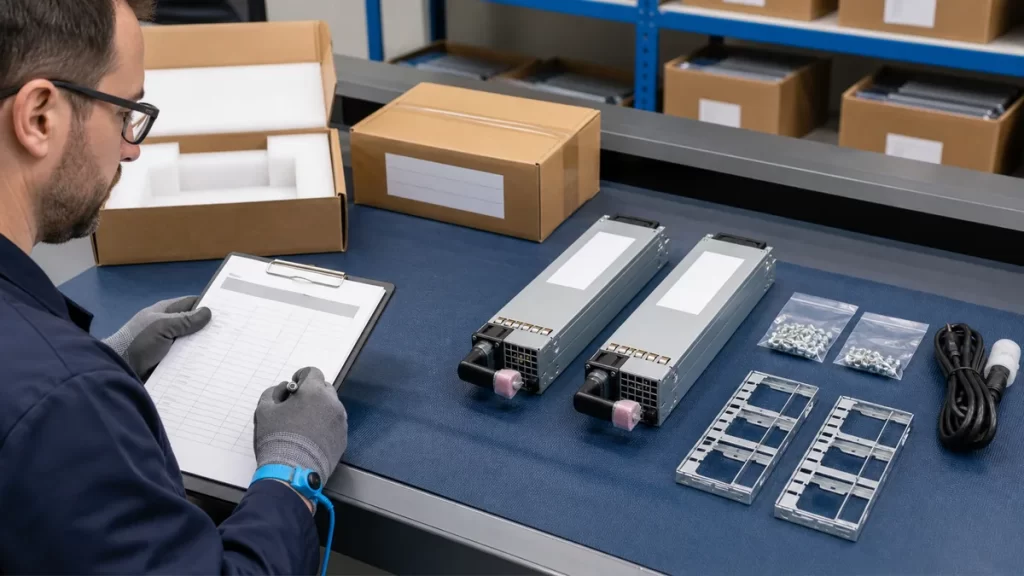
Purchase evidence has value only if the shipment can be matched to it. Receiving personnel should compare the delivered manufacturer, part number, revision, quantity, condition, and included accessories with the approved order. Packaging labels and module labels should agree with the traceability documents. Any approved deviation should be attached to the receiving record rather than left in an email thread that operations cannot retrieve later.
Visual inspection can identify shipping damage, altered labels, missing retention hardware, contaminated connectors, or a module that differs from the approved photograph and drawing. It cannot prove full electrical compatibility. Functional acceptance should occur in the intended host or an authorized equivalent, following the platform’s service procedure and operating limits. Where management behavior is required, acceptance also needs to establish that the BMC recognizes the installed units and reports the expected status without unsupported alarms.
A discrepant shipment should be held before it is mixed with qualified spares. Once visually similar modules enter the same inventory bin, model and revision control becomes harder, especially during an urgent service event.
An unsupported equivalent is not a qualified spare
Approve the purchase when the exact deliverable is defined, the model and revision are traceable, host or assembly compatibility is supported, the 1600W claim applies under the intended operating conditions, and substitutions are controlled. Escalate the offer for engineering review when interface documentation is complete but host approval is absent, or when a revision difference requires assessment. Reject or return the quotation when the seller cannot identify the product, relies on wattage as proof of interchangeability, or reserves the right to ship an unspecified equivalent.
This approach does not require every purchase to include an entire power subsystem. It requires the scope of supply and the remaining responsibilities to be explicit. A module-only spare can be the correct purchase when it matches a controlled host configuration. A complete assembly can be the better purchase for a new integration. In both cases, compatibility evidence—not the 1600W label—determines whether the hardware belongs in the server.