A 12V DC redundant server power supply is not one universally interchangeable product. In a listing, “12V DC” may describe the main output delivered inside the server, a low-voltage input presented to a DC-DC power assembly, or incomplete marketplace shorthand. Resolve that voltage boundary before comparing modules or prices. Then identify the exact server, PSU part number and revision, cage, power distribution board (PDB), mating interface, control behavior, airflow, and redundancy mode. The usable protected capacity is normally determined by the documented surviving configuration—not by adding the ratings printed on two modules.
Attach 12V to a physical boundary
Voltage has meaning only when its measurement points are named. A seller may correctly state “12V DC” while leaving unanswered whether the voltage exists before the PSU, after the PSU, or only on one downstream branch. Those interpretations describe materially different hardware.
| Possible meaning | Physical boundary | What must be established |
|---|---|---|
| Main 12V server output | PSU module or PDB to the server load | Output range, current capacity, standby rails, control signals, connector definition, and host approval |
| 12V DC input | External DC source to the power assembly | Permitted input range, polarity, source current, inrush, protection, grounding, and DC-DC conversion architecture |
| Marketplace shorthand | Not reliably defined | Manufacturer, exact part number, technical document, photographs of the actual label, and intended host platform |
The distinction is not merely terminology. A module that accepts an upstream DC source is not equivalent to an AC-input module that produces a 12V server bus. Official server products can explicitly define DC at the input boundary; for example, HPE publishes a -48VDC hot-plug power-supply data sheet. That product boundary illustrates why a DC value must be tied to either the source side or the server side instead of being treated as a generic PSU attribute.
If the listing is describing the rack or facility source rather than the output rail, evaluate it through the separate process for matching server PSU input voltage to the rack. Do not assume that “12V DC server PSU” means the server can be connected directly to an arbitrary 12V battery, vehicle bus, or industrial supply.
Read the candidate as a complete conversion path
Once the voltage boundary is known, reconstruct the hardware from source to load. The path may be a fixed cabled supply, two removable modules mating with a common PDB, a CRPS or M-CRPS assembly, or a proprietary server-family design. These architectures can all deliver a nominal 12V rail while remaining mechanically and electrically incompatible.
A useful reconstruction names each stage:
- Upstream source: AC or DC input type, documented operating range, connector, cord or cable, and feed arrangement.
- Conversion module: exact manufacturer, model, revision, output definition, airflow direction, and supported operating conditions.
- Combining interface: cage, backplane, PDB, ORing or isolation arrangement, and the contacts used for power and control.
- Server distribution: main bus, standby power, branch protection, motherboard feeds, storage or accelerator feeds, and any intermediate converters.
- Host control: enable, presence, power-good, current sharing, fault reporting, and management communication required by the server.
This exercise prevents a common error: finding a module with a 12V output and assuming that voltage agreement proves compatibility. The module may use different power contacts, signal voltage domains, startup sequencing, current-sharing behavior, or management commands. Even a mechanically mating module can be unsuitable if the PDB interprets its contacts differently.
The host turns a 12V rail into usable server power
The target server—not the marketplace category—sets the compatibility baseline. Start with the server model, chassis revision, installed PDB or power backplane, and the identifiers on both existing PSU modules. For a replacement, the strongest candidate is usually the exact supported part or a documented supersession. For a new integration, module and PDB documentation must describe the same interface and operating architecture.
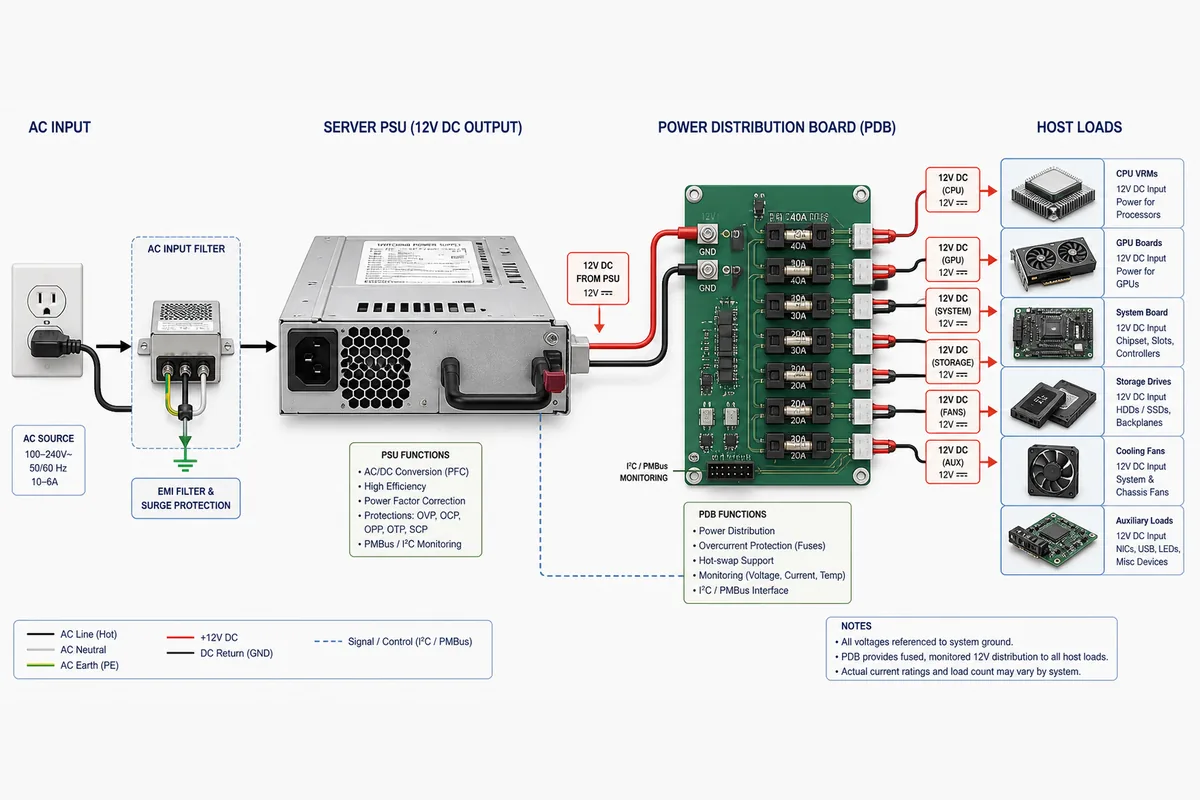
The compatibility record should answer the following questions without relying on appearance:
- Is the candidate approved for the exact server or power assembly?
- Does the module body, rail, latch, handle, keying, and insertion stop match the bay?
- Does its blind-mate or cabled connector match the intended PDB or harness?
- Is the contact-level definition supported by a manufacturer document or controlled platform drawing?
- Are standby power, enable, power-good, current-share, presence, and management functions compatible?
- Does airflow travel in the direction expected by the server’s fan and duct arrangement?
- Does the host permit the proposed module pairing and firmware combination?
Terms such as CRPS, M-CRPS, 1U, hot-plug, and redundant narrow the search, but none independently identifies a replacement. The relationships among module, bay, PDB, cooling path, and service method are covered more broadly in the server PSU form-factor compatibility ecosystem. For this purchase, those relationships must be tied to the exact 12V candidate rather than inferred from a family name.
Pinout uncertainty deserves particular restraint. A listing that proves a 12V output but does not document which contacts carry power, return, standby, control, or communications has not established electrical compatibility. Do not complete the missing map by copying a diagram from a visually similar module. Unknown contacts should remain unresolved until supported by the correct documentation or a controlled engineering investigation.
Redundancy changes which 12V number matters
Two modules do not automatically provide twice one module’s rating as protected capacity. In a 1+1 arrangement, both modules may share the normal load, but either supported module must usually carry the permitted server state after its partner or input path becomes unavailable. Other architectures exist, so the host’s documented operating mode remains authoritative.
The capacity question can be expressed without assuming a particular manufacturer rating:
Available output from the required surviving configuration ≥ maximum permitted server demand in that degraded state.
If the demand is specified at a nominal 12V bus, current is approximately power divided by voltage. For a hypothetical server drawing 720W at the 12V measurement boundary, the nominal bus current is 60A. At 960W, it is 80A. These figures do not select a PSU by themselves: actual current depends on the real bus voltage, dynamic load, measurement point, distribution losses, and any non-12V loads. They do show why the PDB, contacts, copper, harnesses, and branch protection are central parts of a high-current 12V architecture.
A literal 12V input creates a different current problem. Supplying 1,000W from 12V would require about 83.3A before accounting for conversion loss or input-voltage variation. The source, cabling, connector, fuse or breaker, return path, and inrush behavior would therefore need documented low-voltage, high-current capability. This calculation is a boundary check, not evidence that a particular server accepts a 12V input.
Redundancy also needs a named failure scope. Two modules connected through one PDB may protect against one converter failure while sharing the PDB, motherboard, cooling system, or upstream feed. Connecting the modules to independent sources can extend protection upstream, but only if the module inputs and host architecture support that arrangement. “Dual PSU” and “redundant” should therefore be translated into a precise statement of what may fail while the required load remains powered.
Separate four commercial supply scopes
A technically suitable module can still produce a failed purchase if the quotation describes a different assembly from the one expected. Product-heavy search results often mix replacement modules, pairs, kits, and complete redundant assemblies under similar titles. Normalize the noun before comparing price.
| Quoted scope | Likely contents | What remains the buyer’s responsibility |
|---|---|---|
| Single module | One removable PSU | Compatible mate, cage, PDB, host support, cords, and service procedure |
| Module pair | Two PSU modules | Proof that the pair is supported together and matches the existing assembly |
| Redundant power assembly | Modules plus cage or PDB, depending on the offer | Exact bill of materials, output harnesses, mounting, host interface, and cooling integration |
| Platform replacement kit | Manufacturer-defined service components | Target-server eligibility, revision conditions, installation procedure, and exclusions |
The request for quotation should state the exact server or integration target, required module quantity, manufacturer and part-number policy, acceptable revisions or documented substitutions, input architecture, output boundary, airflow direction, PDB or cage identity, required cables and hardware, and intended redundancy mode. Ask the supplier to identify exclusions rather than allowing missing components to remain implicit.
Condition also belongs in the commercial record. New, refurbished, used, and unverified-pull hardware do not represent the same sourcing proposition. The seller should identify the actual part being supplied rather than relying solely on a stock image, cross-reference list, or generic 12V description. If compatibility depends on a label revision, connector view, or airflow marking, request evidence from the offered inventory.
Let missing evidence limit the authorized use
Not every documentation gap has the same consequence. A missing cosmetic drawing may be manageable when the exact platform-approved spare is known. An unknown pin assignment, unsupported host claim, uncertain airflow direction, or undefined input range can invalidate the candidate because it affects safe operation or system behavior.
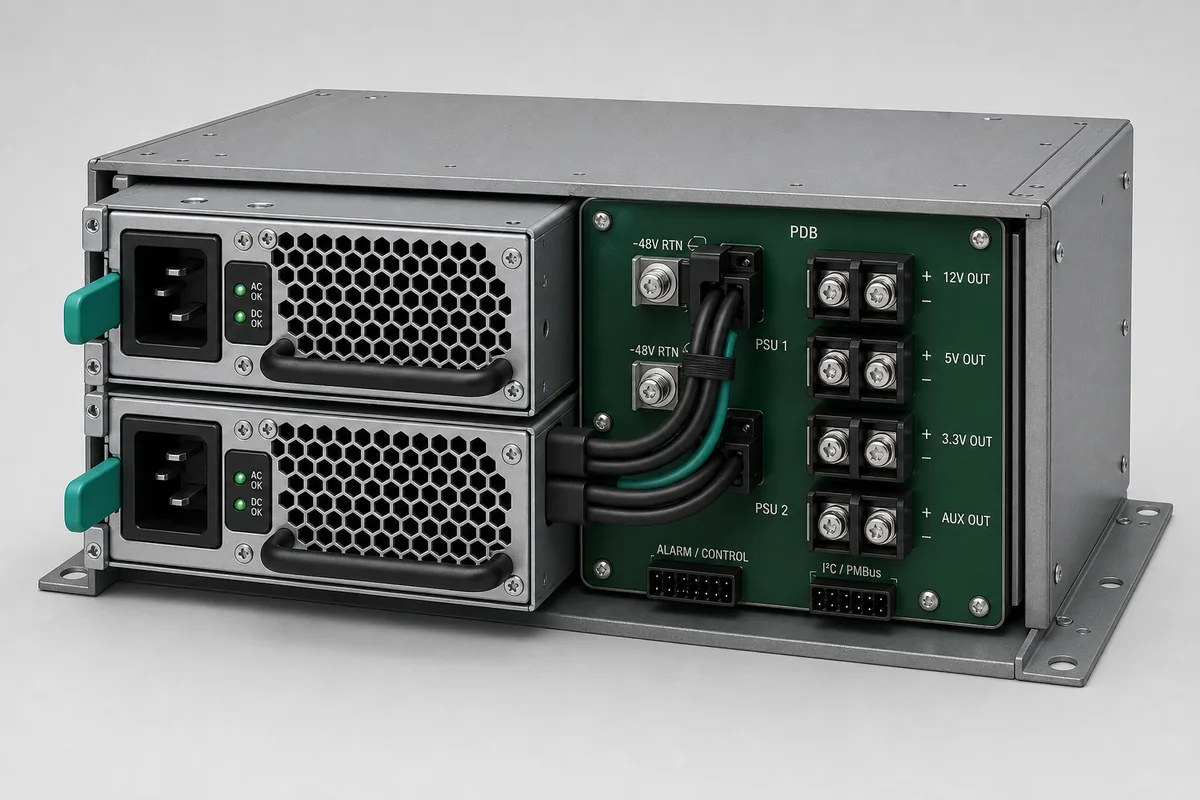
The purchasing response should match the evidence:
- Exact supported replacement: order against the controlled part identity and host service documentation.
- Documented equivalent or supersession: retain the manufacturer evidence connecting the new identity to the target platform.
- New module-and-PDB integration: require coordinated mechanical, electrical, control, thermal, and fault-behavior documentation.
- Voltage-only listing: treat it as an unqualified lead, not an approved substitute.
On receipt, reconcile the actual labels, revisions, quantity, connector keying, airflow indication, and included hardware with the purchase record before installation. Host recognition and redundancy status should be confirmed through the supported platform procedure. Live removal or insertion should not be improvised merely because the listing says hot-swap; it requires the host-approved service method and enough surviving capacity for the current server state.
Voltage evidence cannot substitute for platform approval
A defensible sourcing description can now be concise: the 12V value names a specific point in the power path; the exact module or assembly is supported by the target host or coordinated integration documents; the PDB, connector, signals, airflow, and management behavior agree; one surviving configuration carries the required degraded-state load; and the quotation names every included component.
If documentation proves only that a candidate produces 12V, the purchase remains incomplete. Voltage agreement can establish one electrical characteristic, but it cannot establish pinout, mechanical fit, current-sharing behavior, fault isolation, host recognition, cooling direction, or service compatibility. The correct outcome may therefore be an exact server-approved spare, a complete matched redundant assembly, or a request for additional evidence—not the first generic module whose listing contains “12V DC” and “redundant.”