A redundant server power supply has several ratings, and they answer different questions. Module wattage describes output under documented conditions; redundancy notation describes how many modules the load requires; an efficiency certification relates AC input to DC output at defined test points; and derating limits the available output when voltage, temperature, airflow, or another condition changes. For a 1+1 system, protected capacity is generally bounded by what one surviving module and the associated platform can support—not the sum of both nameplates. Read every number together with its operating condition, hardware boundary, and source document.
Quick answer: treat the specification as a stack of boundaries
Begin by identifying whether a rating applies to one PSU module, a matched redundant assembly, or the complete server. Then separate five fields: documented module output, redundancy mode, supported output after a module is unavailable, efficiency at the applicable load and input, and any environmental or input-related derating. The usable rating is the lowest applicable limit across the module, PDB, host platform, and operating environment. A pair of identically rated modules does not by itself establish protected capacity, efficiency at the deployed workload, or compatibility with the server.
Read the rating stack before comparing numbers
A datasheet, certification record, server manual, and marketplace listing may all display numbers for the same power supply, but those numbers may describe different boundaries. Combining them without preserving their definitions can produce a specification that no real configuration supports.
| Rating field | Question it answers | What it does not establish |
|---|---|---|
| Module output rating | How much output one module can provide under stated input, cooling, and environmental conditions | Protected capacity of the redundant system or capacity of each downstream branch |
| Redundancy notation | How many modules are required and how many may be unavailable in the defined configuration | Independent utility feeds, elimination of shared components, or permission for live replacement |
| 80 PLUS classification | Efficiency performance under the program’s specified test conditions | Output capacity, server availability, redundancy, or efficiency at every workload |
| Input rating | Which source voltage and frequency conditions the PSU accepts | That full output is available throughout the entire listed input range |
| Environmental limit or derating curve | How temperature, altitude, or cooling conditions affect allowable operation | That the host chassis can actually provide the required airflow |
| Platform power limit | What the server supports with its PDB, firmware, cooling, and approved PSU population | Universal capability of the bare module in another host |
The noun attached to the number matters. “1600 W module,” “3200 W installed nameplate total,” and “1600 W protected 1+1 capacity” can describe the same pair from three perspectives, but only if the platform documentation supports those relationships. The installed total is arithmetic. The protected value is an operating-state claim.
Translate module wattage into protected capacity
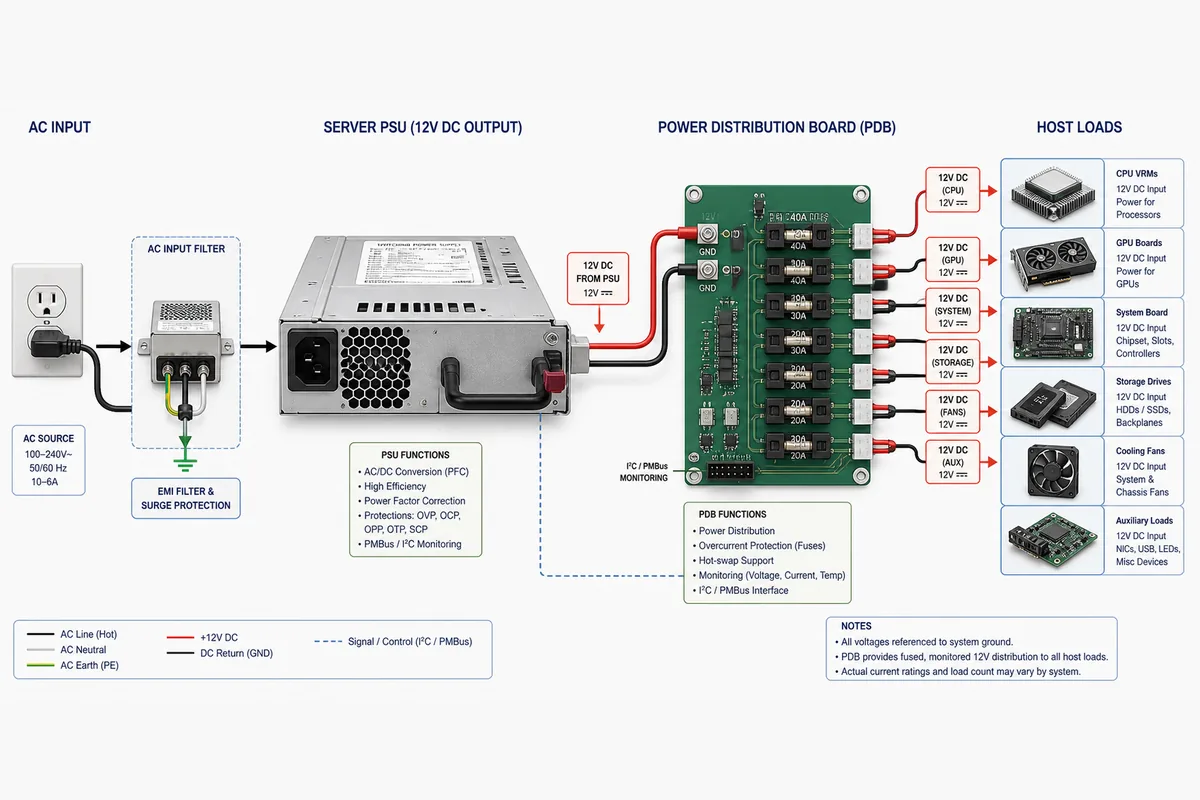
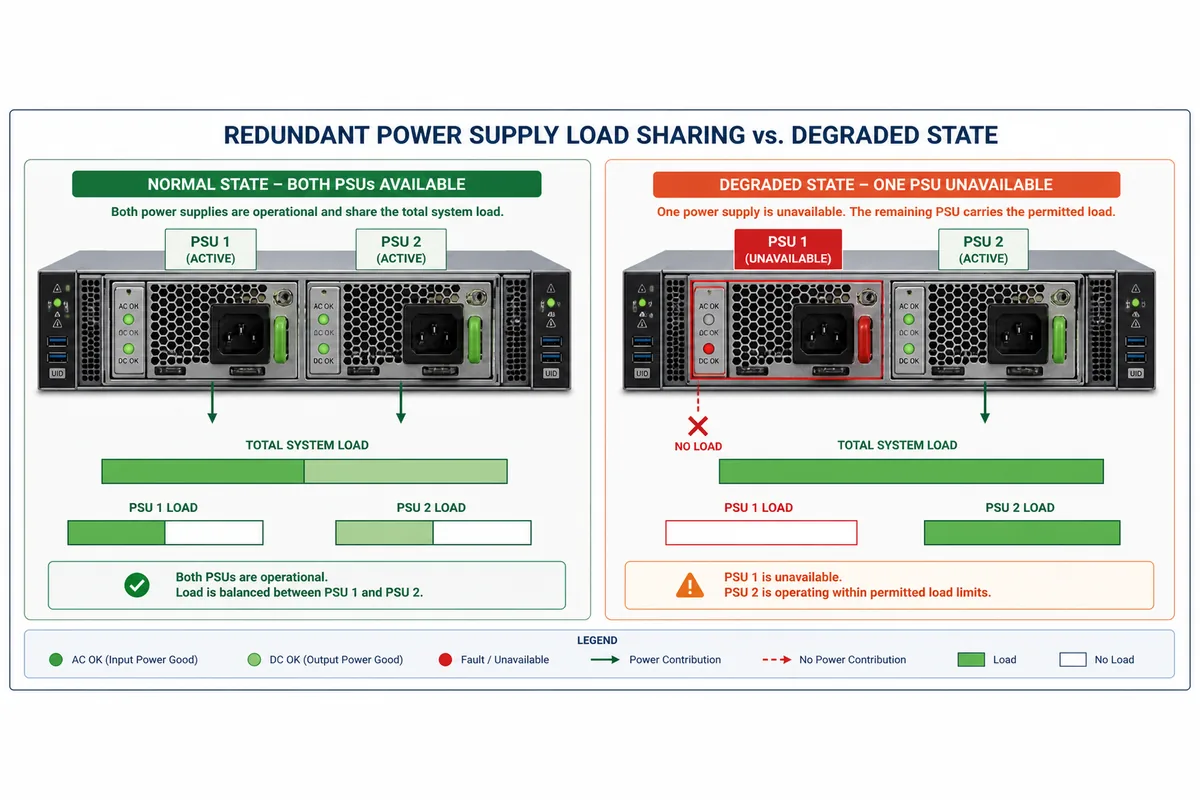
For a 1+1 configuration, one module is required to support the permitted load and the second provides redundancy. During normal load-sharing operation, each module may carry roughly part of the load. If one module fails, loses input, or is removed under an approved procedure, the surviving module must accept the required load without exceeding its applicable output or thermal limits.
A useful engineering expression is:
Protected 1+1 capacity under condition c ≤ the lowest of module output, platform one-module limit, and distribution-path limit under condition c.
The condition c includes the input source, inlet temperature, airflow, altitude where applicable, output configuration, and any other documented derating variable. The distribution-path term accounts for the PDB, connectors, busbars, cables, and branch limits between the module and the loads. A high module rating cannot raise the capacity of a lower-rated shared bus or connector zone.
For example, adding two 1200 W labels produces a 2400 W installed nameplate total. It does not prove that 2400 W is available while preserving 1+1 redundancy. If one module is the required surviving source, the protected load remains bounded by one module’s supported output and the platform’s one-module operating limit. If the server needs both modules to carry its configured workload, it may have shared capacity but no longer has one-module capacity redundancy at that load.
N+1 uses the same reasoning at a different scale. If N modules are required for the supported load and one additional module is the reserve, loss of one module leaves N sources. Protected output is limited by the surviving modules collectively and by shelf, PDB, connector, thermal, and control constraints. Multiplying nameplate ratings is insufficient when current sharing, slot limits, input groups, or platform policy impose a lower boundary.
Redundancy notation also does not identify the complete failure domain. Two modules connected to one upstream feed may protect against a converter failure but not the loss of that feed. A shared PDB, motherboard connection, cooling subsystem, or management dependency can remain a common point. Powernexu’s analysis of what two server PSUs actually protect examines those failure boundaries in greater depth; the ratings task here is narrower: express capacity for the exact normal and degraded states the platform supports.
Keep 80 PLUS separate from capacity and availability
Efficiency describes conversion, not the amount of redundant output. At a defined operating point:
Efficiency = DC output power ÷ AC input power.
Rearranging the relationship gives AC input power as DC output divided by efficiency. Conversion loss is the difference between those two quantities. An efficiency figure is therefore useful for estimating input demand and heat produced inside the conversion stage, but only when the figure applies to the relevant load, input, and test boundary.
The official 80 PLUS explanation from CLEAResult describes the certification as an efficiency rating evaluated under specified test conditions. The badge should not be interpreted as a capacity rating, an availability metric, or proof that the PSU maintains one fixed efficiency percentage at every load. Applicable criteria and test conditions also need to be associated with the correct product and certification category rather than inferred from a marketplace title.
Redundancy can move modules between different points on their efficiency curves. If two modules share a server load, each converter operates at a lower fraction of its rating than the surviving unit does after its partner disappears. A platform may also use an efficiency-oriented policy in which one module carries most of the demand while another remains lightly loaded or in a standby mode. Because those behaviors are platform-specific, the badge alone cannot reveal the pair’s real AC input.
Keep four quantities separate in a rating record:
- the server’s DC demand at the measurement boundary;
- the number of active modules and their approximate individual loading;
- the applicable efficiency evidence for that operating point;
- the resulting AC input at the PSU or server inlet.
This separation prevents a common category error: using a higher efficiency classification to imply higher redundant capacity. A more efficient PSU may draw less AC power for the same DC output under comparable conditions, but the documented output rating and platform redundancy policy still determine how much protected load it can carry.
Derating is product-specific: it reduces allowable output or another operating limit when documented conditions move outside the rating basis. Never apply a generic percentage in place of the exact module or platform curve.
| Condition | Evidence to verify | Risk prevented |
|---|---|---|
| Input voltage and frequency | Full-output range, reduced-output range, inlet-current limits, and platform restrictions; also verify matching server PSU input voltage to the rack. | Assuming that accepted input always permits full output |
| Temperature and airflow | Inlet-temperature limit, airflow direction, host cooling assumptions, and any output curve above a threshold | Treating nameplate wattage as independent of cooling |
| Altitude | The manufacturer’s stated temperature or power adjustment, when applicable | Substituting a generic altitude rule |
| Rails and distribution paths | Aggregate output, standby or auxiliary limits, PDB limits, connector limits, and permitted simultaneous loading | Assuming every branch can carry the module’s total rating |
Retain every limit that can apply simultaneously. The usable output is bounded by the lowest applicable module, platform, distribution, input, or environmental limit.
Establish whether the rating belongs to the module, assembly, or server
The strongest rating evidence comes from the document that controls the relevant boundary. A bare-module datasheet can define the PSU’s electrical input, outputs, protection behavior, efficiency data, and cooling assumptions. It cannot automatically approve that module for an arbitrary server.
The redundant cage or PDB documentation owns another layer: mating interface, module population, source isolation, current sharing, common-bus limits, downstream outputs, and control connections. Even if each module can produce its nameplate output independently, the assembly may impose a lower usable limit.
The server platform documentation then determines supported module options, allowed pairings, firmware or management requirements, workload restrictions, cooling policy, and the configuration permitted after one source becomes unavailable. This is why an electrically capable module can still be unsupported in a particular host.
A certification record owns a still narrower claim. It can substantiate efficiency performance for an identified product under the certification program’s conditions, but it does not replace host approval, prove a redundant topology, or establish field efficiency under a different workload.
Marketplace and distributor listings can help locate a candidate, but shortened titles often collapse these boundaries. Phrases such as “redundant,” “Titanium,” “high efficiency,” and a wattage value should be traced back to the exact model, revision, certification record, assembly, and host documentation before they are treated as one coherent specification.
Preserve every condition in a rating-verification worksheet
A useful worksheet does not ask only whether a number appears. It records what the number describes, where it applies, and which evidence supports it. This makes two apparently similar PSUs comparable without pretending that their nameplates define the complete system.
| Worksheet field | What to record | Ambiguity the field prevents |
|---|---|---|
| Exact identity | Manufacturer, model, revision, and applicable server or assembly | Applying one model’s rating to a visually similar unit |
| Rated object | One module, module pair, populated cage, power shelf, or complete server | Confusing module capacity with assembly capacity |
| Output rating | Continuous output and the input, thermal, airflow, and output conditions attached to it | Treating the nameplate value as unconditional |
| Redundancy state | 1+1, N+1, 2N, shared capacity, or another platform-defined mode | Assuming two installed modules equal one protected architecture |
| Degraded-state capacity | Supported load after the specified module or input event | Using installed nameplate sum as protected output |
| Input boundary | Voltage, frequency, phase where relevant, full-output range, and any derating | Deploying a full-power assumption at an unsupported source condition |
| Efficiency evidence | Certification identity or efficiency data, load point, input, and measurement boundary | Using a badge as a universal operating percentage |
| Environmental boundary | Inlet temperature, airflow direction, cooling assumption, altitude condition, and derating curve | Separating wattage from the cooling needed to sustain it |
| Distribution limits | PDB, common bus, connector, cable, and branch constraints | Assuming module output can reach every load zone |
| Evidence source | Document title, revision or date, relevant section, and responsible platform | Losing traceability when parts or documents change |
Read each worksheet row horizontally. A wattage without its rated object and conditions is incomplete. A 1+1 statement without degraded-state capacity does not define the protected load. An efficiency classification without an exact product identity and test context cannot support an input-power estimate. A temperature limit without airflow assumptions does not describe a reproducible thermal state.
This method also explains why two modules with the same headline wattage may not be equivalent. One may sustain that output throughout the deployed input range, while another may have a documented reduction at the same source condition. One platform may permit either module to carry the complete configured server, while another may require both for peak capacity. Two PSUs may share an efficiency classification but operate at different load points because their host policies distribute demand differently.
A redundant server power supply rating becomes technically useful only when the number travels with its boundary: exact hardware, defined operating state, applicable input, cooling condition, output path, and source document. Once those coordinates are attached, wattage, efficiency, redundancy, and derating stop competing as catalog claims and become separate, traceable parts of the same server power envelope.