There is no single safety-standard label that makes every open-frame power supply safe in every finished product. The relevant standard follows the end equipment and its intended use; a supply evaluated as a component is accepted only within the conditions of that evaluation. A board intended for an information-technology enclosure may be assessed under the IEC/UL 62368-1 family, while a medical or industrial measurement product can call for a different end-equipment standard. The open frame has no protective outer shell of its own, so the host must provide the safeguards the component documentation leaves to the integrator. A certification mark is useful evidence, but it is not permission to leave live parts accessible or assume the assembled machine has been certified.
Start with the equipment people will touch
“Open frame” describes a physical construction: the converter’s PCB, components, terminals, and mounting hardware are supplied without a complete protective housing. It does not name a safety category. Two visually similar AC/DC boards can end up in very different products. One may be installed behind a server’s service panel; another may power a laboratory instrument; a third may be inside a medical device. The hazards presented to users and service personnel, and the applicable regulatory route, are determined by the complete product and its market.
For many audio/video and information-communication-technology products, IEC 62368-1 is a relevant safety framework. Measurement, control, and laboratory equipment commonly brings IEC 61010-1 into the scope discussion. Medical electrical equipment can require IEC 60601-1 and applicable collateral or particular requirements. These are not interchangeable stamps selected by the PSU buyer from a catalog. Their relevance depends on the equipment classification, intended environment, users, national adoption, and applicable edition. A supply certified to one standard should not automatically be represented as suitable for a different end-product category.
A useful early question is therefore: what standard will the completed equipment be assessed against, and what role is assigned to the PSU inside that assessment? Answering it before board selection changes the document request. Instead of asking for a generic “UL certificate,” the integrator needs the specific model and variant, approval category, test report or certification record where available, and the conditions governing installation. The nominal output voltage does not decide this by itself.
Component recognition is narrower than end-product approval
A recognized component has been evaluated for use in other equipment under stated conditions. It is not the same as approval of the finished chassis, cabinet, or machine. UL Solutions explains that component recognition includes conditions of acceptability and does not certify a complete standalone product. This distinction matters acutely for open-frame supplies because the missing outer enclosure is often the finished product’s job.
The conditions are not boilerplate. A report may address the kind of enclosure required, permitted mounting orientation, protective-earth connection, wiring, accessible surfaces, ambient temperature, cooling, or how a component is separated from other circuits. The exact set varies by model and approval. A vendor statement that a board “meets 62368” is too imprecise to resolve whether a proposed layout is inside the evaluated conditions. The issue is not distrust of the component test; it is that the test used a defined installation, while the new host may place the same PCB close to a door, cable harness, plastic wall, or high-temperature load.
The end-product evaluation asks a different question: does the complete equipment, with this converter installed as intended, provide the required safeguards? Those safeguards can involve the enclosure and service access, barriers, wiring, bonding, temperature rise, mechanical strength, abnormal conditions, markings, and other application-specific provisions. A component-level test may reduce the work needed to assess the whole product, but it does not eliminate that assessment.
This is why a PCB with an approval mark should not be shown as a finished mains appliance on an open bench. The mark can support integration into a suitable product. It does not change the fact that its exposed input side and hot components may require a protective enclosure and controlled access.
The enclosure completes the electrical safeguard
The host enclosure is not merely a box that hides the board. It determines whether ordinary users can reach hazardous parts, how service access is controlled, and whether objects, liquids, or loose conductors can contact primary circuitry. A vented metal cabinet, a plastic instrument housing, and a control panel may each impose different constraints. Openings that help cool a PSU can also create an access path if their geometry and location are wrong. The finished-product designer must reconcile the cooling path with the required barrier.
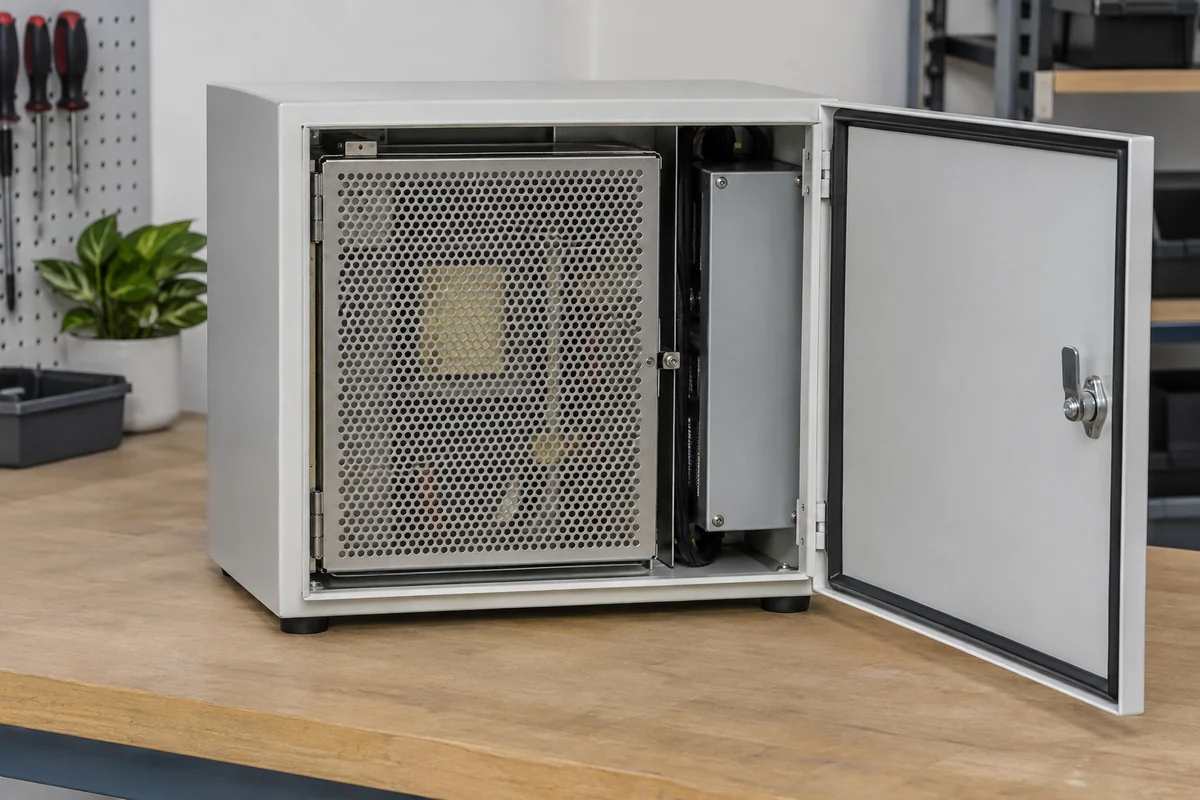
Mounting changes the hazard picture too. PCB standoffs, screw heads, and nearby sheet metal affect how the board sits relative to its enclosure. The underside may contain exposed conductive features that need space and a stable fixing method. A designer cannot infer safe spacing from a marketing photograph or transplant a clearance value from another model. The actual component documentation, evaluated construction, and relevant end-equipment standard govern the layout; contamination, altitude, voltage, and material assumptions can also matter.
Access changes over the product’s life. A locked door may keep a casual user away from mains terminals but be opened by an instructed or skilled service person. What happens during replacement, inspection, and cable movement belongs in the design. A power supply placed directly behind a removable panel may be acceptable under one access regime and unsuitable under another. The enclosure also needs to retain the required mechanical and thermal performance after ordinary service operations.
Engineers already working through physical placement can use the site’s separate open-frame supply integration discussion for mounting and airflow relationships. Here the safety point is narrower: the finished housing has to supply the protections that the bare converter cannot supply on its own.
Bonding, wiring, and fault behavior live in the host
Protective earthing is another area where a component feature and an end-product claim are easily confused. A PSU may provide a designated earth terminal or mounting provision, but the complete equipment still needs a defined protective path where the chosen safety design requires one. Paint, removable panels, flexible harnesses, fasteners, and other mechanical joints can change that path. A drawing that merely shows a green wire near the PSU is not evidence that accessible metal remains bonded under the relevant conditions.
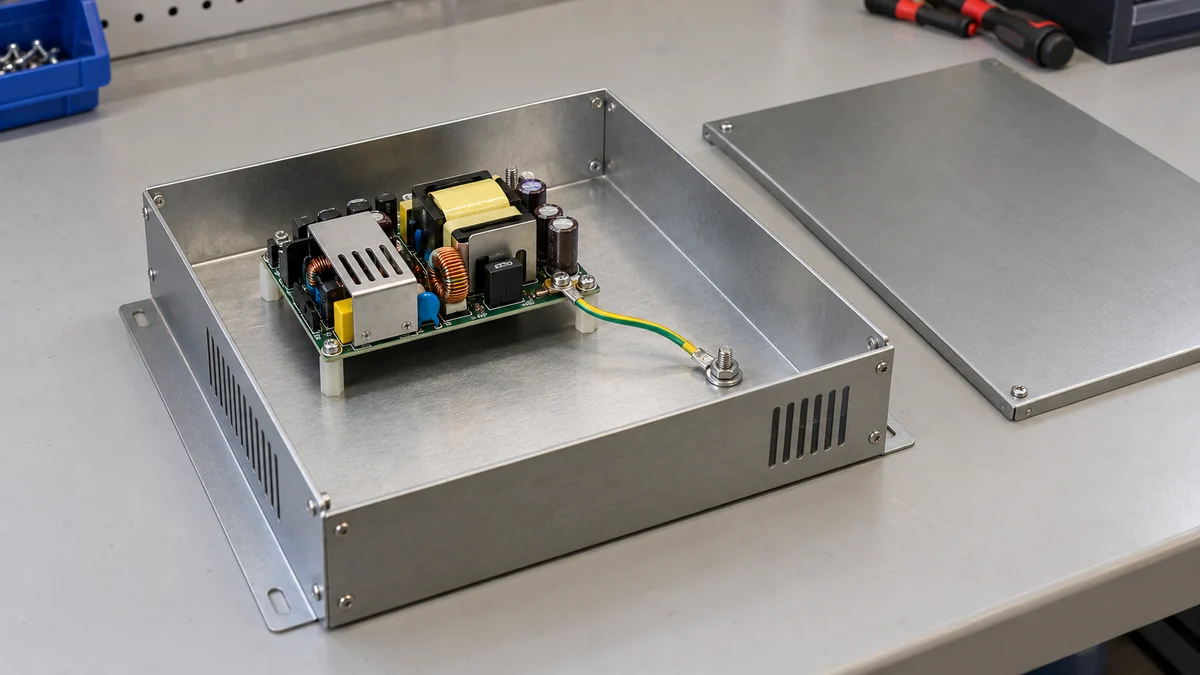
Input wiring must suit the approved terminal or connector arrangement and the host’s protection scheme. A component fuse or internal protection feature does not automatically establish adequate protection for all upstream conductors and branches. The same is true downstream: an output marked as isolated in a datasheet does not excuse arbitrary routing next to hazardous primary wiring or an unreviewed connection to accessible ports. The complete assembly needs controlled wire retention and separation appropriate to the actual supply and equipment.
What happens during a fault can differ from what happens in normal operation. A loose input termination, blocked airflow path, stalled fan elsewhere in the host, or overload may heat the board and nearby material. Component documentation may state how the PSU was evaluated, but a different enclosure can trap heat or place combustible material nearby. Product-level design and testing therefore need to consider the actual installation and credible abnormal conditions, not just a nominal room-temperature load.
None of this authorizes an unqualified reader to probe the mains side of an exposed board. Installation and evaluation of energized open-frame AC supplies belong to personnel and procedures appropriate to the equipment and jurisdiction. The article’s purpose is to identify the safety responsibilities that must be addressed, not to give live-wiring instructions.
Why the same board can have several safety claims
A manufacturer may list more than one safety standard for an open-frame series. That can be legitimate: a family may have separate evaluations for different intended applications. It can also reflect variant-specific limits, national deviations, or different editions. The headline list should not be read as saying every configuration is approved for every possible role. Confirm that the exact ordering code and configuration are covered by the relevant certificate or report and that its scope matches the finished equipment.
For instance, an ICT device manufacturer may care about the 62368-1 route, while a medical-device maker must consider medical electrical equipment requirements. A board carrying both claims would still need to be integrated under the conditions applicable to each claim; the medical device does not inherit approval merely because the board supplier printed “medical” on a product page. Likewise, a PSU sold for industrial control may sit in equipment whose applicable standards and local approval obligations differ from those of a standalone server.
Safety and electromagnetic compatibility should also be kept distinct. An EMC statement speaks to emissions or immunity under specified test conditions; it is not proof that a user cannot touch hazardous energy or that the housing passes a fire-safeguard assessment. Conversely, a safety recognition mark does not settle emissions after a designer changes the cable harness, enclosure, earth path, or load. Separate claims deserve separate evidence.
Older references require care. A legacy datasheet may prominently cite an earlier standard or withdrawn edition. That does not by itself establish whether a product is currently approvable for a new market or how a transition rule applies. The active end-equipment requirements, accepted editions, and the specific approval record should be checked for the intended destination instead of assuming a historical logo settles the issue.
Read the report as a description of a tested installation
A component report is most useful when read alongside the intended mechanical design. If it assumes a particular enclosure type, that is a design constraint, not an optional note. If its thermal test depended on stated airflow, a sealed cabinet with a much warmer internal air mass is a different case. If the approved earth connection relies on a particular terminal or metal mounting point, the host drawing needs to preserve that path. This is where certification evidence becomes an engineering input rather than a purchasing checkbox.
Consider a hypothetical open-frame board placed inside a compact network appliance. Its component documentation might support use in ICT equipment. The finished product still has a vent pattern, a service cover, AC inlet wiring, cable restraints, and a local hot spot near the PSU. Moving the board to make room for a larger fan can improve cooling while bringing a primary area closer to a metal bracket; moving it away can change the airflow the report assumed. The model approval remains valuable, but neither placement can be declared safe from the approval headline alone.
A second hypothetical illustrates the other direction. A supply originally considered for an industrial control cabinet may have the voltage and power the design needs, yet the finished host is a medical instrument. The safe response is not to reinterpret its industrial recognition as medical-equipment approval. The applicable medical standard and any additional requirements determine what evidence and design work are needed. Selecting a different supply with the appropriate evaluated scope may be simpler than trying to justify a mismatched component.
These examples also show why a universal “minimum clearance” or “required fuse” table would be misleading here. Those values depend on the component construction, circuit, installation, and governing standard. A useful safety article can explain which relationships matter without inventing numeric limits that the specific certificate and end-product design have not established.
The claim belongs to the finished product
The practical outcome is a more precise specification sentence: identify the intended end equipment and applicable safety framework, then name the exact supply variant and the conditions under which it will be installed. That sentence is stronger than “UL approved open-frame PSU” because it can be checked against the actual report and the assembled machine. If the equipment type or installation changes, the safety argument may need to change with it.