Who controls a server power supply fan? The answer depends on the module and host, but it is not always a choice between two independent controllers. A PSU may set a minimum fan speed from its own thermal conditions while a server’s baseboard management controller (BMC) requests additional speed for system cooling. Other platforms leave the PSU fan entirely to the module. A reported fan RPM, a configurable chassis-fan profile, and permission to command the PSU fan are three different capabilities. Treating them as interchangeable can produce an apparently responsive setting that never changes the fan, or a quieter setting that removes needed cooling elsewhere.
At the service bench, the useful questions are what this host can ask this PSU to do, what the module can refuse, and what the resulting telemetry actually proves. The exact answer belongs to the supported server, firmware and PSU combination; a connector that physically fits does not establish the fan-control contract.
The PSU has a thermal problem of its own
A power module converts electrical input into useful DC output, and the conversion losses become heat inside a compact enclosure. The heat is not evenly distributed. Semiconductor packages, magnetics, capacitors and airflow obstructions may have different local temperatures even when the room inlet seems comfortable. A PSU’s internal controller can respond to its own sensed temperature, load or a combination specified by its design. It may increase fan speed independently of a host request because its first obligation is to keep its components inside their permitted operating envelope.
Consider two operating points with the same server inlet temperature. At the first, the PSU delivers a modest share of the DC load. At the second, another redundant module is unavailable and the survivor carries more. The second condition can put more heat into the surviving converter, so its fan may rise even if CPU, memory and drive temperatures have not changed. This does not establish a universal relationship between electrical load and RPM: efficiency, airflow path, sensor placement and firmware curve are model dependent. It explains why the host’s visible thermal sensors alone cannot determine the appropriate fan speed inside every module.
Equally, a fast-spinning PSU fan does not prove that the PSU is overheating. The host may have requested a higher floor, the module may be in a startup or failure response, or a missing telemetry value may have led the platform to a conservative profile. The physical origin of the command matters more than the sound. Lowering a chassis fan profile without identifying the controlling domain may leave PSU fan speed unchanged while making other components hotter.
A BMC request can raise the floor without owning the floor
Some servers include PSU fans in system-level fan control. An Intel S2600CW platform specification describes one such arrangement: for certain supported Intel systems, the BMC can control and monitor PSU fans through PMBus, but it cannot drive a PSU fan below the speed demanded by the PSU’s internal control. The same document explicitly says that some, not all, systems using that generation’s processors require this capability. It is a concrete example of shared authority, not a promise that every PMBus PSU or every server implements the same policy.
In that arrangement the resulting fan command is constrained by at least two needs. The module protects its own internal temperature, and the BMC may ask for more airflow to satisfy a chassis thermal domain. Conceptually, the higher required minimum wins. This is not a claim that a particular platform literally calculates one simple maximum of two RPM numbers; implementation details can include conversion tables, sensor clamps and firmware rules. The point is that a lower host request cannot necessarily override the module’s safety floor.
Why would the host ask a PSU fan to run faster if the PSU itself is satisfied? On a platform where PSU airflow contributes to server cooling, the BMC may respond to a system sensor located outside the PSU. A warm component or changed chassis pressure can demand more fan activity even when the module’s own temperature is moderate. Conversely, a PSU hotspot may cause its internal loop to increase speed while the host’s other fan domains remain unchanged. This separation is useful for interpreting behavior, but it requires the platform documentation to establish that its PSU fan is actually part of a system fan domain.
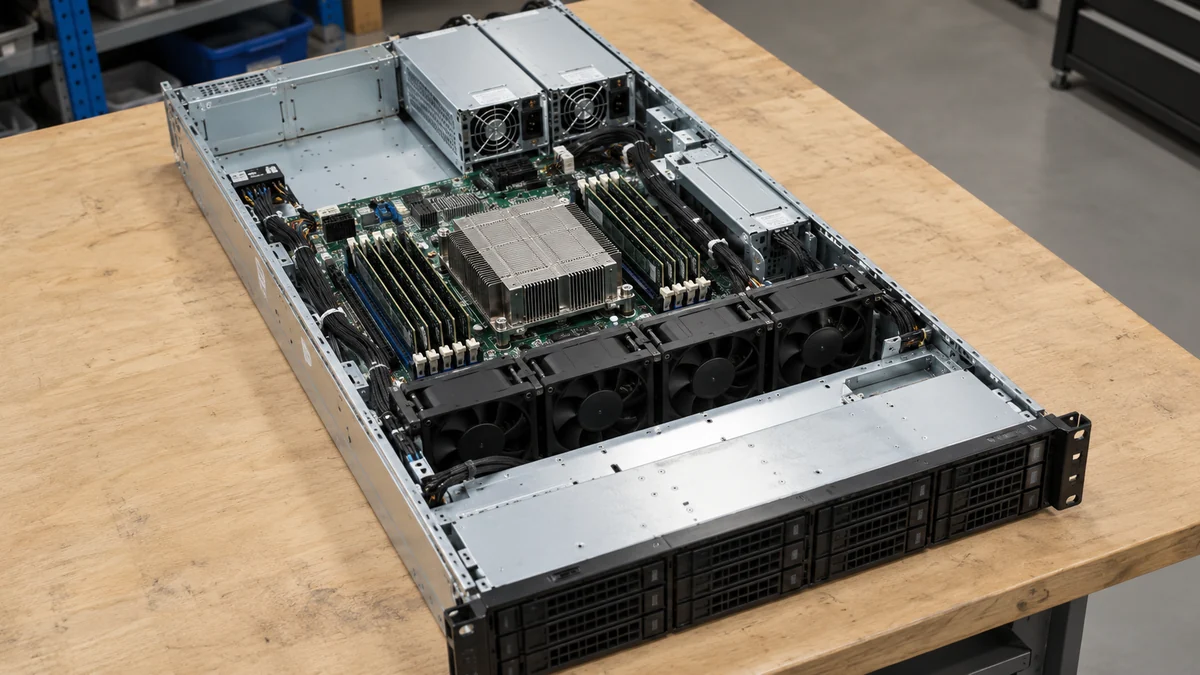
Intel’s described platform also allows PSU internal thermal sensors to become inputs to chassis-fan control on some products. That is the opposite information direction: PSU temperature can influence other fans. It does not mean the BMC always commands the PSU rotor. A system might support sensor reporting without external speed control, speed control without exposing every internal temperature, or neither feature. When a management interface displays “PSU fan,” first ask whether the value is observed RPM, a commanded set point, an alarm state, or a setting that applies only to chassis fans.
PMBus availability is not a universal fan-control license
PMBus can carry management information between a compliant supply and a host. In a server, that may include status and power-related telemetry; the available commands and the host’s use of them are determined by the implemented profile and platform firmware. A listing that says “PMBus supported” therefore does not by itself answer whether a user may adjust the fan. It also does not mean the BMC can command the fan below a module’s internal thermal limit.
The distinction is easy to miss during a replacement. A module may fit the cage, power the DC bus and report ordinary electrical status, yet fail to participate in the host’s expected fan-control exchange. The host could retain basic functionality while entering a conservative acoustic mode, or it could report missing PSU fan information. The exact response is an OEM integration rule, not a generic property of interchangeable server supplies. Fan behavior should be checked against the host’s supported module list and firmware combination, not inferred from identical-looking handles or a matching wattage label.
Reading feedback without confusing cause and effect
RPM telemetry answers a narrow question: a tachometer has observed a rotating fan at an indicated speed. It does not directly measure air mass flow through the converter, the temperature of every component, or the reason that speed was selected. A blocked intake, recirculated exhaust, missing blank or changed rack pressure can leave a fan spinning quickly while less useful cool air reaches the hot parts. Even an accurate RPM reading needs the surrounding thermal and mechanical context.
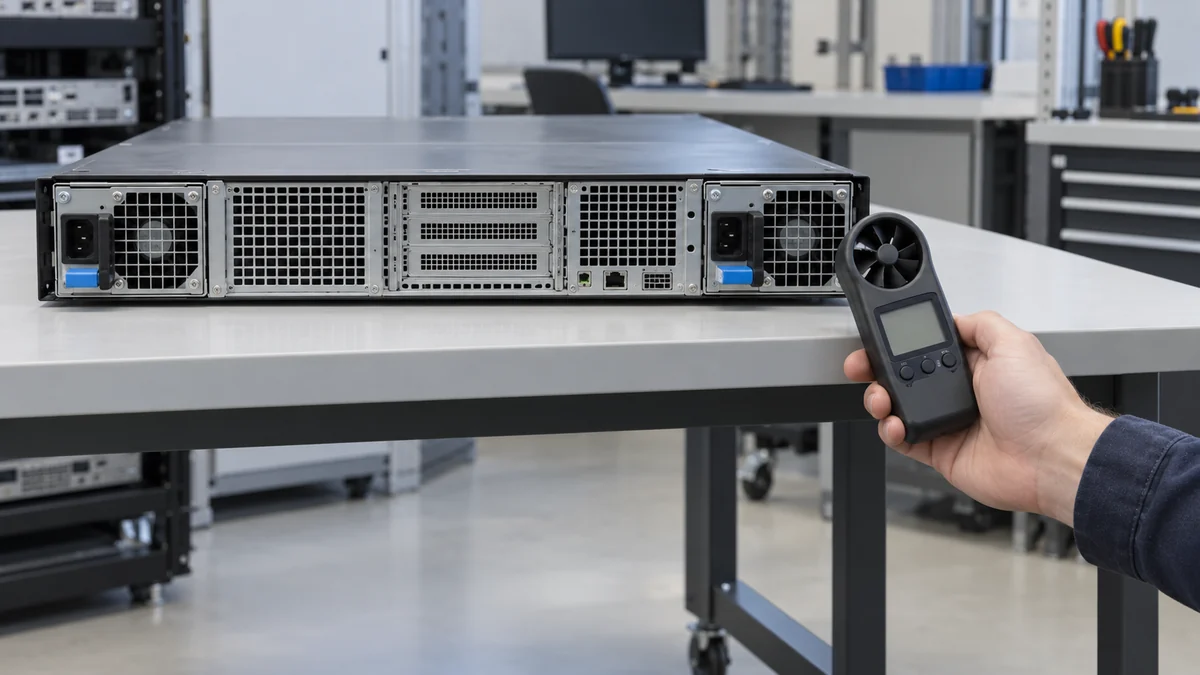
Likewise, a fan-speed rise during a workload is an observation, not a diagnosis. The PSU may be reacting to greater electrical loss; the BMC may be reacting to a system temperature; or both may rise because the workload heats several regions. Correlation with module load, inlet condition, PSU temperature if available, chassis fan speeds and event history helps identify which control loop is active. The best comparison holds as many conditions as possible steady. A profile change made at the same time as a workload change cannot show which one moved the fan.
Timing gives another clue. If a fan increases immediately when a host fan policy is changed, the platform may have command authority over it. If it rises only after the PSU has carried a higher load long enough to warm internally, autonomous module control is plausible. These are hypotheses, not model-independent tests: firmware may filter commands, apply ramp limits or delay sensor updates. A short observation must not be used to declare a PSU safe at a lower speed. The documented fan-domain behavior remains the controlling reference.
Missing values deserve careful wording. “No PSU fan RPM in the BMC” might mean there is no sensor, that the PSU’s telemetry is incompatible, that the module or management path has failed, or simply that the particular user interface omits it. It is not proof that the fan has stopped. The reverse also matters: a visible sensor is not proof that the host can command it. Diagnostic interpretation starts by separating monitoring support from command support.
Failure responses can change several fan domains at once
A server reacts to a lost fan according to platform policy. In the Intel example, an OEM-defined sensor table can specify different reactions in other fan domains when a particular system or PSU fan fails. That allows the remaining cooling resources to respond to the location of the failure rather than applying one universal boost. The exact table belongs to that platform. It would be misleading to turn it into a general rule such as “a failed PSU fan makes all server fans run at full speed.”
Loss of a PSU module is different from loss of its fan. If one redundant PSU is withdrawn or stops delivering output, the survivor may carry a greater share of load and create more internal heat. The BMC may also detect a power-redundancy state change and alter system fan behavior. At the same time, an empty bay can change the air path if the chassis expects a blanking insert. These mechanisms can coexist, but none should be presumed solely from a louder sound. The platform’s event record and physical module state establish which event happened first.
A management or firmware fault can produce another pattern: a fan that stays high without a corresponding rise in load or temperature. Some hosts deliberately select a conservative speed when required sensor information is missing. That behavior is protective, not a defect to defeat by lowering a hidden setting. The relevant questions are whether the host recognizes the installed PSU, whether its telemetry is current, and whether the reported state changed after a module or firmware change. A supported replacement can remove an integration mismatch; forcing the fan slower can conceal it.
Why a quieter profile sometimes changes nothing
An operator might choose a quieter thermal profile, see lower chassis-fan RPM and still hear the same sharp PSU tone. There is no contradiction if the PSU remains governed by its internal minimum. The setting may have reduced only the main fan wall. Even if the BMC sends a lower PSU request, the module can retain a higher speed because its own temperature or load demands it. This is precisely why system-level and module-level control should not be presented as a single slider.
What a module swap can reveal about fan control
For a particular server, describe the control path in plain terms: the PSU protects itself; the BMC may observe it; and, if the documented host and module combination permits, the BMC may request additional PSU fan speed. Then identify which readings are measurements, which are commands and which are platform policies. This description is more informative than saying that “PMBus controls the fan” or that “the PSU controls itself,” because either shorthand can omit a real boundary.
Suppose two supported modules are installed, one module is removed for service and the remaining PSU fan rises. That behavior is consistent with increased load and internal heating, but may also reflect a host failure-state policy or altered airflow. The useful observation is the sequence of module state, load, temperature and fan-domain changes, interpreted under the exact platform guide. There is no need to open a powered PSU, probe its fan wiring or override its controller to learn which authority is plausible.
Server PSU fan-speed control is therefore an integration property, not a universal feature of a fan or bus label. The module’s thermal floor, the host’s optional command path and the reliability of reported feedback all matter. A supported combination can coordinate them; an unsupported replacement may merely look compatible while breaking that coordination. When a fan behaves unexpectedly, establish which side has authority before treating the RPM as a knob to turn.