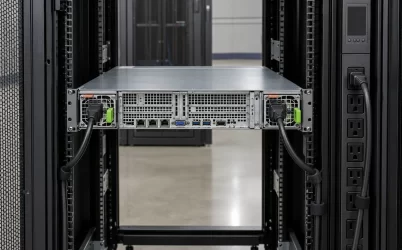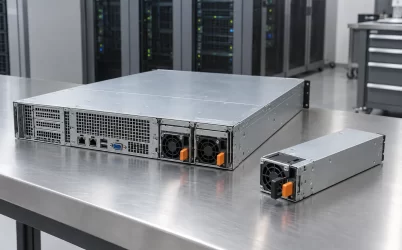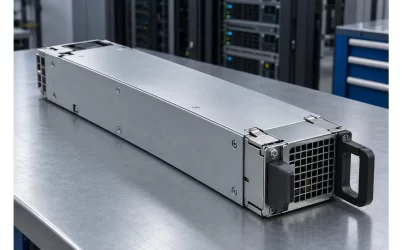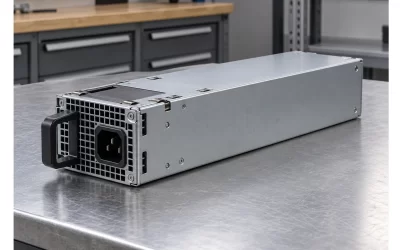
A 650W 80 PLUS Platinum server PSU sits in an awkward but useful part of the power range. It can be generous for a compact storage or edge node and plainly inadequate for a server with a substantial accelerator. The number is a maximum-output class, not a prediction of what the server will consume; “Platinum” concerns tested conversion efficiency, not available connector types or redundant capacity. Whether the combination is sensible depends on the actual DC load profile and on the mechanical and electrical interface of the particular PSU. A listing that says only “650W Platinum” leaves those questions open.
Why 650W can be ample in one server and tight in another
Consider a small rack node with one moderate processor, memory, a network adapter, several drives, motherboard electronics, and fans. Its sustained DC demand might be a few hundred watts. A 650W module could then leave useful room for fan ramps, storage activity, or a future adapter. Replace that workload with a high-power GPU and a second processor, however, and the same module may no longer have enough output capacity. The relevant quantity is the sum of concurrent demands at the PSU output boundary, not the number of components or the server’s rack height.
To make the arithmetic concrete, imagine an illustrative node whose processor and local regulators account for 180W, storage for 90W, memory and motherboard functions for 65W, fans for 35W, and network and expansion cards for 50W at a defined operating condition. That is 420W delivered to the system. A 650W output ceiling leaves 230W between that condition and the nominal rating. These are hypothetical component-group numbers, not a measured Powernexu configuration or a recommendation to buy a particular 650W model. Their value is in making the load boundary visible: the remaining 230W must absorb real coincident excursions, not a list of every component’s independently advertised peak added without timing context.
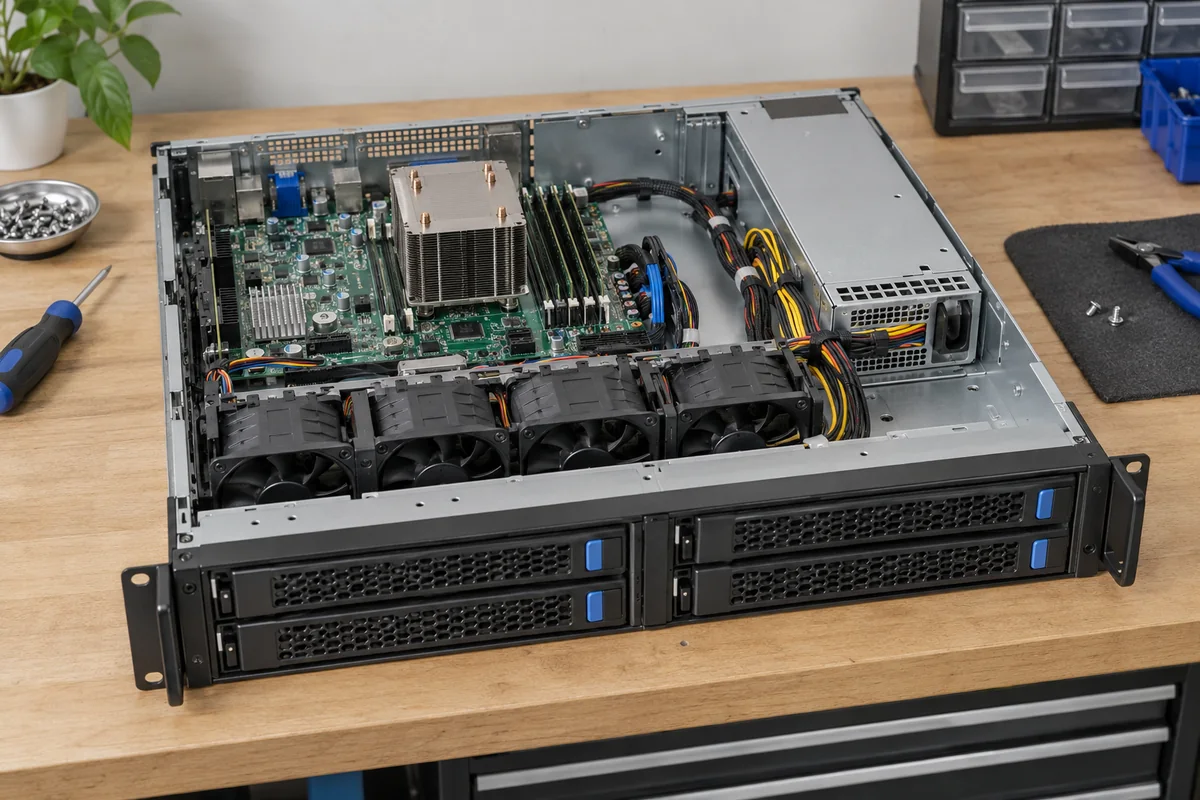
Server loads rarely rise in one tidy sequence. Fans may accelerate because an inlet gets warmer while storage devices are busy. A firmware update or power recovery can produce a startup state that differs from a steady benchmark. A compact node with many drives may have a drive spin-up event at a time when the processor is relatively quiet, but the controller’s spin-up policy matters. A single “typical watts” figure can conceal precisely the event that trips a small PSU. The margin against a 650W ceiling should be understood at the same timescale as the load variations that the platform actually permits.
Adding an accelerator illustrates the breakpoint. If that example node gained a card that required an additional 280W at a simultaneous high-load condition, the total would be 700W before allowing for any secondary effects. No Platinum designation can create the missing 50W of DC output. The system must reduce load under a defined power policy, use a different approved PSU configuration, or change the host architecture. Efficiency affects how much AC input is needed to deliver the load; it does not increase the converter’s specified output rating.
Platinum is a test category, not a flat operating curve
The official 80 PLUS rating explanation separates certification categories for non-redundant internal supplies, redundant data-center supplies, and industrial supplies. Their input conditions and required efficiency points are not interchangeable. When a seller describes a 650W unit as Platinum, the useful next fact is the exact model’s verified certificate or test report and the category under which it was tested. A generic badge reproduced on a listing does not identify the installed module’s efficiency at a 100W idle condition, a 420W application load, or a different AC feed.
At the example node’s 420W DC demand, the load is about 65% of a 650W output rating. That percentage is more informative than comparing 420W with the number on a rack PDU. Suppose, solely for illustration, the installed PSU converted at 92% at that point. The AC real-power input would be approximately 420 / 0.92, or 457W, and converter loss would be about 37W. If its actual efficiency were 89% at the same operating condition, input would be about 472W and converter loss about 52W. The fifteen-watt difference is a model-and-condition question; it cannot be read from “Platinum” alone.
At very light load, fixed electronics and fan power may become a larger fraction of input. A 650W unit serving an 80W idle node is operating near 12% of its rated output, outside some commonly quoted mid-load comparison points. One should not extrapolate a mid-load efficiency figure down to idle without a curve or measurement. The server’s own idle DC demand also has to be measured: a low CPU-utilization percentage is not itself an 80W power reading. For a server that spends most of its life waiting for work, this can matter more to annual energy than a tiny advantage at full output. For a node running a steady production workload near 420W, the middle of the curve may dominate instead.
Nor does higher efficiency remove all heat. A PSU’s conversion loss warms the server or its exhaust, while the energy delivered to processors, fans, memory, and other electronics ultimately becomes heat elsewhere in the equipment. If two compatible supplies serve the same DC workload, the more efficient one can reduce total rack AC demand and the corresponding thermal load by its avoided loss. It does not make a 420W server a 37W heat source just because the converter loss in the example is 37W.
Output architecture matters more than a matching wattage
“Server PSU” can describe a fixed cabled supply, a hot-swappable module, a CRPS-style module, or a host-specific removable assembly. Those products can all be described with a 650W number and still be mutually incompatible. A fixed unit may deliver several rails through a wire harness; a removable module may present a high-current 12V output and standby or control contacts to a board. The motherboard or power-distribution board determines how the remaining voltages and connectors are provided. A replacement must match that architecture, not merely the total output wattage.
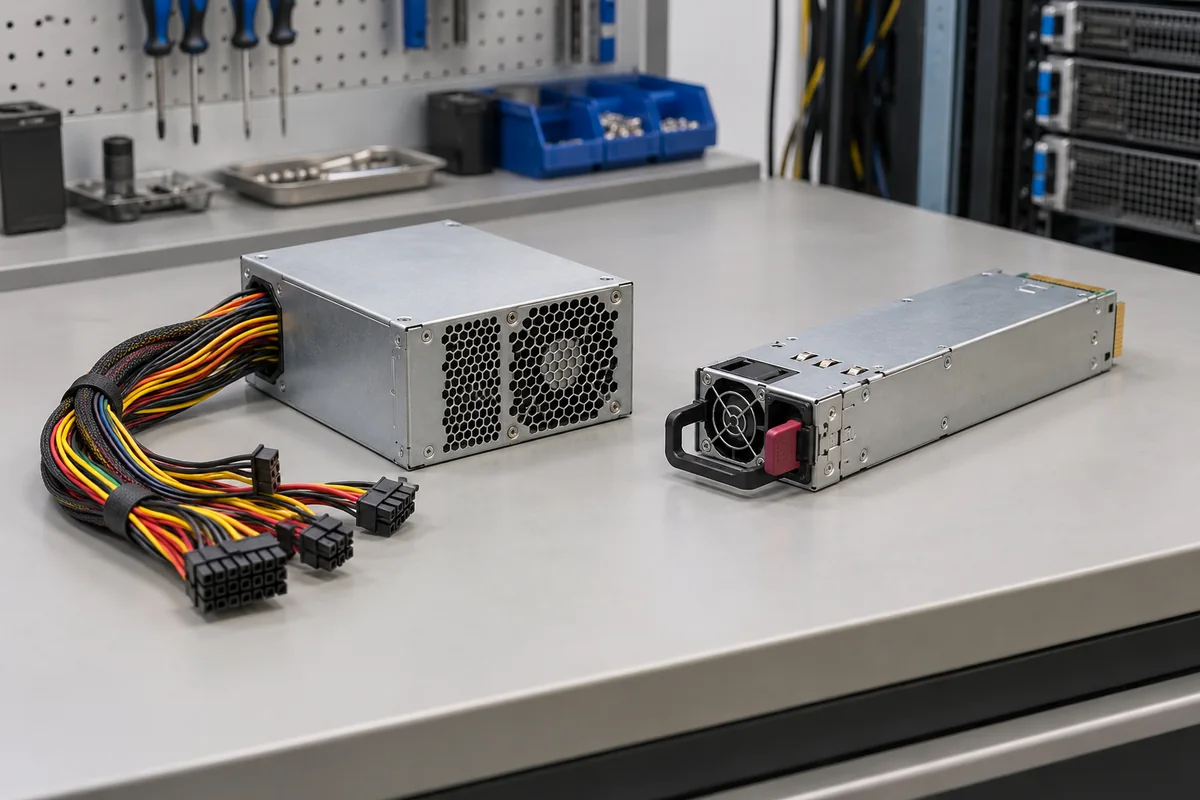
Where the host uses a 12V main bus, 650W corresponds to roughly 54A if all of that output were available on 12V and the design permitted that operating point. This is arithmetic, not an assertion about a real 650W PSU. A multi-output model may allocate its total rating among 12V and other rails, and its combined-load limits can differ from a simple 650 / 12 calculation. Even if two supplies both advertise “12V,” their standby output, enable sequencing, sense contacts, management signaling, and connector keying can be different.
Mechanical fit can be equally decisive in a small server. A removable module has to enter its cage at the correct height and orientation and reach the mating board without forcing the connector to act as a guide rail. Its handle needs rear clearance for service; its airflow must match the chassis path. A cabled supply needs harness reach without blocking fans or bending hard against a sharp edge. None of these properties follows from the 650W rating or the efficiency tier. A product photo that resembles the installed PSU is insufficient evidence of an approved replacement.
If the intended use is a newly designed node rather than a replacement, the interface can be chosen alongside the chassis. That changes the question from “will this part substitute?” to “which power architecture is appropriate?” The latter allows the designer to decide whether hot-swap service is worth a cage and backplane, whether a fixed unit is simpler, how much space to reserve for cooling, and where power distribution belongs. The 650W capacity is one input to that design, not its organizing principle.
Two 650W modules do not imply 1300W of protected load
In a 1+1 redundant system, two installed modules ordinarily exist so one can continue to carry the required workload when the other fails or is removed. If the example node’s required load is 420W, each 650W module can have capacity to support that load, subject to its input and thermal limits and the host’s distribution design. Under normal operation the modules may share current, but the platform—not the number printed on the modules—determines how evenly. After one is lost, the survivor’s output, connectors, and cooling path take the full defined load.
If the server is allowed to climb to 850W DC while both 650W modules are installed, it may run in a non-redundant or power-capped state. It cannot retain that workload on one 650W supply after a fault. Some platforms manage that distinction by limiting processor or accelerator power when redundancy is required; others prohibit unsupported hardware configurations. A buyer who adds the two PSU ratings to claim 1300W of protected capacity confuses installed converter capacity with fault-tolerant capacity.
Normal sharing also affects energy use. At 420W DC total, two modules each delivering approximately 210W would operate at about 32% of their individual output ratings. The surviving module at 420W would operate at about 65%. Actual AC input could change with that shift because efficiency is load-dependent and each module has its own standing losses. Platinum does not force the normal-state pair to be more or less efficient than the single-module state in every product. The host’s current-sharing policy and the selected module’s curves decide the direction.
Feed redundancy is a different boundary. Two PSUs plugged into the same upstream circuit can protect against one module failing while leaving the circuit, PDU, and other common infrastructure unprotected. Separate A/B feeds, if the application requires them, must be supported by the chassis and facility arrangement. A 650W rating says nothing about that topology. This matters most in small edge and network nodes where a redundant PSU pair can appear robust even though both AC cords end at one power strip.
The right-sized module is the one that fits the workload and host
Compared with a 550W or 800W class, 650W offers a particular amount of nominal capacity, but it is not automatically the optimum middle choice. If a node’s approved hardware never exceeds 300W DC, a compatible lower-capacity supply may be sufficient; if it needs 700W under a required operating condition, a 650W part is too small. A larger PSU may operate farther down its load curve at idle, while a smaller one may lack expansion or failure-state margin. Neither direction can be resolved from efficiency tier and wattage without the host’s real demand and an actual model’s performance data.
A useful conclusion for a 650W Platinum inquiry is therefore concrete, not categorical. It is a plausible class for a moderate server, storage, or edge workload when the installed platform supports that exact electrical and mechanical module, the required peak and single-failure load remain within its documented output envelope, and its tested efficiency profile is useful at the hours where the system operates. If an exact compatible 650W product is not identified, the search phrase has not yet named a purchasable replacement. It has named a capacity-and-efficiency target that still needs a real module and a real host to meet.