A 3800W server power supply is not a drop-in 3800W capacity increase for every rack. The one well-documented current example found for this exact search, Lenovo’s ThinkSystem 3800W HVAC/HVDC module for the SR680a V4, has a lower published output ceiling at some input voltages. Its highest redundancy mode also depends on the number of installed modules and the input voltage, and Lenovo does not support upgrading that server from its 3200W supply architecture in the field. The useful reading of “3800W” is therefore a specific platform-and-feed configuration, not a promise made by the module label alone. Other manufacturers’ 3800W products, if offered, need their own documentation.
The nameplate and the inlet describe different limits
Lenovo’s SR680a V4 product guide lists the ThinkSystem 3800W HVAC/HVDC Titanium CRPS Premium Hot-Swap Power Supply, part 4P57B06189, as a supported option. The guide specifies a 200–277 VAC input range and a 240–380 VDC input range for that option. Those ranges describe where the module may accept power. They do not state that the full 3800W output is available at every voltage inside them.
The distinction is explicit in Lenovo’s electrical table. At 200 VAC, the listed maximum output is 2900W and the inlet-current entry is 16A. At 230 VAC, maximum output is 3200W and the inlet-current entry is 15.3A. The same table lists 277 VAC at 14.4A. On the DC side, 240 VDC is limited to 3200W; the table separately lists inlet-current entries at 336 VDC and 380 VDC. A person selecting a 200 VAC rack feed cannot treat the part’s 3800W name as its documented 200 VAC output capability. That is a 900W difference per module between the name and the stated 200 VAC ceiling.
These values are specific to this Lenovo module and host. They should not be copied into a specification for another 3800W PSU or interpreted as a universal derating formula. Nor should the inlet-current entries be treated as a constant operating draw. The guide gives electrical limits at listed conditions, not a meter trace for every workload. Actual AC current changes with DC demand, efficiency, power factor, control state, and the server’s operating conditions.
For a data hall supplied at nominal 230 VAC, the difference between accepting that voltage and delivering 3800W at it is the important surprise. The module accepts 230 VAC, but Lenovo lists a 3200W maximum at that point. An ordinary 230 VAC distribution design may therefore be entirely valid for the server while not enabling the headline module output. A higher-voltage feed is an architectural choice involving the upstream electrical system, rack distribution, permitted cords, and the supported server configuration; it is not a switch on an otherwise unchanged branch circuit.
Eight installed modules do not automatically mean eight times 3800W of protected load
The SR680a V4 supports six or eight identical power supplies, according to Lenovo’s guide. For its 3800W HVAC/HVDC option, N+1 redundancy is listed with either six or eight modules within the supported input ranges. N+N is listed only when eight modules are installed and the input is above 249 VAC or above 260 VDC, still within the supported ranges. This is a configuration-specific statement. It does not say that installing any eight hot-swap modules in any server creates N+N protection, or that an eight-module system remains N+N on 200 VAC.
N+1 and N+N describe what capacity remains after a defined failure, not merely how many converters are visible at the rear. N+1 adds enough capacity to cover the loss of a module under the platform’s intended operating envelope. N+N requires two power groups each able to support the protected load. Lenovo’s documented voltage threshold for N+N matters because the lower-voltage output ceiling changes what each group can carry. The exact protected workload still depends on the configured server and the manufacturer’s capacity calculation; multiplying eight nameplates is not an answer.
Suppose an engineer simply multiplies eight by 3800W and writes 30.4 kW in a rack schedule. That arithmetic is the sum of eight nominal module labels, not an asserted power draw, continuous protected output, branch requirement, or permitted workload for this server. It ignores the documented 2900W and 3200W ceilings at lower AC voltages and says nothing about the loss of a module or a power group. Even a calculation using the correct voltage-dependent ceiling would need the server’s supported power policy and full configuration before it became an operating limit.
The practical question for an eight-module server is what load is protected after a particular source disappears. If an A-side rack distribution path fails, are the surviving modules and their inlet voltage sufficient under the actual Lenovo configuration? If one cartridge fails while both distribution paths remain available, what capacity remains? Those are different events. Lenovo’s N+N condition provides a documented starting point for the first question; the final server configuration and facility design determine whether the arrangement actually implements the intended separation of sources.
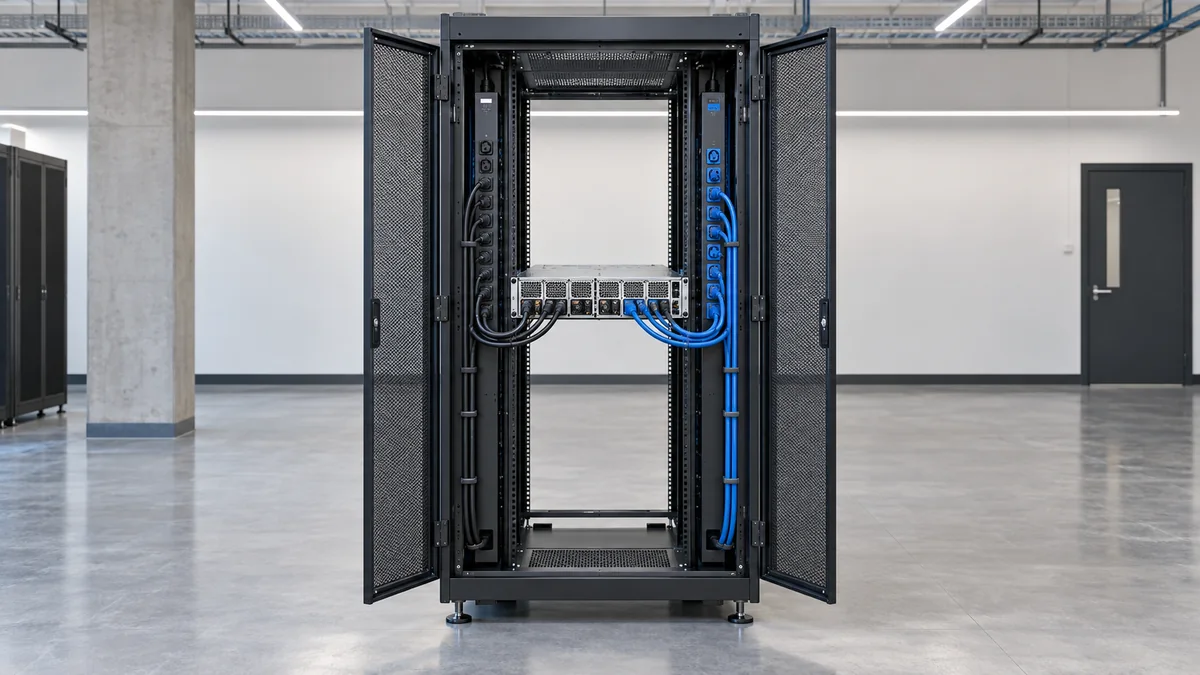
Do not assume a label on a procurement sheet settles the physical failure domains. Eight power cords connected to one PDU do not create two independent upstream paths. Conversely, two facility sources do not improve resilience if the rack cabling, supported module population, or workload exceeds what a surviving side can sustain. These are general reliability principles, but the numerical eligibility and supported mode in this example are Lenovo-specific.
The 3200W and 3800W options are not a field-swap ladder
Lenovo lists a 3200W AC option alongside the 3800W HVAC/HVDC option. A hurried comparison could suggest that a purchaser may deploy the cheaper or more readily powered 3200W variant first, then replace its cartridges with 3800W units later. The product guide explicitly says a field upgrade from 3200W power supplies to 3800W power supplies is not supported because the server’s internal power architecture differs. That is stronger than a caution to check dimensions. It rules out the proposed upgrade path for this documented platform.
The guide also specifies different input connector families: C19 for the 3200W option and 2007G for the 3800W HVAC/HVDC option. The connector difference is visible evidence that the rack-to-module electrical path must be planned with the intended PSU version. It is not sufficient evidence by itself about every internal difference, which Lenovo does not detail in that paragraph. An identical-looking bay opening or a familiar CRPS descriptor cannot override the manufacturer’s supported platform boundary.
All supplies installed in this server must be identical, according to the same guide. Mixing a 3200W unit with 3800W units is therefore not an incremental upgrade strategy. For a replacement inventory, the exact supported part and server configuration matter more than a generic 3800W search result. For a new build, the chosen PSU architecture belongs in the initial server order and facility-power design, not in an assumed future cartridge change.
Rack voltage changes the cord and distribution discussion
A 200–277 VAC compatible PSU invites a question that a conventional 200–240 VAC-only server installation may never ask: is the rack actually equipped for the voltage at which the intended output and redundancy mode apply? The answer involves more than the nominal facility transformer. A compatible UPS output, distribution path, rack PDU, branch protection, receptacle, line cord, and server inlet must all be appropriate for the operating voltage and current. An electrician or qualified facility designer must handle the installation under the applicable site rules. This article is not a wiring instruction.
Lenovo provides separate cord ordering sections for the C19 and 2007G supply options, and notes that inclusion of a line cord depends on the ordered server configuration. The 3800W option’s 2007G inlet does not mean any cord that physically reaches it is approved for a particular 277 VAC rack. Cords and mating distribution devices have their own voltage, current, connector, region, and certification limits. An apparently small difference between 249 and 250 VAC is especially material here because Lenovo’s N+N condition uses an input threshold above 249 VAC. The electrical design should use the manufacturer-supported voltage range and properly rated components, not an improvised threshold adjustment.
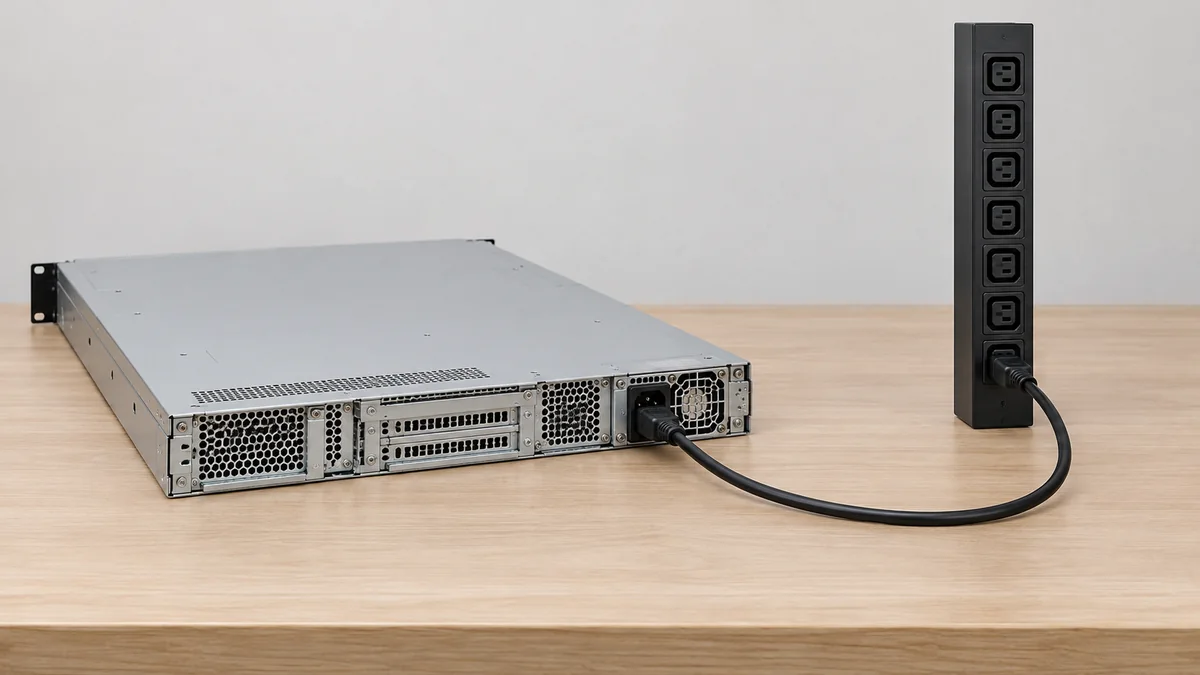
On the DC side, “HVDC” is likewise not an invitation to connect the module to a familiar -48 V telecom bus. Lenovo lists 240–380 VDC for this 3800W option. That is a different voltage class and distribution architecture. The presence of both AC and DC in one input specification also does not establish that a facility may mix source types across individual modules in any arbitrary arrangement. The supported host configuration and source wiring must be checked for that exact use.
Input voltage also changes how a rack planner interprets current. The electrical table’s 14.4A entry at 277 VAC cannot be multiplied blindly by eight and called the server’s constant current. Some module load conditions produce less draw, the redundancy policy affects sharing, and actual server demand varies. Yet the listed inlet data is useful for ensuring that upstream components are not selected from an output-wattage label alone. The facility’s electrical designer needs the manufacturer’s maximum input and supported cord/PDU data for the full installed server, with the intended fault scenario included.
What the 3800W example says about AI-server power density
This particular 3800W module is documented for Lenovo’s high-density SR680a V4, rather than for a generic small rack server. Its power system sits inside a platform with multiple accelerators, dedicated cooling, a high module count, and substantial rack service needs. A large module rating can help support that class of system without making the server’s consumption equal to the sum of its PSU labels. The installed workload, power management, cooling state, and redundancy setting determine the actual draw and available fault tolerance.
At several kilowatts per module, a few percentage points of conversion loss also become tangible heat. That does not justify inventing an efficiency value from the Titanium name. Certification is a useful descriptor of an applicable tested supply, but thermal design must use the actual operating point, airflow path, inlet temperature, and server data. A higher nominal output module can be unusable in a host whose air path or power distribution was built for another option. In the SR680a V4 example, Lenovo’s unsupported field-upgrade statement already closes that path before a speculative thermal calculation can reopen it.
Read the full 3800W configuration before treating it as capacity
The published Lenovo example supports a precise answer to the search phrase. There is a documented 3800W server PSU option, but its advertised wattage is a high-input-condition property of a particular SR680a V4 power architecture. At 200 VAC, Lenovo explicitly limits that module to 2900W output; at 230 VAC, to 3200W. N+N is a supported mode only with eight modules and input above the stated AC or DC thresholds. The 3800W option has a different inlet connector from the 3200W option, and Lenovo rules out the field upgrade between those architectures.
That set of conditions is more useful than a generic “3800W is enough for GPU servers” claim. If the server, feed, module count, and protection target are known, the manufacturer’s configuration data can establish a real power envelope. If they are not known, 3800W remains a label on one component rather than a defensible workload or redundancy figure. That is the boundary this search result should make visible.