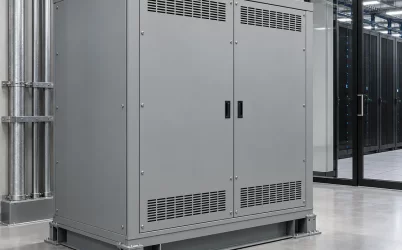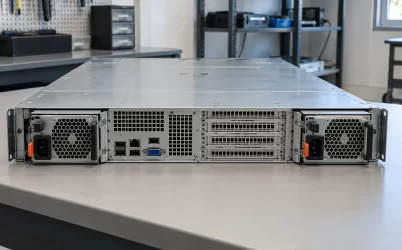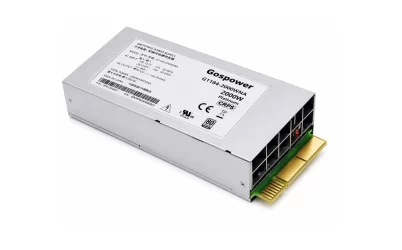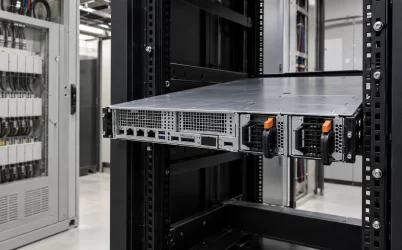
Four server power supplies enter a hypothetical burn-in rack together. All show acceptable output at the end, but one measurement channel stopped recording during the run, and a shared input interruption affected every position. Those final readings leave different questions unresolved. Burn-in testing for server power supplies operates units under defined electrical and environmental conditions to screen for early failures. A useful result connects each identified unit to its exposure history and the observations required by the approved screening procedure.
For production-test and supplier-quality teams, the central task is preserving that connection throughout a multi-unit run. The method below separates missing observations, interrupted exposure, and detected failures. It proposes a way to organize evidence; actual stress levels, duration, acceptance limits, and recovery rules must come from the applicable product and quality procedures.
The screen needs an exposure definition before the rack starts
Production burn-in seeks to reveal defects through an approved operating exposure. It differs from design qualification, which investigates whether a design meets its requirements across specified conditions. Passing a production screen supplies evidence about that unit under that screen. It does not establish its remaining service life, eliminate every latent defect, or replace qualification of the server installation.
PULS describes cyclic loaded operation at elevated ambient temperature as part of its manufacturing process. That manufacturer example supports the general distinction between ordinary operation and deliberate screening. Its published recipe cannot be transferred to an unidentified server PSU. No exact server-model screening procedure accompanies this article, so no universal temperature, load percentage, or duration is prescribed.
The adopted procedure should distinguish preparation from credited exposure. Chamber warmup, establishing output demand, commanded off periods, and recovery after an interruption can serve different purposes. Counting elapsed rack occupancy as burn-in time can merge those states. A unit loaded later than its neighbors needs its own exposure start, even when the rack has one overall start timestamp.
For a server module, the fixture must also reproduce the required cooling and control arrangement. Some operating configurations depend on host commands, auxiliary loading, or a supported receiving assembly. An energized module does not necessarily establish that its main output delivered the required demand. Record the applicable state rather than inferring it from a power indicator.
Thermal settling answers another question: whether observed temperatures have stabilized under a defined duty. Burn-in completion instead follows the approved exposure and screening requirements. A stable temperature does not establish sufficient exposure, while completion of a prescribed screen does not automatically characterize every internal temperature. Keep these findings separate in the production record.
Each position needs an identity and an observation history
A rack position is a temporary address, not the identity of the PSU occupying it. Bind the unit serial number and complete part identity to the position, load channel, voltage channel, and relevant environmental references before the run. If hardware moves, preserve the old association and the time of the change rather than replacing the original mapping.
A removable carrier can help maintain that association when units travel between loading, screening, and unloading stations. Its identifier should remain connected to the actual PSU identity. Swapping two carriers without updating their records can produce electrically plausible results assigned to the wrong units, a problem that output readings alone may not reveal.
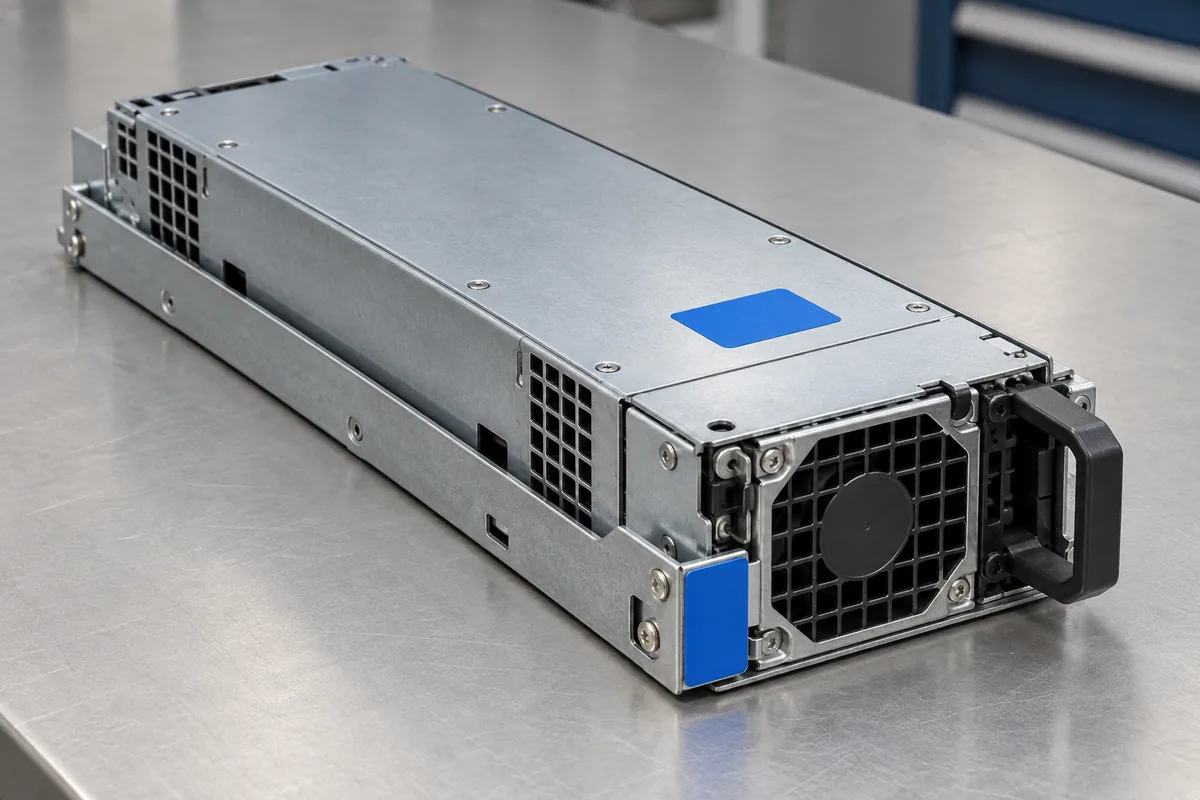
Keithley’s application note on switching-supply burn-in measurement describes monitoring loaded outputs through a multichannel acquisition system and discusses measurement difficulties in a noisy burn-in environment. Its historical output arrangements and instrument settings are examples. They do not define the required channels or acquisition settings for current server modules.
The practical implication is that channel count and observation coverage belong together. A scanner visits channels sequentially. Increasing rack population can lengthen the interval between observations of one PSU, even when the instrument’s individual conversion is fast. Switching, settling, filtering, repeated readings, communications, and record handling can all contribute to the actual revisit interval.
Use acquired timestamps to establish that interval under the intended population and configuration. A nominal scan setting may omit overhead or pauses. Where startup or output cycling is part of the screen, associate observations with the relevant commanded and delivered states. A reading acquired after a unit turns off cannot establish its voltage during the preceding on interval.
Time alignment also matters across instruments. The load controller, chamber recorder, and voltage scanner may use different clocks. Preserve their alignment method and any known uncertainty when correlating events. Otherwise, an apparent output failure could be associated with the wrong load state, or an intended off interval could appear to be an unexplained dropout.
Periodic readings and event detection answer different questions
A periodic voltage record establishes sampled behavior with the configured measurement aperture and processing. It does not demonstrate that voltage remained acceptable at every instant between samples. Whether that limitation matters depends on the screen’s stated objective. A procedure concerned with sustained loss of output has a different observation task from one requiring detection of brief interruptions.
If brief events matter, specify the event that must be detected before selecting the capture method. The definition may include voltage threshold, event duration, permitted startup exclusions, and the required timing relationship to output commands. Suitable continuous acquisition or event detection may supplement scanning, but its bandwidth, thresholds, coverage, and retained evidence need an explicit basis.
Server PSU telemetry can add useful context when supported by the exact model and fixture. A reported fault or output state may help explain an event. However, its update behavior, accuracy, fault retention, and communications handling determine what it establishes. A successful management read cannot automatically substitute for an external voltage observation or prove that no shorter event occurred.
Measurement validity must remain visible too. Keithley’s note discusses electrical noise and settling effects when scanning different channel voltages. Applied engineering practice is to distinguish an out-of-limit electrical result from an invalid or suspect measurement. Preserve the original reading and acquisition status; do not silently replace a questionable value with the next favorable sample.
Nor should averaging erase the event the screen intends to detect. Averaging can improve discrimination for a steady quantity while reducing visibility of short departures. Conversely, a fast isolated sample can respond to pickup rather than the PSU behavior of interest. The adopted measurement method must resolve the defined failure condition with appropriate treatment of uncertainty and interference.
Shared output arrangements deserve particular attention. If several modules feed one supported common bus, an acceptable bus voltage can persist while one module contributes insufficient current. Monitoring that bus answers a collective question. A screen claiming individual loaded operation needs evidence of each unit’s required contribution or another approved method establishing equivalent individual coverage.
A missing channel and a shared interruption create different records
Return to the hypothetical four-position rack. Unit B has valid observations before and after a recorder gap. Independent load and environmental records continue throughout the gap. Those records may support a finding that relevant exposure continued, but they cannot reconstruct B’s missing output measurements. A later acceptable voltage does not fill that observation interval.
Now suppose a shared AC source interruption removes input from all four units. This changes delivered exposure across the rack. Mark the affected interval for every occupied position, retaining the source event and each unit’s observed response. An expected output loss following input removal should not automatically receive the same classification as output loss while approved input and demand remain present.
The distinction becomes clearer when the evidence is separated before assigning a disposition. The following categories describe the hypothetical records, not universal acceptance rules.
| Recorded situation | Supported finding | Question still open |
|---|---|---|
| B’s output channel stops recording while independent condition records continue | Required output observation is missing for B | Whether exposure remains creditable and what additional screening is required |
| The shared source removes input from every position | The delivered input condition changes for all affected units | How the approved procedure treats interrupted exposure and recovery |
| A valid output observation violates its limit under established test conditions | An electrical nonconformity was observed under those conditions | The applicable containment, investigation, and unit disposition |
Do not invent a restart rule after seeing the outcome. Some approved procedures may permit continuation, while others may require repeating a segment or restarting exposure. The relevant rule must address continuity, preparation, and observation requirements. Simply subtracting downtime from elapsed time can be inadequate where cooling or a new startup changes the intended stress history.
An interruption can also leave overlapping gaps. Suppose acquisition restarts before the loads, but environmental recording returns later. The software’s resumed timestamp does not establish that every required condition resumed simultaneously. Retain separate state histories and identify the interval supported by the necessary evidence, including any prescribed recovery preparation.
A detected unit failure should remain attached to that unit even if subsequent operation appears normal. Likewise, a recorder fault should remain a station event unless evidence establishes a PSU fault. This separation prevents missing data from becoming an automatic product rejection while also preventing incomplete screening from becoming an automatic pass.
Rack capacity should preserve the meaning of each unit’s result
Adding more positions expands more than the electrical load. It can change scan intervals, thermal distribution, communications traffic, and the consequences of shared equipment loss. Assess the proposed population against the existing observation requirement. A rack that accommodates more modules physically may still lack sufficient acquisition coverage for the approved cycle.
A separate dissipative load bank releases absorbed output energy as heat. Positioning its exhaust away from the PSU air intake helps avoid adding an unintended local heating condition. The environmental record should represent the reference required by the screen, rather than assuming one chamber reading describes every module inlet under a densely populated arrangement.
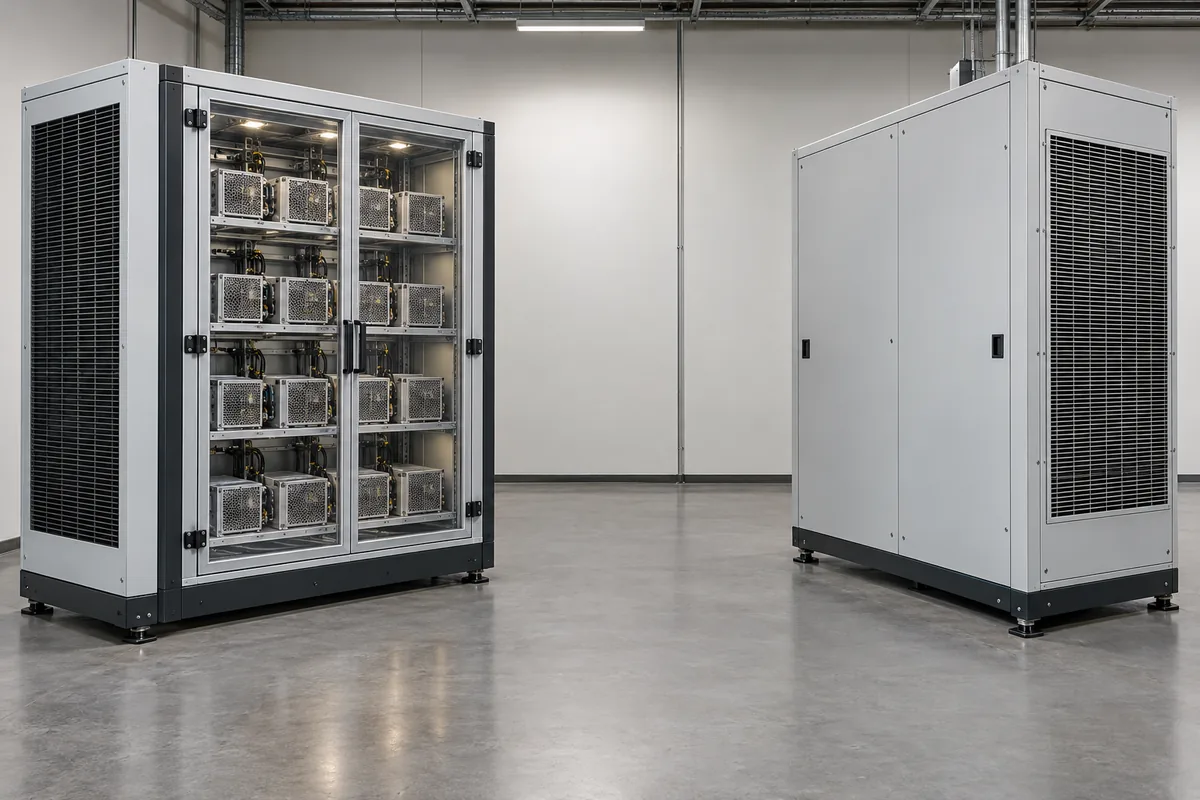
Pacific Power Source’s regenerative-load application note describes returning absorbed energy to the facility or grid. That can change the station’s energy and heat balance, but regeneration does not establish per-unit observation coverage. The proposed load arrangement still needs suitable voltage and current ranges, channel relationships, control behavior, and records for the actual server PSU screen.
Keep the energized station guarded and the required electrical interfaces enclosed. Keithley’s application note identifies operator protection and interlocking as test-system responsibilities. Production personnel should not need to reach into hazardous connections to recover a unit identifier or inspect an indicator. Fixture access and identification can be designed together without exposing live conductors.
The resulting per-unit record can remain compact: identity and configuration; procedure revision; position and channel history; exposure states; observation coverage; detected events; interruptions; and disposition with its authority. Preserve underlying records behind that synopsis. A rack-level pass count is useful for throughput, but it cannot explain which evidence supported one particular shipped module.
For Unit B, the report can state that later output was acceptable while the earlier observation gap awaits disposition. For its neighbors, the shared interruption remains part of their exposure histories even if their channels recorded continuously. Those differences are the useful outcome: each result describes the screen actually evidenced for that PSU, rather than inheriting the rack’s final green indication.