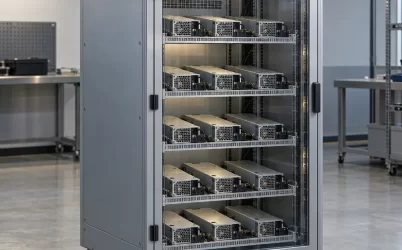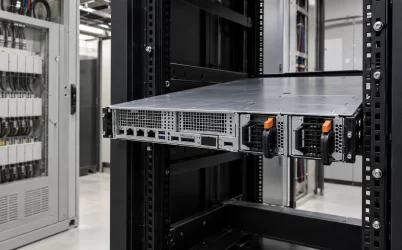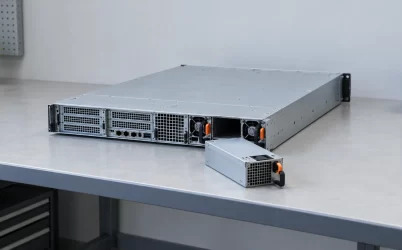
Can G1184-2200WNA replace the power module in a particular server? The public evidence available for that exact suffix does not establish that it can. A Powernexu catalog entry describes a 195 mm, 2,200 W module, but I could not verify those figures against an exact-model Gospower datasheet or a revision-specific manufacturer product page. They must therefore be treated as claims to check, not installation limits or proof of compatibility. The safe answer is to match the delivered unit’s complete label and hardware revision to the server maker’s approved spare, then obtain the manufacturer drawing and rating table for that same revision before ordering or installing it.
Start with the exact identity, not the similar-looking module
The model string G1184-2200WNA is the starting point. Record it exactly, including the suffix, together with any secondary part number, revision, serial or date code on the unit offered for sale. Ask for a clear photograph of the entire label and both ends of the physical module. A seller title, a product-family name, or a wattage printed in a marketplace listing does not identify the revision that will arrive. The controlled manufacturer document must name the same module and explain whether any secondary part number represents an OEM-specific assembly.
The Powernexu catalog entry is useful for finding the proposed item, but its dimensions, nominal output, current and input range have not been confirmed against an exact-suffix Gospower source. Do not put those figures into a procurement specification as verified data. The Obsidian model-verification ledger likewise marks this entry as an unverified candidate. It is a research lead, not a manufacturer approval.
There is an important trap in using other Gospower documents to fill the gap. Gospower has publicly discussed a 2,200 W, 185 mm CRPS solution. That official statement concerns a solution described by the manufacturer, not a dimensional drawing for G1184-2200WNA. The existence of a 185 mm solution does not prove that a 195 mm listing is wrong, and the catalog’s 195 mm claim does not prove that this exact ordered unit is longer. Neither number should be selected as this model’s verified length without the matching revision drawing. The manufacturer’s 2200 W CRPS technology announcement is useful precisely because it shows why power class alone cannot identify a mechanical version.
Resolve the 195 mm claim at the mating datum
A server bay has more than an empty rectangular volume. The module must follow its guides, latch at the designed position, bring its output and control contacts into the correct mating depth, and leave space for the input connector and service extraction. The nominal body length, if eventually confirmed, is only one part of that geometry. Ask for a dimensioned manufacturer drawing showing the rear connector datum, insertion stop, handle and latch, body envelope, airflow openings and any protrusions. Compare it with the host’s power-bay and PDB drawing rather than measuring only the open cavity with a ruler.
If a seller quotes 195 mm, ask what endpoints were measured. A number that includes a handle, connector tongue or other projection is not interchangeable with a bare-body dimension from another document. A ten-millimetre difference would matter in a closely controlled bay, but the actual difference is not established here for G1184-2200WNA. Do not force a module that stops before the latch engages or leave it partly seated to test whether it powers up. A partial electrical mate can create contact heating or intermittent status even when the front of the module appears close to flush.
The host’s approved spare list can answer the replacement question more directly than a generic form-factor description. Check whether it names G1184-2200WNA itself, an OEM cross-reference with the same complete revision, or a qualified alternative. If it names only a nearby G1184 suffix, obtain the host maker’s written compatibility statement. Shared series digits and similar outer photographs cannot carry that conclusion.
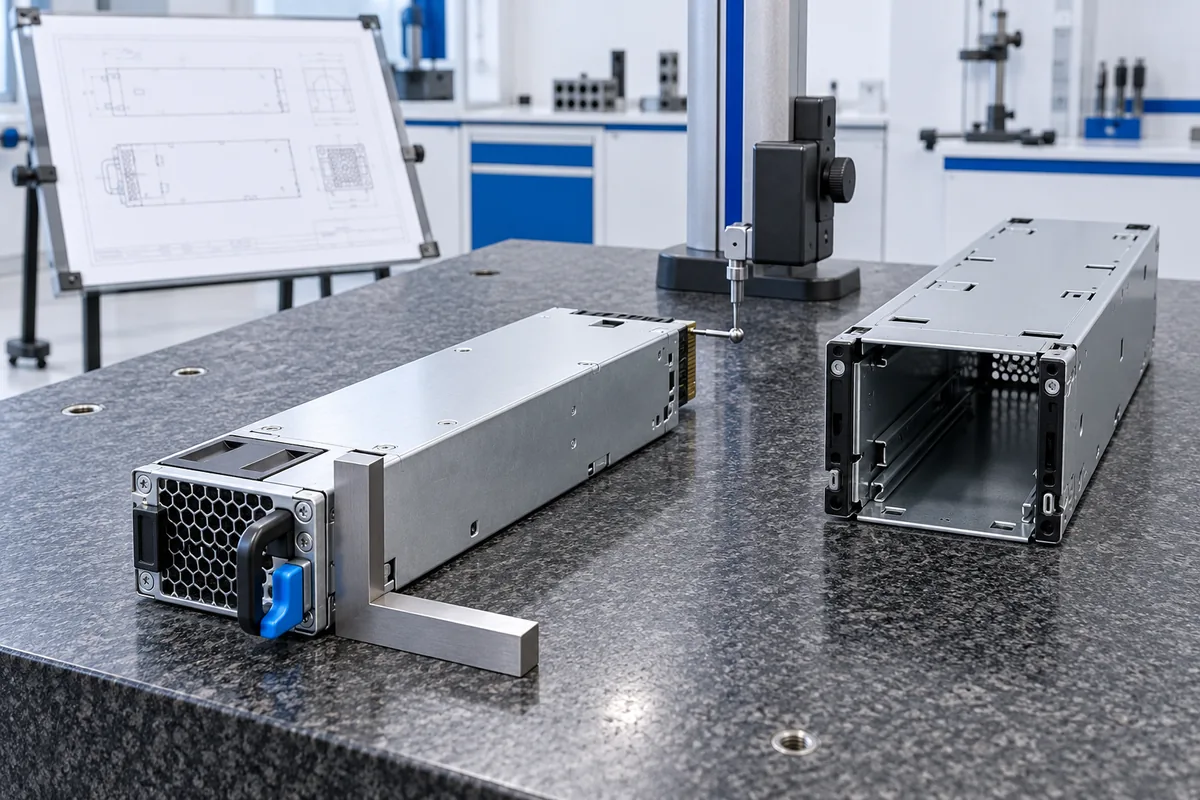
Illustration only: a bay and module being compared at their mechanical mating points. It is not a measured G1184-2200WNA drawing.
Build an electrical comparison from one controlled document
The next record is the manufacturer rating table for the offered revision. It should identify the permitted AC or DC input, output set point and tolerance, main and standby rail limits, operating temperature and airflow assumptions, and any input-voltage or temperature derating. The main-output voltage must match what the host distribution board expects. The catalog’s 12 V description remains unconfirmed for this exact revision, and a label from a different unit cannot resolve it. Even when two nominal figures are close, their set points, tolerances, remote-sense behavior and host limits need to be reconciled from the exact documents.
Do not reverse-engineer a current rating by dividing a seller’s headline wattage by a nominal voltage. That arithmetic cannot tell whether the output is continuous, limited at low input, shared with a standby rail, or subject to thermal derating. A credible replacement decision needs the applicable main and standby current limits for the actual rack feed and module inlet temperature. The input range itself does not guarantee the same available output at every point in that range.
A complete interface drawing is also needed. It must identify the power and return contacts, standby supply, presence and enable signals, current-sharing connection, fault/status pins, and management interface where applicable. A CRPS-style edge connector is not a promise that every contact assignment and host control sequence is identical. A module can have adequate theoretical output and still fail to start, be isolated by the host, or present unusable telemetry. Do not transplant a pin map or PMBus register description from G1184-2000WNA, a newer Gospower model, or another vendor’s CRPS supply.
If the server maker publishes a field-replacement procedure, use it to confirm the expected LED states, supported hot-swap conditions and whether paired modules must be matched. These are host-level rules. A seller’s “hot-plug” label cannot certify a live replacement in a particular enclosure, especially while the other source, input feed or system load is degraded.
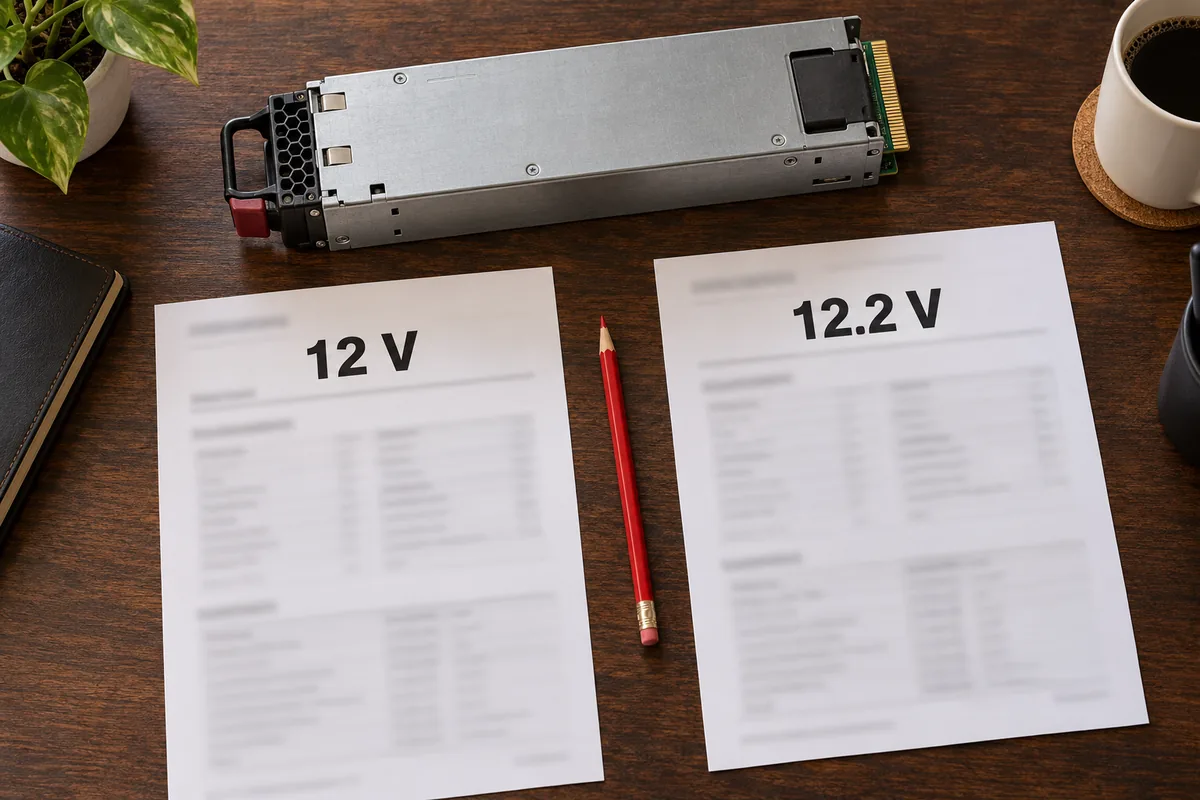
Illustration only: two possible voltage descriptions beside a removable module. Neither sheet depicts a verified G1184-2200WNA manufacturer specification or documents an actual revision difference.
Test the redundancy claim against the surviving module
A two-module server can be arranged for capacity, redundancy, or a platform-specific mix of both. For 1+1 operation, the one module left after a failure must support the allowed system demand at its own input and thermal condition. Adding the two module nameplates and calling the sum protected capacity would be incorrect. This calculation cannot be completed for G1184-2200WNA from the public catalog claims because its exact-revision output envelope remains unverified.
The data to request are concrete: the host’s worst allowed DC demand at the PSU interface, the valid one-module rating at each rack feed, any current-sharing and transfer limits, and the host’s behavior when a supply or AC source disappears. Distinguish DC output at the module from AC input at the wall. The latter includes conversion loss and cannot be compared directly with a DC nameplate. If A and B feeds use different voltages, the surviving module’s available capacity may differ depending on which feed fails. The manufacturer table and the server’s supported configuration determine that case.
A bench test with a loose module is not a substitute for those records. It may demonstrate that a unit produces voltage under one controlled condition. It does not prove that its contact system, cooling, management identity and failover behavior are approved inside the intended host. Qualification should follow the server maker’s procedure and be performed by competent personnel. No one should improvise live-backplane probing to compensate for missing documentation.
Use a short acceptance record before purchase
A buyer can turn the uncertainty into a precise request rather than an open-ended question about whether the module “fits.” The vendor should supply a photograph of the delivered label, the exact-revision Gospower specification and dimensioned interface drawing, and the host maker’s approved spare or cross-reference. Record the source and revision of each file. Then compare the following items against the host documentation:
- Identity: complete model, suffix, secondary/OEM part number and hardware revision match the proposed order and the host approval.
- Mechanics: body and insertion datum, guide rails, latch, connector position, extraction clearance and airflow direction match the bay.
- Electrical capacity: main and standby outputs, input-dependent limits and temperature derating cover normal and single-module operation.
- Interface: mating connector, contact ratings, power and return allocation, control, sharing and management signals are documented for this revision.
- Service behavior: the host’s permitted removal sequence, paired-module rules, fault indications and firmware recognition are known.
If one of these items cannot be reconciled, classify the offered module as an unqualified alternative, not an exact spare. The unresolved item should be written into the purchase inquiry so the manufacturer or host vendor can answer it against the specific revision. This is especially important for refurbished inventory, where the listing may describe a family while the physical unit carries a different suffix or OEM label.
What can be concluded today?
There is not enough controlled, public exact-model evidence here to state that G1184-2200WNA is a 195 mm, 2,200 W, 12 V/183 A drop-in replacement for a named server. These are catalog or resale claims awaiting manufacturer confirmation. Gospower’s public discussion of a different 185 mm, 2,200 W CRPS solution cannot fill the gap. The useful present answer is conditional: do not approve the substitution until the delivered revision’s specification, mechanical and electrical interface, and the host’s spare approval agree. That answer protects both the server’s power path and the buyer’s procurement record without inventing a missing specification.