Touching the intact exterior or designated handle of a server PSU can be part of normal operation or an approved replacement procedure. Touching its electrical contacts, reaching through a vent, or opening the metal enclosure is a different matter: the module can contain hazardous voltage and stored energy. There is no unconditional “safe to touch” rule based on whether the server is running, its power button is off, or a cord has just been removed. Use the exact server manufacturer’s instructions, and stop using the equipment if its enclosure, wiring, temperature, smell, or grounding condition suggests a fault.
Which part of the supply is your hand approaching?
A closed, correctly installed PSU is built so an operator can encounter its exterior during ordinary use. Rear-panel handles, release tabs, cord retainers, and surrounding chassis metal are not the same as the conversion circuitry inside. That distinction is more useful than a blanket statement that “a PSU is safe” or “a PSU is dangerous.” The intended touch point, the equipment state, and the manufacturer’s service classification decide which actions are permitted.
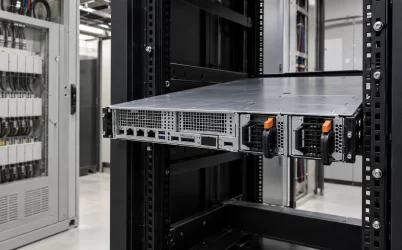
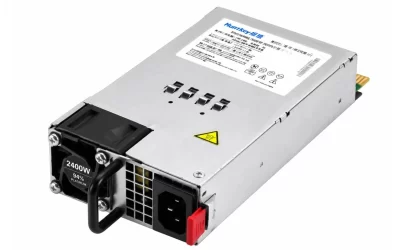
A hot-plug cartridge often has a handle so a trained operator can remove and replace it under conditions specified for that server. Some servers instead have a fixed, cabled PSU that requires opening the host and isolating its power before access. A similar-looking rear face does not establish identical service rules. A module may be mechanically removable while the particular host has no surviving-capacity margin or approved live-replacement procedure. The fact that someone can pull it out does not establish that doing so is electrically safe or operationally nondisruptive.
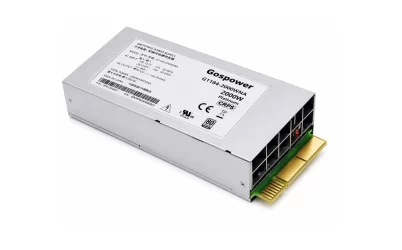
The external case should also be distinguished from the connector at the opposite end of a removed cartridge. A blind-mate connector can expose metal contact surfaces after extraction even though the converter remains enclosed. It is not a finger grip, a test point, or a place to rest a tool. A server bay may have mating contacts and adjacent active hardware when other modules remain powered. Neither side should be explored by touch to identify pins or infer whether voltage is present.
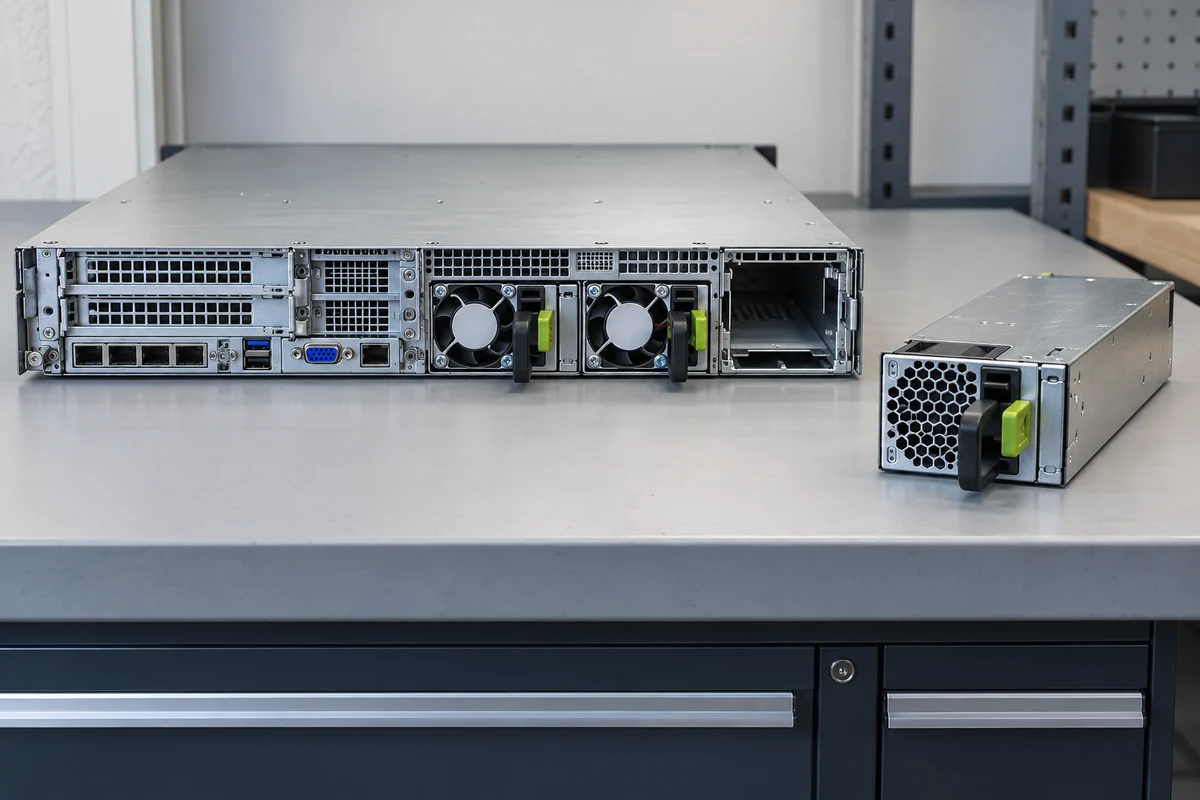
Ventilation openings are another boundary. Air can pass through them; a fingertip, metal probe, or cleaning implement should not be inserted into them. A fan may start unexpectedly under host control, and the opening does not give safe access to internal conductors. If dust, debris, or a mechanical obstruction appears inside a PSU, the remedy is a documented maintenance path or service referral, not reaching through the grille.
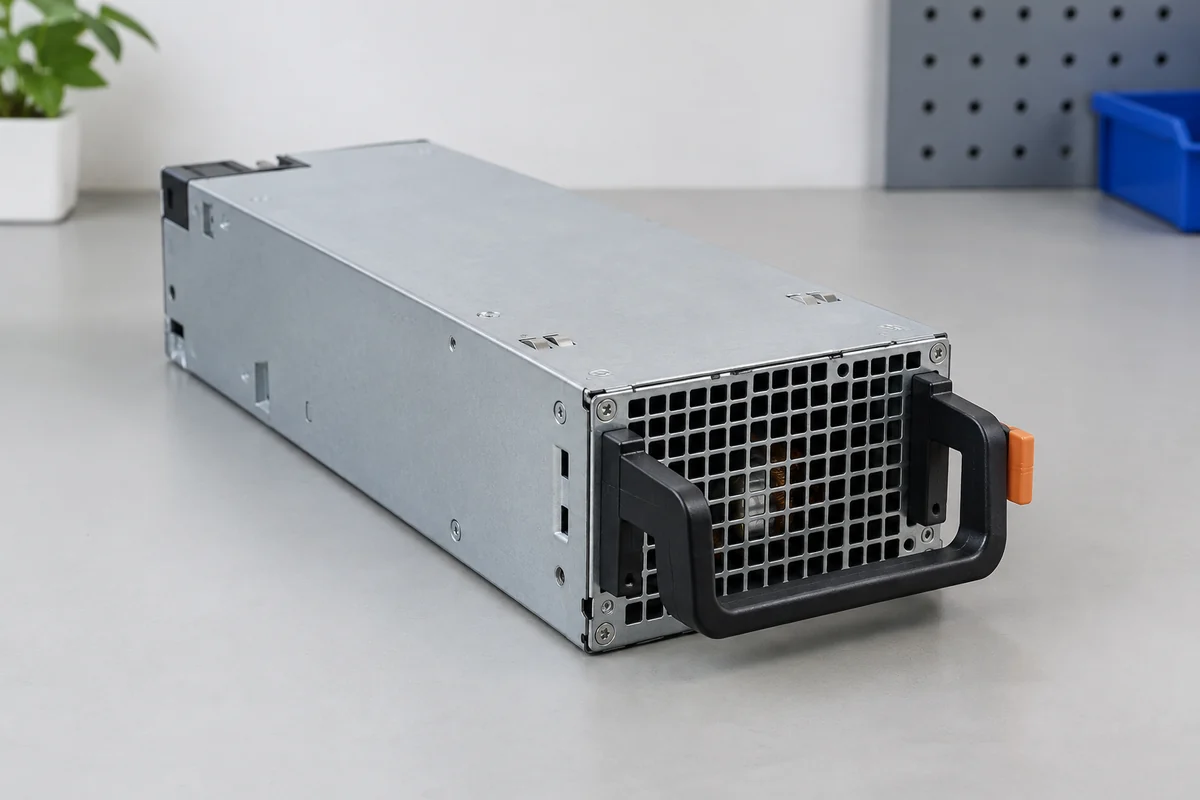
A permitted hot swap does not make the internals touch-safe
Hot swap describes how a supported server and its power-distribution hardware manage module removal and insertion. It does not convert the PSU interior into an operator-serviceable space. The host may isolate one output path, transfer load to another module, control insertion current, and report the changed state. These are system functions behind the enclosure. They do not authorize opening the removed cartridge or touching exposed electrical interfaces.
Lenovo’s ThinkSystem SR950 removal instructions illustrate the distinction for one specific platform. They warn not to remove a power-supply cover because hazardous voltage, current, and energy may be present, while giving a separate procedure for removing the module itself. They also distinguish a redundant operating arrangement from a server that must be powered off before PSU removal. That page is not a universal procedure for another server; it demonstrates why the equipment manufacturer’s instructions, rather than the word “hot-swap,” define the boundary.
Redundancy matters to availability, not to whether a finger can touch a contact. A two-PSU machine can continue running after one cartridge is removed only when the remaining path supports the permitted load and the host supports that operation. Meanwhile the remaining power path may still energize the chassis and the mating assembly. A failed module could also have damaged its own connector or neighboring hardware. Operational continuity should never be mistaken for permission to handle every nearby part.
An orange latch or tool-less handle can be a useful visual cue on a particular host, but color and shape do not transfer safety approval between vendors. The correct bay, cord, replacement part, and permitted system state are defined by documentation for the exact server generation. An operator who does not have that information should not experiment with the handle to see what happens. The risk is not only shock: removing the wrong module can shut down a production server, while leaving an empty bay can upset cooling on platforms that require a filler.
“Off” has several meanings around a server
A host may be shut down at the operating-system level while its PSU still receives AC or DC input. Standby circuits can continue supplying a management controller, wake function, or power-button logic. A dark front display or stopped workload therefore does not prove the PSU input is isolated. The host power button controls a system state; it is not necessarily a disconnect for every power cord or facility feed.
Redundant servers complicate this further. Two PSU cords may lead to different rack PDUs, UPS systems, or DC branches. Disconnecting one cord can leave the other path live, and the common power-distribution board may remain energized. Conversely, a cartridge removed from its bay is no longer connected to the host but may still retain charge in components inside its case. These are separate questions: is energy arriving at the chassis now, and is energy stored inside the removed module? An answer to one does not settle the other.
The manufacturer’s isolation instructions specify which sources must be disconnected for the maintenance task. The correct answer can differ for an AC-input rack server, a −48 V telecom-input variant, a shelf with several modules, or a fixed supply inside a tower. An unqualified observer should not use a hand, a generic voltage tester, or an improvised probe to decide whether an inaccessible part has become safe. The proper response is to stop at the accessible status information and involve personnel trained for that equipment and site power system.
Time since unplugging is not a reliable shortcut. Internal capacitors and other stored-energy elements may take different paths and times to discharge, and a fault can defeat an expected discharge behavior. A fixed wait copied from another PSU model is not proof of a safe internal condition. Unless the manufacturer provides an authorized internal-service process for qualified personnel, the closed module remains closed after disconnection.
Heat, damage, and electric sensation change the answer
Even an exterior meant to be handled under normal conditions may be too hot after a fault or high-temperature operation. A warm case is not automatically a defect; a burning odor, smoke, discoloration, melted plastic, arcing, or a surface that causes pain is not a normal service cue. Do not grasp a suspect cartridge just because it has a handle. Keep people away from the affected area and use the site’s authorized emergency and electrical-isolation process.
An electric tingle or shock from a PSU case, server chassis, or rack deserves the same stop-and-escalate response. It should not be explained away as an inevitable characteristic of switching supplies. Protective earthing, damaged insulation, an incorrect cord or outlet, leakage paths, and facility conditions require qualified assessment. Continuing to touch different surfaces to compare the sensation, or asking another person to try it, creates unnecessary exposure and does not identify the fault.
Mechanical damage also matters. A bent housing, missing screw, exposed wire, fractured connector, or liquid contamination can invalidate assumptions about the protection provided by the enclosure. A module that appears unpowered can still have an unsafe input connection elsewhere. A failed fan or blocked ventilation path may create a heat hazard without an immediate alarm. Visual observations can justify stopping use; they do not authorize probing inside to locate the damaged component.
Do not treat a successful server reboot as evidence that a previously suspect PSU is safe. A transient arc, marginal connector, or overheated cable can leave the host functional for a while. The danger may be in the module, its cord, the rack outlet, or the shared distribution assembly. Service personnel need the complete incident context rather than just a replacement cartridge. Preserving the visible condition and error history without recreating the event is usually more useful than repeated power cycling.
Normal handling still has a defined scope
If the equipment is intact and the exact OEM procedure permits handling a hot-swap module, contact should stay on the specified exterior grips and latches. This is not an invitation to press on circuit-board edges, grip the connector end, touch contacts in the empty bay, or force a module that does not slide normally. Installation instructions may also call for specific protective equipment, access restrictions, and handling of cords. Follow those instructions as written; do not transfer a familiar sequence from a different server.
A removed PSU should be treated as a sealed replaceable unit. Protect its connector from damage and contamination, keep it away from loose conductive objects and liquid, and use the manufacturer’s packaging or service process for return. Avoid leaving a cartridge where its metal end could be confused with a safe work surface. These ordinary handling limits protect both people and the mating interface; they do not require opening the supply to inspect whether it is “really dead.”
Static-electricity precautions are sometimes mentioned alongside server maintenance, but they address a different problem. Grounding a person or using an antistatic surface can protect sensitive electronics from electrostatic discharge. It does not make a mains-fed converter or high-current DC plant safe to touch internally. Likewise, insulated gloves, a plastic handle, or standing on a mat should not be substituted for the specified isolation and service method. Accessories do not change the permitted contact boundary.
Operators who only need to inspect status can usually remain outside the enclosure. The server’s documented indicators, management events, and visible cord condition may show whether a module is present or reporting an input fault. Indicator meanings vary by platform, and a healthy-looking LED does not certify a contact as de-energized. A noninvasive check can support a service decision without becoming an electrical test.
Different power architectures preserve the same enclosure rule
An AC-input server PSU, a telecom DC-input cartridge, and a high-voltage rack power shelf present different source and distribution hazards. It would be inaccurate to claim that one fixed voltage threshold makes all of them harmless. Fault current, available stored energy, protective devices, accessibility, and the installed environment matter. The stable rule across these systems is narrower: use the intended exterior touch points under the documented conditions, and do not access the converter’s internal or unguarded electrical parts.
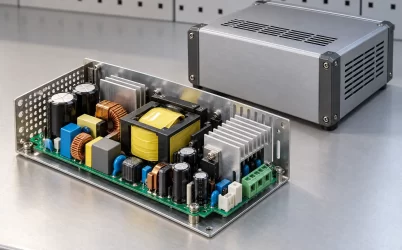
Open-frame power assemblies illustrate the distinction. A bare board that is safe only after installation inside a finished enclosure is not equivalent to a sealed server cartridge. If a supply exposes components in the completed machine, access control, guarding, and service instructions must come from that machine’s design. Calling it a “power supply” does not grant the same touch boundary as a covered removable module. The article’s question therefore cannot be answered from the technology name alone; the physical protection and installation state are part of the answer.
For a conventional server, the practical boundary is visible: intact outer housing and approved handle on one side, vent interiors, contacts, opened covers, and damaged assemblies on the other. The first side may be handled when the manufacturer permits it and no fault signs are present. The second side is for authorized service procedures, not casual touch. When the state is uncertain, preserving that boundary is more important than proving by hand whether a part still carries power.