A dielectric-withstand voltage describes an insulation test; it does not, by itself, authorize continuous operation at that voltage. That distinction matters when interpreting open frame power supply safety standards and specifications. An OEM may find a substantial input-to-output withstand rating yet still lack the evidence needed for its intended continuous insulation duty. The useful question is what the documented test establishes about the electrical stress the application will actually impose.
Manufacturer specifications illustrate the problem. MEAN WELL separates withstand voltage from insulation resistance in its EPP-120S specification. OmniOn Power documents an input-to-output dielectric test with an explicit duration for CLP0448. Neither entry should be rewritten as a continuous working-voltage rating. Reading these statements accurately requires preserving their endpoints, electrical form, and conditions before drawing a selection conclusion.
Read the withstand entry as a complete statement
The MEAN WELL EPP-120S specification dated September 28, 2026, includes EPP-120S-24 among its listed models. Its shared safety section identifies input-to-output withstand voltage as 4 kVAC. The same section gives separate entries for input to frame ground and output to frame ground. Here, the input-to-output entry is the relevant example; the other entries cannot enlarge what it says about that separation.
Read the manufacturer’s EPP-120S specification as a document with distinct fields. The withstand entry describes an applied insulation-test voltage. The input operating range elsewhere describes the supply presented to the converter’s input terminals. Those two statements concern different electrical relationships, even though both use voltage units.
The shared withstand row does not state a test duration beside the 4 kVAC entry. An engineer should preserve that omission rather than supply a familiar duration from another product or laboratory practice. The applicable report or manufacturer procedure may provide further detail, but that additional detail has to come from evidence covering the selected model.
Now compare the wording, rather than the apparent strength, of another document. OmniOn Power’s CLP0448FP_DS revision 7.6 specifies a minimum input-to-output dielectric withstand of 4,250 VDC for one minute. This statement explicitly supplies a duration and uses DC. It establishes a different documented test description from the MEAN WELL entry; it does not create a ranking between the products.
The distinction is useful at the purchasing interface. A request for a supply with “4 kV isolation” leaves the electrical form, duration, endpoints, and intended meaning unresolved. A quotation repeating that phrase can appear responsive while answering a different requirement. Carry the manufacturer’s complete field description into the comparison instead of reducing it to a single voltage number.
Continuous duty asks what stress remains during operation
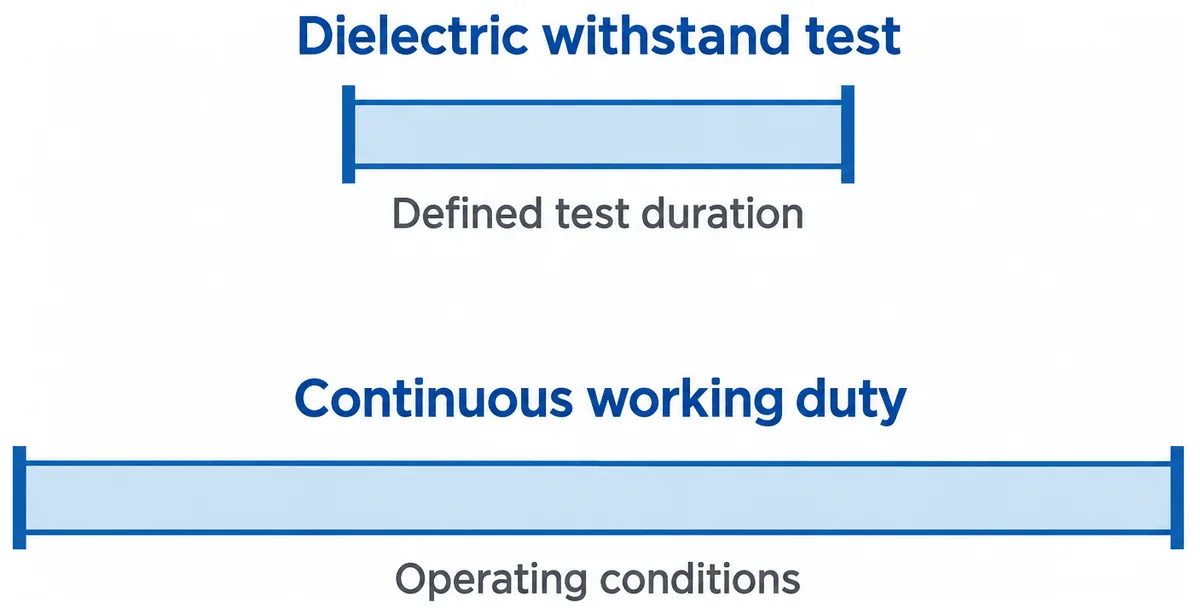
Working voltage concerns the voltage stress across insulation during the relevant operating conditions. Dielectric withstand concerns resistance to an applied test stress under a defined procedure. The purposes differ: one describes the intended electrical duty, while the other provides test evidence. Passing a brief higher-voltage test does not independently characterize long-term operation at that same voltage.
Time is part of the distinction, but duration alone does not convert one specification into the other. Insulation behavior also depends on construction, electrical waveform, temperature, and the conditions under which the insulation system was assessed. Dividing a withstand value by an informal safety factor cannot recover a missing working-voltage rating. The resulting number would have no documented relationship to the manufacturer’s evaluated construction.
A short test and continuous operation therefore belong in separate descriptions. For CLP0448, the supplied safety entry gives a one-minute DC test between input and output. The defensible interpretation retains those attributes. It does not say that the product may continuously sustain 4,250 VDC across that separation, and it does not establish an application-specific protective insulation classification from that number alone.
The application description must identify the actual electrical stress. A nominal DC output value is the voltage between output conductors; it is not necessarily the voltage between the output circuit and another reference. Likewise, the converter’s AC input rating is not automatically the maximum permitted continuous voltage between its output and the equipment chassis. Confusing these relationships can conceal the requirement being investigated.
For a useful manufacturer inquiry, identify the two conductors or circuit domains being separated and describe each relative to the same reference. Include any intentional earth bond, external bias source, and operating state that changes their relationship. This lets the manufacturer determine whether the requested duty concerns the internal conversion barrier, output-to-earth insulation, or a host-created separation. A requirement stated only as a working-voltage number leaves those alternatives unresolved, even when its numerical value is precise.
For example, an output circuit deliberately referenced to another powered subsystem may experience a different voltage relative to earth from a conventionally referenced installation. That possibility does not establish that either cited supply supports such use. It explains why the manufacturer’s permitted circuit relationships matter. An isolated output designation should not be expanded into permission for arbitrary external bias.
The relevant operating description may include AC and DC components, repetitive peaks, and environmental conditions where those affect the assessment. Which quantities control the assessment follows the applicable safety framework and insulation construction. An engineer should obtain that interpretation from the responsible safety assessment rather than select whichever voltage measurement makes a candidate appear acceptable.
Other insulation fields cannot fill the working-voltage gap
Insulation resistance answers another question. The EPP-120S specification lists 100 megohms for the named insulation relationships, measured at 500 VDC, 25 degrees Celsius, and 70 percent relative humidity. Those conditions belong with the resistance figure. They describe a resistance measurement, not a continuous 500 VDC operating permission.
A high insulation resistance indicates limited conduction under the stated measurement conditions. Dielectric withstand addresses behavior under a different applied stress and procedure. Neither measurement, standing alone, supplies every property needed to assign a safety role to the insulation. Treating them as interchangeable loses the distinction between measured leakage through insulation and resistance to electrical breakdown.
Insulation classification adds a further layer. Basic, supplementary, reinforced, and functional insulation describe roles within an applicable safety arrangement. A withstand number does not independently tell the reader which role a particular construction fulfills. The classification must be supported for the relevant circuit relationship and conditions; it should not be inferred from a voltage threshold borrowed from another product.
Safety-standard references also have a defined but different purpose. A standard listed on a datasheet points toward an evaluation framework and associated documentation. It does not expose every construction detail or operating limitation in that evaluation. For broader standard selection and component-versus-equipment responsibilities, the existing discussion of open-frame power supply safety standards addresses that separate task.
The physical installation can introduce insulation relationships outside the board’s documented construction. A conductive enclosure near exposed circuitry is an additional surrounding object, not part of the input-to-output withstand entry. XP Power’s installation article explains that spacing between an open-frame assembly and its enclosure requires attention. Its guidance supports that installation principle, rather than a universal numerical spacing for the two supplies discussed here.
Keeping these evidence types separate makes a technical review shorter. The withstand statement supports the stated test claim; the resistance entry supports its measurement claim; the safety documentation establishes applicable construction and conditions. Missing working-duty evidence remains missing instead of being replaced with a collection of individually valid but differently scoped facts.
Apply a hypothetical continuous requirement without inventing a rating
Consider a hypothetical equipment design whose safety engineer requires documented reinforced separation across a specified input-to-output relationship at 300 VAC RMS working voltage. Assume the requirement also identifies its waveform, environment, and installation conditions. The 300 VAC figure is an invented teaching input, not a recommendation or a published working-voltage rating for either manufacturer.
The EPP-120S withstand entry provides evidence of its stated 4 kVAC test claim. It does not, by itself, establish the hypothetical reinforced classification at 300 VAC RMS working voltage. The arithmetic comparison, four thousand being greater than three hundred, is true but does not answer the engineering question. The two numbers describe different properties.
The CLP0448 one-minute DC withstand statement leaves the same kind of question open. Its explicit duration improves understanding of the test description, but does not supply the hypothetical continuous-duty classification. Converting its DC number into an AC equivalent would not resolve that omission. Even where a particular test procedure permits a conversion, that permission concerns the procedure, not an automatic continuous operating rating.
The appropriate finding is that the supplied withstand entries alone do not establish the hypothetical requirement. This is narrower than declaring either product unsuitable. A manufacturer safety report or written clarification may contain the necessary evidence. Conversely, a later document could specify conditions incompatible with the intended duty. Both possibilities remain open until the applicable evidence is obtained.
Suppose the manufacturer subsequently confirms the required classification and working conditions for the exact ordering code and revision. That statement would address the insulation question described here, subject to its conditions. It would not establish unrelated output behavior, thermal capability, or finished-equipment approval. A supported insulation conclusion should remain attached to the requirement it actually answers.
Now suppose the response only repeats the original withstand figure. Nothing material has changed in the continuous-duty assessment. Asking for an even higher test voltage would pursue a different claim while leaving the intended operating relationship unresolved. The useful follow-up names the missing property directly: the documented insulation classification and permitted working stress for the proposed application conditions.
Comparable numbers need comparable meanings
Two suppliers can publish different withstand figures without providing enough information to compare their suitability for the same continuous duty. Differences in electrical form, duration, test configuration, and documented insulation role can matter. A comparison sheet should preserve those differences visibly rather than normalize unlike entries into a column headed “maximum safe voltage.”
Absence of a duration in a public table is an evidence limitation, not proof that no controlled test exists. Similarly, absence of a working-voltage field does not prove the product lacks a suitable evaluated insulation system. These distinctions prevent two opposite errors: approving an unsupported application and rejecting a potentially suitable component because its short datasheet does not reproduce the full report.
Document revision matters when closing that gap. The MEAN WELL example here comes from the specification dated September 28, 2026; the OmniOn example comes from CLP0448FP_DS revision 7.6. A later clarification should identify the covered ordering variant and applicable revision. A general statement about another family cannot silently become evidence for the selected supply.
The manufacturer inquiry can be precise: “For this exact model and revision, does the evaluated input-to-output insulation support the stated continuous working voltage, waveform, required insulation classification, and installation environment? Please identify the controlling report or conditions.” Attach the application’s electrical description so that “working voltage” cannot be mistaken for the nominal output setting.
That response determines how the specification can be used. An explicit supported operating relationship can settle the continuous insulation-duty question; an incompatible limitation can exclude the proposed use; a repeated test value leaves it unanswered. The useful outcome is a statement about the intended operating stress, with the withstand result retained as the test evidence it actually provides.