Choosing a 450W 80 PLUS Gold server PSU starts with identifying the supported part, because the wattage and efficiency words can describe several different records. Lenovo’s ThinkServer RD450 documentation illustrates the problem: its PSREF calls the 450W option Gold, while a separate product guide lists a 450W ordering number as Platinum. An official firmware page names an Acbel Gold 450W module, but its title does not connect that module to the ordering number. Treating those descriptions as interchangeable would create a purchasing claim the documents do not establish.
The useful decision is therefore specific: which power supply is supported for this server, and what evidence connects the offered unit to that identity? A Gold label can remain part of that answer, but it cannot supply the missing cross-reference. The RD450 is a legacy example, and Lenovo marks the product guide discussed here as withdrawn. It provides a practical lesson for buying replacement hardware, rather than a recommendation for a new server deployment.
Three official records describe different levels of identity
Lenovo’s RD450 Product Specifications Reference, carrying a 2017 copyright, describes a platform with redundant hot-swap power-supply options. Its power-supply entry identifies the 450W option as 80 PLUS Gold qualified. This is useful platform information: it establishes that a manufacturer-described 450W Gold configuration exists in the RD450 documentation. It does not identify every module that a reseller might advertise under those words.
The separate Lenovo RD450 E5-2600 v4 product guide makes the reading less straightforward. Its standard-specifications table calls the 450W supply Gold and attaches that description to machine types 70DA and 70DC only. Later, its power-supply options table identifies ordering number 4X20G87845 as a 450W Platinum supply. The article cannot honestly collapse these entries into one universally applicable rating.
A third Lenovo record is titled “Firmware Update for Acbel FSD062-EL0G Gold 450W Power Supply Unit (PSU)” and names ThinkServer RD350, RD450 and TD350. That title identifies an OEM module model within a Lenovo support context. The retrieved static page did not expose the update package’s version, detailed applicability or installation procedure. It therefore supports recognition of that named module, without supporting a firmware instruction or a mapping to 4X20G87845.
| Record | What it establishes | What remains unresolved |
|---|---|---|
| RD450 PSREF | A published RD450 450W Gold option | The exact offered module and orderable service identity |
| RD450 v4 product guide | Machine-type qualification in one entry and a specific 450W ordering number in another | The relationship between its Gold and Platinum descriptions |
| Acbel firmware support title | FSD062-EL0G named as a Gold 450W module for listed ThinkServer families | Its cross-reference to the proposed option or spare, and update applicability |
These records are not worthless because they fail to line up neatly. They answer different questions, and the mismatch tells the buyer where a quotation needs more detail. Keeping their scopes separate preserves useful evidence while avoiding an invented equivalence.
The host name is the beginning of the match
“For RD450” is a broader statement than “supported for this RD450 configuration.” Lenovo’s v4 guide explicitly distinguishes its coverage from a separate E5-2600 v3 guide. It also lists machine types associated with different configurations. A shared family name does not erase those distinctions, especially when the power-supply description itself contains a machine-type restriction.
For a replacement, record the server’s actual machine type and configuration before interpreting a supplier’s compatibility claim. Then preserve the installed supply’s complete label information as a separate identity. The host identification tells the seller which system needs service; the module identification tells the seller what is currently installed. Neither substitutes for the supported-parts relationship between them.
This separation prevents a circular argument. A seller may say the offered module fits because it resembles the installed one, while the buyer assumes the installed one is approved because the machine currently runs. That observation can be useful, but it is weaker than a documented supported relationship. A previous repair or substitution may have changed the hardware without providing the records needed for the next purchase.
For an expansion project, the starting question changes. The buyer is no longer merely restoring a known supported configuration; additional hardware may change the approved power arrangement. A valid spare identity does not by itself approve the expanded configuration. The required evidence belongs to the host’s configuration guidance, rather than an assumption that a familiar cartridge can support any equipment installed behind it.
The RD450 example also shows why a processor-generation label should not become a shortcut. A page headed for the v4 platform can contain qualifications that refer to particular machine types, while another table describes orderable options. Read the qualification attached to the entry being used. Do not silently extend a Gold description to every machine listed elsewhere on the page.
Keep the ordering number and OEM model separate
An ordering number identifies something purchased through a manufacturer’s option or service system. An OEM model identifies the power-supply design named on a module or support record. A supplier may legitimately need both, but they are different identifiers until a reliable cross-reference connects them. Similar power ratings and a shared server family do not create that cross-reference.
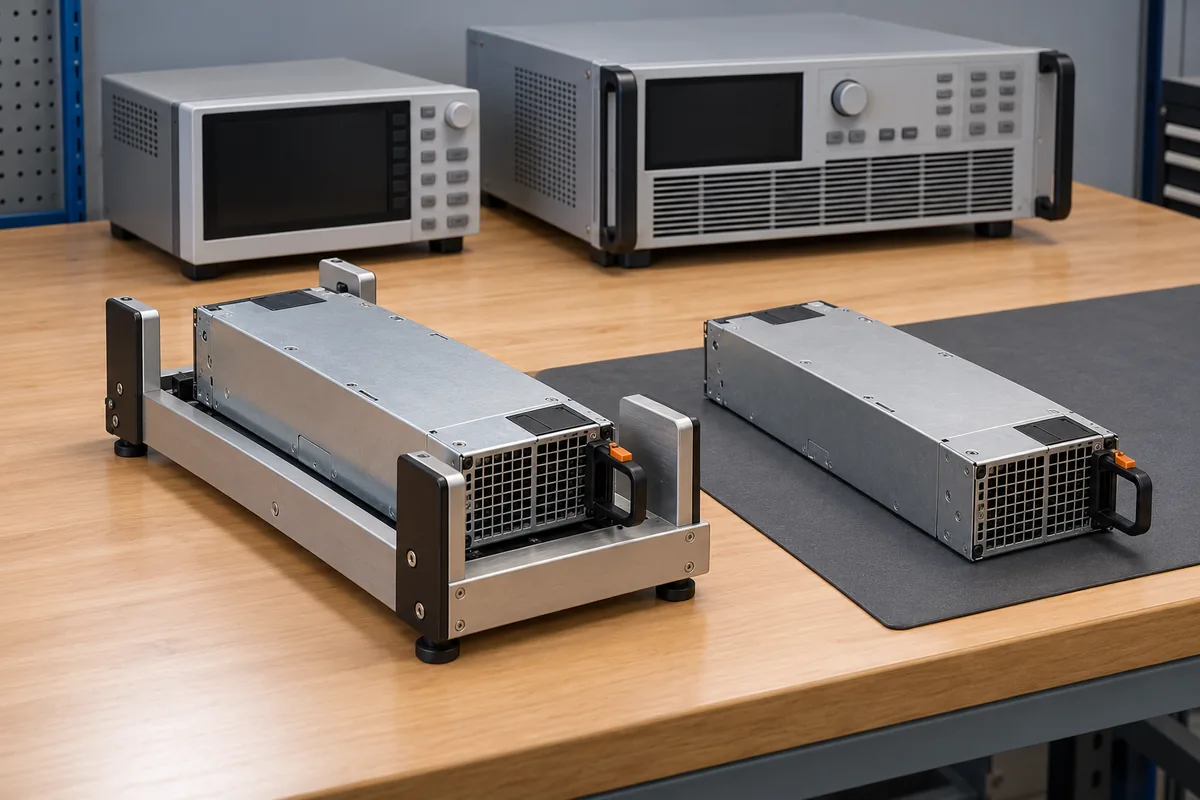
In this example, 4X20G87845 appears in Lenovo’s ordering table. FSD062-EL0G appears in the Lenovo firmware-support title. The retrieved records do not establish that they are the same unit. They also do not establish that they are incompatible. The correct boundary is narrower: the relationship has not been verified from these documents.
That distinction matters when a seller offers an “equivalent” part. The word might refer to a manufacturer-approved replacement, an OEM module supplied under another service identity, or merely a physically similar item. Ask which meaning applies and which document supports it. A useful response names the exact offered part and the supported substitution; repeating “450W Gold for RD450” adds no missing information.
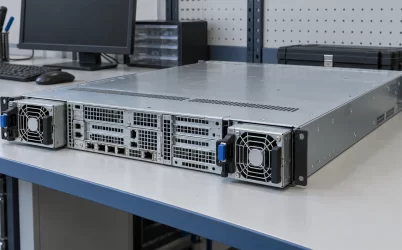
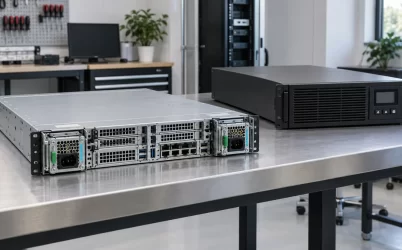
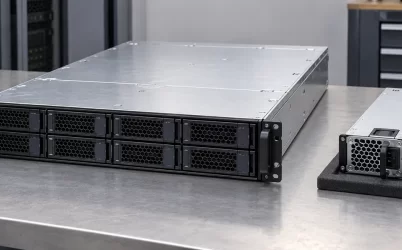
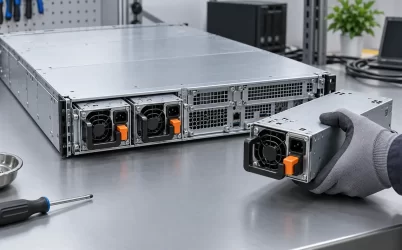
Photographs help establish what is being offered when the complete label is legible. They can reveal a mismatch between the listing title and the actual unit. They cannot establish an electrical or firmware compatibility relationship on their own. A complete label image is identification evidence, while the manufacturer’s supported-parts record is compatibility evidence. The purchase becomes clearer when both refer to the same offered item.
Keep accessory scope equally explicit. A quotation should say whether it supplies a module alone or includes any associated assembly the purchase requires. This is a question about the offered contents, not a claim that the RD450 needs a particular additional part. Avoid discovering after delivery that the seller and buyer meant different things by “power supply.”
Resolve the Gold description without guessing
The discrepancy between the PSREF and ordering table should remain visible in the purchase record. It would be tempting to call one entry a typo, assume a later revision explains it, or treat Platinum as an automatic upgrade from Gold. None of those explanations follows from the retrieved evidence. They would hide the very uncertainty the buyer needs to resolve.
Instead, separate two questions. First, is the offered part supported for the identified host and intended configuration? Second, what efficiency classification is documented for that exact part? The answer to one may be available before the other. A supported replacement can be identified while its advertised tier still needs clarification, and a genuine efficiency description can exist without proving host support.
A model-specific certification record can help settle the efficiency claim once the module identity is known. It still cannot replace the host approval. Conversely, a host options table should not be rewritten as a measured efficiency curve for an unidentified module. This article does not assign a single percentage to Gold or estimate energy savings from the label.
For a buyer whose procurement specification explicitly requires Gold, the unresolved classification may be material. Ask for the exact model and the controlling efficiency evidence rather than accepting a generic family statement. If the supplier offers a different tier, evaluate that as the actual proposed item with its own supporting documents. Do not rename it to satisfy a search phrase.
For a repair focused on restoring service, a manufacturer-confirmed supported replacement may be the central requirement. Even then, the quotation should describe the delivered hardware accurately. Correct part support and correct product description are complementary requirements; neither justifies inventing the missing relationship between the Lenovo entries.
A firmware title adds identity, not an update instruction
The FSD062-EL0G support title is valuable because it is more specific than “450W server PSU.” It names an OEM and complete model, identifies Gold and 450W, and associates the support item with three server families. Those details can guide a precise inquiry when a module label carries that model.
However, seeing the model in an official firmware title does not mean every unit needs that update. The retrieved static content did not provide a version comparison, eligibility test, prerequisites or procedure. It would be unsupported to tell a buyer to flash the unit, promise that an update fixes compatibility, or infer that different firmware makes two otherwise unidentified parts interchangeable.
Where a proposed replacement raises a firmware question, request the applicable support instructions for the exact module and host. Preserve the difference between identifying a support package and establishing that it applies to the installed hardware. This is especially useful for refurbished stock, where a seller may know the model but lack a verified account of its installed firmware.
The purchasing consequence is modest but concrete: do not use “firmware available” as a substitute for “supported replacement identified.” An available support record is one piece of evidence in the identity chain. It does not supply all the other links.
Compare quotations as claims about identifiable hardware
Consider two hypothetical offers. One says only “450W Gold RD450 PSU” and supplies a generic photograph. The other identifies the offered module, its service or ordering identity, the supported host machine type and the evidence for any substitution. The second offer is easier to assess even before price enters the comparison. That does not prove the hardware is suitable; it makes the suitability claim specific enough to check.
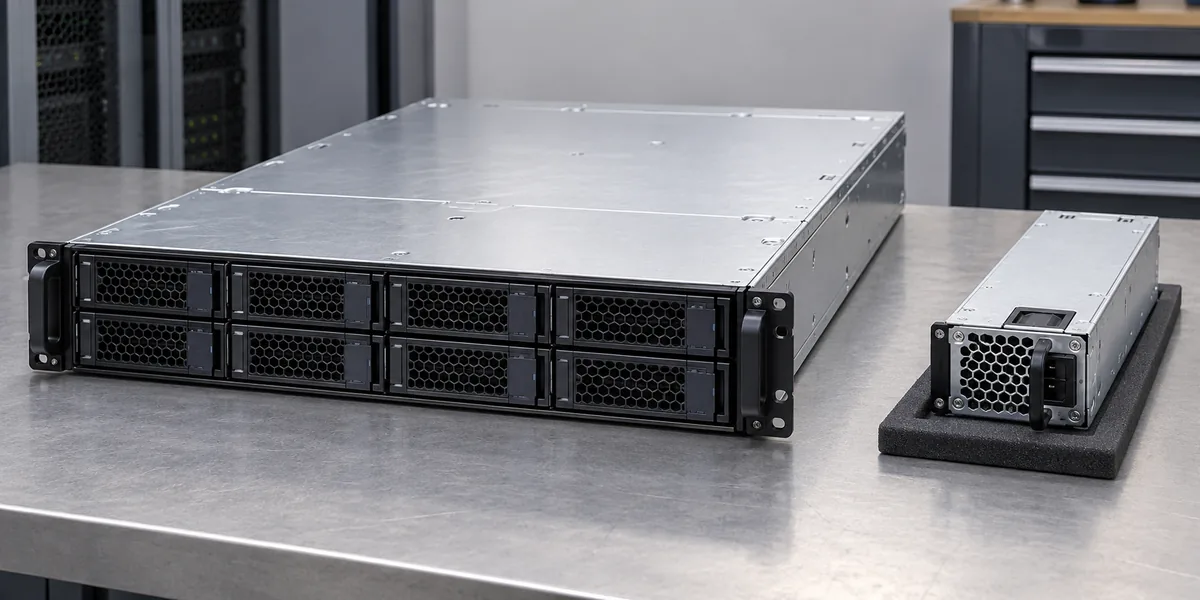
If an offer names FSD062-EL0G but gives no service cross-reference, the Lenovo support title provides a useful lead without closing the purchase decision. If an offer names 4X20G87845 and calls it Gold, the guide’s Platinum table entry gives a precise reason to request clarification. Neither situation requires accusing the seller of supplying a bad part. It requires matching the description to evidence before treating it as settled.
A defensible order therefore identifies the host configuration, the delivered module and service identity, the documented support relationship, and the exact scope of the efficiency claim. Any remaining contradiction stays attached to that claim until the manufacturer or an authoritative record resolves it. For a 450W Gold server spare, this is what makes a choice useful: the buyer knows which hardware is being bought and why it belongs in that server, rather than relying on two attractive words beside a wattage.