The letters on a safety capacitor describe a qualified role, not a general upgrade for every capacitor in an industrial power supply. A part marked X1/Y2 is especially easy to misread if its two designations are treated as one combined performance rank.
A short answer before selecting a part
Identify the capacitor’s electrical position before interpreting its safety marking. X and Y roles address different connections and consequences in the power-supply design. A dual X1/Y2 marking states separate qualifications for those roles; it does not turn the part into Y1. For an actual selection or substitution, retain the exact component documentation, operating conditions, and end-equipment requirements rather than matching capacitance or a voltage number alone.
Placement gives the marking its meaning
RECOM’s discussion of safety capacitors identifies Class-X parts with across-the-line filtering and Class-Y parts with line-to-ground filtering. It relates those uses to differential-mode and common-mode interference respectively. That distinction is a starting point for reading the circuit, not a complete selection rule for every position in an industrial AC-DC converter.
Across-the-line describes the conductors a component connects. Line-to-ground introduces a different reference and a different relationship with accessible conductive structures and the equipment’s protection arrangement. Calling both components noise suppressors does not make the connections interchangeable. Their function in the filter and their safety qualification must be understood together.
Start with the actual schematic and its connection names. Locate the incoming conductors, protective earth or other designated reference, and the relevant insulation boundaries. Then identify the two nodes connected by the capacitor. A symbol drawn near a transformer or a ground label does not, by appearance alone, establish the appropriate safety class.
This matters where several meanings of ground appear on one drawing. Primary return, secondary circuit return, chassis, and protective earth can have different roles. A capacitor between two circuit regions needs to be assessed for that actual relationship. Do not move a generic line-to-ground example into an isolation-crossing position and assume that the same component is authorized there.
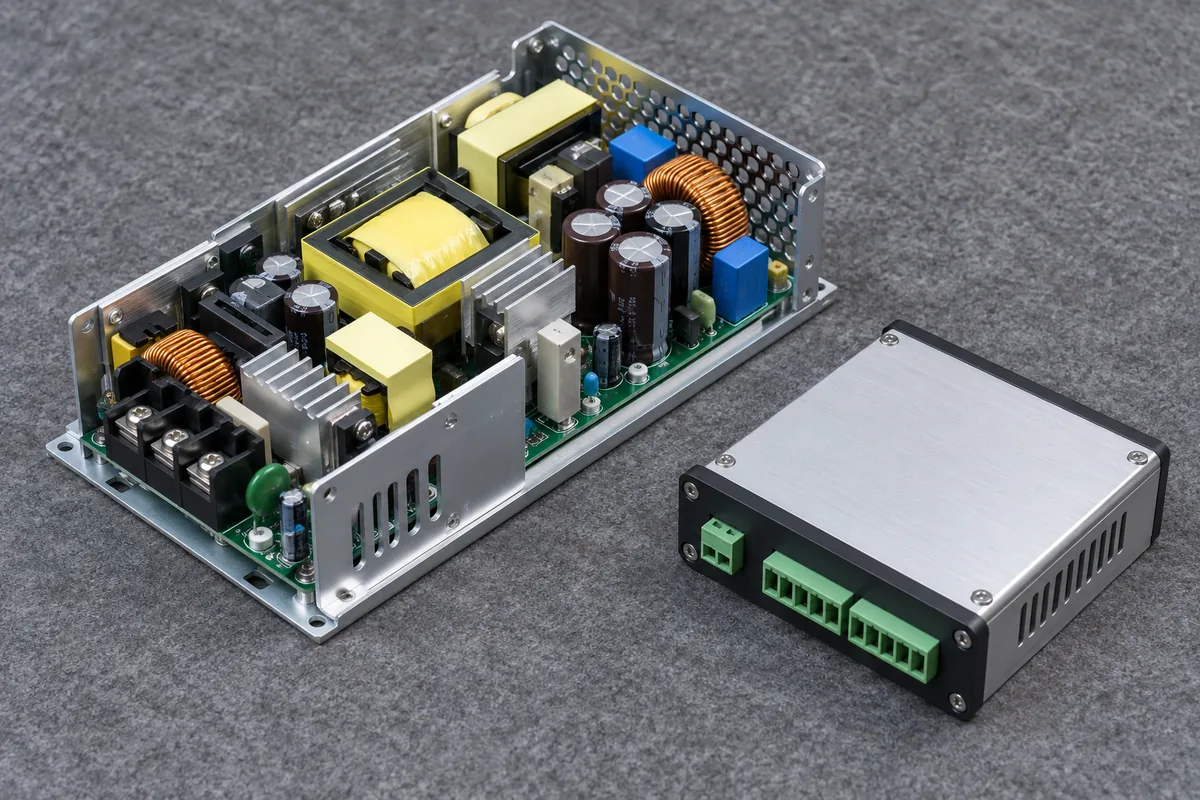
A complete open-frame supply and a separate control assembly identify different physical objects during an equipment review. Their appearance or proximity cannot prove which capacitor is safety-qualified, where an insulation boundary lies, or whether a visible component has a particular approval. Those conclusions require the controlled design and component records.
X1/Y2 is two qualifications, not one ladder
Knowles explains the point directly in its safety-capacitor classes article: an X1/Y2 component can serve an X1 role across the line or a Y2 role in the line-to-ground portion of the circuit. The X1 designation belongs to one application role and the Y2 designation to the other. The slash does not combine them into an unnamed stronger Y qualification.
Imagine a purchasing record shortened from an exact approved component to “X1 capacitor, same capacitance.” That description loses information if the installed position actually relies on the part’s Y2 qualification. The X1 entry may be accurate yet irrelevant to the requirement being checked. A technically correct partial label can still produce the wrong substitution decision.
The reverse mistake is possible too. A reader may see Y2 on a dual-marked part and assume its across-the-line qualification is also Y2, or omit the across-line role from the comparison. Preserve the complete marking and map each designation to the intended connection. This is a reading discipline rather than a recommendation to reuse one component in every position.
Subclass names must also remain separate from ordinary voltage entries. Continuous voltage conditions, impulse-related qualification, environmental limitations, and the applicable approval information are different fields in the component record. A single larger voltage number cannot independently establish equivalence across those fields.
This article deliberately provides no universal numeric subclass table or rule permitting one class to replace another. Such a table can hide the exact approval conditions and end-product requirements that control the decision. For a consequential barrier or protection function, obtain the applicable component evidence and the responsible equipment assessment rather than selecting from an abbreviated chart.
Equal capacitance does not establish an equivalent installation
Capacitance describes an electrical property, but the approved role includes more than that nominal value. Two components with matching capacitance can differ in qualified application, voltage conditions, construction, package, environmental behavior, and installation requirements. A matching footprint adds mechanical information without resolving the rest.
For an industrial PSU, identify whether the proposed action is a production alternate, a redesign, or a service replacement. Each has a different evidence route. A controlled alternate must remain within the documented design requirements. A redesign can deliberately change those requirements through the appropriate engineering process. A field replacement remains limited by the manufacturer’s authorized service policy.
A hypothetical supplier offer illustrates the risk. The offer states the same nominal capacitance, a higher printed voltage, and a package that fits the board. Those facts can support further comparison, but they do not establish that the candidate has the required X or Y qualification for the installed connection. The missing approval information remains missing despite three favorable-looking matches.
Likewise, a catalogue family may include several approved variants or ordering options. Use the complete orderable identity and its applicable documentation. Do not assemble an imaginary candidate from one variant’s class marking, another variant’s voltage, and a third variant’s package drawing. A family-level description is useful for discovery, while the exact supplied item controls the component claim.
The wider host boundary matters as well. A capacitor’s qualification does not approve the complete power supply or cabinet. Wiring, mounting, accessible parts, and the equipment’s insulation and protection design still have their own requirements. A component substitution needs to preserve the relevant design relationships, not merely carry a familiar logo or letter pair.
Powernexu’s discussion of open-frame grounding and reference paths explains why a fixing point, protective-earth connection, and DC return cannot be merged by name alone. The same node discipline is useful here: identify the connection before deciding which component qualification the design depends on.
A parts-list error can begin even before a substitution is proposed. A drawing may retain the required class while a purchasing system stores only a shortened commercial description. The received item can then appear to match the order while the order itself no longer preserves the design requirement. Reconcile the drawing, controlled parts list, and supplied identity when those records disagree.
Traceability is particularly useful when a board revision moves the connection. Reusing the previous capacitor part number does not establish that its qualification still suits the new role. Conversely, a changed reference designator does not mean the electrical role changed. Follow the nodes and the governing requirement rather than using either the part number or the schematic label as a substitute for that review.
EMI improvement is a separate outcome from safety suitability
A safety-qualified capacitor still participates in an electrical network. Its value, location, connections, and the surrounding impedances affect filtering. Selecting the required safety role does not automatically establish enough attenuation for the finished equipment, while an improved emissions trace does not independently establish a suitable safety construction.
Changing capacitance can alter more than one relationship. In a deliberately simplified sinusoidal case, capacitive current magnitude is proportional to frequency, capacitance, and applied voltage. That relationship explains why increasing capacitance is not merely adding a free noise-filtering benefit. It changes current through that branch under the assumed conditions.
The simple relationship is not a touch-current assessment or a model of every switching waveform. The complete circuit, reference paths, applicable measurement method, and equipment requirements matter. No permissible current or capacitor value is assigned here. The purpose is to keep filtering performance and the consequences of the connection visible in the same design decision.
A capacitor’s physical leads and the surrounding wiring also belong to the implemented network. A layout change can alter the filter behavior without changing the nominal component value. However, adding a random connection to chassis or bypassing a component to improve one observation can alter the protection arrangement. Those changes require the actual design process, not a generic EMI remedy.
A complete cabinet beside the machine it serves illustrates where a supply becomes part of finished equipment. Its metalwork, cable entries, and external connections create additional system boundaries. The cabinet’s appearance does not establish the capacitor connections inside it or demonstrate an emissions or safety result. Keep the component claim and the finished-equipment evidence at their respective levels.

Carry the required role through procurement and change control
The useful component record begins with the installed function: which two nodes are connected and which qualified role the design requires there. Add the exact manufacturer identity, ordering code, applicable documentation, electrical conditions, package, and any consequential installation or environmental requirements. This makes the reason for the chosen part visible to someone who did not design the original filter.
Where a supplier proposes an alternate, compare the candidate against that requirement rather than against a photograph of the old part. A dual marking can make a component suitable for more than one documented role, but each role still needs its own applicable evidence. The procurement description should retain the role used by this design instead of treating every printed designation as equally relevant.
Approval evidence also has a scope. A statement about a capacitor series does not automatically resolve every ordered suffix, production option, or intended use. If the supplied documentation leaves a consequential requirement unresolved, request clarification from the responsible manufacturer or equipment designer. Uncertainty is a reason to preserve the question, not to infer equivalence from the most impressive field.
For a complete industrial power-supply purchase, the equipment buyer may not control internal capacitor selection at all. The appropriate inquiry then concerns the supply’s documented operating environment, EMC arrangement, protection and insulation requirements, and change-control responsibilities. Request evidence at that product boundary rather than asking for an unsupported internal substitution in a closed unit.
That distinction keeps this topic useful to both designers and equipment buyers. The designer maps the connection to the required component qualification. The equipment buyer maps the supply’s documented construction and conditions to the intended machine. Neither should infer an approved replacement from capacitance, color, or a dual marking viewed without its circuit role.
A useful comparison can therefore end with more than one unresolved field. The candidate may have the required nominal capacitance and a documented class marking while its environmental or package conditions remain unconfirmed. Record those findings separately. Passing one comparison does not erase the others, and missing evidence is not proof that the component would fail.
The same restraint applies when evaluating an existing machine. An intact capacitor and a normally operating supply do not establish the approval basis of an undocumented repair. The service record and authorized component identity answer a different question from whether the DC output presently regulates. Internal inspection or replacement should follow the equipment manufacturer’s service classification rather than become an improvised method of interpreting a marking.
Discuss the industrial PSU requirement
For an industrial AC-DC power-supply inquiry, share the input source, required outputs, installation environment, enclosure arrangement, and relevant EMC or insulation requirements with Powernexu. Identify whether the project needs a complete supply or an integrated assembly. These details support a discussion of the required documentation and product boundary; they do not establish an approved capacitor replacement.