A 600W open-frame power supply may deliver full output with specified forced airflow, yet support substantially less by natural convection. The number on a catalog card does not tell a fanless-equipment designer which condition applies. For example, the published MEAN WELL LOP-600 rating lists 360W natural cooling for its 12–18V variants and approximately 400W for its 24–54V variants, versus 600W with the specified additional airflow. Other boards make different distinctions. Before treating any model as a 600W source, identify the selected output variant, cooling method, ambient-temperature basis, and duration. The useful question is whether the installed board can deliver the intended continuous load in the thermal state the equipment will sustain.
Three 600W labels, three different convection limits
The difference between a series name and its operating envelope is unusually large in this power class. The MEAN WELL LOP-600 specification lists 360W under natural air cooling for the 12–18V variants and approximately 400W for the 24–54V variants, with 600W requiring the specified additional airflow. Its documentation also describes a short-duration overload capability; that feature does not turn the convection rating into a 600W continuous rating. The applicable output-current row, temperature curve, and cooling notes still belong to the selected voltage variant.
TDK-Lambda describes its CUS600M as a 600W forced-air supply that can deliver 400W continuously by convection, with a 600W peak rating in the convection-cooled configuration. Sinpro lists 600W fan-cooled and 250W convection-cooled ratings for its HBA600 family. These are manufacturer-published examples, not a ranking of quality or a universal rule. Their purpose is to show why two boards advertised as “600W open frame” can have very different uses in equipment without a fan. Even within a family, voltage variant, ambient temperature, installation option, and accessory configuration can change the allowable operating point.
A product drawing 350W continuously might fit the stated natural-cooling output of the cited LOP-600 or CUS600M under their specified conditions, yet exceed the cited HBA600 natural-cooling figure. Selection still depends on output voltage, input, board orientation, enclosure temperature, and derating instructions. At 500W continuous, none of those three cited convection ratings establishes fanless operation. A different supply with a documented 500W-or-higher natural-cooling rating, or an engineered forced-air path, would be needed.
These named manufacturers’ ratings do not establish the rating, approvals, or compatibility of any Powernexu product.
Continuous power is not the same as a short peak
A peak claim answers a different question from a sustained rating. An intermittent motor start, radio transmission, or downstream capacitor charge may demand more than the normal operating load for a defined interval. A manufacturer may permit that excursion while limiting its duration, repetition, starting temperature, or total thermal energy. Continuous operation has no such recovery period. The converter’s magnetics, switches, rectifiers, capacitors, and board connections must reach a stable temperature that remains within their supported limits.
Consider a hypothetical embedded machine that draws 380W for most of a work cycle and rises to 560W for two seconds. The load profile cannot be judged by comparing its 560W peak with a 600W headline. The exact candidate must allow the peak magnitude and duration, the interval between peaks, the applicable ambient and airflow, and the way its overload protection responds. If the machine’s 380W phase lasts long enough to reach thermal equilibrium, that phase must also fit the candidate’s continuous rating in the installed cooling condition. A peak feature offers no relief if the ordinary operating level is already above the allowed convection output.
Conversely, a board with 600W continuous forced-air capability can be suitable for a sustained 520W load if the documented airflow and other operating conditions are reproduced. A short peak rating is then relevant only to excursions above the continuous operating point. It should not be added to the continuous rating or used as a substitute for the supply’s transient-response and protection documentation. Some applications also need to know how output voltage behaves during the excursion, not merely whether the supply avoids shutting down.
A fan rating belongs to air at the board, not the fan catalog
Forced-air output is usually tied to a defined cooling arrangement. A fan’s free-air flow rating describes its performance without the resistance created by an equipment housing. Grilles, filters, cable bundles, neighboring PCBs, and narrow ducts change the installed flow. A fan positioned beside the supply can also move most of its air through an easier bypass route while the hottest components remain sheltered. An apparently generous chassis-airflow figure therefore cannot be substituted for the supply manufacturer’s board-level cooling condition.
For a 600W-class open-frame board, draw the path from enclosure inlet to the board’s heat-generating regions and then to the exhaust. Check whether the fan pushes or pulls air in the direction required by the product documentation. A tall output harness may create a wake behind a heatsink; a nearby partition may trap warm air above a transformer; a filter can increase pressure drop as it loads with dust. None of these observations establishes an allowable wattage by itself, but each explains why an uncovered bench test can be more forgiving than the installed product.
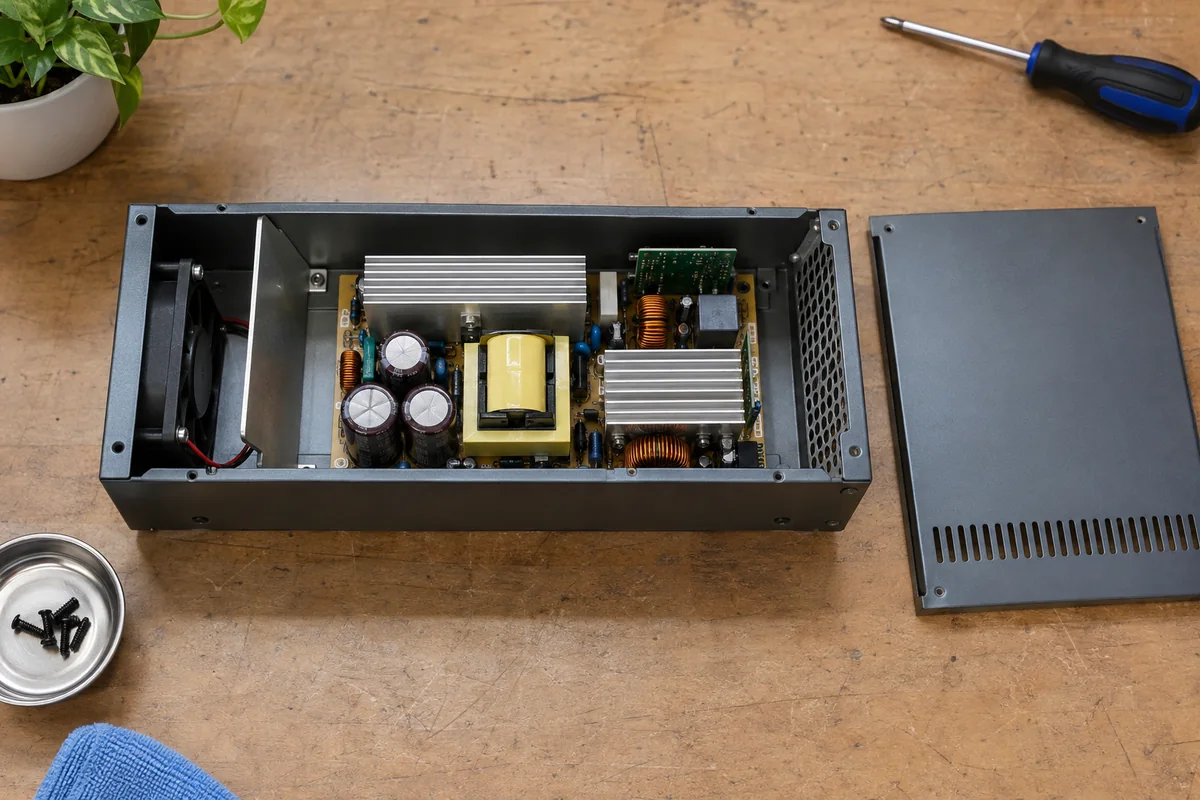
Air temperature at the board is another part of the rating. If air passes a processor, motor drive, or other dissipative stage before reaching the power supply, the board receives preheated air. The room thermostat is then the wrong thermal reference. A sealed enclosure may not have a stable path for natural convection even if the board itself is sold with a convection figure. Board orientation and clearance above components matter because warm air needs room to rise and leave. The published natural-cooling rating assumes particular conditions; it is not permission to bury the PCB beneath a tight cover.
Measurement should follow the manufacturer’s specified method. If a datasheet names airflow, case, or component temperature locations, use those locations in the completed enclosure. Thermocouples or other suitable sensors can reveal a local hotspot hidden from an enclosure-air probe. Test after the equipment has reached a stable thermal state at its relevant input and load conditions; a short functional run may show correct DC voltage while storing heat in components that will continue warming. This is a thermal question about one exact board and its host, not a generic formula that converts fan CFM into guaranteed watts.
The stopped-fan state can be the real power limit
A system with forced cooling has at least two thermal operating states: normal airflow and reduced or lost airflow. The 600W rating may describe the first. What happens in the second depends on the supply’s documented natural-cooling capability, protection behavior, the load’s ability to shed demand, and how quickly the enclosure warms. A fan alarm alone does not lower the load. If the equipment is required to keep running after one fan fails, its degraded-state load must be compatible with the surviving cooling arrangement.
Imagine an illustrative industrial controller with a 500W steady load and a chosen board rated at 600W with forced air but 400W by natural convection under its specified conditions. If the only cooling fan stops, the 400W figure is not automatically the new real-world capacity: airflow may persist from other fans, or the enclosed board may be hotter than the published natural-cooling setup. What is clear is that the 600W forced-air rating no longer supports an unqualified 500W-continuous claim. The controller needs a defined response. It might shed a known load, reduce machine duty, transition to a safe state, or use a cooling arrangement that remains sufficient after one fan is lost.
Thermal protection is not a continuity strategy. An overtemperature shutdown may protect the supply while stopping the equipment. A failed fan does not reproduce a manufacturer’s open-bench convection test: its stationary blades may obstruct the duct, other components heat the enclosure, and vents may be too small for buoyancy-driven flow. The operating policy should reflect installed thermal behavior and the consequences of shutdown.
For quiet or maintenance-light equipment, discovering a forced-air requirement late also means finding room for the fan, acoustic allowance, filter access, and service. Board price alone misses that cooling cost.
At full output, wiring and input conditions become visible constraints
The thermal condition determines how much output power is available, but the output voltage determines how that power appears at the terminals. At an illustrative 600W delivered on a single 12V rail, current is 50A. At 24V it is 25A, and at 48V it is 12.5A, using current equals power divided by voltage. Those arithmetic values do not describe any particular board or its allowed terminals. They show why the exact voltage option and current-path design matter when the equipment is intended to use the full 600W.
At 12V, a small amount of harness or contact resistance can consume meaningful voltage and create a concentrated hot spot. At a higher distribution voltage, the same power can travel at lower current, but the loads may then require downstream conversion. The appropriate architecture depends on the actual load rails, allowable voltage at those loads, wiring length, connector construction, grounding scheme, and losses introduced by any additional converter. Neither a thicker wire nor a different voltage option compensates for an open-frame board operating above its cooling-dependent rating.
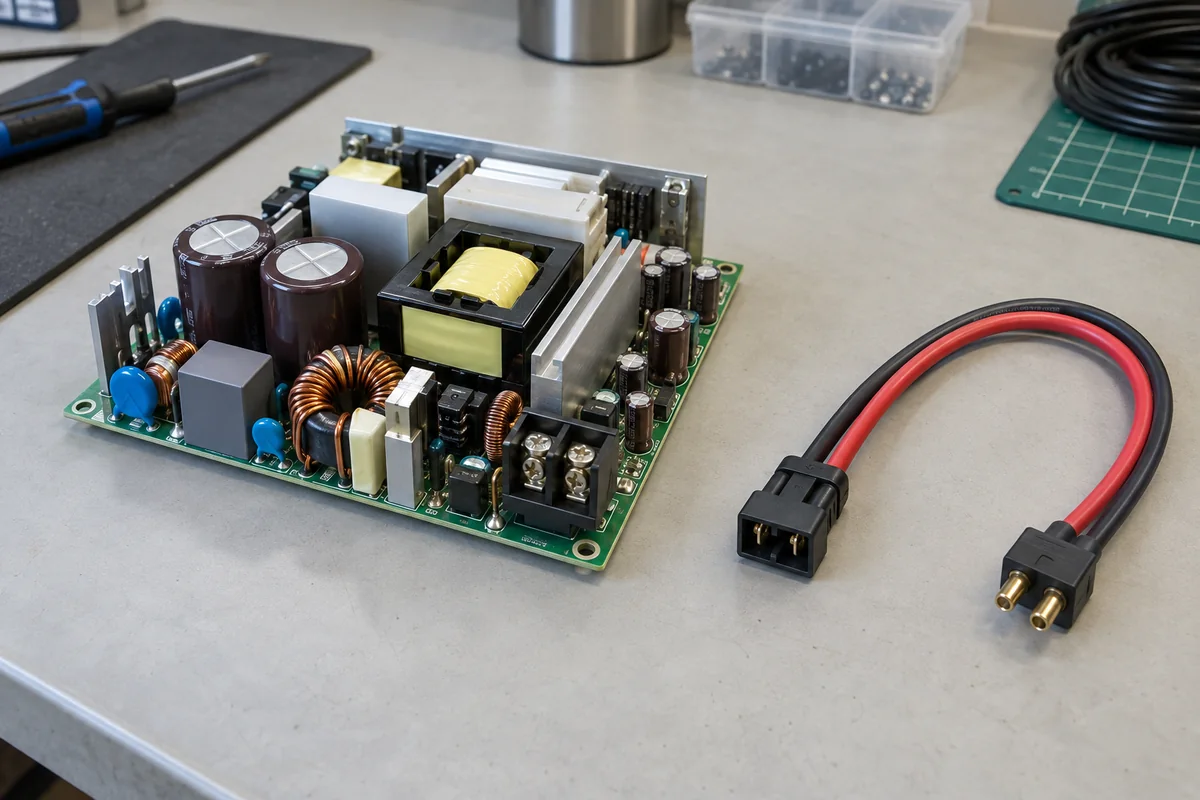
Input conditions must also be read from the exact datasheet. Some supplies have different output or temperature limits at low AC input, and higher input current can change the stress on upstream wiring and protection. A model’s wide stated input range does not imply that every output, every ambient temperature, and every cooling method permits 600W across that range. The relevant operating envelope is the intersection of the selected voltage variant’s output table, input-voltage notes, temperature curve, and cooling requirement. Do not infer a universal low-line derating percentage from another manufacturer’s 600W model.
The host must still guard the exposed AC-DC board and handle grounding and system-level compatibility, as outlined in Powernexu’s open-frame integration guide. Here, the key electrical implication is to size the conductors and feed for the power the installed board can sustain.
When the application truly needs 600W continuously
If the finished equipment must draw close to 600W for extended periods, choose a board whose documentation supports that load at the intended input, temperature, and cooling state. For the three manufacturer examples above, their quoted 600W continuous condition uses forced cooling. That does not prove that every 600W open-frame product needs a fan, and it does not establish that an arbitrary fan satisfies their published conditions. A naturally cooled design needs a model with a documented natural-cooling rating at or above the intended sustained load, or a different power architecture that moves the heat elsewhere.
A forced-air design needs room for the fan, inlet, exhaust, and harness routing before the board layout is frozen. Fan loss must also have a defined response: continued operation, controlled load reduction, or safe shutdown impose different demands on the supply and host.
For a quieter machine that only peaks near 600W, compare the ordinary load with the continuous convection rating and the transient with the documented peak envelope. When the load truly approaches 600W continuously, another cooling architecture may fit better. The nameplate alone cannot settle either case; the relevant rating is the one that survives the installed cooling condition for the full load duration.