
APPLICATION SCENARIO
Server Power Supply in Telecom Networks
The Role of Server Power Supplies in Telecom Networks
In telecom networks, server power supplies provide the stable power foundation required to support continuous connectivity, communication services, and network infrastructure operation. Power enters through utility power, UPS systems, PDU distribution, or DC power systems, then passes through redundant server PSUs where it is converted into stable and regulated power for telecom equipment. Because telecom networks must operate continuously across base stations, core network systems, transmission equipment, edge access nodes, and cloud infrastructure, reliable power delivery is essential for maintaining service availability. A well-designed server PSU helps ensure that critical telecom systems can operate under demanding 24/7 conditions with stable output and reduced risk of interruption.
Key Power Requirements for Telecom Infrastructure
Telecom applications require server power supplies with high reliability, high efficiency, stable output, hot-swappable design, and intelligent monitoring. Unlike general IT environments, telecom networks often support real-time voice, data, video, mobile communication, and low-latency services, so power instability can directly affect network performance and user connectivity. The PSU must support continuous operation across high-density equipment, distributed network sites, and centralized telecom data centers. Redundant power architecture helps protect against service disruption, while hot-swappable PSU modules allow maintenance without shutting down critical systems. Intelligent monitoring also helps operators track power status, detect abnormal conditions, and improve infrastructure visibility across complex telecom environments.
Power Distribution Across Telecom Network Systems
After power is converted by redundant server PSUs, it is distributed across multiple layers of telecom network infrastructure. Base stations such as BTS, 4G, and 5G systems require stable power for BBU, RRU, AAU, and other radio access equipment. Core network equipment depends on reliable power to support core routers, aggregation switches, service gateways, and high-availability systems. Transmission systems also require continuous power for optical transport, microwave links, SDH, DWDM, and stable signal transmission. Edge and access equipment relies on dependable power for edge servers, access switches, small cells, and low-latency applications. Telecom data centers and cloud nodes also need stable power to support virtualized services, cloud infrastructure, and scalable computing resources.
Distributed telecom infrastructure also requires power solutions that remain practical across many remote and edge locations. Standardized PSU models can simplify spare inventory, field replacement, and maintenance procedures for access equipment, network servers, and communication platforms. Sufficient power margin supports traffic growth and future hardware upgrades, while redundancy helps services remain available during module maintenance or failure. When power capacity, airflow, and monitoring are planned together, operators can improve service continuity and manage expanding 5G, cloud, and edge network deployments with greater confidence. Clear PSU documentation and consistent replacement standards further help field teams restore service quickly across geographically distributed network sites.
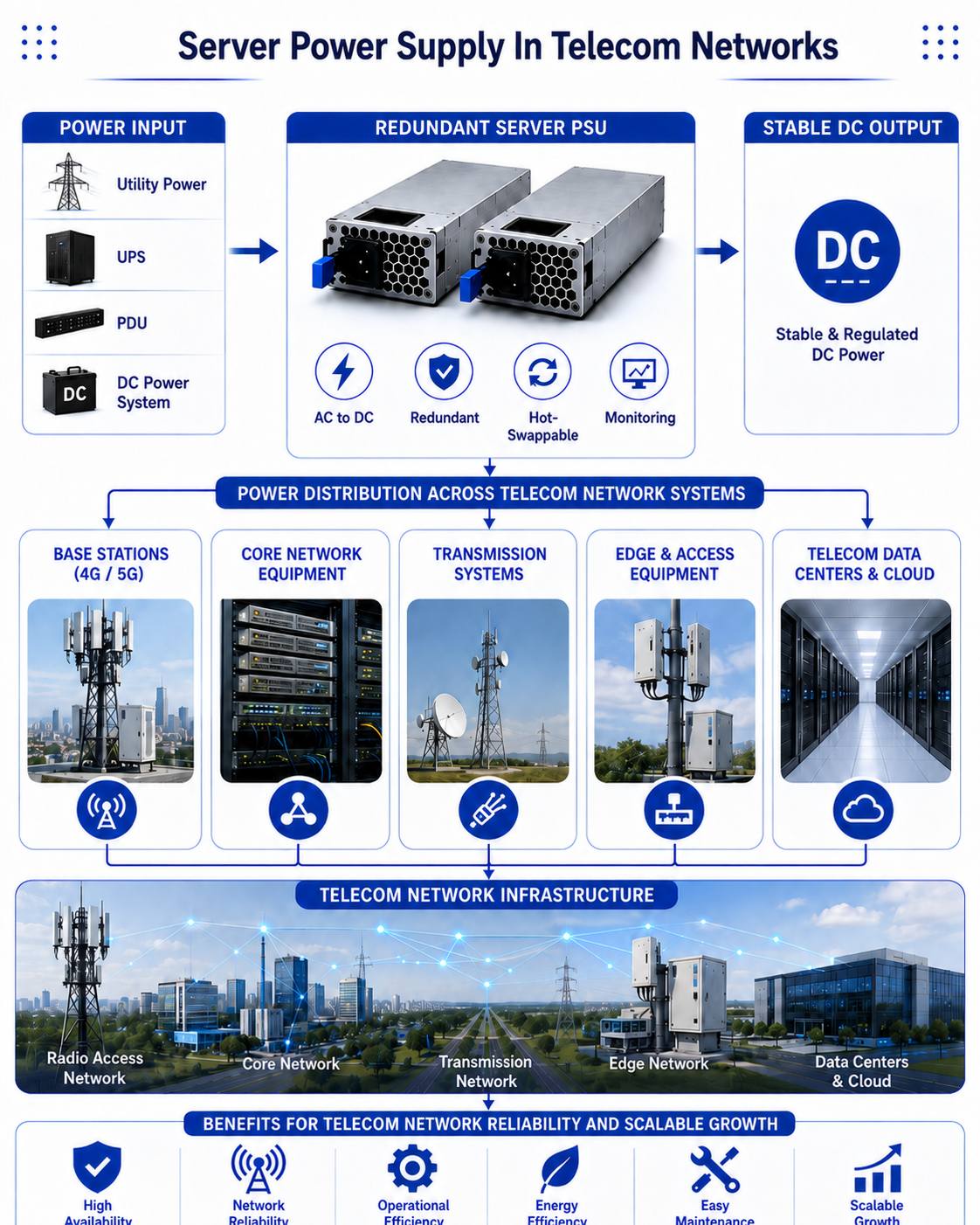
Benefits for Telecom Network Reliability and Scalable Growth
A reliable server power supply helps telecom network infrastructure achieve high availability, network reliability, operational efficiency, energy efficiency, and scalable growth. By delivering stable power to base stations, core network equipment, transmission systems, edge access devices, and telecom data centers, the PSU helps reduce the risk of service interruption, signal instability, equipment downtime, and network performance degradation. This is especially important for telecom operators, ISPs, mobile networks, 5G infrastructure, and communication service providers that must support continuous connectivity for users, businesses, cloud platforms, and mission-critical applications.
High-efficiency power conversion helps reduce energy loss and heat generation, which is valuable in both centralized facilities and distributed telecom sites where power consumption and thermal control affect long-term operating costs. Redundant and hot-swappable PSU designs improve serviceability by allowing power modules to be replaced or maintained with minimal disruption to network operation. Intelligent monitoring further supports proactive maintenance by giving operators better visibility into power conditions, load status, and potential faults. As telecom networks continue to expand toward 5G, edge computing, cloud-based services, and high-bandwidth communication, dependable server power supplies provide the foundation for continuous connectivity, stable network services, efficient operation, and long-term infrastructure growth.