There is no universal number of years after which every server power supply should be replaced. Useful life depends on the exact module, its operating temperature, load profile, component design, airflow and fault history. A server PSU can remain serviceable for years without a calendar-triggered swap, while a newer one exposed to blocked cooling or repeated electrical stress may need attention sooner. The practical question is whether the supply still meets the host’s required electrical and availability behavior, and whether its age and operating conditions justify planned replacement before a disruptive failure.
Searches for “server power supply lifespan” often return a single broad year range. That is not a reliable maintenance policy for a rack. The age of a module is one input; operating evidence and the cost of its failure matter more. A redundant pair can hide deterioration until one unit is removed and the other takes full load. A nonredundant edge server may need a more conservative spare strategy because its one PSU is a single interruption point.
Calendar age and operating hours answer different questions
A PSU installed three years ago may have run continuously, remained powered in standby, or spent long intervals in storage. Those are different histories even though the purchase date is identical. Operating hours record exposure to energized heat and electrical stress; calendar age captures storage and component aging that can occur without continuous operation. Neither number alone tells whether the unit will fail next month.
A useful maintenance record starts with the module’s exact identity and installation date, then tracks powered hours when available, inlet temperature history, load profile, fault events, fan behavior and major service interventions. The operating history should follow the physical module when it moves between bays or hosts. If a replacement pair contains modules of different ages, treating the pair as one undifferentiated asset can hide which survivor would carry the load after a failure.
Manufacturer warranties and stated design life are not the same as a failure deadline. Warranty defines commercial coverage under terms; design life may depend on environmental and duty assumptions; measured field experience reflects a population. A high mean-time-between-failures figure describes an estimated or observed failure-rate property under specified conditions, not the expected life of one particular PSU. Confusing those measures can lead either to premature disposal or an unjustified belief that a module is guaranteed for a vast number of hours.
Heat changes the rate of aging inside the module
Power conversion creates loss, and that loss raises internal temperatures above the air or metal surface an operator can see. Capacitors, semiconductor junctions, magnetics, solder joints and fan assemblies do not all age by one mechanism. Their temperatures depend on load, inlet air, heat-sink contact, fan performance and nearby restrictions. In a compact server bay, a dust mat or recirculated exhaust can matter more to lifetime than a modest difference in nominal room temperature.
Electrolytic capacitors are a particular reason to avoid simple calendar promises. Their usable life depends strongly on internal temperature and ripple conditions, and a value printed on a capacitor is specified at particular test conditions. An Advanced Energy application note on power-supply life explains how temperature affects electrolyte loss and why capacitor life enters supply-life estimates. That mechanism helps explain why two nominally identical PSUs in different thermal environments can age differently; it does not predict the replacement date of either installed module.
Consider two servers with the same PSU model. One runs in a well-sealed rack with clean inlet air and stable cooling; the other has a partially blocked PSU bay and frequent high-load bursts. The second module may spend more time at elevated component temperatures even if the data-center thermostat shows the same temperature. The relevant comparison is not the room setting but the conditions at the PSU inlet and inside the thermal path. A hot module should prompt a search for obstructed airflow or an overtaxed operating point before an age-only conclusion.
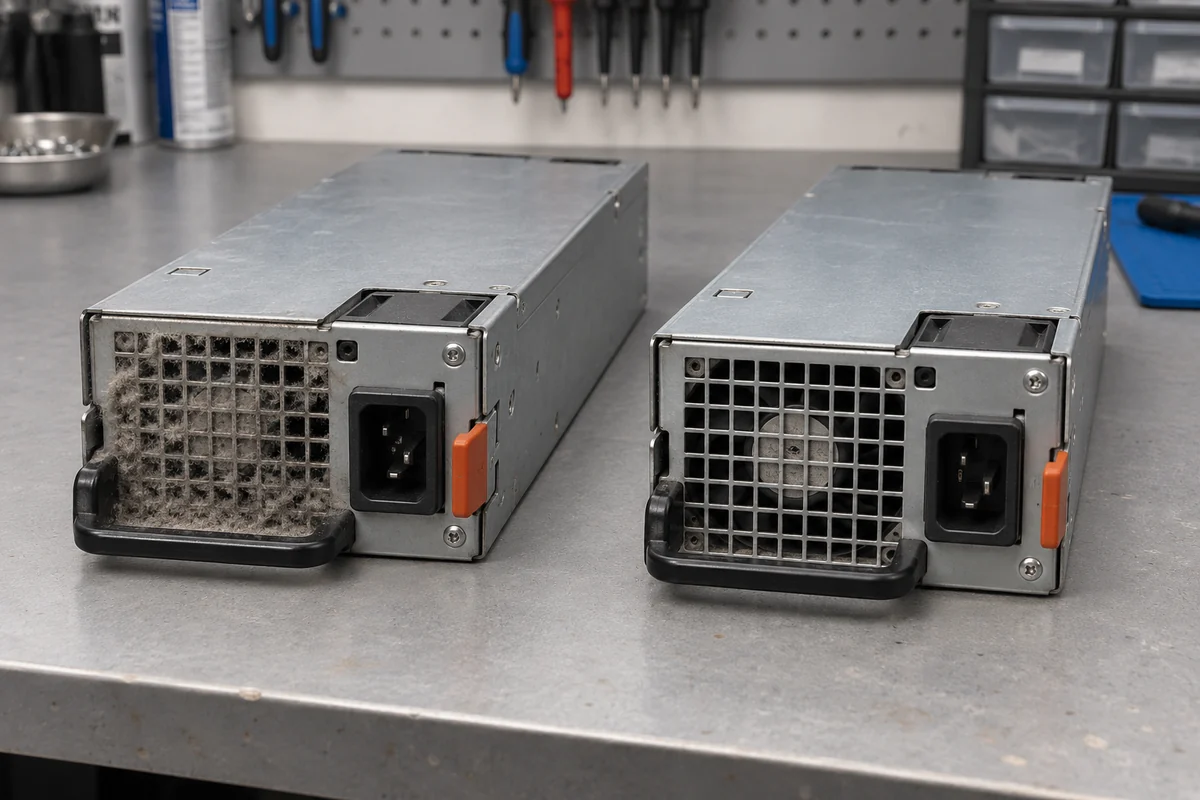
Fan-bearing wear introduces a different clock in modules with internal fans. A fan may grow noisy, slow, fail to start or trigger a host alarm. But a quiet fan is not proof that all electronics are healthy, and a fanless or host-cooled supply still has heat-sensitive components. Replacing a fan on a sealed hot-swap module may not be an approved field repair. Follow the manufacturer’s service boundary rather than opening a PSU to extend its life.
What changes when one module must carry the server
In a 1+1 redundant system, normal operation may share output between two modules or use a different energy-saving policy. After one module fails or is removed, the survivor must support the required server load within its actual input and thermal rating. This state exposes a weakness that light normal loading can conceal. A supply can appear healthy while sharing the load yet trip, overheat or derate when it suddenly becomes the sole source. Lifespan planning for redundant systems therefore includes the condition of both modules and the PDB, not merely the fact that two green status lights are visible.
A failure of one module should not automatically prompt disposal of the remaining module. Nor is the survivor automatically suitable for another long service interval. Look at its age, event history, operating temperatures and the duty it just experienced. If the replacement module differs in revision or approved pairing, the host’s compatibility rules matter. Some platforms require supported matched options or specific firmware behavior; a same-wattage sticker is not enough.
The upstream feeds influence risk as well. Two PSU modules powered from the same circuit can survive one module failure but not necessarily a feed loss. That issue does not physically age the PSU, yet it changes the operational consequence of a failure and hence the value of planned replacement or spares. A low-cost module in an easily serviced redundant host may justify a different policy from a remote single-PSU node whose downtime requires a site visit.
Signs that deserve investigation before a scheduled age limit
Persistent PSU fault logs, recurring loss of redundancy, unexpected shutoffs under load, a fan fault, overheating alarms, unusual acoustic change or visible connector damage are stronger reasons for action than an arbitrary birthday. Repeated events should be read with timestamps and operating context. Did a fault coincide with a power-feed disturbance, increased workload, high inlet temperature or maintenance? The cause may be external to the module: a loose cable, blocked intake, failing PDB or host power policy can produce similar symptoms.
Monitoring values can help if the platform exposes them, but they are not universal diagnostics. Input power, output power, temperature, fan speed and fault bits may be available through the host; their accuracy and reporting behavior depend on the model and firmware. A slow drift is most useful when compared with the same module under similar load and ambient conditions. Comparing two unequal workloads can manufacture a false trend.
A failed status LED is not a license to open an energized PSU or probe its internal capacitors. Server supplies can contain hazardous stored energy after unplugging. Use supported hot-swap or shutdown procedures and approved replacement parts. If the issue requires electrical diagnosis beyond host telemetry and external checks, it belongs with qualified service personnel and model-specific documentation.
One failure can also be a cohort signal. If several modules of the same installation batch show similar fan or thermal faults, investigate the shared environment and part history. This does not prove a manufacturing defect; it may reveal common dust exposure, a fan-control issue or an inappropriate operating temperature. A fleet record should allow the operator to see whether failures cluster by model, site, rack, production batch or install date.
Choosing a replacement policy for different server roles
Run-to-failure can be defensible for a well-monitored, easily replaceable module in a truly redundant host with approved spares on site and tested alerting. The decision depends on the failure consequence and service response, not a belief that old PSUs are immune. The operator should know how long the server can safely remain on one module and whether that state affects performance or thermal limits. A spare sitting on a shelf is useful only if it is the correct model and can be installed when needed.
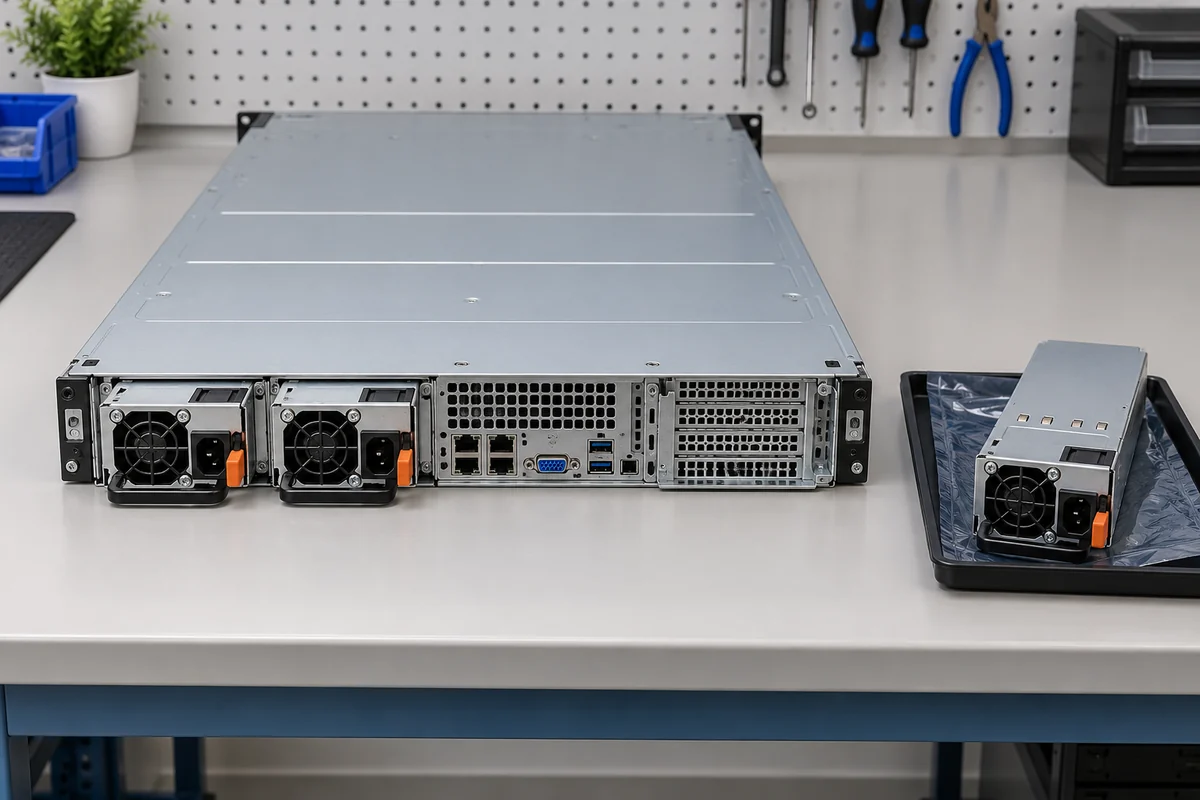
Condition-based replacement uses observable warnings or a documented deterioration pattern. It can avoid discarding healthy modules by age alone, but only if the host provides reliable signals and someone responds to them. A fan fault that goes unnoticed for months does not create a condition-based program. Neither does a single snapshot of a PSU temperature that lacks context about load and inlet air.
Age-based preventive replacement may make sense where failure consequences are high, site access is difficult, or vendor support specifies a lifecycle for the exact platform. The interval should be grounded in model data, fleet experience and operating conditions rather than borrowed from a desktop PSU article. Replacing both members of a redundant pair in one maintenance window can also create avoidable risk if the procedure removes redundancy throughout; sequence the work according to the supported host service method.
For remote edge devices, spare logistics often dominate. A compatible replacement might require a specific bay, control interface and airflow orientation. If it takes weeks to source, the operator may keep an approved spare locally before any failure. At a large data center, common modules across a fleet may permit pooled stock. In both cases, the most useful “lifespan” number may be the period for which genuine compatible spares and vendor support will remain available, rather than a guess at when electronics wear out.
Storage age is not the same as installed service life
Keeping a spare in its packaging does not expose it to the same operating heat as an installed PSU, but it still needs appropriate storage conditions and inventory control. Humidity, contamination, physical damage and long-term component behavior can affect a spare. The manufacturer’s storage instructions and any required checks before installation should be followed. A spare is not operationally useful if its exact revision, connector or firmware compatibility cannot be verified when a failure occurs.
Rotate or inspect stock according to the site’s controlled procedure rather than assuming the newest carton is always best. Record part number, revision and serial identity, along with receipt and installation history. If a product line is discontinued, determine whether a formally approved successor exists; do not infer compatibility from nominal output power alone. A server’s useful life can outlast availability of its original PSU, making spare planning part of the system lifecycle.
The most honest lifespan answer is conditional: a server PSU lasts until its electrical, thermal or mechanical behavior no longer meets the host’s needs, and no generic year figure can replace the model’s documented operating conditions. Track the module’s history, address heat and airflow problems early, investigate fault trends, and choose run-to-failure or preventive replacement according to downtime consequence and spare availability. A healthy old module need not be condemned by the calendar, while a young module with persistent faults should not be protected by it.