An AC-DC open frame power supply is a component intended to operate inside equipment that provides the missing mechanical and safety enclosure. Selecting the electrical rating is only the beginning. The equipment designer remains responsible for mounting, protection against access to hazardous parts, earthing where required, spacings, airflow, thermal derating, wiring, fusing, electromagnetic compatibility, and the approvals of the finished product. Integration should therefore be planned around the final enclosure and use environment from the first layout.
The enclosure completes the power supply
An open board exposes components and conductive areas that a packaged supply would normally place behind a cover. The final equipment must prevent users and service personnel from unintentionally contacting hazardous energy, while still allowing the cooling method assumed by the PSU documentation. The required safeguards depend on the equipment category, installation environment, service access, and applicable safety standard.
Use the manufacturer’s mechanical drawing and safety documentation for the exact model. Identify primary and secondary regions, high-temperature parts, mounting points, keep-out zones, and any stated requirements for insulating sheets, chassis spacing, airflow, or protective earth. Do not derive clearance values from a photograph or a different model in the same family.
Mounting without creating a new hazard
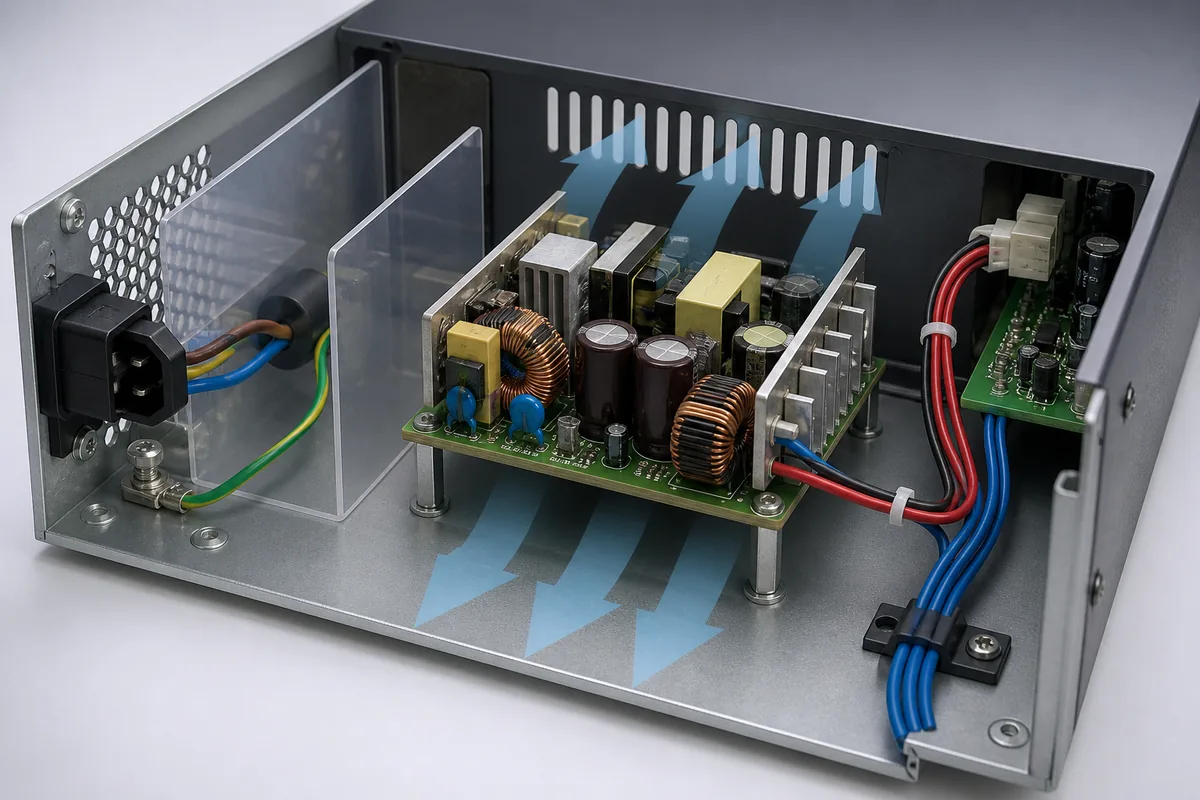
Standoffs must support the board without bending it and must not contact traces or components. Fastener heads, washers, metal chassis features, and nearby boards all become part of the spacing assessment. Account for manufacturing tolerance, vibration, cable forces, and the possibility that a wire moves during service.
Orient input and output wiring so low-voltage cables do not cross or rest against the AC input region. Provide strain relief and suitable conductor protection at sheet-metal openings. If protective earthing is required, use a deliberate earth path designed for the equipment; a mounting screw should not be assumed to provide a reliable earth connection unless that use is documented and validated.
Thermal performance depends on the installed orientation
Open frame ratings are commonly conditional on ambient temperature, airflow, orientation, input voltage, and load distribution. Confirm those conditions in the exact datasheet. Air volume alone does not describe cooling: the flow must reach the heat-producing components, and enclosure backpressure or recirculation can reduce its effectiveness.
For a hypothetical calculation, an equipment load requiring 180 W of DC output from a supply operating at 90% efficiency would draw about 200 W of AC power at that operating point, neglecting power-factor detail for this energy balance. Approximately 20 W becomes heat in the supply: 200 W input minus 180 W output. That heat joins losses from every other component in the enclosure and must be removed while keeping PSU component and local ambient temperatures within their documented limits.
Measure temperature after the complete unit reaches equilibrium at the most demanding supported input, load, and ambient combination. A bench test in open air cannot establish the result inside a sealed or crowded product. For additional selection context, see how to select an open frame power supply.
EMC is determined by the complete installation
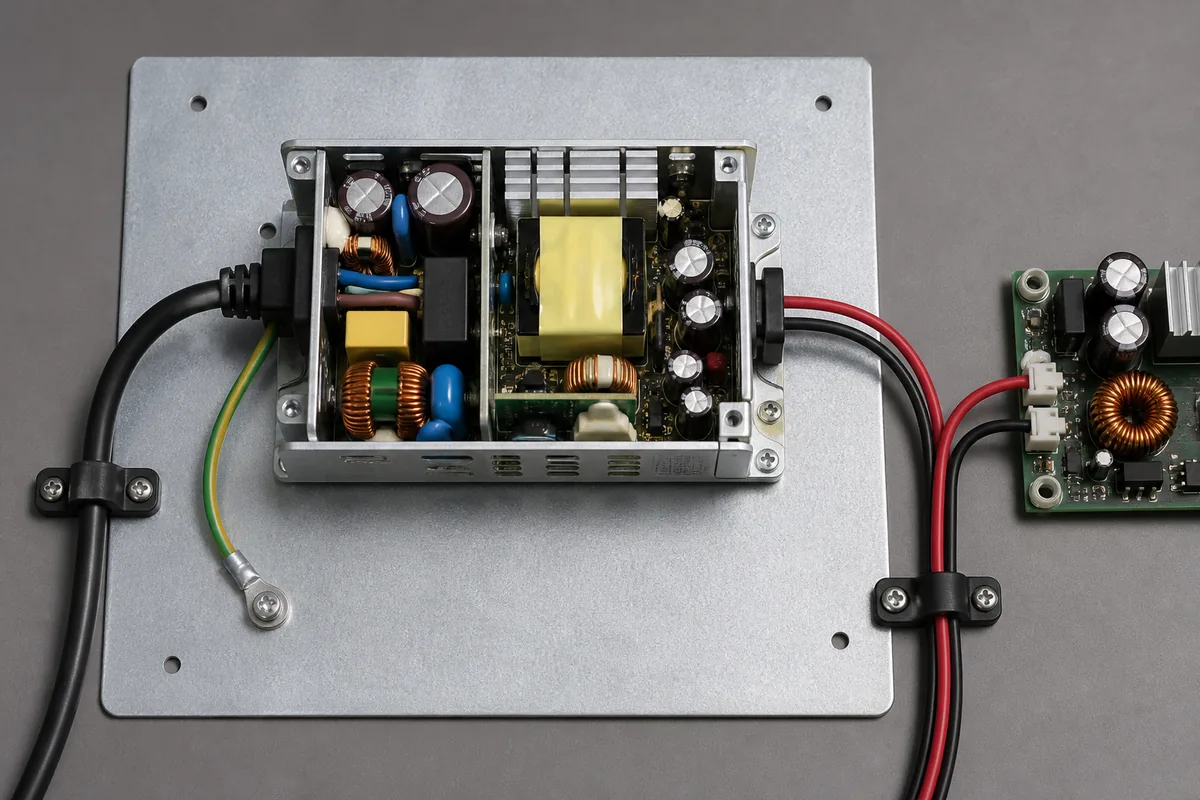
A component’s EMC test results do not automatically guarantee compliance of the finished equipment. Chassis construction, cable length, grounding, load behavior, filters, shielding, and the position of the supply relative to external ports can change conducted and radiated emissions. Immunity also depends on how disturbances couple through the assembled product.
Keep high-current loops compact, separate noisy switching paths from sensitive signals, and place required filter components according to verified application guidance. Avoid adding arbitrary capacitors or filters without considering leakage current, stability, safety classification, and surge behavior. Pre-compliance testing on a representative enclosure is more useful than testing the PSU on a loose bench setup.
Input, output, and protection coordination
Choose connectors and conductors for the expected voltage, current, temperature, and installation standard. The equipment input should include the required disconnect, overcurrent protection, and surge strategy based on its environment and the PSU documentation. On the output side, consider branch protection when wiring or downstream loads cannot safely carry the full available current.
PSU protection functions and equipment-level safeguards have different roles. Overcurrent or short-circuit protection may protect the converter, but its behavior may not protect every wire or load branch. Overtemperature protection may respond to an internal sensor after a local cable or neighboring component has already become too hot. Coordinate the layers and test credible faults in the assembled product.
An integration review before certification
- Confirm the exact model, revision, input range, output requirements, and documented derating conditions.
- Review access protection, insulation system, spacings, earthing, fusing, wiring, connectors, and flammability requirements for the finished equipment.
- Verify mounting tolerances and keep-out zones in production drawings.
- Test thermal behavior in the final orientation and enclosure at worst supported conditions.
- Perform EMC pre-compliance with representative cables, loads, ports, and enclosure panels installed.
- Exercise startup, shutdown, abnormal load, fan failure if applicable, and other credible single-fault conditions.
- Keep the PSU safety reports, declarations, application notes, and change-control records with the equipment technical file.
This review should involve the responsible safety and compliance specialists early enough that layout changes remain practical. Certification is not a substitute for engineering integration; it is the formal evaluation of a design whose safeguards, thermal path, and EMC behavior already work together.
Release the assembly, not just the board
The most reliable specification describes the installed AC-DC subsystem: enclosure material, mounting hardware, wiring, protective devices, cooling conditions, accessible surfaces, and approved PSU revision. Production inspection can then verify the details that laboratory samples established.
An open frame supply provides valuable packaging flexibility, but that flexibility transfers important responsibilities to the equipment designer. When mechanical, thermal, safety, and EMC decisions are made as one system, the result can be compact and serviceable without relying on assumptions that disappear when the board leaves the test bench.