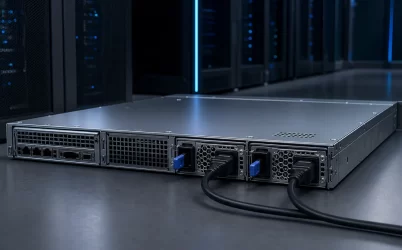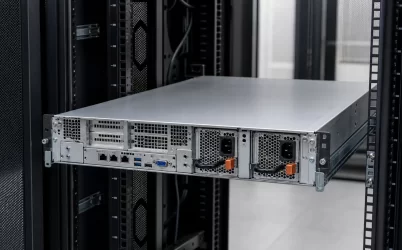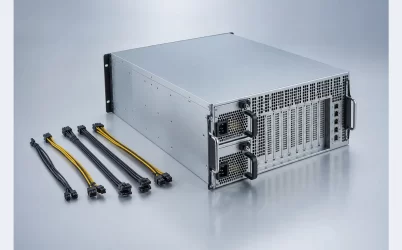
An 1100W redundant server power supply is not identified safely by wattage, shape, or “hot-plug” wording alone. For replacement purchasing, the controlling identity is the exact part approved for the server configuration—or a documented supersession—under the installed PDB, firmware, AC input, airflow, and pairing policy. Begin with the host service documentation and both installed PSU labels. Then reconcile ordering numbers, regulatory or manufacturer part numbers, revisions, and supported substitutions before comparing price or condition.
This evidence-first approach prevents a visually similar 1100W module from being treated as an interchangeable spare. It also separates two procurement questions: whether the candidate is compatible with the host, and whether the particular unit offered is in a condition suitable for service.
The replacement identity is a chain, not one number
Search results for this wattage mix OEM service parts, third-party modules, refurbished pulls, and supplies intended for integration into a manufacturer’s own power assembly. Those listings may all describe 1100W hardware, yet belong to different mechanical and electrical ecosystems.
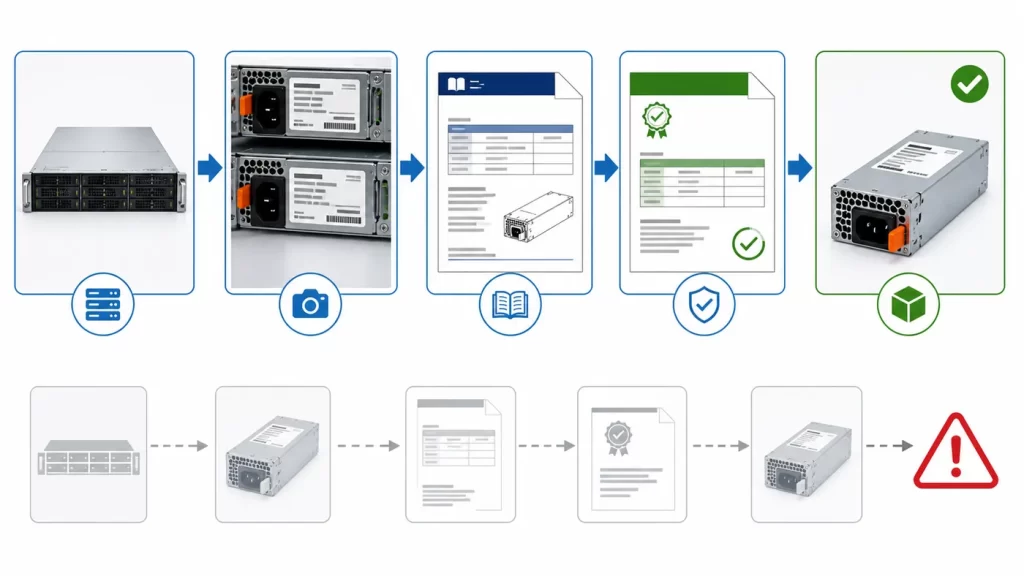
A defensible identification record starts with the host and works outward:
- Server identity: manufacturer, exact platform or chassis model, configuration, and service identifier where applicable.
- Installed supply identity: every ordering, assembly, spare, regulatory, and manufacturer number visible on each module.
- Revision evidence: hardware revision, manufacturing revision, efficiency designation, input marking, and any option code relevant to the host documentation.
- Assembly context: PSU cage, PDB, blind-mate connector, firmware or BMC level, and installed partner module.
- Operating context: available AC input, power cords, airflow direction, redundancy mode, and permitted server configuration.
Do not discard numbers merely because two labels appear to describe the same unit. An OEM ordering number may be the purchasing reference, while another number identifies the underlying assembly. A reseller may index only one of them. Keeping photographs and a transcription of the complete label makes it possible to reconcile these identities without relying on a shortened listing title.
Use a compatibility evidence ladder
Compatibility claims are not equally strong. The most useful evidence is host-specific and traceable to the party controlling platform support. General statements such as “server PSU,” “1U,” or “1100W redundant” describe a category, not authorization to install the module.
| Evidence level | What it can establish | Procurement implication |
|---|---|---|
| Host service manual, parts catalog, or configuration tool | The approved ordering identity and any pairing or configuration restrictions | Use as the primary basis for the purchase |
| OEM supersession or substitution record | That a newer or alternate part replaces the installed identity for specified systems | Retain the record with the purchase |
| Original PSU manufacturer documentation | Published electrical, mechanical, environmental, and interface details for that exact model | Useful for integration or corroboration; not automatically host approval |
| Product change or lifecycle notice | A controlled change, affected products, dates, or replacement path within its stated scope | Review exact affected numbers and implementation details |
| Reseller compatibility statement | The seller’s assertion about fit or application | Require the underlying source and a suitable return remedy |
| Visual similarity or matching wattage | Only that the candidate appears similar | Insufficient evidence for installation |
For example, Dell publishes an OEM listing for a 1100-watt hot-plug power supply. That listing supports the existence and stated application of that Dell part; it does not establish that an unrelated 1100W module is equivalent. Likewise, a manufacturer page for a slim 1U supply documents its own product, not compatibility with every server accepting a similar-looking module.
Change control matters for older platforms. A product-change notice can explain a transition between identified parts, but its title alone is not enough. Read the affected-product table, implementation date, nature of the change, and any replacement instructions. An approved supersession is stronger than a seller’s claim that two numbers “cross-reference.”
Resolve the installed-pair policy before ordering one module
A buyer replacing one failed supply must determine whether the host permits the candidate to operate beside the surviving module. Some platforms may require identical ordering identities; others may permit explicitly approved revisions or replacements. Mixed efficiency classes, firmware, output behavior, fan control, or management data should not be assumed acceptable merely because both modules can be inserted.
The relevant answer should come from host documentation or a support record tied to the exact server. Ask four precise questions:
- May one module be replaced independently, or must both be changed as a matched pair?
- Which old and new part numbers are approved to coexist?
- Does the server impose configuration or input restrictions with the replacement installed?
- Will the BMC recognize both supplies without mismatch, unsupported, or redundancy-degraded alerts?
If pair replacement is required, the quotation should identify two traceable units rather than two modules advertised only as equivalent. If mixed operation is allowed, retain the document that defines the permitted combination. This prevents a future technician from interpreting unlike labels as an assembly error.
The separate 1100W dual hot-plug architecture explanation covers why a two-module system generally protects only the supported load of one module in a 1+1 state. Replacement procurement has a narrower task: preserve the host-approved combination that already provides that behavior.
Fit includes the PDB, signals, firmware, and airflow
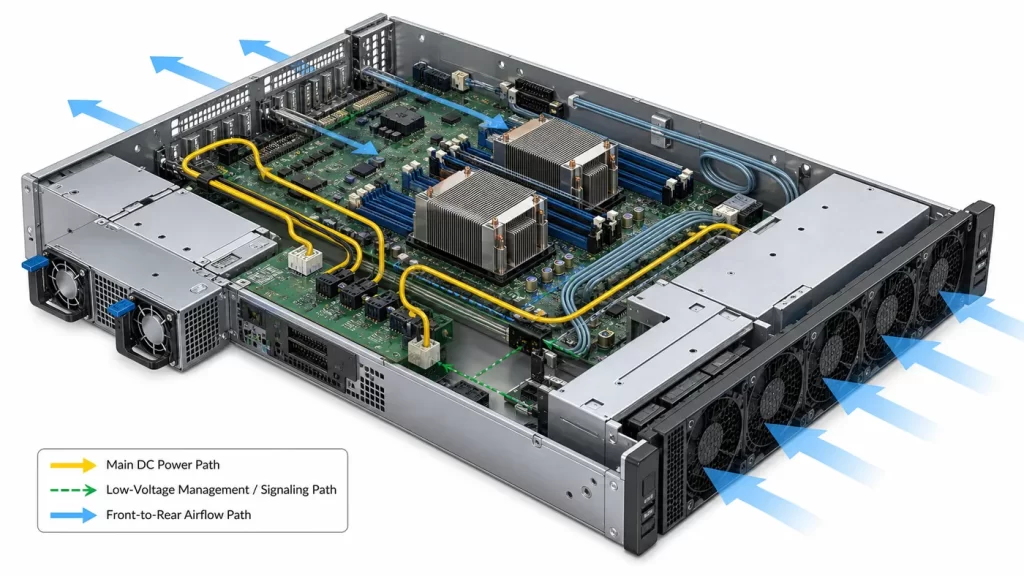
Even where two supplies share a nominal form factor, the server still depends on an exact mating and behavioral contract. The module must seat correctly in the cage, engage the intended blind-mate connector, present the required standby and control behavior, communicate as expected, and cool in the host’s airflow direction.
This is why photographs are useful but not dispositive. They can expose an obviously different handle, latch, connector key, or airflow marking. They cannot prove pin assignments, current-share behavior, management compatibility, insertion sequencing, or firmware support.
The PDB is especially important because it is the point where removable modules become a server power system. Its connector implementation, main-current path, control wiring, and host interface define a supported assembly with the PSU. The CRPS and PDB interface boundaries provide a deeper view of this relationship. For a field replacement, however, the practical rule is concise: no adapter, rewiring, connector modification, or mechanical alteration should be introduced unless the platform owner has engineered and approved it.
Input conditions also belong in the record. The same headline output does not prove identical behavior across all mains voltages, ambient conditions, or airflow situations. Compare the exact input and output markings of the installed and proposed units, then use host documentation to determine whether the server’s permitted configuration changes under the available facility supply.
Evaluate the offer separately from compatibility
Once the part identity is supported, assess the physical unit being sold. “Compatible” answers which part it claims to be; condition and provenance determine whether that particular item is a reasonable service spare.
| Offer detail | Evidence to request | Risk if omitted |
|---|---|---|
| Exact identity | Photographs of the actual label and all relevant part numbers | A generic stock image may hide a different revision or assembly |
| Condition | New, manufacturer-refurbished, seller-refurbished, or used-pull status stated explicitly | “Refurbished” may describe no defined process |
| Work performed | Repairs, component replacement, cleaning, firmware action, and test scope | Unknown rework or merely cosmetic preparation |
| Test evidence | What functions were tested, under which setup, and how the unit was identified during test | A power-on check can be mistaken for host compatibility or load qualification |
| Provenance | Source, serial-number traceability, and tamper or damage disclosure where available | Counterfeit, altered, or poorly handled stock is harder to screen |
| Commercial protection | Warranty term, return window, restocking conditions, and wrong-part remedy | Compatibility disputes may become non-returnable |
A serviceable refurbished module is not defined by a polished enclosure. The seller should distinguish inspection from repair, state whether the unit was tested in a representative compatible environment, and disclose exceptions. Test records do not need to reveal proprietary procedures, but they should identify the unit and explain what “tested” means.
Be cautious when a listing combines numerous cross-reference numbers without explaining which are exact identities and which are claimed substitutes. Ask the seller to quote the offered number explicitly and to confirm that the photographed label belongs to the shipped unit. If the purchase depends on a supersession, attach the approving source to the purchase order rather than relying on marketplace text that may later change.
A purchase order should preserve the evidence
The strongest procurement record is short enough to use and specific enough to prevent substitution. It should include the host identity, required part number or approved supersession, acceptable revision or pair policy, condition grade, quantity, included hardware, labeling requirements, and return terms. State whether seller substitution requires written approval.
For operators managing several similar servers, map serial or service identifiers to the approved PSU identities. Two chassis with the same family name can have different configurations, PDB revisions, or support histories. Stocking by “1100W server PSU” can therefore merge spares that should remain separate.
Lifecycle planning should also distinguish an approved alternate from an engineering replacement project. If the original part is unavailable and no documented supersession exists, the task is no longer routine spare purchasing. It becomes a platform-level compatibility exercise involving the module, PDB, control interface, thermal path, firmware, and service process. A mechanically convenient candidate should not bypass that work.
Receiving checks catch identity and condition errors early
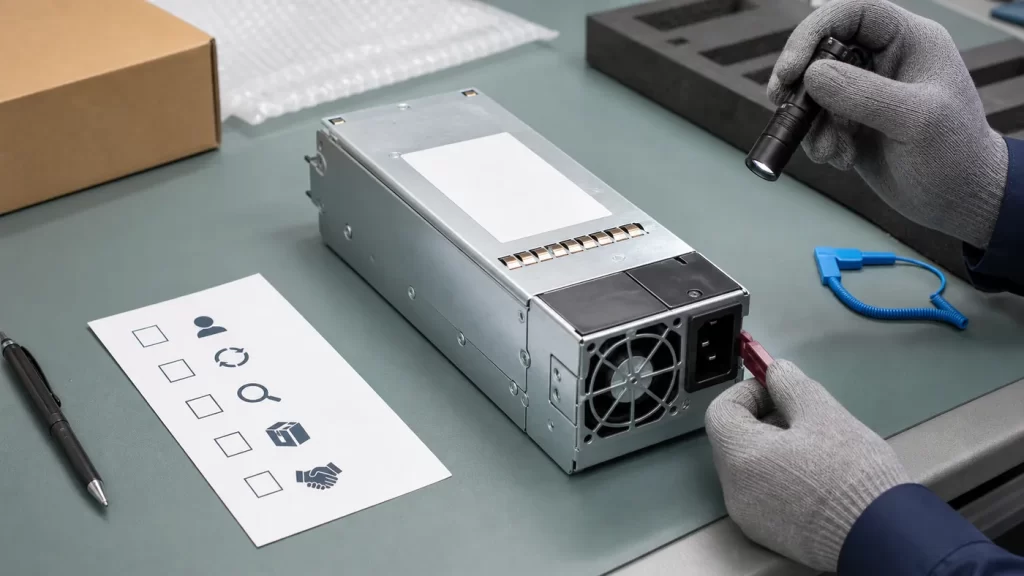
Inspect the module before it reaches a production server. Compare the received label with the purchase record and preserve photographs of the serial number, part numbers, revision, connector area, latch, handle, and enclosure. Look for bent contacts, damaged guides, loose hardware, corrosion, contamination, distorted sheet metal, broken seals where meaningful, or evidence of unreported rework.
Next, confirm that the host is in a supported state for service. Follow the manufacturer’s procedure for module replacement; do not infer that a removable handle alone authorizes live replacement. Verify that the healthy module and its input path can support the permitted server load during the service interval.
After installation, the acceptance evidence should answer operational questions rather than merely noting that the server stayed on:
- Does the module seat, latch, and extract without abnormal force or interference?
- Does the server identify the expected PSU, revision, status, and input condition?
- Are redundancy, mismatch, communication, fan, and power alerts clear after the prescribed settling period?
- Do telemetry and event logs show both modules participating as the host design intends?
- If the approved service procedure includes a redundancy check, does each supported input or module-loss state behave correctly without exposing the workload to an unsupported condition?
A controlled redundancy check must remain within the server manufacturer’s procedure and the site’s operational rules. Pulling a cord or module casually can test the wrong failure domain, overload the surviving path, or interrupt a workload whose configuration exceeds single-module capacity. Where production risk is unacceptable, use a maintenance environment or a representative spare chassis.
The approved spare is the real purchasing outcome
The successful result is not simply an 1100W unit that powers on. It is a traceable module whose ordering identity or documented supersession is approved for the exact host, whose pairing and input conditions are understood, whose condition is represented accurately, and whose receipt checks return the server to its intended redundancy state.
That definition changes how offers are compared. A lower-priced listing with vague cross-references, stock photographs, and an undefined refurbishment process carries work and uncertainty that are absent from its price. A well-documented offer can be evaluated against the server’s service record, received without identity ambiguity, and retained as a repeatable spare baseline. For 1100W redundant server power supply replacement, evidence—not the shared wattage label—is what turns inventory into a usable service part.