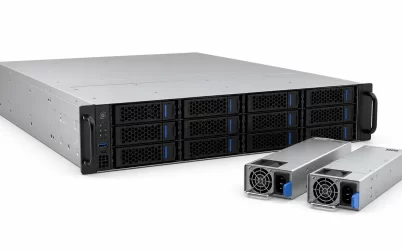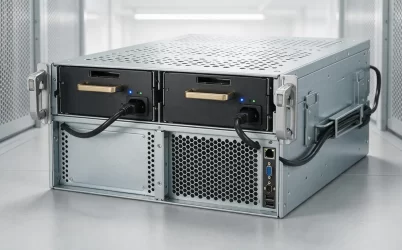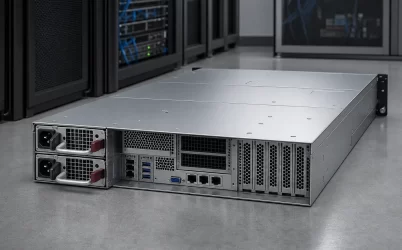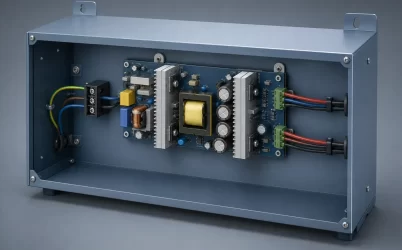
“Server power supply sizes” can describe four different things: the rack height of the host chassis, the PSU packaging family, the exact mechanical envelope, or the electrical capacity in watts. These terms help narrow a search, but they do not carry equal technical authority. A 1U server does not identify one universal PSU module, a CRPS label does not prove that two modules share a pinout, and an 800W rating says nothing about whether a supply fits a particular bay.
The practical way to research server PSU size is to separate those meanings before comparing products. Use rack height and packaging family for early screening, use the host and PSU records to establish the intended platform, use a model-specific drawing for physical fit, and evaluate wattage against the required operating and redundancy states. This approach produces a shorter, more defensible candidate list without treating a category label as interchangeability evidence.
Quick answer: “size” is a four-layer specification
Start by recording four separate fields: chassis context such as 1U or 2U, PSU packaging such as fixed ATX, Flex ATX, CRPS, M-CRPS, or a proprietary module, mechanical envelope including the body, connector plane, latch, guides, and service path, and capacity in watts under stated input and thermal conditions. The first two fields can screen a catalog. The third determines whether the hardware can occupy the bay. The fourth determines whether it can support the server, including the required degraded state. None of these fields substitutes for the others.
A four-layer map for server PSU size terms
The word “size” becomes useful when each search term is assigned to the question it can answer. The table below is intended as a screening map, not a universal dimension chart.
| Size layer | Typical terms | What it helps identify | What it cannot establish |
|---|---|---|---|
| Chassis height | 1U, 2U, 4U | The vertical packaging context and approximate space available to the complete server | The PSU module’s width, depth, connector position, cage, or electrical interface |
| PSU packaging family | ATX, Flex ATX, CRPS, M-CRPS, proprietary hot-plug | Whether the supply is likely fixed and cabled, or removable and paired with a cage or PDB | Interchangeability across manufacturers, revisions, hosts, or connector assignments |
| Mechanical envelope | Length, width, height, bay outline, insertion path | Whether a named supply and host bay can physically accommodate one another | Correct pinout, current sharing, firmware behavior, or host approval |
| Electrical capacity | 495W, 800W, 1600W, and similar ratings | The output-capacity class and a starting point for load analysis | Physical fit, input compatibility, efficiency at the deployed load, or protected capacity in a redundant system |
This separation also explains why search results can appear contradictory. A catalog may group products by wattage, a chassis page may group systems by rack units, and a distributor may use a form-factor name as a product filter. Each classification is valid within its own boundary. The error occurs when one classification is used to answer a question belonging to another layer.
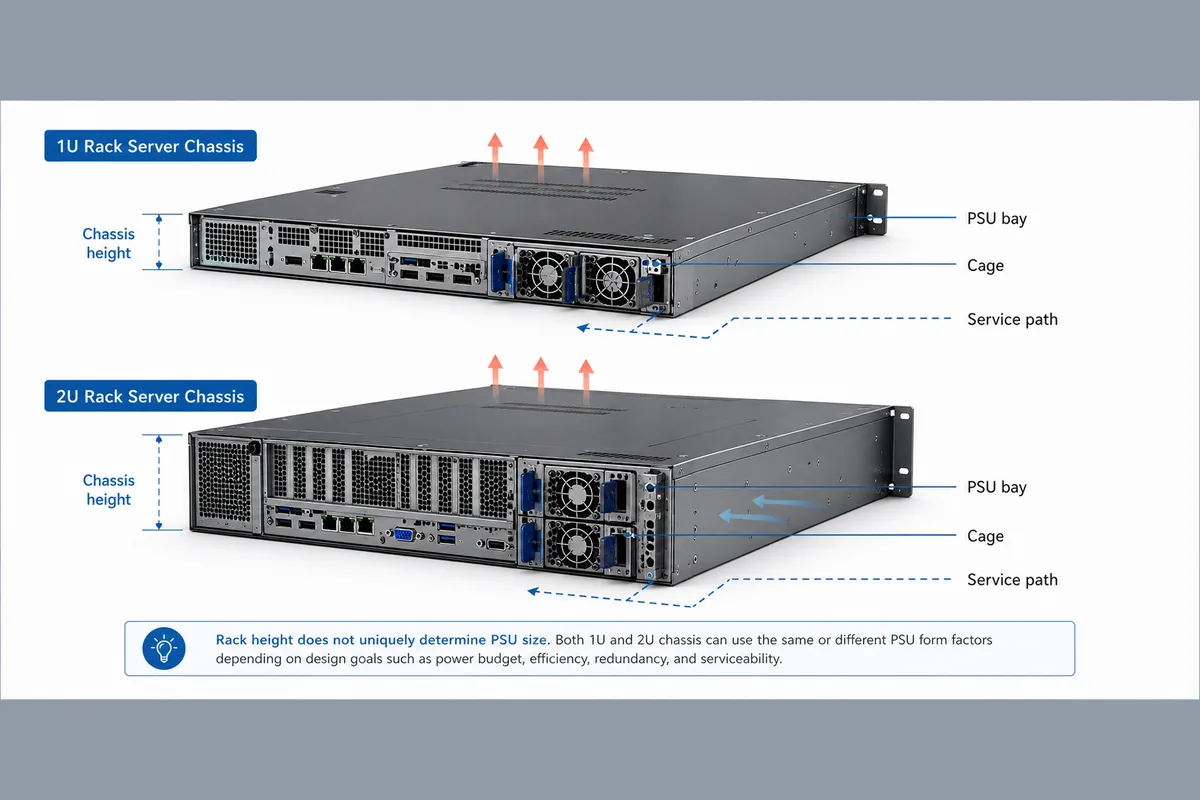
Rack units describe the vertical height of the server enclosure, not a universal PSU envelope. A 1U or 2U host may use a fixed cabled supply, proprietary hot-plug module, CRPS-family assembly, or another architecture. The label screens chassis context but does not determine module width, depth, retention, connector position, or interface.
After filtering by rack height, identify the exact chassis and PSU bay. Record insertion direction, cage and guide features, protruding latches or handles, rear-panel allocation, and conflicts with adjacent hardware or cable bends. Extra chassis height can ease packaging without proving interchangeability. Use host records and model-specific mechanical and interface evidence to determine which PSU can be installed.
Packaging family narrows the ecosystem without proving interchangeability
PSU family names describe how the supply is packaged and integrated. A fixed ATX-style unit commonly delivers power through cables and connectors selected by the host designer. Flex ATX generally signals a compact cabled package, but the host’s mounting pattern, cable set, airflow direction, and electrical requirements still matter. CRPS and M-CRPS generally point toward removable server modules used with a compatible cage and power distribution board. Proprietary modules may resemble a known family while using different keying, contacts, signals, firmware expectations, or supported chassis.
That is why a family name works as a search branch rather than a replacement code. A CRPS candidate still needs a matching host ecosystem. The cage, blind-mate or card-edge interface, PDB, airflow orientation, control signals, and management behavior form a combined platform boundary. The relevant server PSU form-factor ecosystems can help organize these categories, but the category explanation should not be used as proof that a particular module crosses from one platform to another.
Packaging also determines what the quotation contains. “Server PSU” may mean one fixed supply, one removable module, a matched redundant pair, or a complete assembly with cage, PDB, harnesses, and mounting hardware. A size comparison that does not state the supply scope can compare unlike objects. For a replacement, the module may be the correct orderable item. For a new chassis design, the cage and PDB may be equally important to the physical and electrical result.
Dimensions become meaningful at the host-bay boundary
Length, width, and height are valuable once they belong to a named model and a named host assembly. Before that point, they are broad screening data. The body envelope may exclude a handle, flange, latch, rear connector, front bezel, cable bend, or airflow keep-out. A module can fit inside a rectangular opening and still fail to seat because its connector plane is offset, its guide rails do not align, or its extraction path is blocked by adjacent hardware.
For the size investigation, record the minimum evidence needed to move from catalog screening to fit review:
- Exact PSU manufacturer part number, revision, and orientation shown in the drawing.
- Host chassis model, PSU cage or bay identity, and the relevant mounting or guiding features.
- Maximum body envelope, including protruding handles, flanges, latches, and connector housings.
- Connector seating plane, insertion stop, extraction direction, and service clearance.
- Air inlet and outlet locations, together with any adjacent component or cable keep-outs.
This is not a request to create a universal size table. It is a way to decide when a candidate needs a model-specific fit review. Once the body and bay must be compared in a common coordinate system, use a documented mechanical fit drawing rather than relying on a marketplace photograph or a nominal 1U/2U description. The drawing answers the physical question; it does not close electrical compatibility.
Watts describe capacity, not the physical meaning of size
Wattage is often the most visible number in a server PSU listing, but it belongs to the electrical-capacity layer. It should be read with the input range, inlet temperature, airflow condition, output voltage, rating method, and system operating policy that accompany the exact model. A supply rated at 800W may not deliver the same usable output under every input or environmental condition, and a redundant pair may be limited by the capacity of one surviving module rather than the sum of two nameplates.
For a 1+1 arrangement, the relevant question is whether one available module can support the server state that the platform permits after the other module or feed is unavailable. That state may include CPU demand, accelerator or storage activity, fans, startup behavior, and a short workload transition. If the server normally requires both modules to provide capacity, the pair may provide load sharing without providing full 1+1 continuity. “Two 800W PSUs” and “800W of protected capacity after one failure” are not interchangeable statements.
Wattage also affects the physical design indirectly. Higher output at the same conversion voltage means greater current through the PDB, connectors, busbars, and harnesses. Greater loss becomes heat that the chassis airflow must remove. A higher-wattage module may therefore require a different cage, connector family, fan policy, input cord, or host approval even when its outer body appears similar. Capacity is a useful filter, but the number cannot settle the mechanical or platform question.
Route each size question to the document that can answer it
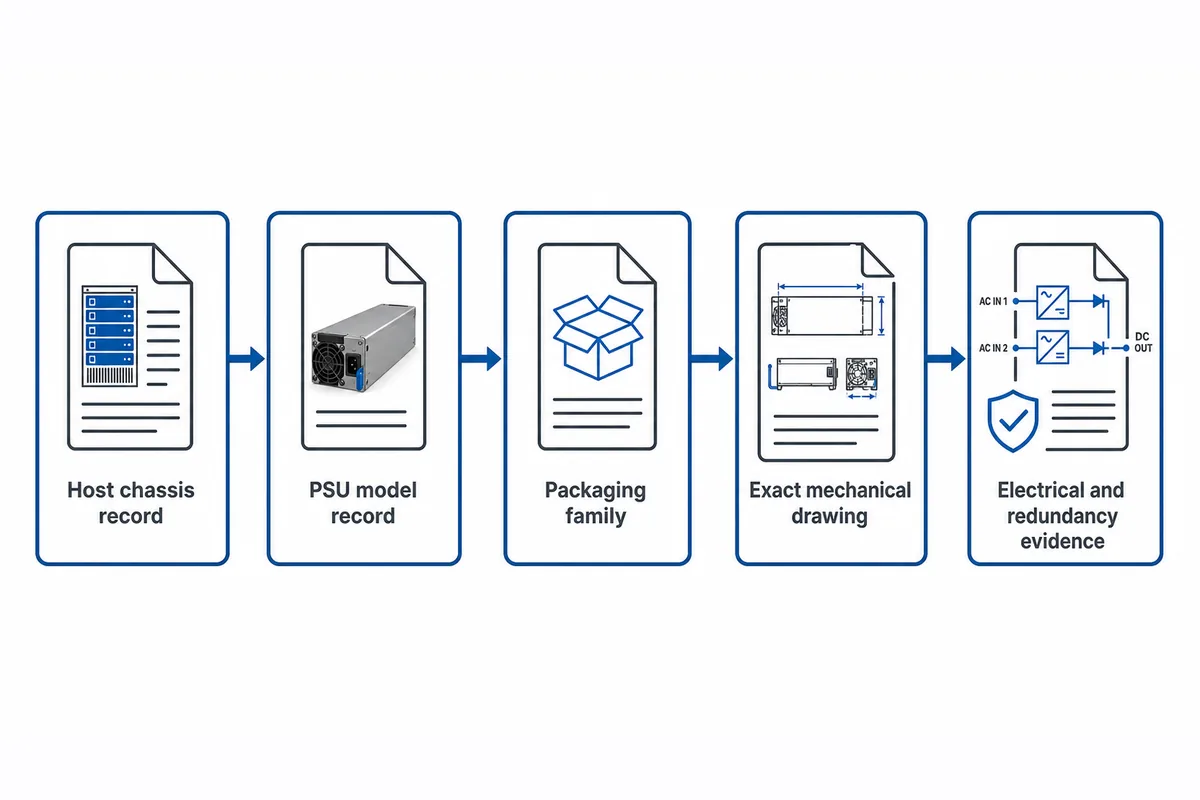
A reliable shortlist uses different evidence for different layers instead of searching for one document that claims to prove everything. The host service manual, chassis matrix, PSU matrix, product drawing, PDB documentation, and electrical specification each have a defined job.
- Identify the host context. Record the complete server or chassis model, revision, installed PSU labels, rack height, intended configuration, and whether the requirement is a replacement, spare, or new integration.
- Classify the packaging. Mark the candidate as fixed cabled, removable module, CRPS or M-CRPS family, proprietary assembly, or another documented architecture. Do not mix a module-only listing with a complete assembly listing.
- Connect the host to a model record. Use the chassis manufacturer’s supported PSU information and the exact module part number. A manufacturer matrix such as Supermicro’s power-supply matrix illustrates the correct research habit: use model-specific records rather than assume one universal server PSU size.
- Escalate the physical question. Obtain the exact drawing when the candidate must fit a bay, cage, guide, latch, connector plane, or service path. Record unresolved dimensions instead of filling them with a nominal family value.
- Close the electrical boundary. Match input conditions, output architecture, connector and signal documentation, PDB relationship, supported management behavior, cooling direction, and required capacity in the relevant operating state.
The evidence hierarchy matters when documents disagree. A host-specific approved-parts record normally has more decision value for replacement compatibility than a generic distributor category. An exact product drawing has more value for envelope analysis than a product photograph. A platform electrical specification or PDB document is needed to interpret contacts and control behavior; physical resemblance cannot supply that information.
Use a size-screening worksheet before requesting a quotation
A short worksheet prevents four different meanings of “size” from collapsing into one purchasing line. It can be maintained for a single server or used as a controlled record for a fleet.
| Record | Example entry format | Open question if missing |
|---|---|---|
| Host context | Server/chassis model, revision, 1U or 2U, installed PSU identifier | Which platform record governs the candidate? |
| Packaging | Fixed cabled, hot-plug module, CRPS-family, proprietary, or shelf | What cage, mounting, or PDB is part of the system? |
| Mechanical | Model-specific envelope, connector plane, guides, latch, extraction path | Can the module seat and be serviced without interference? |
| Electrical | Rated output, input boundary, output bus, signals, management, airflow | What exact operating conditions qualify the rating and interface? |
| Resilience | 1+1, N+1, load sharing, or capacity-only dual installation | What must remain powered after the defined failure? |
For procurement, add the commercial supply scope: one module, a pair, a cage, a PDB, cables, mounting parts, or a complete host-approved kit. Ask the supplier to state the exact manufacturer part number, revision, included hardware, supported host family, airflow direction, input condition, and approved substitutions. If an offer says “same size” or “compatible CRPS” without naming the mating assembly, treat that language as an unresolved field rather than a technical conclusion.
When a size shortlist is ready to move forward
A candidate has passed size screening when the four layers point to the same documented configuration: the rack-height context matches the host, the packaging family matches the installed architecture, the exact envelope is compatible with the bay and service path, and the output capacity fits the required operating states. The remaining evidence should be visible rather than implied—especially the mating PDB, interface definition, airflow requirement, input range, and redundancy policy.
This layered method keeps “server power supply sizes” useful without pretending that one dimension, one family name, or one wattage rating can identify a replacement. It also routes readers to the right next document: a form-factor reference for category orientation, a model-specific drawing for physical fit, and a host or manufacturer record for supported configuration. The result is a candidate list that is narrower, easier to quote, and less likely to confuse similar-looking hardware with a qualified server power assembly.