A 3000W redundant server PSU should enter a Platinum-specific RFQ only when the efficiency claim is supported for the exact manufacturer model and applicable revision. A product title containing “3000W,” “redundant,” and “Platinum” is not sufficient evidence. The record must identify what Platinum means, the input and load conditions behind it, and whether the documentation applies to one removable module, a redundant kit, or a server-qualified configuration. Candidates documented as Titanium should remain separate alternatives, while products with an unstated efficiency class should be held for clarification rather than presented as confirmed Platinum options.
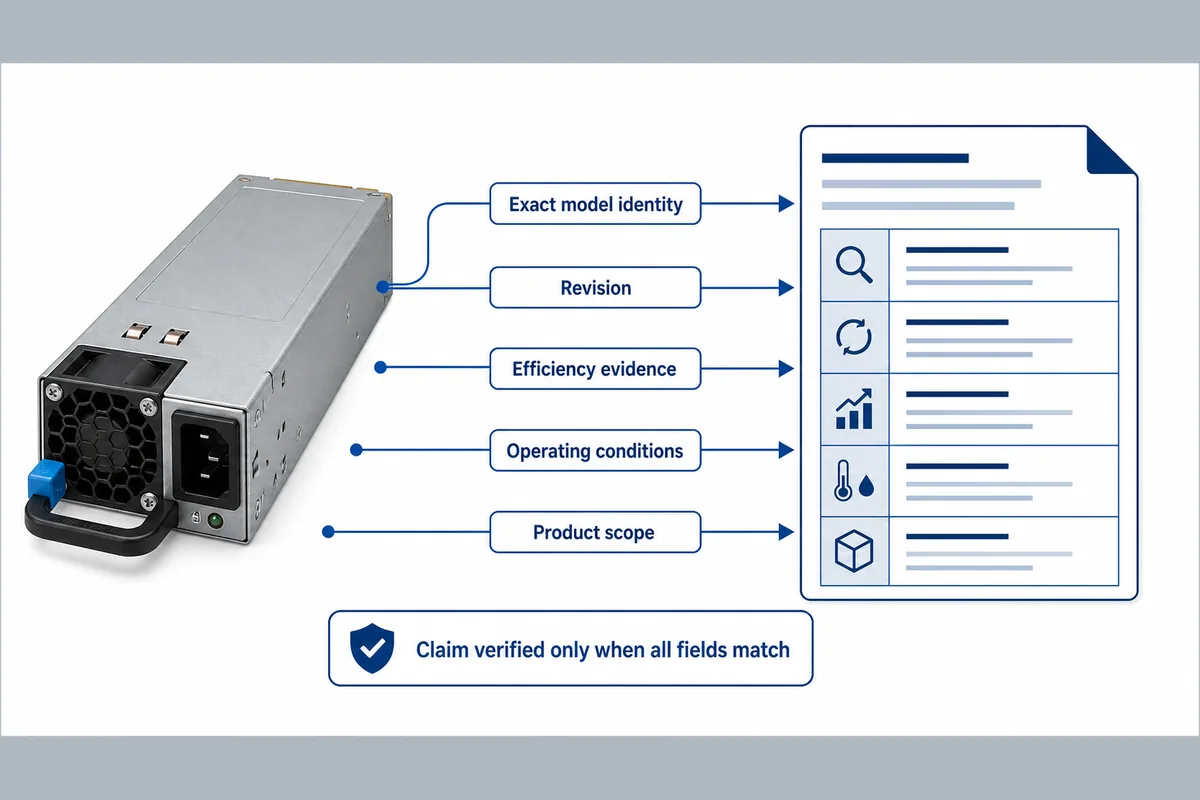
A Platinum claim needs five technical coordinates
The first procurement task is not to rank products. It is to convert each listing into a traceable efficiency claim. That claim needs coordinates because manufacturers, platform vendors, distributors, and resellers may identify the same hardware through different numbers or package descriptions.
| Claim coordinate | Evidence to capture | What leaves the claim unresolved |
|---|---|---|
| Exact product identity | Manufacturer, model or part number, and relevant revision or variant | Seller SKU, stock photograph, family name, or wattage alone |
| Meaning of Platinum | Named certification program or an explicit manufacturer efficiency classification | “High efficiency,” an efficiency icon, or Platinum wording without a defined basis |
| Operating conditions | Applicable input condition, documented load points, and any thermal or airflow conditions attached to the data | A peak percentage with no test coordinates |
| Product scope | Whether the evidence covers a removable module, pair, kit, power assembly, or host configuration | Documentation from a related product applied to the quoted item |
| Document control | Source title, revision or publication date where available, and a direct mapping to the offered part | An undated screenshot or copied specification with no model association |
An official manufacturer page is a useful identity anchor, but it should support only the claims it actually makes. For example, the Supermicro PWS-3K01G-1R manufacturer listing establishes an exact 3000W 1U redundant power-supply candidate. Product identity and wattage, however, should not be converted into a Platinum classification unless documentation associated with that exact product supports it.
The distinction matters when a manufacturer offers several mechanically related supplies with different efficiency grades, input envelopes, airflow variants, or platform assignments. A certificate or datasheet for a neighboring model is not evidence for the quoted part merely because the chassis shell and nominal output look similar.
Three catalog labels describe three separate claims
The phrase “3000W redundant Platinum PSU” compresses capacity, availability architecture, and conversion efficiency into one line. Each part answers a different procurement question.
- 3000W describes a documented output rating under stated conditions. It does not identify the input required to obtain that output or prove that the host permits the full rating.
- Redundant describes an intended multi-source configuration. It does not establish that the quotation includes two modules, a cage, a PDB, or any other hardware needed to implement that configuration.
- Platinum describes an efficiency classification or claim. It does not establish output capacity, host compatibility, hot-swap behavior, or continuity after a module is lost.
A candidate can satisfy two labels and fail the third. A manufacturer may list an exact 3000W redundant module while leaving the efficiency class unstated in the material supplied with the bid. Another result may document a 3000W Titanium module. That Titanium product is not a confirmed Platinum candidate, even though it may meet a higher efficiency tier under its applicable program and conditions.
If the RFQ treats Platinum as a minimum efficiency requirement, a documented Titanium option can be submitted as a clearly identified alternate when the buyer permits alternatives. If the approved bill of materials requires an exact Platinum model, substituting Titanium is still a configuration change. The alternate may differ in product identity, input requirements, host support, airflow, firmware behavior, kit contents, or commercial availability. Powernexu’s separate analysis of the 3000W Titanium redundant server PSU deployment boundary addresses that category without merging it into a Platinum shortlist.
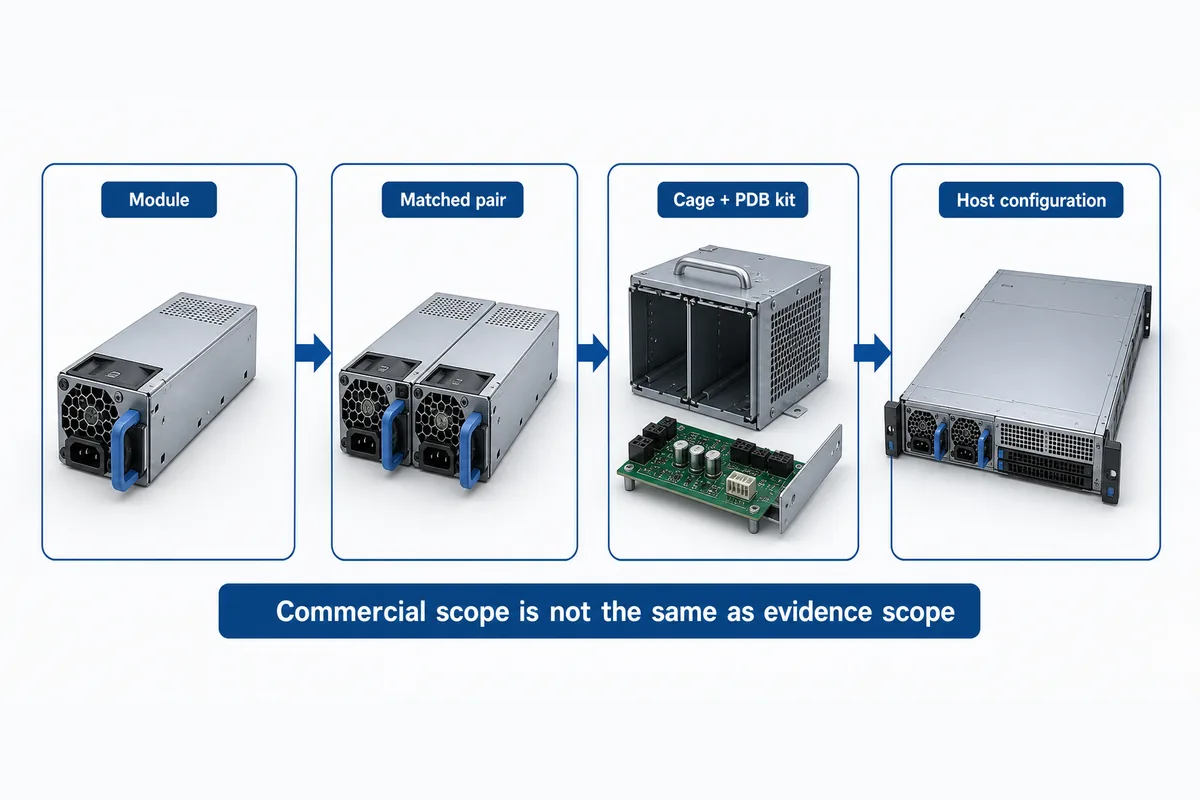
Module, pair, kit, and server configuration are different evidence scopes
Efficiency data usually belongs to a defined conversion product, while a seller’s line item may describe a broader or narrower commercial package. Procurement should therefore record the object covered by the evidence separately from the object being shipped.
One removable module
A module-only offer is appropriate for a controlled spare purchase when the target server already has a supported cage, PDB, mating interface, and pairing policy. The efficiency record should map to the exact removable module rather than to a generic server family. The quotation should also state quantity explicitly; “redundant PSU” in a product description does not necessarily mean that two modules are included.
A redundant pair
A two-module offer establishes quantity but not a complete redundant assembly. The modules may still require a host-specific cage or PDB, and the server vendor may impose matching rules for part numbers, revisions, efficiency classes, or firmware. The evidence record should show whether both offered modules have the same controlled identity.
A hot-plug kit or complete assembly
A kit may include modules, mechanical retention, a cage, a PDB, cords, or other host-specific items. Its efficiency evidence may still refer only to the converter module. Conversely, a platform datasheet may describe behavior available only when that module operates in a particular supported server. Buyers should not move a statement between those scopes without a document that provides the mapping.
Terms such as 1U, CRPS, and M-CRPS help describe packaging ecosystems, but they do not prove that two candidates share an envelope, blind-mate interface, pin assignment, control protocol, or host qualification. Those questions remain important after the Platinum gate has been passed; they should not be allowed to substitute for efficiency evidence during the gate itself.
Classify each result before comparing price
A shortlist is easier to control when every candidate receives an evidence state. This prevents an unsupported marketplace claim from appearing equivalent to a documented manufacturer classification merely because both rows contain the same wattage.
| Candidate state | Interpretation | RFQ treatment |
|---|---|---|
| Platinum documented for the exact model | The model identity and efficiency evidence agree, subject to the stated conditions | May enter the Platinum shortlist; continue with scope and platform review |
| Platinum asserted but not mapped | The listing uses Platinum wording, but the source does not identify the exact offered model or variant | Clarify before technical comparison |
| Efficiency class unstated | The 3000W model exists, but the available evidence does not establish Platinum | Hold as unclassified; do not fill the gap by inference |
| Titanium documented | The product belongs to a different documented efficiency category | Keep as a named alternate only if the RFQ allows it |
| Conflicting sources | Seller, manufacturer, certificate, or platform documents identify different grades or variants | Escalate for written resolution tied to the offered part |
| Exact model unresolved | The offer allows an equivalent, family member, or unspecified revision | Exclude until the supplied identity is fixed |
This classification is intentionally conservative. “Unclassified” does not mean inefficient, unsuitable, or counterfeit. It means the available evidence cannot authorize the specific Platinum claim. That status gives the supplier a precise question to answer instead of forcing the buyer to accept or reject the entire product on incomplete information.
Compare efficiency at the server’s relevant operating points
Once the class is documented, the badge should not replace operating-point analysis. Conversion efficiency is the relationship between DC output and AC input at a defined condition. For a fixed DC output, approximate AC input can be expressed as:
AC input = DC output ÷ efficiency
Approximate PSU conversion loss at that point is:
Conversion loss = DC output × (1 ÷ efficiency − 1)
These relationships are useful only when the efficiency values being compared refer to the same input condition and the same output measurement boundary. A maximum advertised percentage from one model should not be compared with a certified load point or a server-level wall measurement from another.
Redundant operation can also move each module across its efficiency curve. Consider a hypothetical server requiring 2400W of DC output. If two 3000W modules share that demand equally, each supplies approximately 1200W, or 40% of its nominal rating. If one module becomes unavailable and the platform permits the remaining unit to carry the load, that module supplies approximately 2400W, or 80% of nominal rating.
The example does not prove that a particular 3000W module can support the server in either state. Input voltage, output derating, thermal conditions, sharing accuracy, transient demand, PDB limits, and host policy remain model-specific. It shows why a buyer may need efficiency data near both the normal shared-load point and the required single-module point. A Platinum label does not guarantee that two candidates have identical curves at those operating states.
It is equally important not to treat efficiency as protected capacity. A highly efficient module may still be unsuitable if its documented output falls below the server demand under the deployed input or thermal condition. The separate boundaries between wattage, efficiency, derating, and 1+1 capacity are examined in redundant server power supply ratings.
Write the RFQ so the verified claim cannot disappear
The RFQ should preserve the relationship between model identity and efficiency evidence. Otherwise, a technically acceptable evaluation can be replaced at order entry by an unspecified “3000W Platinum equivalent” whose classification, revision, or product scope is unknown.
A useful line item can require the supplier to state:
- the PSU manufacturer and exact manufacturer part number;
- the offered revision or variant when it affects the documented configuration;
- whether Platinum refers to a named certification or a manufacturer-declared efficiency class;
- the document or database record supporting that classification for the offered model;
- the applicable input and load conditions shown by the source;
- whether the price covers one module, a pair, a kit, or a complete redundant assembly;
- the target server or assembly supported by the quotation, where platform compatibility is part of the supply;
- all proposed alternates, including Titanium products, as separate line items; and
- a prohibition on unspecified equivalents without written buyer approval.
The evidence does not need to take one universal form. An official certification entry, manufacturer datasheet, platform quick specification, or controlled product document may support different parts of the record. What matters is that each source is used for the claim it can substantiate and that the offered part can be traced to it without relying on appearance or seller interpretation.
Resolve discrepancies without weakening the requirement
Accept for further evaluation
Move a candidate forward when its exact identity is fixed, the Platinum basis is explicit, the documented conditions are available, and the commercial scope is clear. This outcome confirms the efficiency claim; it does not yet authorize mechanical or electrical substitution into an unsupported server.
Return for clarification
Clarification is appropriate when a credible manufacturer model is identified but the efficiency document, revision mapping, input condition, or package contents are missing. Ask for the unresolved field directly. Do not let a reseller replace evidence with a statement that the unit is “equivalent,” “high efficiency,” or “commonly used” in 3000W servers.
Exclude or record as an alternate
Exclude a candidate from the Platinum shortlist when the supplier cannot identify the delivered model, the available documentation conflicts with the claimed class, or the quotation permits an uncontrolled substitution. A documented Titanium product can remain visible as an alternate when the procurement policy allows one, but its identity and deployment consequences should be evaluated on their own terms.
The resulting shortlist may be shorter than the search results, which is the intended outcome. A defensible 3000W redundant Platinum server PSU candidate is not merely a high-power module described with an efficiency adjective. It is an exact product whose efficiency class, operating conditions, evidence scope, and commercial identity remain attached to the same line item from technical review through purchase.