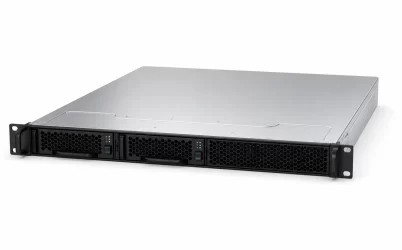
An 80 PLUS Titanium 800W server power supply search does not identify one interchangeable PSU category. Current results include an HPE 800W Flex Slot kit, a Supermicro fixed-800W listing, and a Supermicro product advertised with an 800/1200W rating structure. Those descriptions refer to different models, packaging scopes, and potentially different operating conditions. The practical buying answer is to keep a candidate only when three records agree: the manufacturer’s exact model and applicable rating, the exact model’s 80 PLUS certification record, and the target server’s supported configuration. A shared wattage or efficiency class cannot substitute for that three-way match.
Three search results do not represent the same product
The shortlist first needs to be divided by manufacturer and exact identity. Comparing all results under a generic “800W Titanium PSU” heading erases differences that determine whether the hardware can be ordered or installed.
| Search result | What the manufacturer listing identifies | What remains to be established |
|---|---|---|
| HPE 865438-B21 | An 800W Flex Slot Titanium hot-plug low-halogen power-supply kit | Exact kit contents, target-platform support, applicable option or spare-part references, and permitted pairing |
| Supermicro PWS-802A-1R | An 800W 1U redundant power supply | Whether the exact model has Titanium certification, which systems support it, and whether the offer is one module or a larger assembly |
| Supermicro PWS-1K22A-1R | A 1U redundant model advertised with an 800/1200W rating structure and 80 PLUS Titanium | Which documented condition produces each rating and which rating applies in the intended rack and server |
This classification does not rank the products. It prevents a product title from becoming an unsupported cross-reference. HPE Flex Slot and Supermicro 1U descriptions belong to manufacturer-specific platform ecosystems unless documentation explicitly establishes otherwise. Even within one manufacturer’s portfolio, a similar module outline or power rating does not demonstrate that the connector, firmware behavior, cooling direction, or supported host list is identical.
The words “hot-plug” and “redundant” also answer different questions. Hot-plug describes a supported service capability in an appropriate host configuration. Redundant describes an architecture in which another supported path can maintain the required load after a defined failure. Neither term proves that a single search result includes two modules, a cage, a power distribution board, or every component needed to create redundancy.
The useful audit is a three-record join
A reliable shortlist joins records that have different authorities. Combining them into one evidence chain is more useful than collecting more marketplace specifications.
Record 1: manufacturer identity and rating structure
The manufacturer record should identify the model or ordering part, product type, stated output rating, and any documented conditions attached to that rating. Record the wording exactly enough to distinguish a module from a kit. If a product page presents two power values, retain both as unresolved conditional ratings until the corresponding technical documentation explains them.
A seller-created title should not overwrite the manufacturer identity. For example, adding “800W Titanium” to a listing for an exact model does not establish that the model has both attributes. Conversely, a manufacturer kit number may legitimately differ from the identifier printed on the removable module. That relationship requires a manufacturer-supported mapping rather than an assumed match.
Record 2: exact 80 PLUS entry
Efficiency evidence should be traced through the official 80 PLUS Titanium certified power-supply registry. Search for the exact manufacturer and certification model. If the registry identifier differs from the commercial ordering number, obtain a documented cross-reference showing that the certified unit is the unit being offered.
The registry record supports an efficiency-class claim under the program’s test framework. It does not establish server compatibility, output availability under every field condition, redundant capacity, hot-swap support, or the contents of a commercial kit. Those claims belong to other records.
Record 3: target-platform support
The host record should connect the exact PSU or kit to the intended server model and configuration. Depending on the platform, useful evidence can include an option list, service-parts document, configuration guide, technical manual, or manufacturer-supported replacement notice. The record should also resolve any restrictions on revisions, module pairing, firmware, input source, or server configuration when those restrictions are documented.
Host approval matters because the server supplies the other half of the interface. The bay, latch, blind-mate connector, PDB, control signals, management behavior, and cooling path are properties of an assembly rather than of the wattage label. Powernexu’s claim-to-evidence matrix for server-grade power supplies provides a broader method for assigning each claim to the document capable of supporting it.
Why 800W can mean different things on two listings
A fixed 800W result and an 800/1200W result should not be normalized into one “800W” column without preserving the rating conditions. In the fixed-rating case, 800W may be the manufacturer’s principal stated output for the product. In a dual-value listing, 800W may be one available operating rating while 1200W applies under another documented condition. The title alone does not explain the boundary.
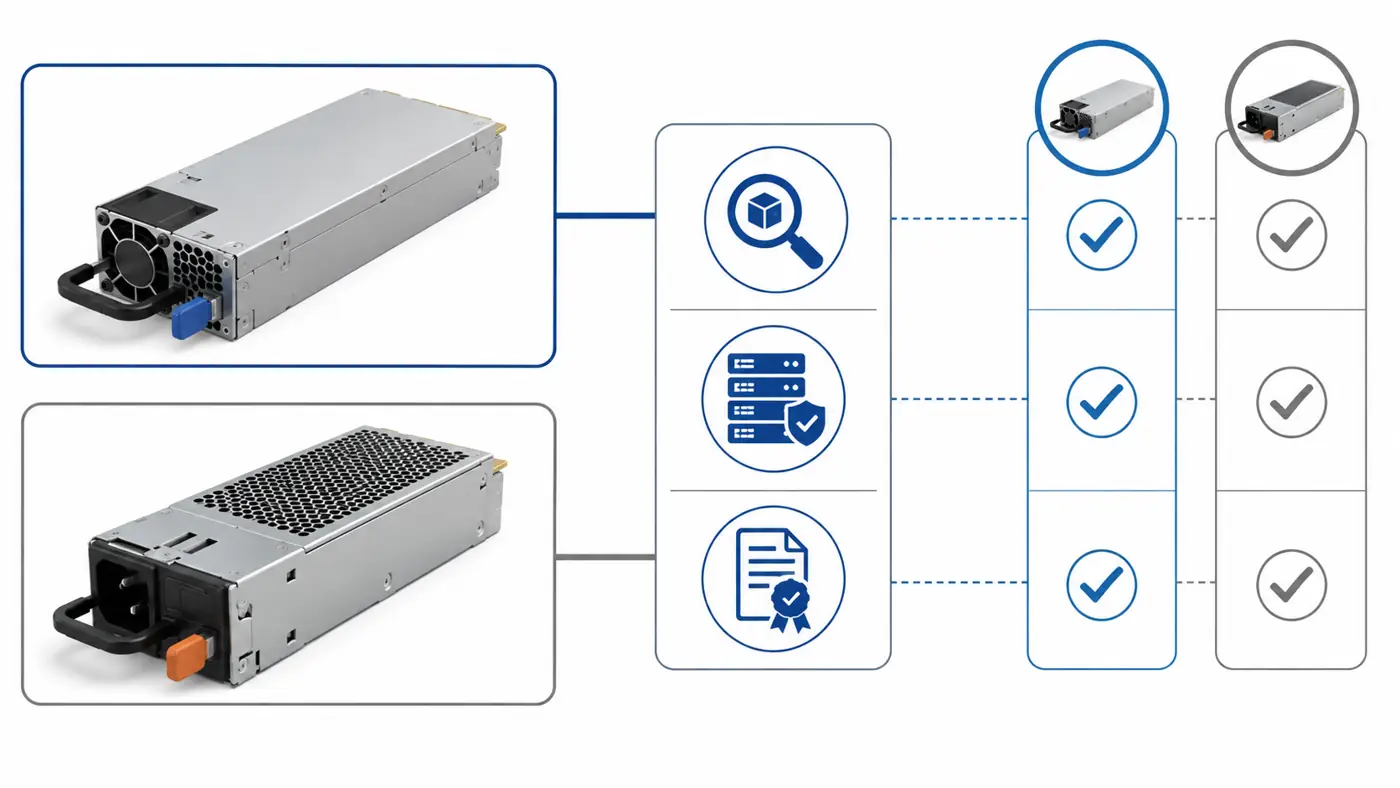
Several variables can make a server PSU’s available output conditional, including AC input, thermal environment, airflow, and platform policy. Which variable explains a particular product’s two ratings must come from that product’s documentation; it should not be inferred from another PSU family. The purchasing record should therefore state:
- the exact model and revision when revision is controlled;
- the intended AC input and frequency;
- the output rating documented for that input and deployment condition;
- the server configuration in which the rating is supported;
- the required load after a permitted module or source loss.
This distinction is especially important in a redundant server. If one module must support the permitted workload after its partner becomes unavailable, the applicable single-module output in that condition becomes the capacity boundary. Two installed modules do not automatically turn an 800W rating into 1,600W of protected capacity. The platform may use both modules for sharing, reserve, or additional capacity, and its supported operating mode determines which interpretation applies.
An 800/1200W candidate may still be relevant to an 800W requirement, but only after the buyer establishes why the lower value applies and confirms that the selected operating point matches the rack source and host configuration. Treating the lower number as a model identity would discard the very condition that explains it.
Titanium is not a platform compatibility certificate
80 PLUS Titanium classifies conversion efficiency under defined program testing. It is valuable evidence, but its scope is narrow. It does not certify that an HPE module fits a Supermicro server, that two similarly shaped Supermicro models share a pinout, or that a module is supported by a particular BMC and PDB.
The exact-model requirement also prevents three common sourcing errors:
- Family substitution: a certified product in the same family is treated as proof for every related wattage or revision.
- Seller-title substitution: a reseller’s Titanium wording is accepted without matching the offered model to the registry.
- Kit-to-module substitution: certification or compatibility evidence for a module is applied to an unidentified kit, or a kit number is assumed to identify every module that could be packed under it.
Certification status should therefore be recorded as an exact relationship: manufacturer, certification model, efficiency class, and the commercial part to which the evidence applies. If any link in that relationship is absent, “Titanium” remains a clarification item rather than an accepted specification.
Kit, module, and redundant assembly are different purchase objects
The HPE result explicitly identifies a power-supply kit. That noun should remain attached to the part number throughout evaluation, but “kit” alone does not disclose every included item. The quotation should enumerate the actual supplied hardware rather than relying on an assumed bundle.
The Supermicro results identify 1U redundant power supplies. That wording does not by itself prove whether an offer contains one removable converter, a pair, a cage, a PDB, or a complete server power assembly. A single module can be designed for use in a redundant system while the other module and shared hardware are purchased separately.
This commercial boundary changes the comparison. A platform-approved module-only spare can be the correct object for an existing server with an intact bay and PDB. A new server integration may require the cage, mating distribution hardware, harnesses, mechanical drawings, and control documentation. Comparing the price of the first object with the price of the second would not reveal which is better; it would compare different bills of material.
The redundancy role must also be kept separate from quantity. “One redundant PSU” can mean one module intended for a redundant architecture. It does not necessarily mean one self-contained product with two independent converters. The quotation should state module quantity and every included assembly explicitly.
Normalize the evidence, not the hardware
Normalization should place unlike products into the same review fields while preserving their differences. It should not convert manufacturer-specific modules into apparent equivalents.
| Review field | Required entry | Why it changes the disposition |
|---|---|---|
| Commercial identity | Manufacturer, exact model or option number, revision if applicable | Prevents an unspecified equivalent from replacing the evaluated unit |
| Stated rating | Every advertised output value and its documented conditions | Separates a fixed 800W model from an 800/1200W operating structure |
| Efficiency evidence | Exact registry model and Titanium classification | Stops family or seller wording from substituting for certification evidence |
| Product scope | Module, pair, kit, or complete assembly, with quantities | Makes price and installation responsibility comparable |
| Host support | Named server, supported configuration, and controlling document | Establishes whether the candidate belongs in the target platform |
| Deployment condition | Input source, cooling condition, redundancy state, and applicable output | Connects the rating to the environment in which it will be used |
After these fields are populated, each candidate can receive one of three narrow outcomes:
- Retain: the exact model has the required certification evidence, its applicable rating covers the intended condition, and the target platform supports the configuration.
- Clarify: the candidate may fit the requirement, but a rating condition, registry cross-reference, kit scope, or host-support relationship remains unresolved.
- Exclude: the exact model lacks a mandatory attribute, is unsupported by the target host, cannot supply the required output in the deployed condition, or cannot be quoted with a controlled identity.
Under this method, the Supermicro PWS-802A-1R can remain an 800W candidate while its Titanium status is held open rather than inferred. The PWS-1K22A-1R can remain visible while the 800/1200W conditions are resolved. The HPE 865438-B21 kit can be evaluated within its Flex Slot platform context without implying that its wattage and efficiency class make it interchangeable with either Supermicro product.
Preserve the three-record match after selection
The approved combination can still be lost between technical review and delivery if the purchase order permits an unspecified equivalent. The line item should preserve the manufacturer part or kit number, acceptable revision policy, quantity, package scope, applicable rating condition, and target host. Any substitution should reopen the affected manufacturer, certification, and platform records rather than inherit approval from the original candidate.
Receiving should compare the delivered package and module labels with that line item. A box label, module label, quotation, and certification record may use different identifiers, so discrepancies should be reconciled through documented manufacturer relationships. Similar wattage, appearance, or connector geometry is not an adequate explanation for an identity mismatch.
The purchase-ready result is not a universal winner between HPE and Supermicro. It is an exact model or kit whose 800W description has one documented meaning, whose Titanium claim belongs to that exact identity, and whose intended server supports it under the proposed operating conditions. That outcome turns a product-heavy search page into a controlled shortlist without erasing the platform boundaries that make each result distinct.