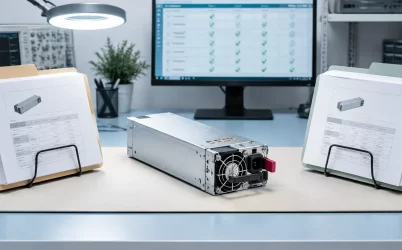
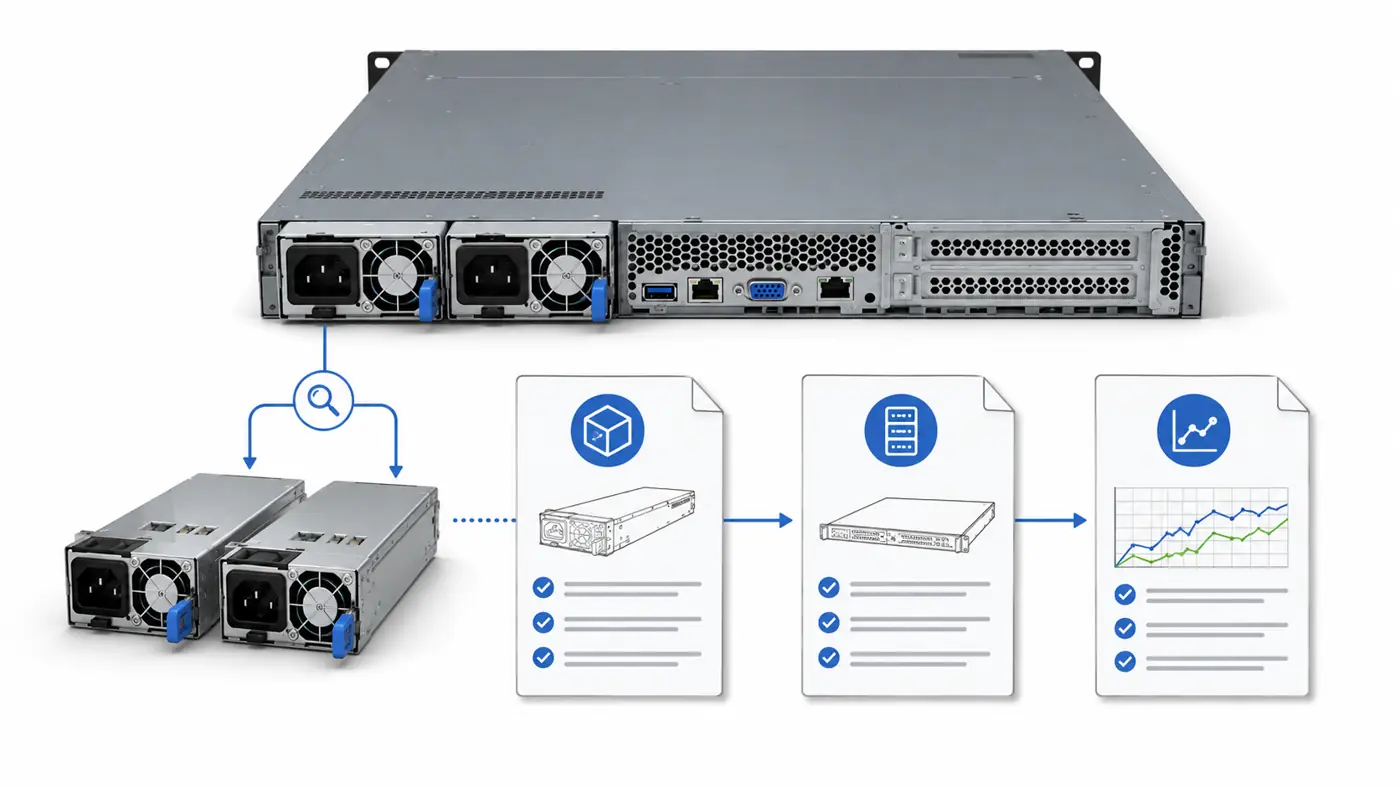
A 1U Titanium server PSU should not reach a purchasing shortlist until the seller’s exact part number has been reconciled with three independent records: the manufacturer’s product documentation, the manufacturer’s platform or power-supply matrix, and the 80 PLUS certification registry. These sources answer different questions. The product record identifies the module and its documented specifications; the platform matrix indicates where the manufacturer supports or associates it; and the certification registry substantiates the efficiency classification for the recorded model. Even a clean three-record match does not prove every deployment condition, so input, airflow, redundancy, management, mechanical interface, and package contents must remain explicit.
“1U Titanium” is a search filter, not an orderable identity
Product-heavy search results make the phrase look more precise than it is. Current listings associated with this query span multiple output classes, including 1000W, 1200W, and 1600W candidates. They also combine terms such as redundant, hot-swap, and PMBus in different ways. A buyer is therefore not choosing among equivalent products with different prices. The results may describe materially different modules, host relationships, electrical conditions, and scopes of supply.
Each word narrows the search without completing the identity:
- 1U may refer to the host chassis height, a PSU packaging category, or a seller’s marketplace classification. It does not establish the module’s exact envelope, latch position, connector datum, or bay fit.
- Titanium is an efficiency classification associated with a tested model and defined program conditions. It does not establish server compatibility, usable wattage in the target rack, or redundancy.
- Server PSU can mean one removable converter module, a matched pair, or an assembly containing a cage, power distribution board, and harnesses.
- Wattage is conditional on the exact product’s documented input, output, and thermal operating envelope. It is not evidence that a host supports the module.
The first commercial task is consequently identity resolution. Price, delivery time, and feature comparisons become meaningful only after each candidate refers to one manufacturer, one exact part number, one relevant revision, and one defined shipped object.
Normalize each search result before interpreting its features
Create a candidate record directly from the seller’s page, quotation, and label photographs. Preserve the seller’s wording rather than silently converting it into an engineering conclusion. For example, “1U compatible” should remain a seller claim until an exact host or mechanical record supports it. A blank PMBus field means unresolved, not absent; “redundant PSU” does not establish whether the offer contains one module or a pair.
| Candidate field | What to record | Why it changes the audit |
|---|---|---|
| Manufacturer identity | Manufacturer named on the product label, not only the storefront brand | Determines which primary records control the model |
| Exact part number | Full ordering number, including meaningful prefixes and suffixes | Prevents a family-level description from being applied to another variant |
| Revision or secondary number | Revision, regulatory number, assembly number, or alternate identifier visible in the evidence | Exposes unresolved substitutions or documentation applying to a different build |
| Stated output | Wattage and any stated input or thermal conditions | Separates a headline rating from its operating envelope |
| Feature wording | Redundant, hot-swap, PMBus, airflow direction, and efficiency class exactly as claimed | Allows every feature to be assigned to an appropriate supporting source |
| Quoted object | One module, module pair, spare kit, or complete cage/PDB assembly | Prevents a module-only price from being compared with a complete subsystem |
| Evidence state | Live product record, quotation, label photographs, and retrieval date | Preserves what was actually reviewed if the listing later changes |
If the seller does not disclose the exact manufacturer part number, the result can remain a market lead, but it cannot enter the model-level audit. Stock photographs, approximate dimensions, matching wattage, and a similar release handle are not substitutes for identity.
Audit the same model against three authoritative records
The normalized listing supplies the candidate identity. The following three records test different parts of that identity; none should be stretched beyond the claim it can support.
4. Airflow and thermal integration
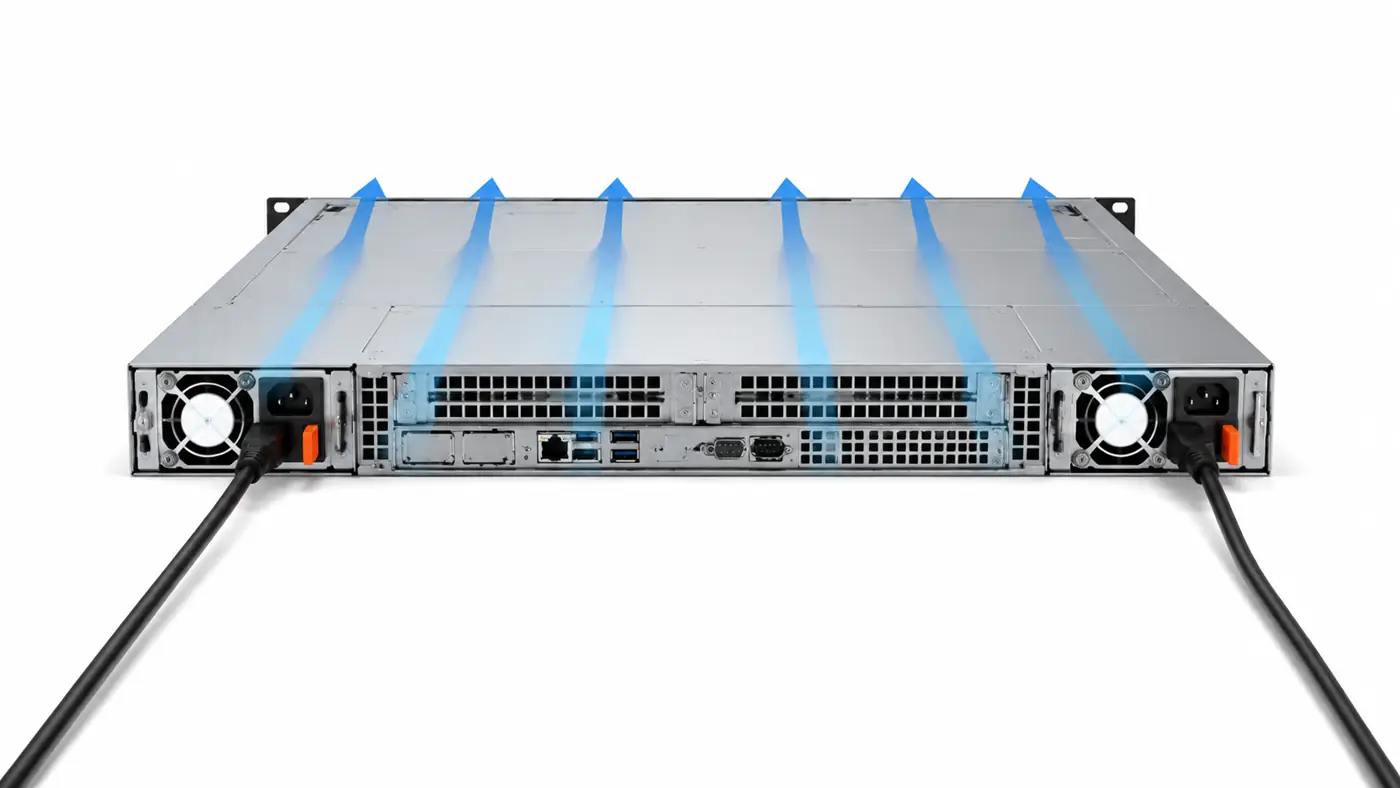
Confirm airflow direction and the host conditions behind the documented rating. A module with the wrong airflow direction can oppose the server fan plan or recirculate heated exhaust. Also distinguish the PSU’s own fan capability from airflow or inlet-temperature conditions imposed by the host platform.
| Record | What it can support | What it does not establish by itself |
|---|---|---|
| Manufacturer product record | Exact product naming, documented wattage, input conditions, form-factor description, available feature statements, and sometimes drawings or datasheets | Compatibility with every chassis that can physically accept the module |
| Manufacturer power-supply or compatibility matrix | Documented relationships between the model and listed systems, product families, or supported options within the matrix’s stated scope | Support for an unlisted host, custom PDB, different revision, or inferred mechanical equivalent |
| 80 PLUS certification registry | The recorded efficiency classification for the model identity shown in the registry | Host approval, hot-swap behavior, redundant capacity, PMBus interoperability, or performance outside the certification scope |
For example, the 80 PLUS registry entries for Super Micro provide a primary place to compare a claimed classification with the exact model identifier recorded by the certification program. A family resemblance or shared wattage is not enough. If a seller lists one suffix while the registry contains another, record the discrepancy rather than assuming that the suffix has no technical significance.
The same discipline applies to the manufacturer matrix. A matrix may associate a PSU with a server family, a replacement option, or a broader product group. Record exactly what it says. Do not expand a family-level entry into support for every configuration, motherboard, PDB, firmware baseline, or thermal arrangement carrying that family name.
Use a claim-to-source ledger
A compact ledger prevents one strong document from being treated as proof of unrelated features. Put each commercial claim in its own row—model identity, wattage, Titanium class, 1U relationship, host support, redundancy, hot-swap service, PMBus, airflow, and included hardware. Assign the source that actually supports it and leave the status unresolved when no applicable source is available.
This is especially important for PMBus and hot-swap wording. A product record may confirm that a module implements a management interface, yet the target host may require particular commands, addressing, telemetry behavior, firmware support, or fault handling. Likewise, a removable handle does not authorize removal under load. Hot-swap behavior belongs to the supported module, PDB, host policy, capacity state, and service procedure together.
Treat identity mismatches as engineering information
Search-result audits frequently expose minor-looking differences: an added suffix, a changed revision, two ordering numbers on the same label, or a product page whose title differs from the certification entry. These differences are not automatically disqualifying, but they require resolution from a source able to explain the relationship.
A manufacturer may use separate commercial, assembly, regulatory, and service identifiers for related hardware. A later part may also be a documented supersession. The acceptable evidence is a controlled cross-reference or manufacturer statement that connects the identifiers and defines the applicable scope. Seller-created equivalence tables can help locate that evidence, but they do not independently prove the substitution.
Use three statuses rather than forcing an early yes-or-no answer:
- Reconciled: the identifiers match directly or an authoritative cross-reference explains the relationship.
- Open: the difference may be legitimate, but its meaning or scope has not been established.
- Conflict: records refer to different products, revisions, ratings, efficiency classes, or package contents without a supported relationship.
An open field can be returned to the supplier for clarification. A conflict should prevent the candidate from being represented as the audited model. This rule is more defensible than selecting the most favorable description among several inconsistent pages.
The three-record match opens six deployment gates
Reconciliation establishes what the product is and whether its Titanium claim and documented platform relationships belong to the same model. It does not yet establish that the candidate can be installed in the target server. Six additional gates remain, each with its own evidence owner.
1. Host support
Identify the exact server, chassis revision, supported PSU option, installed PDB, and any platform restrictions on module pairing or firmware. A manufacturer matrix is useful only within its stated scope. If the intended host is absent, the result is unresolved rather than implicitly compatible.
2. Mechanical and blind-mate interface
Determine whether “1U” describes the server or the actual module packaging. Compare the body envelope, insertion rails, flange, latch, connector location, insertion stop, and extraction clearance. The method for creating a server PSU mechanical fit drawing is useful when a candidate is being assessed for a nonstandard or insufficiently documented bay. Similar external dimensions do not prove that the connector seats at the correct position or depth.
3. Input and output operating conditions
Record the accepted AC input, frequency, documented output availability, and any input-dependent or thermal limitations for the exact model. Match those conditions to the rack PDU, branch circuit, cords, staging location, and recovery environment. Titanium certification should not be used as evidence that the full stated wattage is available from every input source.
5. Redundant and management behavior
Determine whether the host supports one module, a matched pair, or another population policy. For a protected 1+1 configuration, the required server load must remain within the documented capacity of the surviving supported path under the intended conditions. Separately establish current sharing, fault isolation, host recognition, alarms, and management behavior. A generic PMBus claim does not define every command or BMC interaction.
6. Supplied hardware
State whether the quotation covers one removable module, two modules, a cage, PDB, output harnesses, AC cords, mounting parts, and documentation. The exact module-to-PDB boundary should be recorded in a server PSU connector and interface map when the purchase involves new integration rather than a host-approved spare. A complete-looking listing can still omit the hardware that makes the module usable.
Freeze the audited identity in the transaction
Once a candidate passes the model audit and the applicable deployment gates, carry the same identity into the RFQ. Name the manufacturer, complete part number, accepted revision or revision range, quantity, supply scope, required source documents, and target host. If alternatives are permitted, require them to be identified before shipment and subjected to the same audit. “Equivalent or better” is not adequate substitution language for a platform-specific hot-plug PSU.
The receiving record should compare the delivered label with the approved identity before installation. Check the manufacturer and part number, revision, quantity, airflow marking where documented, connector and keying arrangement, physical condition, and included hardware. A discrepancy should reopen only the affected evidence chain; it should not be waived because the carton or invoice repeats the expected wattage and Titanium wording.
There are three useful shortlist outcomes. Proceed to platform review when one exact model remains consistent across the manufacturer product record, applicable compatibility matrix, and certification registry, with no unresolved identity conflict. Hold the candidate when a potentially resolvable source or deployment field is missing. Exclude it when the seller cannot identify the supplied product, records describe conflicting models, or the quotation permits an unspecified replacement.
This approach intentionally makes the shortlist smaller. The purpose of searching for a 1U Titanium server PSU is not to collect the largest number of efficient-looking modules; it is to preserve one exact product identity while each record proves only the claim it is qualified to support. Product identity, platform relationship, and Titanium classification must converge before price comparison begins—and any remaining host, electrical, thermal, redundancy, management, or supply-scope question must stay visibly unresolved until its own evidence closes it.