If you searched for the Common Redundant Power Supply Design Guide for Servers, the primary destination is Intel document 573090. Use the official Intel document page to obtain the authorized file and confirm its current revision, access conditions, and stated scope. Do not treat a copied PDF, search-result excerpt, or supplier summary as the controlled source. The engineering task that follows is to connect each applicable requirement to that source without assuming the document proves compatibility for an unidentified PSU, power distribution board, or server.
Quick answer: use the guide as a controlled source, not a compatibility certificate
Register the exact document and revision before extracting requirements. Classify each source as a governing specification, an implementation resource, or host-specific evidence. Then create one matrix row per requirement with a source pointer, applicability statement, design owner, planned evidence, and status. Keep unresolved mechanical, electrical, control, thermal, firmware, and service interfaces open. A CRPS or M-CRPS family name can narrow the relevant document set, but it does not by itself establish that two modules are interchangeable or that either one is supported by a particular server.
Three document classes answer different engineering questions
The search results for this topic bring together documents that may all be technically useful but do not have equal authority. The Intel Common Redundant Power Supply Design Guide for Servers is the exact document sought by the query. An M-CRPS base specification addresses a defined specification scope. Semiconductor-vendor CRPS resources, such as reference designs and component guidance, help engineers investigate possible implementations.
Those roles must remain separate. A formal requirement can govern a design only when its source, revision, and applicability have been adopted for that project. A reference design can show one way to implement a function, but it does not automatically define what the server must support. Host service documentation may be narrower than either family document, yet it can be the controlling evidence for an approved replacement in a named platform.
| Source class | What it can establish | What it does not establish alone |
|---|---|---|
| Official CRPS design guide | Requirements, recommendations, definitions, and interfaces within the document’s declared scope | Support for an unidentified module, revision, PDB, or server platform |
| Formal M-CRPS specification | Requirements applicable to the M-CRPS scope and revision identified by the project | Automatic equivalence with every product marketed as CRPS or M-CRPS |
| Component or reference-design resource | Implementation options, component behavior, topology guidance, and design examples | Host approval or compliance with a separate system specification |
| PSU, PDB, and host documentation | Model-specific ratings, interfaces, supported configurations, service rules, and revision relationships | Requirements for products or configurations outside the document’s identified scope |
Before using a statement, ask two questions: “Is this source authorized to make this claim?” and “Has the project adopted this source for this exact hardware boundary?” A technically credible document can still be the wrong authority for a particular requirement.
Freeze document identity before extracting requirements
A filename is not sufficient revision control. Files can be renamed, copied without release history, or retained after a newer issue becomes available. Create a source register that identifies the document independently of its local storage name. Where permitted by organizational policy, retain the controlled file or a secure reference to it and record enough information to detect an accidental substitution.
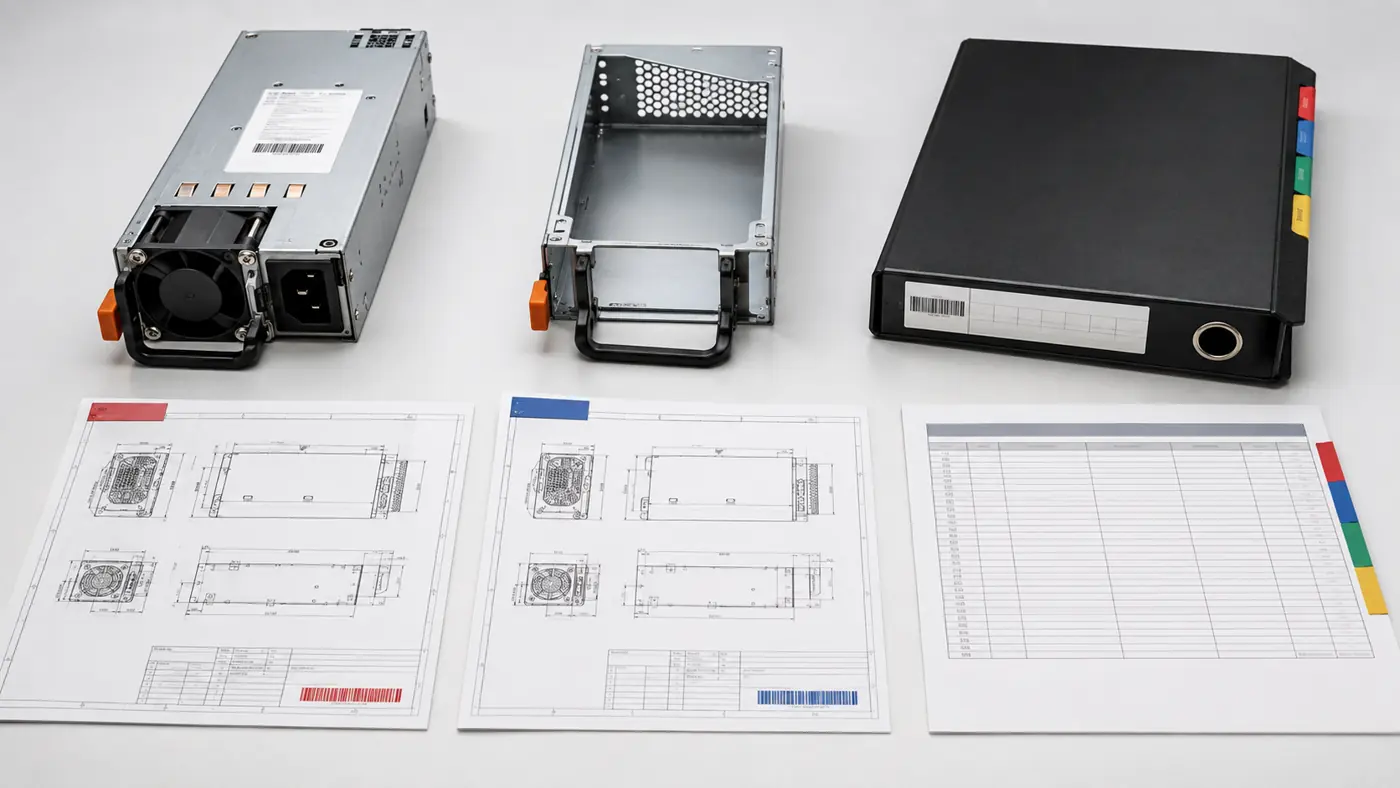
| Register field | Purpose |
|---|---|
| Source ID | Provides a short, stable identifier for matrix references |
| Official title and publisher | Separates the document from similarly named summaries or derivative copies |
| Document number | Preserves identity when filenames and web addresses change |
| Revision or release date | Defines the technical baseline being interpreted |
| Retrieval location and date | Records where the controlled copy originated |
| Applicability decision | States whether the source governs, informs, or does not apply to the project |
| Hardware scope | Names the PSU, PDB, cage, host, or subsystem to which the decision applies |
| Supersession status | Shows whether a later document exists and whether its impact has been assessed |
| Record owner | Assigns responsibility for resolving revisions and access questions |
Do not silently combine requirements from multiple revisions. If one project document cites an earlier guide while a supplier proposes hardware against a later revision, keep both source identities visible until the differences have been assessed. “Latest available” is not a durable baseline because its meaning changes over time.
The applicability field is equally important. It can state, for example, that a source governs a new power-subsystem design, informs a preliminary architecture study, or is retained only for comparison with installed equipment. This prevents an informative document from acquiring unintended contractual authority.
An effective row therefore has two traceable directions. Looking upstream shows why the requirement exists and which source controls it. Looking downstream shows which design element responds to it and where supporting evidence will be found. That bidirectional structure is more useful than a simple compliance column containing only “yes,” “no,” or “open—evidence pending.”
Organize the matrix around server power boundaries
Document chapter order is convenient for reading but often poor for system integration. Requirements that affect one interface may appear in several chapters or in several different files. Grouping the working matrix by physical and functional boundary exposes where a project has adequate evidence and where authority changes from a family guide to model-specific documentation.
| Boundary | Questions the matrix should resolve | Likely controlling evidence |
|---|---|---|
| Mechanical module-to-cage boundary | What envelope, datums, insertion path, retention features, connector position, and extraction clearance apply? | Applicable family specification plus exact module, cage, and host drawings |
| AC input boundary | Which source conditions apply, and what ratings or restrictions change with the deployed input? | Exact PSU documentation and server or rack deployment records |
| PSU-to-PDB electrical boundary | Which power, standby, control, sense, and communication functions cross the mating interface? | Applicable specification and revision-matched module/PDB interface records |
| PDB-to-load boundary | How are power paths combined, isolated, protected, and distributed to host load zones? | PDB schematic, layout, interface schedule, and host power architecture |
| Control and firmware boundary | Which states, commands, telemetry items, alarms, and revision dependencies must the host support? | Applicable protocol requirements plus module, PDB, BMC, and platform documentation |
| Thermal boundary | Which airflow direction, inlet condition, obstruction limits, and failure-state cooling assumptions apply? | Module thermal data, chassis airflow definition, and host operating envelope |
| Redundancy and service boundary | What module-loss or service state is supported, where does isolation occur, and what capacity remains? | Host architecture, PDB design, PSU operating data, and authorized service procedure |
This arrangement prevents a family-level statement from being stretched across a model-specific gap. A guide may define an interface category, but the project still needs exact evidence for the selected module and mating assembly. Likewise, a module datasheet can document a rating without proving that the host firmware recognizes that revision or that the PDB implements the required distribution behavior.
For the distribution boundary, Powernexu’s explanation of the 1+1 CRPS power distribution board shows why combining, isolation, standby power, management, and downstream load paths must be assigned to actual hardware. The traceability matrix should point to that hardware’s controlled evidence rather than stating broadly that redundancy is “handled by CRPS.”
Open interface flags prevent false CRPS equivalence
A useful matrix makes unknowns conspicuous. It does not turn a shared family name, similar card edge, matching wattage, or common mechanical appearance into proof of interchangeability. Use explicit flags that describe why a row remains unresolved:
- Source gap: no authorized document supports the required claim.
- Revision gap: the available evidence applies to a different module, PDB, host, or firmware revision.
- Authority conflict: two sources appear to disagree, or their precedence has not been assigned.
- Implementation-only evidence: a reference design demonstrates a possible approach but does not establish compliance for the selected product.
- Host-specific gap: family documentation exists, but platform approval or behavior remains undocumented.
- Interface gap: mating, signal, sequencing, management, or thermal information is incomplete.
For example, a mechanical drawing may show that a module can enter a cage while leaving the electrical functions of its contacts unresolved. The row may support a fit study, but it cannot authorize energization or substitution. Powernexu’s method for reading and verifying a server PSU pinout explains why contact assignments must remain tied to the exact module, revision, viewing orientation, host, and mating PDB evidence.
The same discipline applies to M-CRPS terminology. A source may legitimately define requirements for its stated M-CRPS scope, but the label on a listing does not prove that a candidate implements the same revision, optional functions, host behavior, or physical interface. Record the claimed family first; authorize a use only after the relevant boundaries have their own evidence.
Keep requirement authority separate from compliance evidence
Each matrix row should distinguish at least four ideas: what is required, why it applies, how the design responds, and what evidence supports that response. Combining them into one narrative cell makes review difficult and can hide circular reasoning—for example, treating a supplier’s claim as both the requirement and the proof that the requirement is met.
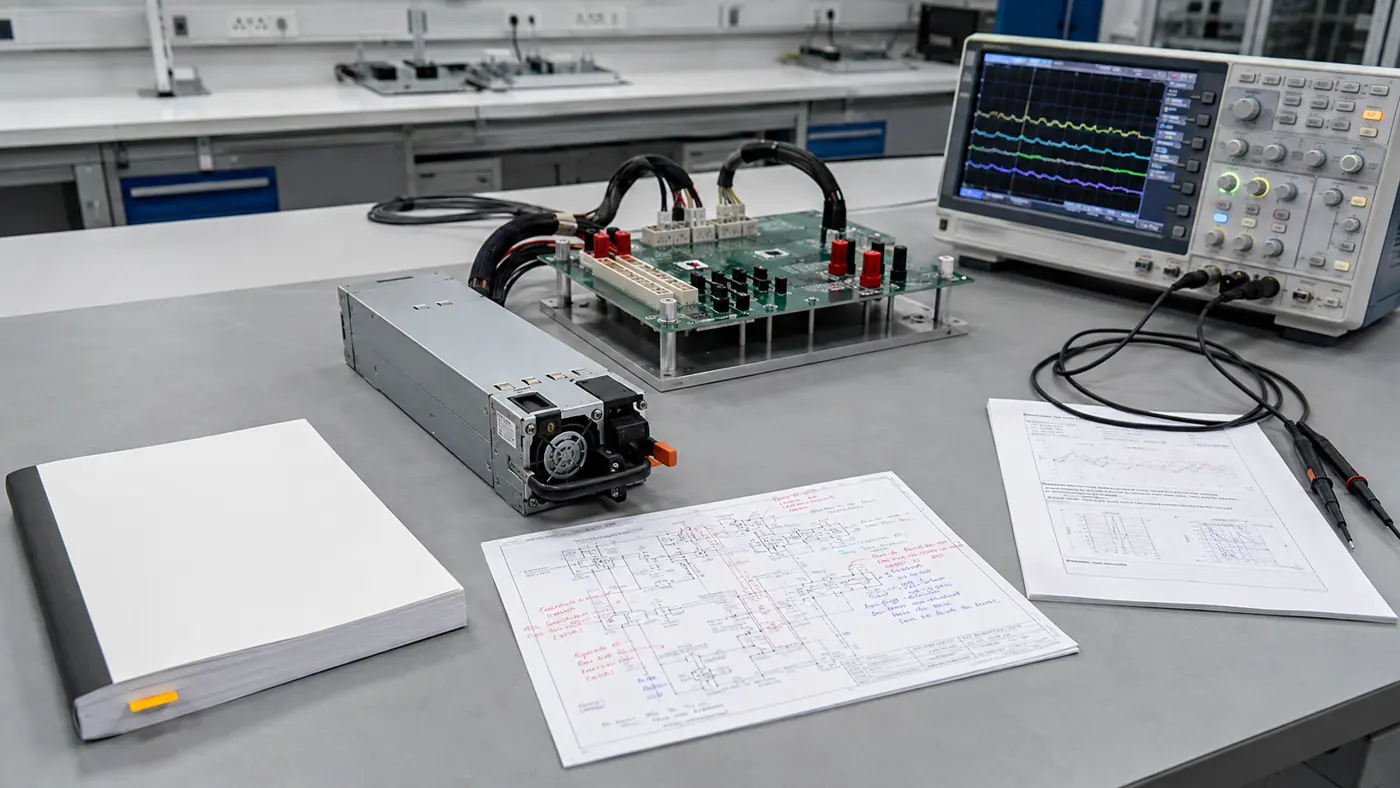
A source document normally establishes the requirement. A design record identifies the chosen implementation. Evidence then supports the implementation for a defined configuration. The resulting status should be narrow: compliant to the recorded source and revision, open pending host evidence, not applicable with an approved rationale, or deviating under a separately controlled disposition. Avoid a universal “CRPS compliant” status when the matrix covers only selected boundaries.
Change control follows naturally from this separation. A new guide revision changes the source baseline; a new PSU or PDB revision changes the implementation baseline; a BMC update may change host behavior; and a chassis airflow modification changes the thermal context. Each event should trigger review only of the rows connected to the affected source or component. That is the practical value of traceability: engineers can identify the consequences of a change without reopening every unrelated requirement.
The completed record defines what the documents actually authorize
A revision-controlled CRPS requirements matrix is not a substitute for the Intel guide, an M-CRPS specification, a supplier’s technical file, or a server manufacturer’s support record. It is the project’s map between those sources and the exact power subsystem being designed, quoted, or reviewed.
The record is ready for use when every adopted requirement has a governing source and revision, every source has a stated applicability, every matrix row names its hardware or firmware boundary, and every unresolved interface remains visible. It should allow an engineer to say precisely that a requirement applies to a named module-to-PDB interface or host configuration. It should not imply that CRPS naming alone proves universal fit, pinout equivalence, firmware support, redundant capacity, or hot-swap behavior. That boundary between documented authority and unresolved implementation is what turns a collection of CRPS design documents into a defensible server power baseline.