An AC redundant server power supply search should begin by deciding what is being purchased: an exact host-approved replacement, an OEM-supported platform option, or power hardware for a new assembly. These routes require different sources and evidence. A manufacturer series page can reveal available PSU families, an OEM parts channel can establish a relationship to a server ecosystem, and an exact model page can identify one orderable unit. None automatically proves every aspect of host support, supplied hardware, or redundant operation. Classify the result before comparing wattage, efficiency, hot-swap wording, or price.
Quick answer: choose the procurement route before the PSU
For an existing server, start with the host service record and source the exact approved part or documented replacement. For an optional PSU configuration, use the server OEM’s configuration and support documentation before opening a store listing. For a new server or power assembly, begin with a component-manufacturer series, then move to exact-model drawings, interface documents, and an assembly-level quotation. The broad search term is useful for finding a market route; it should not become the technical identity on the purchase order.
An AC redundant server power supply may mean one removable AC-DC module, a matched pair, an OEM spare, or a subsystem containing modules, a cage, a power distribution board, and harnesses. “Redundant” does not establish 1+1 operation, protected capacity, or permission for live removal; those behaviors depend on the host or complete assembly.
“AC” also does not prove that the candidate accepts the deployed rack source or retains full output across its input range. After identifying the exact model, check it against the rack source, PDU, cord, and operating location with the server power supply voltage matching process.
Before searching, choose one route:
- Exact replacement for a named server configuration.
- OEM-supported option or upgrade for a named platform.
- Modules or a complete redundant assembly for new integration.
If none applies, the comparison is still mixing different commercial objects.
Read the four source types as different forms of evidence
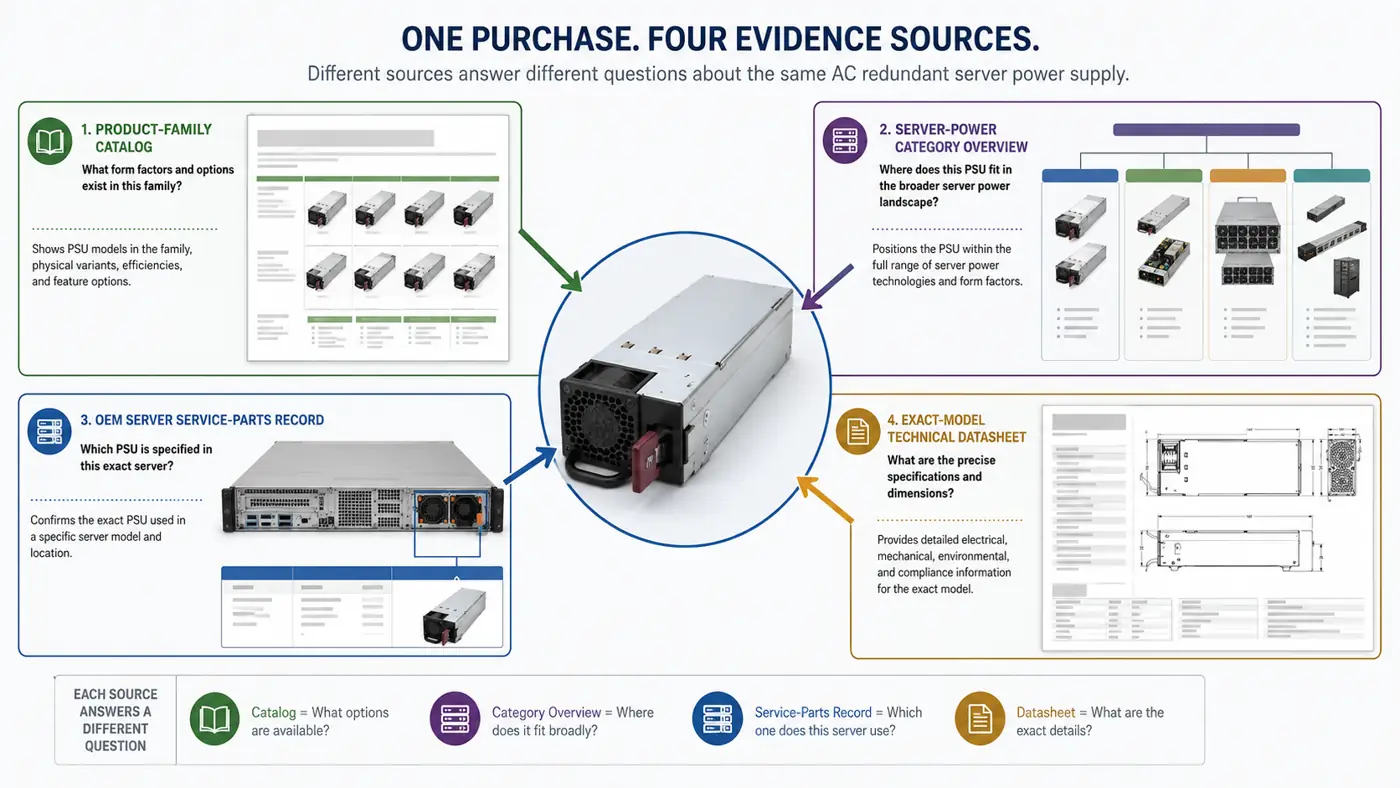
Product-heavy search results often place four kinds of pages beside one another. Their positions may look equivalent, but each page answers a different purchasing question.
| Result type | What it can establish | What usually remains unresolved | Best next document |
|---|---|---|---|
| Component-manufacturer series | Available product family, architecture, and documented family scope | Exact orderable identity, host approval, revision, and supplied assembly hardware | Exact-model datasheet, drawing, and integration documentation |
| Broad manufacturer category | Range of server-power products and possible capacity or packaging classes | Whether one candidate fits the target host or represents a complete redundant system | Individual product page and model-specific documents |
| Server-OEM parts channel | Commercial route into a server vendor’s parts ecosystem | Support for the exact server configuration, supersession status, and kit contents | Host service manual, parts matrix, or configuration record |
| Exact model page | A named model, its stated specifications, and potentially an orderable item | Host relationship, assembly compatibility, pairing policy, and any omitted accessories | Host support record or complete assembly interface package |
Component-manufacturer series pages
A series page is most useful during architecture discovery. For example, the Advanced Energy CRPS series is presented within an AC-DC front-end PSU portfolio. That source can direct an integrator toward a relevant product family, but the family name should not be treated as proof that every model shares the same dimensions, connector implementation, output, management behavior, or host support.
The correct next step is to identify one exact model and obtain the documentation that controls the proposed use. If the project needs a cage, PDB, harnesses, or mechanical mounting, a module-series page is only the beginning of the integration route.
Broad manufacturer categories
A category page is a map of a supplier’s server-power portfolio. It can help a buyer determine whether the manufacturer offers front-end modules, fixed supplies, redundant assemblies, or several capacity classes. It rarely closes a purchase by itself because category-level language may combine products intended for different platforms, airflow directions, input conditions, and interface families.
Use category pages to identify candidate families and eliminate obviously unsuitable architectures. Do not transfer a feature displayed for one item to every product in the category. The shortlist entry should remain at “family candidate” status until an exact model record is available.
Server-OEM parts channels
An OEM channel is usually the strongest route for servicing an existing branded server because platform support is controlled by the server manufacturer. Even then, a store category is not the support record. The buyer may still need the server model, configuration, service identifier, installed PSU label, and documented replacement or supersession relationship.
This route also requires attention to the commercial noun. An OEM listing might describe one replacement module, a kit, or an option intended for factory configuration. Product photography and a shared wattage do not show whether rails, latches, firmware policy, airflow, and the blind-mate interface agree with the installed server.
Exact manufacturer model pages
An exact model page provides the most precise product identity among the four result types, but precision is not the same as platform authority. It may document input, output, physical characteristics, cooling, or efficiency for that model while saying nothing about the server in which the buyer intends to use it.
For an approved replacement, connect the exact model back to host documentation. For a new integration, connect it forward to the mating PDB, cage, control system, thermal design, and load distribution. An exact listing is purchase-ready only for the claims its documentation actually supports.
Replacement, platform option, and new integration take different exits
The supplier route should lead to a specific evidence owner. Continuing to browse broad results after that owner is known adds alternatives without necessarily reducing uncertainty.
| Procurement task | Controlling authority | Preferred route | Point to leave broad search |
|---|---|---|---|
| Replace a failed or stocked module | Server service documentation and controlled installed configuration | OEM parts channel or exact approved-part source | When the exact part or documented supersession is identified |
| Add or upgrade a supported power option | Server OEM configuration and support records | OEM platform documentation followed by the corresponding orderable kit | When the supported option, required quantities, and included hardware are known |
| Integrate a new redundant assembly | Exact PSU, PDB, cage, interface, and host design records | Manufacturer series followed by exact-model and assembly engineering documents | When the architecture is narrowed to named components and an assembly RFQ |
Exact replacement
Begin with the server, not the search engine. Record the host model and revision, both installed PSU identities, the current configuration, and any platform-approved substitution. Search results then become sources for that identity rather than sources of proposed equivalents.
If the seller offers another part number, require a documented relationship to the approved identity. A claim such as “compatible with” has limited value unless the source has authority over the target host. The condition of the part, included accessories, warranty, and delivery terms are commercial questions that should be evaluated after technical identity has been established.
OEM-supported option
This path applies when the server platform supports more than one power configuration or when a power kit is associated with a particular chassis or workload range. The OEM’s configuration record should establish the permitted option and whether other changes are required. Those changes might include module quantity, cords, airflow-related parts, firmware, or other platform-specific hardware; they must be taken from the applicable documentation rather than assumed.
The store listing is then used to obtain the supported option. It should not be used to invent an upgrade path that the host documentation does not describe.
New assembly integration
A new design reverses the authority chain. There is no existing server approval to rely on, so the integrator must define and control the interfaces. A manufacturer series can identify plausible modules, but the deliverable may need to include the cage, mating PDB, output connections, control and management behavior, cooling arrangement, and mechanical service path.
If the project requires more than a converter module, move from product discovery to a documented subsystem request. The Powernexu article on specifying a CRPS redundant power backplane assembly explains how to distinguish a bare board, populated PDB, cage, and complete subsystem without treating “CRPS compatible” as a complete interface definition.
Match each claim to the source that has authority over it
No single page should be expected to prove every property of an AC redundant server power supply. The useful question is not whether a source looks official, but whether it controls the specific claim being made.
- Product identity: use the exact manufacturer model record, label, and applicable revision information.
- Host support: use the server manufacturer’s service, configuration, or parts documentation.
- Electrical ratings: use exact-model technical documentation and retain the stated input, output, cooling, and environmental conditions.
- Mechanical and electrical interface: use controlled drawings and interface documents for both mating assemblies.
- Redundant behavior: use host or complete-assembly documentation that defines module population, capacity policy, fault behavior, and service conditions.
- Supplied hardware: use the quotation, bill of material, or orderable kit description, reconciled with the evaluated configuration.
A source may be authoritative for one claim and silent on another. A PSU manufacturer can define the ratings of its module without authorizing that module for an unrelated server. A server OEM can approve a service part without publishing every internal interface detail. A reseller can confirm stock and condition without having authority to establish an undocumented host substitution.
Build a shortlist record that exposes the next missing document
The shortlist should show why each result is present and what must happen next. A compact record prevents a family page, store category, and exact model from being compared as though they were equivalent offers.
- Procurement route: exact replacement, OEM option, or new integration.
- Candidate object: one module, pair, kit, cage and PDB, or complete assembly.
- Exact identity: manufacturer, model, revision, and any controlled ordering identifier.
- Target relationship: named host, supported platform option, or proposed mating assembly.
- Source class: manufacturer series, category, OEM channel, or exact-model record.
- Claim supported: the narrow fact that the source is qualified to establish.
- Unresolved evidence: host approval, interface, rating conditions, supplied hardware, cooling, management, or another explicit gap.
- Next document and owner: the record needed and the party responsible for providing it.
Do not fill an unresolved field from a neighboring model, a similar photograph, or a category-level feature list. “Unknown” is a useful status because it controls what the candidate may be used for. A model with a documented AC input and output rating may remain suitable for further integration review while still being unauthorized as a replacement for an existing server.
The broad keyword should disappear from the purchase order
An AC redundant server power supply search has done its job when it routes the buyer to a more authoritative identity. For replacement, that identity is an approved service part or documented supersession tied to the installed host. For an OEM option, it is a supported configuration and its exact orderable kit. For new integration, it is a controlled module or assembly with named mating hardware, interfaces, operating conditions, and commercial scope.
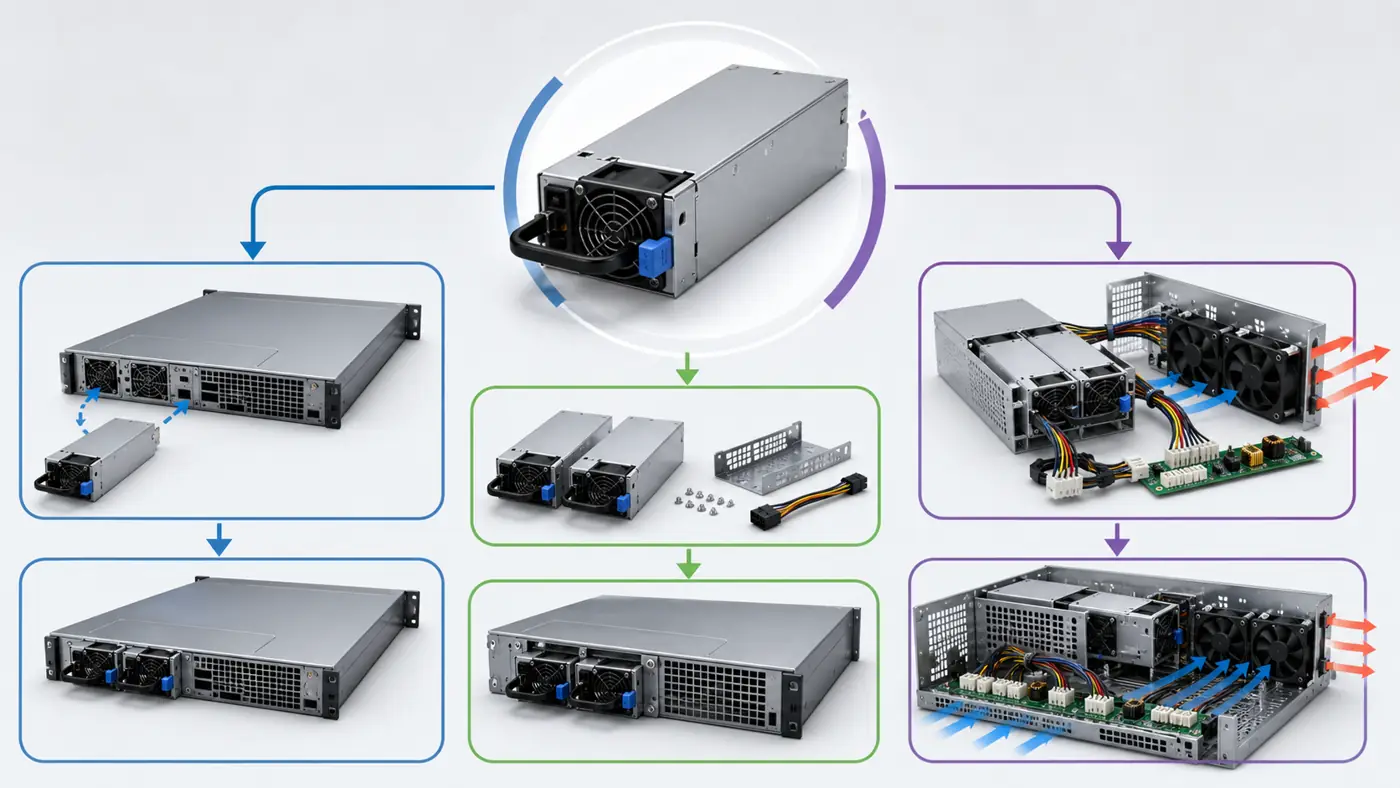
If a result identifies only a family, leave it at the family-discovery stage. If it identifies an exact PSU but not the target host, route the host claim to platform documentation. If the project needs a PDB, cage, or harnesses, stop comparing module-only listings and request the assembly that the design actually requires.
The final purchase line should therefore name the exact supplied object, quantity, revision or permitted substitution, applicable documentation, and included hardware. At that point, “AC redundant server power supply” remains a useful market description, but it no longer carries responsibilities that belong to the exact product, host, and assembly records.