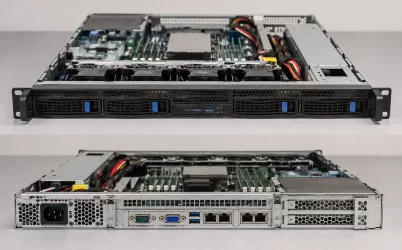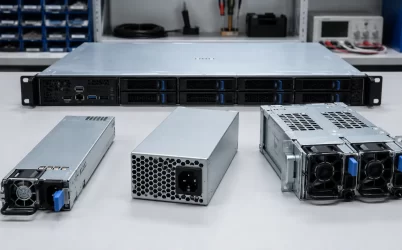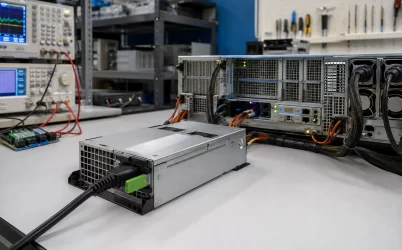
An 800W 1U server power supply search creates a useful market filter, but it does not identify an interchangeable PSU class. Current manufacturer results include a named Supermicro model, a Tiger Power product presented as a 1U CRPS supply, and an Advanced Energy CRPS-type series. Those identities lead to different buying paths. For an existing server, begin with the exact replacement or supported option documented for that host. For a new power assembly, evaluate the module together with its bay, power distribution board (PDB), interface, cooling path, input conditions, and control behavior. Shared 800W and 1U wording is not enough to move a candidate between those paths.
Quick answer: route the result before comparing the specifications
Treat 800W and 1U as screening terms rather than proof of fit. First decide whether the project needs a documented replacement for a named server or a module for a new CRPS-based assembly. A replacement candidate must trace to the host manufacturer’s supported part record. An integration candidate needs model-specific mechanical, electrical, thermal, and management documentation for the intended cage and PDB. Keep input conditions, redundancy behavior, and shipment contents open until the applicable records resolve them. Price comparison begins only after the candidates belong to the same purchasing route.
Three manufacturer results enter different purchasing lanes
The three live result types contain enough information to establish candidate identities, but not enough to declare them equivalent. Their useful role is to show how the same search phrase can point to an exact named part, a CRPS product description, or a CRPS-type series.
| Manufacturer result | What the source establishes | Useful initial route | Facts still unresolved for a target chassis |
|---|---|---|---|
| Supermicro PWS-802A-1R | A specific model presented by its manufacturer as an 800W 1U redundant power supply | Named-part replacement research, followed by host-support confirmation | Support for the buyer’s exact server, applicable revision, pairing policy, input conditions, bay and PDB relationship, and quoted shipment contents |
| Tiger Power 800W 1U CRPS result | A manufacturer product presented as an 800W 1U CRPS redundant supply with an 80 PLUS Platinum claim | CRPS integration screening or evaluation for a platform that explicitly supports the exact product | Exact orderable identity and revision, target-host approval, mating interface, mechanical drawing, airflow conditions, control functions, and included hardware |
| Advanced Energy CSU800AP | An 800W CRPS-type power-supply series | Component evaluation for a documented CRPS-based assembly | Whether the proposed variant fits the target 1U bay, its complete interface relationship, applicable operating conditions, host support, and commercial package |
The wording in the second and third rows may sound more architecture-oriented than the named Supermicro result, but CRPS terminology does not by itself close the integration boundary. The official Advanced Energy CSU800AP product page, for example, identifies an 800W CRPS series. That fact supports product discovery; it does not prove fit in an unidentified server, cage, or PDB.
The same limitation applies in the other direction. An exact Supermicro model number provides a stronger identity than a broad marketplace description, but the model page alone does not establish that the part belongs in every Supermicro server or any third-party 1U chassis. The target host record must supply that relationship.
The host boundary separates replacement from integration
Supported replacement for a named server
A replacement project starts with the installed machine rather than the search results. Record the server model and revision, the labels on both installed PSUs when a pair is present, the cage or PDB identity available from service records, and the current firmware or management baseline. The next question is narrow: does the server manufacturer document the candidate as the supported part, option, or supersession for that configuration?
If the answer is yes, the platform record can authorize a replacement without requiring the buyer to reverse-engineer every contact on the blind-mate interface. It should still be clear whether the quotation contains the exact supported identity, whether mixed models or revisions are allowed, and whether the operating environment matches the host documentation. A similar CRPS module from another manufacturer does not become a replacement merely because it has the same nominal output and enters the bay.
If no documented host relationship can be found, move the candidate out of the replacement lane. It may remain technically interesting for a new design, but that is a different project with different ownership and evidence.
Component integration into a new 1U assembly
A new assembly reverses the logic. There is no existing host approval to absorb interface risk, so the integrator must define the complete module-to-server relationship. The module, cage, PDB, downstream distribution, host controller, airflow system, and service method must form one documented design.
CRPS or CRPS-type language can help locate relevant product families, but it should not be converted into a universal mating claim. The proposed module and PDB must agree on connector geometry, seating position, high-current contacts, standby and control functions, current sharing where applicable, fault isolation, communication behavior, and insertion sequencing. Exact functions remain model- and assembly-specific; they cannot be reconstructed safely from photographs or a different manufacturer’s pin table.
This route also changes what must be purchased. A module-only quote may be appropriate when the project already has a supported cage, PDB, and mechanical design. It is incomplete when the buyer expects the supplier to deliver an installable redundant power subsystem.
Give “1U” one precise meaning in the shortlist
“1U” may describe the host chassis, a PSU envelope, or only a seller category; it is not a universal replacement code. Record which object the label describes, then qualify physical fit against the target bay with a model-specific drawing. Compare the body envelope, flange and latch, seating and connector datums, ventilation openings, and insertion and extraction clearances.
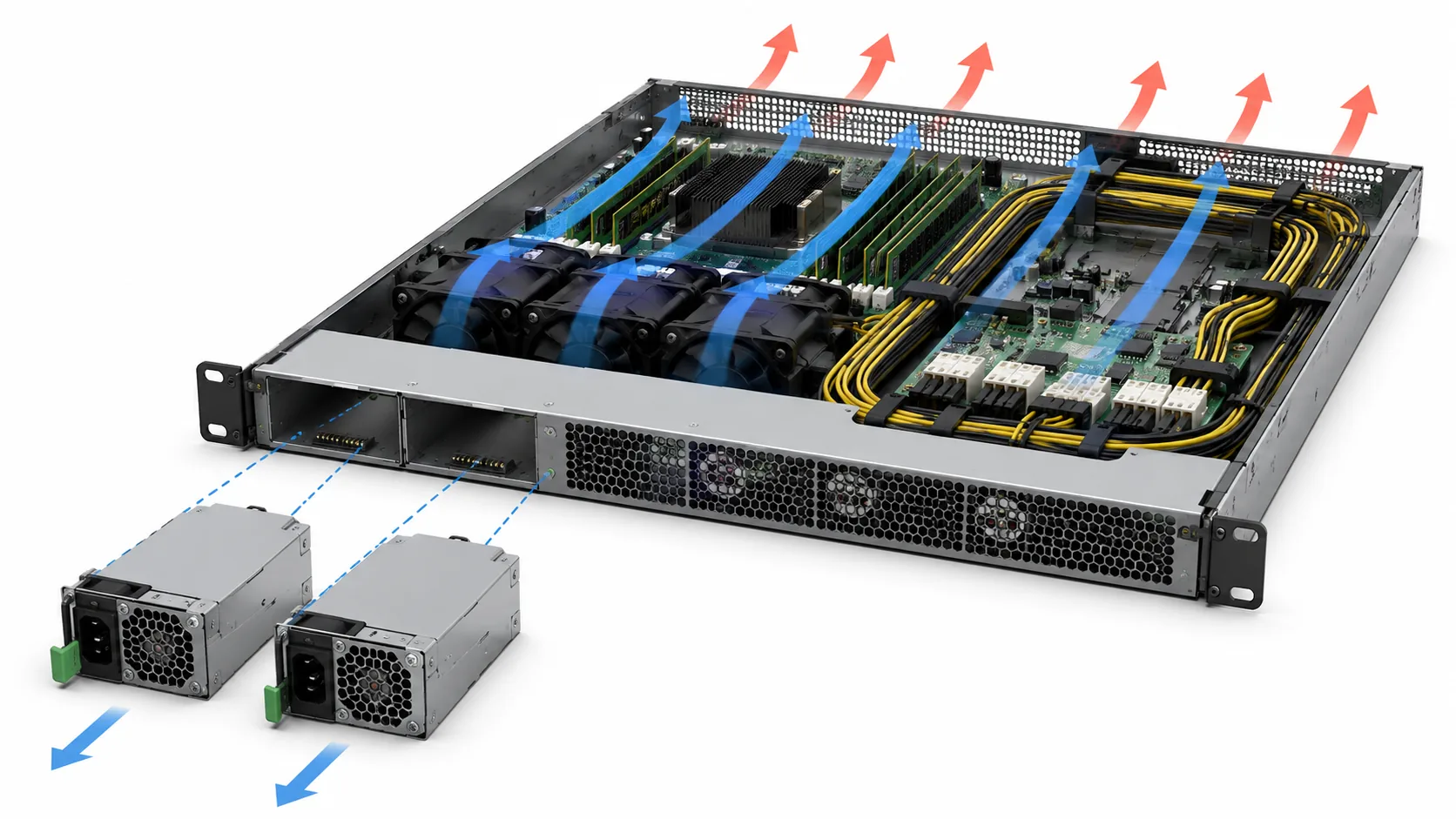
Use a model-specific mechanical fit drawing after the purchasing route is chosen. For a replacement, host support outranks the search snippet. For new integration, coordinated PSU, cage, PDB, and chassis drawings must close the fit question. A 1U label—or successful insertion alone—does not prove PDB mating or electrical compatibility.
Seven evidence gates reduce the list to chassis-specific candidates
A useful shortlist does not require every candidate to pass the same route. It requires each candidate to pass the gates appropriate to its authorized use. The following matrix keeps replacement evidence separate from new-assembly evidence while exposing gaps that block either path.
| Evidence gate | For a documented replacement | For a new CRPS or CRPS-type assembly | Disposition when missing |
|---|---|---|---|
| 1. Exact identity | Manufacturer, complete part number, applicable revision, and documented supersession if used | Exact orderable model and revision, not only a family or category name | Hold the candidate; price and compatibility claims cannot be attached reliably |
| 2. Target bay | Host documentation connects the part to the exact server or PSU option | Coordinated PSU, cage, and chassis drawings establish seating and service clearance | Remove from the chassis-specific list while retaining it, if useful, for category research |
| 3. Mating PDB and interface | The supported host configuration defines the module-to-PDB relationship | Controlled interface records define both mating sides, including power, control, sense, and management functions that the design uses | Do not infer interchangeability or energize an unverified interface |
| 4. Airflow and cooling | Module airflow and installed server cooling agree with the supported configuration | Airflow direction, inlet conditions, pressure environment, fan ownership, and thermal limits are assigned to the module or host | Retain the rating as unproven in the proposed enclosure |
| 5. Input and output conditions | The installed rack source and host configuration fall within documented operating conditions | The exact variant’s input envelope and available output under the proposed source and cooling conditions are documented | Do not treat 800W as available at the intended deployment point |
| 6. Redundancy and host behavior | The server supports the installed population, pairing policy, alarms, and required operating state | The PDB, modules, controls, and host policy implement the intended sharing, isolation, failover, and restoration behavior | Describe the candidate only as a power module, not a proven redundant subsystem |
| 7. Shipment scope | The quote states whether it includes one module, a pair, accessories, and any host-specific kit items | The quote explicitly includes or excludes the cage, PDB, harnesses, mating connectors, mounting hardware, and documentation | Return the quote for clarification before comparing total cost |
The interface gate deserves special care because visual similarity can be persuasive. A card edge or blind-mate connector can physically resemble another design while carrying different control assignments, voltage domains, contact sequencing, or management behavior. Use model-, revision-, host-, and PDB-specific server PSU pinout evidence where contact-level knowledge is necessary. Unknown contacts should remain unknown rather than being completed from an unrelated diagram.
The 800W claim must survive the intended operating conditions
An 800W label should be read as a rated output associated with documented conditions, not as a promise that every rack source, temperature, airflow arrangement, or redundant state produces the same result. The shortlist should retain the input range, applicable output condition, cooling requirement, and any documented derating alongside the model identity. If the source material does not resolve one of those fields, mark it as unresolved instead of filling it with a family-level assumption.
Efficiency belongs in a separate column. The Tiger Power result’s Platinum claim may be useful when comparing conversion efficiency after product identity and deployment conditions are established. It does not prove that the module fits the target bay, mates with the PDB, supports the host’s management behavior, or provides the required capacity after a module becomes unavailable.
Redundancy also requires an assembly-level statement. A product may be described as redundant because it is intended for a redundant architecture, but continuity depends on the installed module population, PDB, isolation method, host policy, available capacity, and upstream feeds. For this search, there is no need to repeat generic 1+1 capacity arithmetic. The necessary question is more specific: under which documented input, cooling, and host conditions can the proposed 800W module perform its assigned role in this chassis?
How the chassis changes the shortlist
If a server’s service documentation lists Supermicro PWS-802A-1R, that result can remain in the replacement lane after its revision, pairing conditions, seller identity, and shipment scope are reconciled. Tiger Power and Advanced Energy do not compete as replacements unless the host manufacturer documents them for that server.
For a new 1U design with an undeveloped cage and PDB, the Tiger Power CRPS result and Advanced Energy CSU800AP series may enter component evaluation. Neither becomes chassis-specific until its exact variant, drawing, interface, cooling, controls, operating conditions, and supplied hardware are resolved. The shortlist may therefore retain one supported spare, several integration candidates, or no purchase-ready result.
Write the quotation around the surviving route
For a replacement, the requested line should name the server, exact PSU manufacturer and part number, acceptable revision or documented supersession, quantity, condition, included accessories, and permitted substitutions. It should request confirmation that photographs, labels, and shipped hardware refer to that identity rather than to a representative 800W 1U unit.
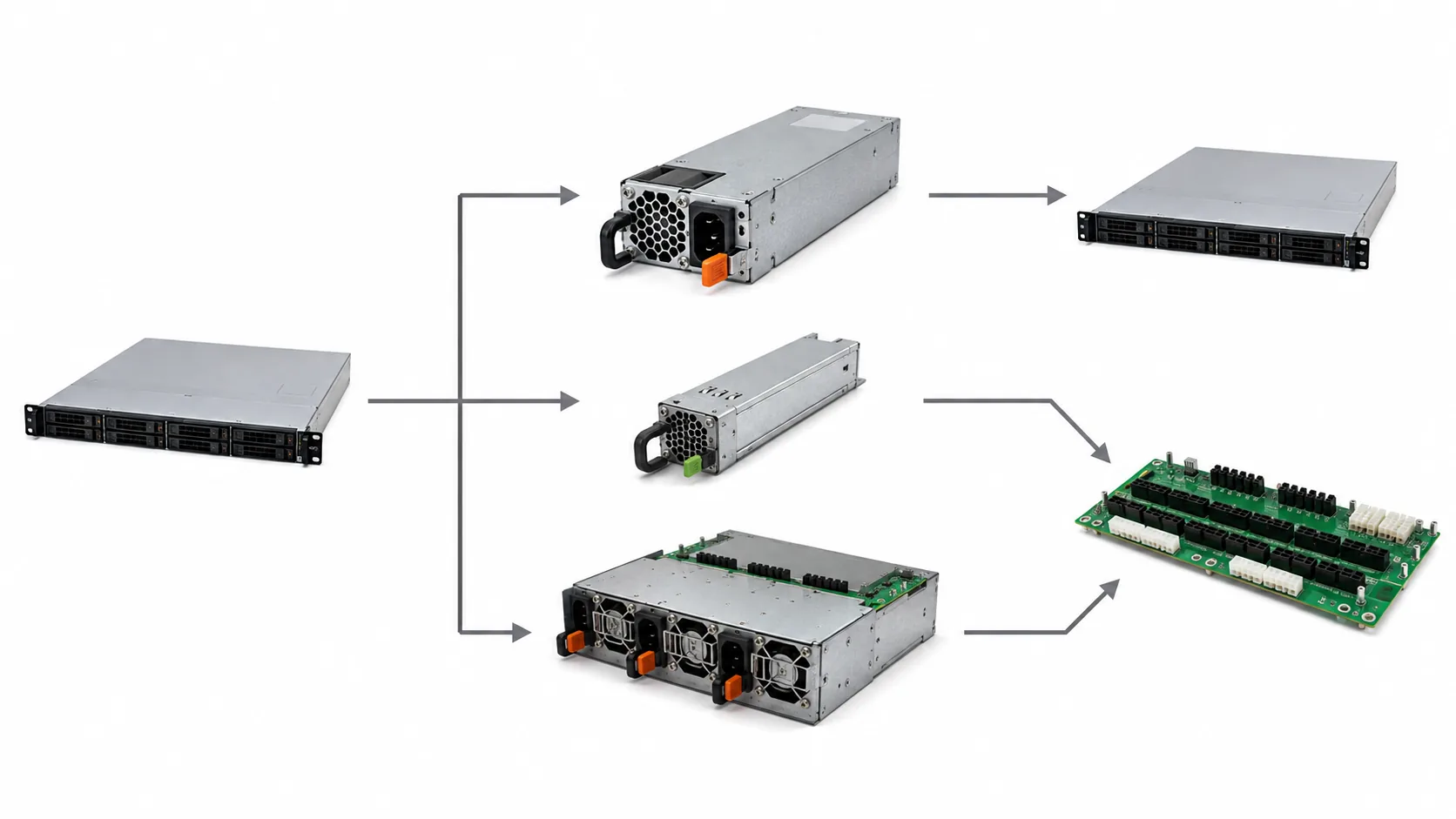
For new integration, the requested line should name the exact module variant and quantity, target chassis and bay, mating cage and PDB, required drawings and interface documents, airflow direction, applicable input and output conditions, intended redundancy role, management functions used by the host, and every included or excluded mechanical and electrical component. Any proposed equivalent should be evaluated as a new candidate rather than substituted through a shared CRPS or 800W description.
The finished chassis-specific shortlist may therefore contain one supported spare, several integration candidates, or no purchase-ready result at all. Each retained row should state its authorized use, exact identity, target chassis relationship, unresolved conditions, and quoted package. That is the point at which an 800W 1U server power supply result becomes actionable without pretending that three unlike manufacturer products are interchangeable.