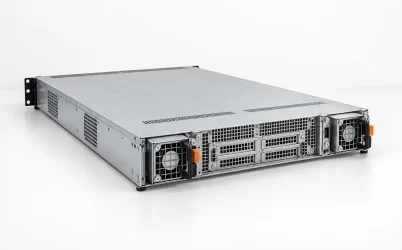
Gold and Platinum are efficiency classes, not server power-supply form factors. A Platinum badge does not make a module fit a particular chassis, and a Gold badge does not mean that the supply wastes an intolerable amount of energy. The useful comparison is narrower: for two electrically and mechanically suitable server PSUs, how much input energy and heat does the efficiency difference save at the loads where the server actually operates, and is that saving worth any price difference? The answer changes with the 80 PLUS test category, redundancy arrangement, electricity price, and operating hours.
Start with the certification category, not the color of the badge
80 PLUS publishes different efficiency requirements for different supply categories. Its 230 V Internal Redundant category, relevant to many data-center modules, specifies Gold minimum efficiency of 88% at 20% load, 92% at 50%, and 88% at 100%. Platinum requires 90%, 94%, and 91% at those same three points. Those figures are tier thresholds under the program’s test conditions, not a prediction of an installed server’s measured efficiency at every workload. A supply can exceed its class minimum, so the actual difference between two candidates may be smaller or larger than the threshold gap.
The same words appear on other 80 PLUS categories with different input conditions and requirements. A desktop-class Gold result and a redundant-data-center Platinum result should not be laid side by side as though only the efficiency level changed. Identify the exact certified model, input-voltage category, and published test result for both candidates. If either candidate is a DC-input module, an AC-input 80 PLUS label is not a substitute for its own DC conversion data. The category sets the comparison’s boundary before any energy calculation begins.
Translate efficiency into input watts and heat
Efficiency is DC output divided by AC input. At a fixed DC load, input power equals output power divided by efficiency; the difference between input and output becomes loss inside the PSU, predominantly heat. For a purely illustrative 600 W DC load, a module operating at 92% draws about 652 W and dissipates about 52 W. At 94%, it draws about 638 W and dissipates about 38 W. The 2-percentage-point efficiency change saves roughly 14 W at that operating point, not 2% of the module’s nameplate wattage. These are example efficiencies selected from the 50%-load tier thresholds, not performance claims for particular products.
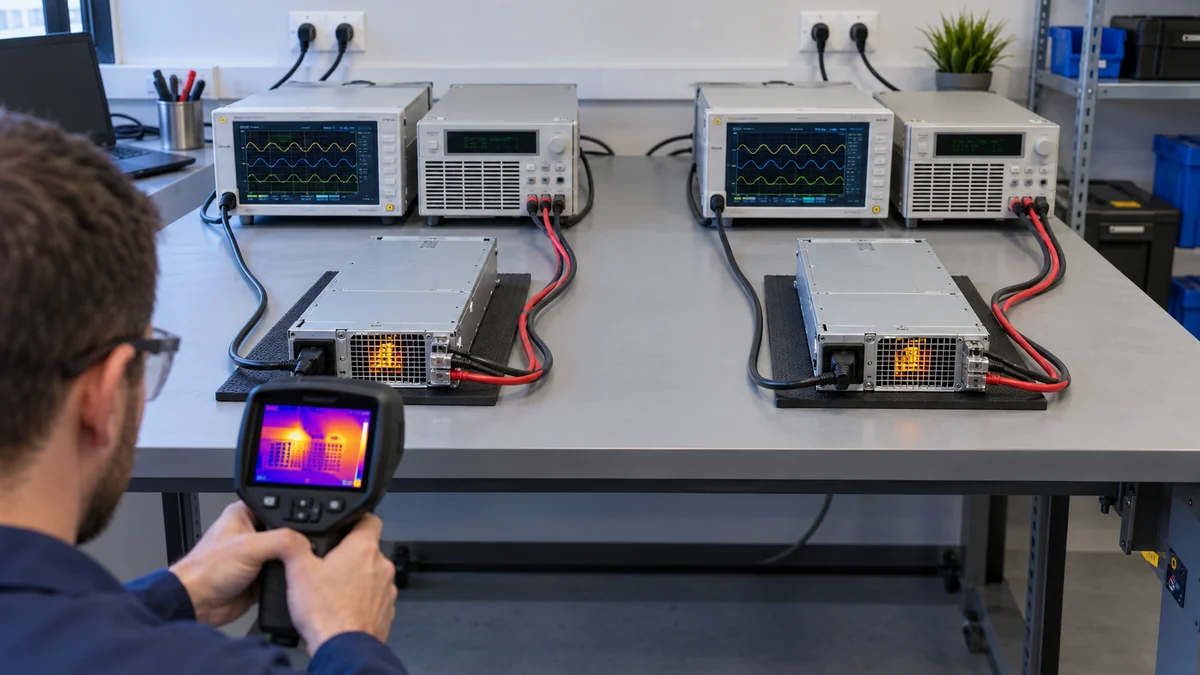
The thermal difference is not just an accounting detail. Heat rejected by the PSU joins the server’s exhaust stream and ultimately reaches the cooling system. Fourteen watts is modest for one server; multiplied by hundreds of continuously operating units it becomes a noticeable facility load. It may also matter locally in a dense chassis where the PSU inlet already sees warm air. Conversely, the difference will not fix a blocked air path or an incompatible fan direction. Energy and temperature are related, but the rack’s cooling geometry still has to work.
At 20% load, the threshold difference is again two percentage points; at 100%, it is three points in this particular category. That does not prove Platinum always saves more watts at full load. The watts saved depend on the DC load as well as the actual efficiency of each candidate. Comparing measured curves is better than extrapolating the certificate’s three thresholds into a continuous curve. One candidate may outperform its tier minimum substantially, especially near a load point that was not reported in a short product listing.
Redundancy moves the operating point
A server with two 1,200 W modules in a 1+1 arrangement may share a 600 W DC demand between them. With roughly equal sharing, each module then supplies about 300 W, or 25% of its 1,200 W rating. A single-module 600 W calculation at 50% load cannot be applied to each of those modules. If one module is removed or fails, the survivor supplies approximately the full 600 W, shifting toward 50% load. Normal operation and failed-module operation therefore call for different points on the efficiency curve.
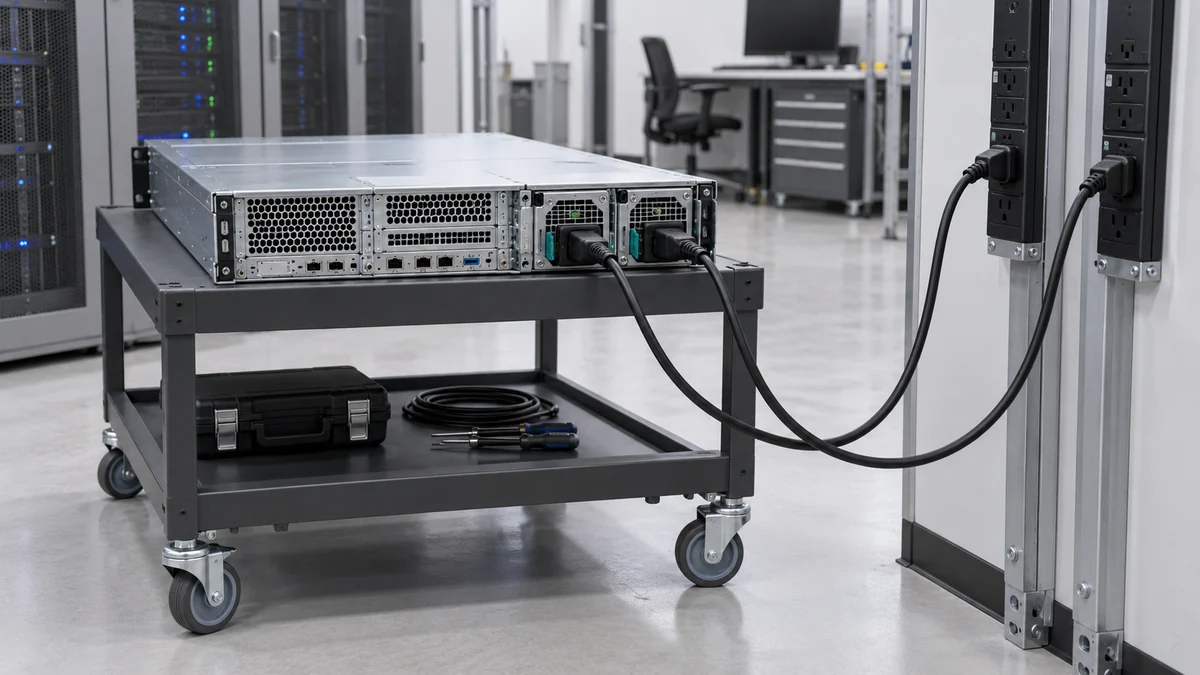
The exact sharing behavior is determined by the power system, not by an assumed perfect 50/50 split. Some chassis change sharing with load or place one module in a low-power operating mode. Fan consumption and control overhead can alter the low-load result. A Gold module with an excellent 25%-load curve might narrow the gap to a Platinum module at this server’s normal operating point, even though the tier thresholds differ. Alternatively, a Platinum candidate may hold a useful advantage across both shared and single-module states. The certificate is a starting coordinate; the deployed topology locates the relevant points.
Redundancy must first meet its availability purpose. Each surviving module and its upstream feed must support the server’s defined worst-case load, including applicable environmental derating. Do not choose a lower-output Gold module merely because its efficiency peak aligns with normal load if it cannot sustain the failure state. Equally, do not buy vastly oversized Platinum modules solely for a higher badge if they will idle at a very low load for most of their life. Capacity and conversion losses have to be evaluated together, but they are different constraints.
A payback calculation needs an actual load profile
Suppose a buyer has approved Gold and Platinum alternatives for the same chassis. The server’s measured DC demand is approximately 600 W for 6,000 hours each year. At that point, testing of the exact units—not their tier labels—shows a 14 W difference in combined AC input power. Annual electricity saving is 0.014 kW × 6,000 h, or 84 kWh per server. At an illustrative electricity price of $0.15 per kWh, that is $12.60 per server-year before accounting for cooling. If the Platinum configuration costs $75 more, simple electricity-only payback is about six years. Change the load, measured efficiency difference, hours, price, or premium, and the result changes. None of these figures is a Powernexu or competing product claim.
Real servers rarely sit at one output level. A more useful calculation divides operating time among a few representative DC loads: idle, typical workload, and high demand. For each load bin, obtain the Gold and Platinum input power at the intended AC voltage and redundancy state. Multiply the input-watt difference by hours in that bin, then add the bins. For example, a module that saves almost nothing during long idle periods but saves substantially during a short processing window may not deliver the annual benefit suggested by its best-load certificate point. A storage system with steady demand could produce a different result from a bursty accelerator server using the same nominal PSU class.
Cooling savings can be included, but they should not be invented as a universal multiplier. The conversion-loss reduction lowers heat that must eventually be removed; the incremental facility energy depends on the cooling plant and operating conditions. If the organization knows its marginal cooling energy per watt of rack heat, it can extend the model. Otherwise, report the electrical saving separately and describe the cooling benefit qualitatively. This keeps the comparison transparent rather than hiding a speculative payback assumption inside an impressive-looking total.
The module price is only one cost difference
Gold and Platinum candidates may differ in more than efficiency. A platinum-rated unit could use another connector system, mechanical envelope, fan orientation, firmware interface, or supported input range. If it requires a different power distribution board, cable set, cage, or service spare, the acquisition premium is not just the PSU invoice difference. Conversely, a direct-fit Platinum module that is already approved as a service replacement may carry little integration cost. The financial comparison only makes sense after the two options have been shown to serve the same host requirement.
Maintenance economics may also outweigh a modest efficiency saving. A module available as a supported hot-swap spare within the site’s service window can be a better operational choice than a slightly more efficient module with uncertain replacement supply. This is not an argument to ignore energy. It is a reminder that an efficiency tier does not describe interchangeability, failure behavior, or long-term parts availability. The comparison needs to hold those non-efficiency requirements constant or state how they differ.
For a large fleet, small power differences become material because energy is purchased continuously, and replicated integration mistakes also become expensive. A one-rack pilot can confirm the proposed module’s mechanical fit, load sharing, telemetry, acoustics, and inlet temperature before a fleet decision. The purpose is not to create a ritual certification process for the badge. It is to ensure the energy result being multiplied across hundreds of servers belongs to a configuration that can actually be deployed.
Do not confuse Gold-versus-Platinum with wattage selection
A 1,600 W Platinum PSU and an 800 W Gold PSU are not matched alternatives merely because both are server supplies. Their relative load fractions at a 400 W module output are 25% and 50%, respectively, and they may belong to different chassis ecosystems. A tier-to-tier comparison is strongest when candidates have the same required output capacity, compatible input and DC interfaces, and equivalent redundancy behavior. If wattage differs, compare complete operating curves at the same actual DC loads while separately checking capacity margin and failure-state capability.
The server’s total nameplate capacity is particularly misleading when two redundant modules are installed. Two 1,200 W supplies do not make a 2,400 W 1+1-protected server. If either one must be able to carry the load alone, protected capacity is bounded by one module and by the rest of the power path. Misreading this point can corrupt both the capacity decision and the efficiency comparison: it encourages dividing a normal server load by the sum of the ratings without asking what each module actually outputs.
Likewise, efficiency is not power factor. Efficiency compares real AC input watts with DC output watts. Power factor relates real input watts to AC apparent power in volt-amperes. Gold and Platinum certification may carry power-factor conditions within a test category, but the energy saving calculated from conversion efficiency is not a VA saving that can automatically be applied to a UPS or breaker. Facility sizing still needs the input-current and power-factor data for the chosen module and load state.
What the certificate does not settle
An 80 PLUS result is valuable because it uses a defined test method and public model identification. It does not establish all conditions that a particular server faces. The rack might run at an AC voltage different from the test category; the module may encounter warmer inlet air; fans may follow a chassis-controlled profile; and the server may spend substantial time below a certificate’s lowest tabulated point. Use the published result for the claim it actually supports, then seek an efficiency curve or model-specific data for the operating region that drives annual energy consumption.
Certification also cannot prove that a supply will survive a GPU power excursion, communicate correctly with the BMC, share current gracefully, or remain removable under load. These are host-integration and reliability questions, not Gold-versus-Platinum efficiency questions. If a seller describes a product only as “Platinum server PSU” without identifying the exact compatible module and its electrical interface, the efficiency badge is insufficient information to specify a replacement. The physical product and its test evidence must refer to the same model.
There is no automatic winner. Platinum’s higher tier thresholds make it a strong candidate where many servers run for long hours at loads that expose a real efficiency gap and the price premium is reasonable. Gold can be the sound choice when the exact approved unit’s measured losses are close at the fleet’s dominant loads, the premium cannot be recovered within the intended service life, or only the Gold unit meets a non-negotiable integration constraint. Compare real input watts over the server’s load profile first; let the badge explain the test class, not substitute for that comparison.