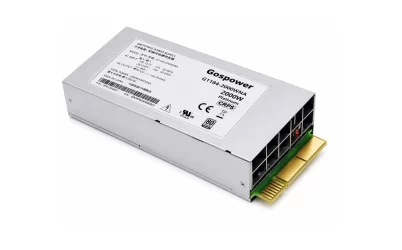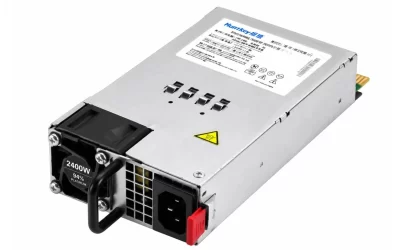
Some DC-input server power supplies are labeled “−48 V,” but the minus sign does not mean that the server runs on a negative motherboard rail. It describes the input feed’s voltage relative to its return conductor. In the common telecom convention, the conductor called −48 V is below the conductor called RTN; a converter then makes the positive, isolated rails the server actually needs. This convention matters chiefly in servers installed on a telecom-style DC plant. An ordinary AC-input server PSU, or a rack designed for a positive 48 V bus, must not be assumed to use it.
Negative voltage needs a reference point
Voltage is a difference between two points, not an independent property of one wire. If a meter’s reference were placed at a return conductor defined as zero, a supply conductor 48 V below it would be described as −48 V. Across the pair, the magnitude is still 48 V. Moving the reference changes the displayed sign without changing the electrical energy available between those conductors. This distinction is the first answer to the question, because a catalog label saying “−48 V input” often compresses an entire two-conductor interface into a single number.
RTN is short for return. It identifies the other side of the intended supply path, not automatically every piece of metal in a rack. In many telecom plants the return is associated with a positive-ground convention, but the exact bonding, grounding, isolation and protection arrangement belongs to that plant and the equipment design. A marked RTN terminal cannot safely be treated as a generic chassis-ground terminal merely because the nominal bus is called −48 V. Conversely, the minus sign is not an instruction to reverse the leads of an unrelated positive-output supply.
A useful conceptual drawing has three different labels: the negative feed, the return, and protective chassis earth. The first two form the DC input circuit. Earth serves a protective and bonding role whose connection to either supply conductor depends on the specified architecture. Those relationships need to remain separate in a wiring diagram even if two points are bonded at a particular location. The distinction is especially important when a removable server module meets a backplane or distribution board: the connector must carry the intended feed and return, while the chassis connection has its own mechanical and safety function.
Why the telecom plant gave the bus its sign
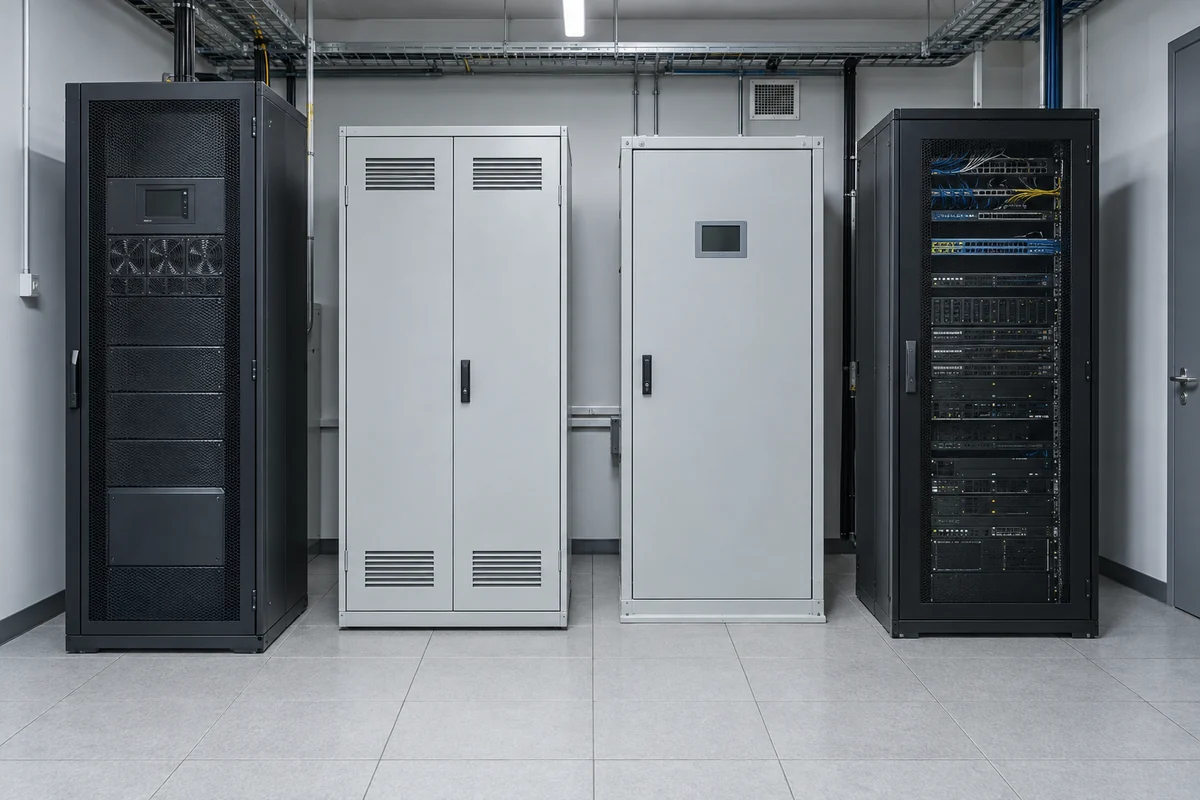
The convention comes from telecommunications DC distribution, not from a special requirement of processors or server motherboards. A central rectifier-and-battery plant can maintain equipment power through an interruption of AC supply. Batteries, rectifiers and the distribution system share a DC bus, so equipment specified for that environment accepts the plant’s polarity convention at its input. A server installed in a telecom facility may therefore need a DC-input PSU that accepts that facility bus, whereas an otherwise similar server in an ordinary data center may use AC-input modules.
Historically, the negative-feed, positive-return arrangement was associated with limiting corrosion in buried telecom cable. That history helps explain why the convention persisted, but it should not be inflated into a promise that any modern negative feed prevents corrosion in every rack. Moisture, materials, protective coatings, grounding, leakage paths and maintenance all affect a real installation. The convention also supported long-established battery-backed communication networks. Neither historical reason means every modern DC server uses −48 V, nor that the sign of a bus by itself determines its safety classification.
“48 V” is usually a nominal system name rather than a guarantee that a live conductor remains exactly 48.0 V from its return. Rectifier operation, battery charging and discharge, distribution drop and equipment input limits can all shift the actual voltage. The accepted input window is therefore a model-specific specification. For example, Supermicro’s support answer for a particular DC server PSU lists a negative DC input range rather than a single fixed voltage. That example establishes that the interface exists in server hardware; it does not define the range, polarity tolerance or connector behavior of another manufacturer’s module.
There is a second reason to be precise about history: a facility may have a positive 48 V architecture for different equipment. The magnitude alone cannot identify the polarity convention. “48 V battery plant,” “48 V server bus” and “48 V output supply” may describe different electrical interfaces, some of which use opposite reference conventions. A purchasing label that omits the sign, return definition and input range is not enough to establish interchangeability.
A DC-input server PSU converts the plant bus again
The input connector of a −48 V server PSU receives energy from the external DC system. The converter then regulates and, where its design requires, isolates that input to produce the voltage rails used by the server’s distribution board and electronics. The processors are not ordinarily connected directly between the −48 V plant conductor and its return. Inside the server, output bus voltage and downstream point-of-load regulators belong to a different electrical domain from the plant connection.
This architecture explains why an input labeled negative can supply positive loads without a contradiction. “Negative” describes one conductor relative to the selected input reference. The converter controls energy transfer between its input and output. If it provides galvanic isolation, the output-side reference is not automatically the same node as RTN. Even without describing an exact topology, the engineering consequence is clear: the input-polarity marking cannot be used as a shortcut to infer output-rail polarity, motherboard voltage, or chassis bonding.
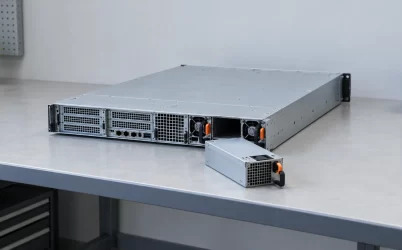
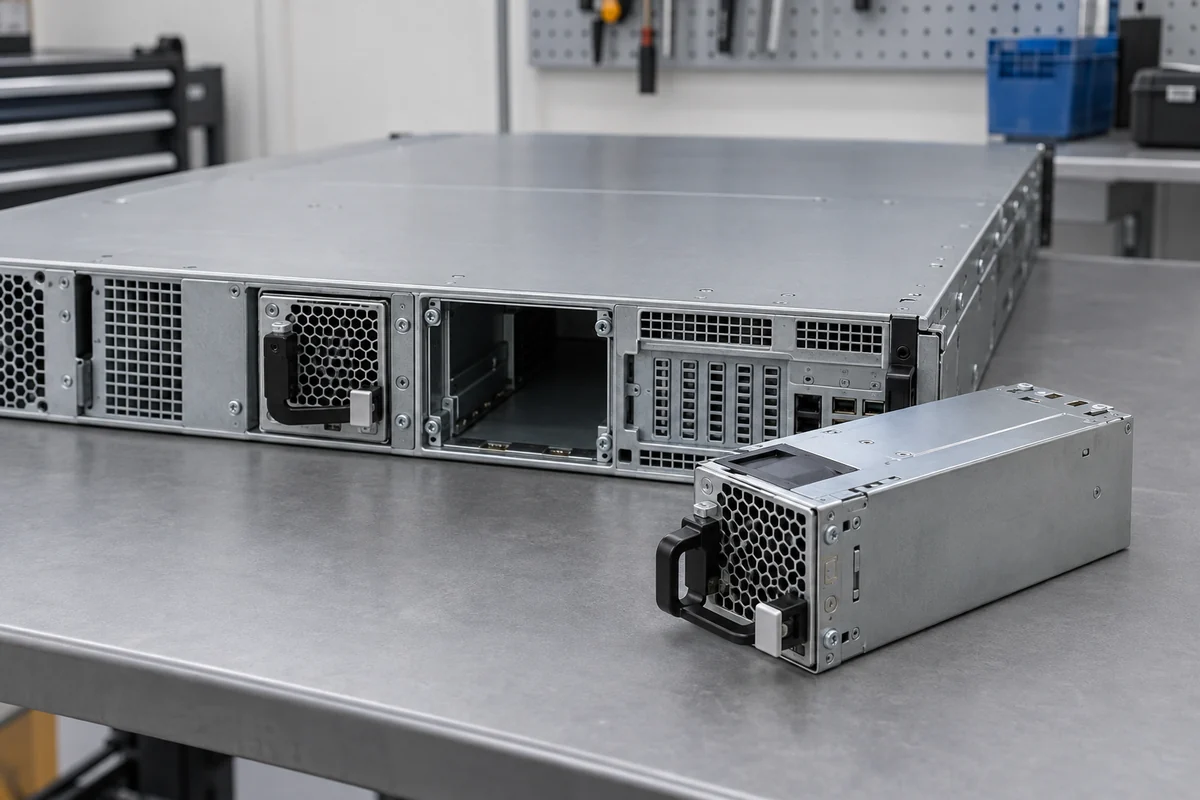
Server PSUs may also have input filtering, inrush control, protection and management functions suited to their platform. Those functions are not universal just because the module accepts a −48 V plant. A server vendor can specify approved modules, mating interfaces, allowable input range and compatible chassis or PDB revisions. A removable cartridge that fits an opening or has the same wattage is not automatically compatible with a DC-input bay. Electrical compatibility includes the intended feed and return paths, control signals, protection behavior and thermal design.
Consider a telecom-edge server ordered in an AC variant and a DC variant. The compute board may be similar, while the rear power interface and supply modules differ substantially. Substituting a DC module into the AC arrangement is not a general retrofit; the platform must explicitly support the variant and its power-distribution hardware. The same caution applies in reverse when a site changes from a −48 V plant to an AC-fed rack. The server’s supported configuration, not a shared nominal wattage, determines whether a conversion path exists.
Return is not a synonym for chassis or protective earth
Three terms often collapse into one vague word, “ground.” In a DC-input server they should be kept distinct. The power return completes the normal input-current circuit. The metal chassis provides an enclosure and a protective bonding path as required by the equipment design. Signal reference points may exist on either side of a converter’s isolation boundary. A specific product may bond some of these points, but an installer cannot infer that bond from a −48 V label alone.
Bonding decisions affect more than the sign seen on a meter. They influence fault-current paths, accessible-metal potential, conducted noise and the way redundant supplies interact with the distribution board. For instance, if two input feeds arrive from different plant branches, the equipment’s design must accommodate their return and protective-earth arrangement. Assuming that every conductor called RTN can be tied to any nearby chassis stud can defeat an intended isolation boundary or introduce an unwanted current path. The appropriate connection is the one documented for the exact server, PSU and site power system.
This is not a live-wiring tutorial. A DC plant can deliver very high fault current even at a nominal voltage commonly called “low.” Protected conductors, connectors and isolation procedures are part of the facility design. A person who finds a mismatch between a PSU label and a site’s feed should stop at identification and request the applicable service documentation and qualified electrical review. Reversing conductors to see whether a machine starts, or relying on an isolated bench supply to predict plant behavior, is not a sound test.
Where management electronics report an input fault, the report also needs context. “Input absent,” “input low,” “polarity error” and “module unsupported” are different conditions if the platform can distinguish them; not every BMC exposes all four. A chassis that refuses to start on one DC branch may have a source, protection, connector, return or compatibility issue. The label’s minus sign is an important clue about the expected interface, but not a complete diagnosis.
Positive 48 V equipment does not invalidate negative 48 V equipment
Modern server and rack-power designs also use positive-voltage distribution. Some published rack specifications define a positive 48 V payload bus with a negative return and a separate chassis-ground connection. This is a different convention from a telecom plant that labels its feed −48 V relative to its return. Both can have approximately the same voltage magnitude across a pair. That numerical similarity is precisely why a specification needs to say which conductor is the feed, which is the return and how either relates to the chassis.
A regulated +48 V output on a standalone AC-DC supply is yet another case. It tells the reader what that product delivers across its output terminals under stated conditions. It does not imply that the device can accept a −48 V input or that it can be inserted into a telecom DC server. Likewise, a PSU whose input is −48 V may convert to a positive internal distribution rail. Input description and output description answer different questions; placing both in the same sentence without naming their sides invites an expensive mismatch.
The safest technical comparison is not “negative versus positive is better.” It is “which complete interface does this particular host implement?” A positive-bus server and a negative-plant server can each be well engineered for their own power ecosystem. Their connector keying, protective devices, grounding scheme, monitoring and permissible voltage excursions may differ. Even a theoretical polarity-tolerant converter would not make the rest of two host platforms interchangeable. The installation boundary includes the rack distribution, server mating hardware and documented configuration.
Nor should the term “−48 V server PSU” be generalized to all servers operating near 48 V. AC-input servers may have internal 48 V stages; some rack power shelves may output a positive 48 V bus; telecom DC-input servers may draw from a negative plant. These are three distinct places in a power chain. The same number appears because it is a useful voltage class for distribution, not because the equipment shares an identical pinout or polarity reference.
Read the label as an interface claim
When a DC server PSU is marked −48 V, the useful interpretation is narrow: the manufacturer has defined an input whose supply conductor is negative relative to a specified return, within the product’s documented operating range and connector arrangement. That is not an output specification, a claim about every server PSU, or permission to wire by intuition. Exact ranges and reference relationships remain those of the named module and host.
For an engineer comparing a server against a facility plant, the decisive documents are the server’s approved power configurations, the PSU’s input-interface definition and the plant’s distribution drawings. These establish whether the named feed and return actually meet at the intended connector and whether the chassis/bonding architecture agrees. If those documents describe different conventions, the remedy is a supported power architecture, not a relabeling of one conductor. That is why a small minus sign on a server power-supply label carries a system-level meaning without making the server itself a “negative-voltage computer.”