A server power supply can fail because a component inside the module deteriorates or is damaged, but a server can also report a PSU fault when the converter is protecting itself from an external condition. Excess heat, a failed internal fan, aged capacitors, damaged switching components, and a defective connector are plausible module-level causes. Lost or unstable AC input, an overloaded output, a short elsewhere in the server, or an unsupported power configuration may produce similar warnings without proving the PSU itself is broken. The distinction matters: replacing an intact module will not repair a bad feed or a shorted load.
“PSU failure” describes an observation before it identifies a cause
A power supply has several jobs at once. It receives AC or DC within its specified range, converts that input to regulated output, limits abnormal current and temperature, and reports operating status to the host. The server sees only the signals and measurements its particular architecture exposes. A management alert may mean input has disappeared, output has moved outside a limit, the PSU has entered protection, or the module has identified an internal fault. Those events do not all describe the same physical failure.
Think of three different questions. Did the power source feeding the module fail? Did the module stop converting acceptable input into usable output? Or did the host demand power the module was not permitted to deliver? A fourth possibility is that the output was available at the module but a connector or distribution path failed downstream. The resulting server behavior can look similar at a high level, especially if another PSU keeps the host running.
A failure message is therefore evidence about a power path, not a certificate that one component has failed. The event type, input state, module identity, temperature, and timing help narrow the boundary. None should be turned into a universal LED-code table: OEMs assign indicators and management events differently, even among generations of the same server family.
What actually fails inside a server PSU?
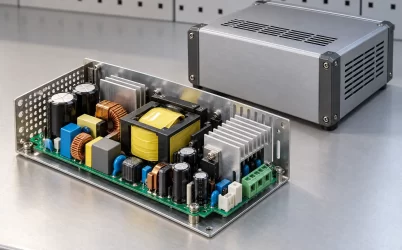
The converter contains electrical and mechanical parts exposed to heat, voltage stress, current, airflow, and repeated operating cycles. Electrolytic capacitors are one familiar aging concern; their useful life depends strongly on their own operating temperature and ripple-current conditions, not merely the room thermometer or the PSU’s calendar age. A part that loses capacitance or develops excessive equivalent series resistance can make regulation or startup unreliable. That is a possible mechanism, not a diagnosis that can be made from a single reboot.
Semiconductors, magnetics, resistors, control circuits, solder joints, and insulation can also be damaged or degrade. A high-current output connection may heat locally if contact resistance rises. The PSU may then operate intermittently under load while appearing healthy at idle. Contamination, corrosion, vibration, or repeated poorly aligned insertion can affect a separable interface. A damaged chassis-side mating connector is not repaired by swapping only the removable cartridge.
Some modules include their own fan, while others rely partly on server-chassis airflow. If a required fan stops or airflow is obstructed, hot components can cross a protection threshold. In one design the PSU may shut its main output down; in another the host may raise fan speed, reduce available power, or report a thermal event. The response depends on the specific module and platform. Dust can worsen cooling, but a warm exhaust or an audible fast fan alone is not evidence that a component has failed.
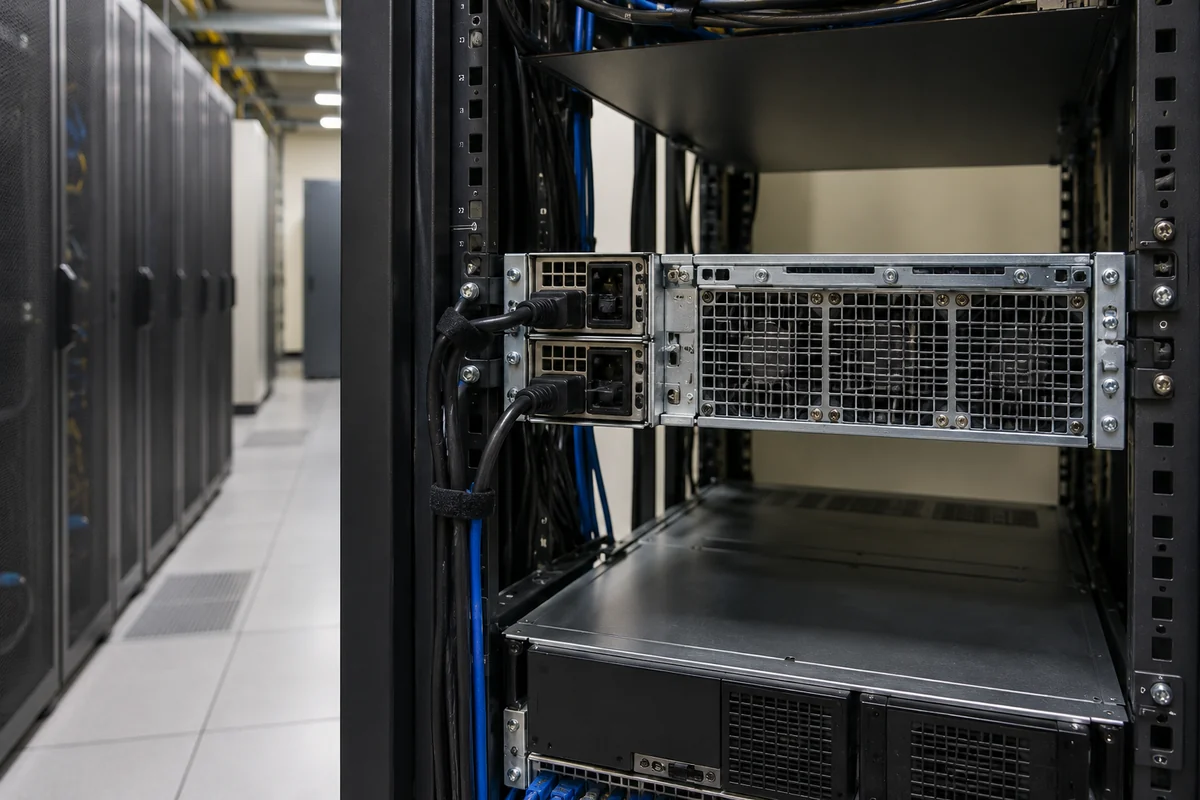
Manufacturing defects and damage in transport or installation are possible as well, even in a new unit. Conversely, an older PSU is not automatically defective. Age changes risk, while a failure determination needs evidence tied to the module and its conditions. A fleet MTBF figure is a population estimate under stated assumptions, not an appointment for the next failure of one cartridge.
External input can imitate a dead converter
If AC disappears at a PSU inlet, the supply cannot maintain its main output indefinitely. That says little about its internal health. A loose cord, tripped breaker, failed PDU outlet, UPS transition, or upstream wiring problem may remove or disturb the input. Two nominally redundant modules can both be affected by one shared power source, so simultaneous alarms deserve an upstream look before both PSUs are condemned.
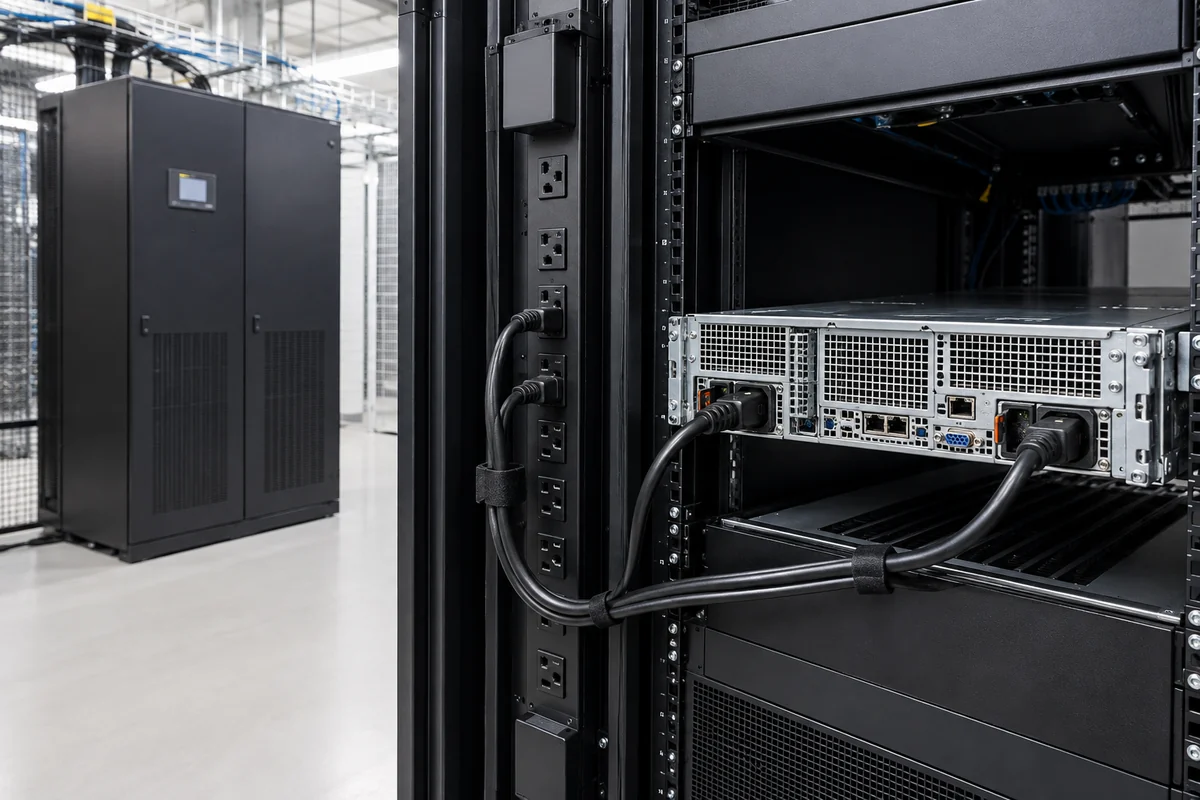
Input quality matters as well as presence. A voltage sag may push a module below its permitted input range or reduce the power it can deliver at low line. A UPS output that is unsuitable for a particular active-PFC supply may create trouble during battery operation, even while normal mains operation appears stable. Dell’s PowerEdge power and UPS guidance describes voltage mismatch, UPS compatibility, inadequate UPS capacity, and unstable electrical supply as distinct causes of power-system symptoms. Its recommendations are specific to the covered PowerEdge environment, not proof that any one of those conditions damaged a PSU in a different server.
Input failure can be transient. A feed may recover before a technician reaches the rack, leaving only an event record. Comparing an input-loss event with a PDU or UPS record is more informative than looking at a currently green indicator. It also prevents a recurring upstream defect from being mislabeled as a series of bad replacement modules. There is a meaningful difference between an inlet losing energy and a converter receiving valid energy but failing to produce output.
A protected shutdown is not always a failed power supply
PSUs are designed to stop delivering power under certain abnormal conditions. Overcurrent protection may respond when a server load or distribution board draws beyond the supported limit. Short-circuit protection may act when a component elsewhere in the chassis faults. Overtemperature protection may respond to blocked airflow or a failed cooling path. These functions are intended to limit damage; their operation does not establish which component initiated the event.
Consider a server that works until a GPU workload increases. One explanation is an internal PSU defect that becomes apparent at higher current. Another is that the configured system has exceeded the surviving module’s permitted capacity, especially after redundancy was lost. A third is a downstream fault that occurs only when that GPU or its power stage becomes active. The same abrupt loss of main output can result from very different mechanisms. A larger wattage label does not fix a short, and replacing a fault-free module does not make an unsupported load arrangement valid.
The recovery pattern also depends on design. A supply may remain latched off until the platform resets it, automatically retry, or recover only when temperature falls. It is unsafe to infer a universal protection mode from a series of clicks or a brief return of power. These behaviors belong to the exact PSU and host specification. If the system repeatedly enters protection, the fact that it temporarily recovers is not a reason to keep forcing it through restarts.
Connections and power distribution can be the failed component
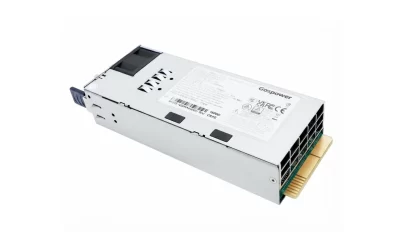
A modular server PSU does not deliver useful power in isolation. Its output reaches the system through blind-mate contacts, a cage or midplane, a power-distribution board, and load connectors. Control and status signals follow their own defined paths. A partially seated module, bent guide, damaged contact, or failed board can prevent normal operation while the converter cartridge remains capable of working elsewhere. Some server platforms identify such conditions explicitly; others expose only a general power fault.
Electrical loss at a resistive contact rises with current. A connection that passes light load can overheat or drop excessive voltage at peak load. Discoloration, deformation, unusual odor, or intermittent detection are reasons to stop using the affected assembly and follow the OEM service path, not to scrape contacts or probe a powered bay. A replacement module inserted into a damaged mating interface may inherit the same symptom and may itself be damaged.
Compatibility belongs here too. Two cartridges that share a broad wattage description need not have the same output interface, management behavior, airflow direction, or supported firmware relationship. A server may reject or derate an unsupported combination. That is a configuration problem unless there is separate evidence of physical damage. The allowed pair and host slot rules are platform facts, not something that can be guessed from a generic PSU shape.
The evidence boundary: what distinguishes the failure mechanisms?
The useful comparison is between what entered the module, what it was asked to supply, and what the host received. A recorded input-loss event points attention toward the feed but does not exclude a bad inlet connection. A recorded fan fault raises concern about module cooling but does not by itself prove that every converter stage is damaged. A high-current or output-voltage fault may arise in the PSU, the distribution assembly, or the load. Event messages should be interpreted with the OEM’s documentation for the exact model and alongside the chronology of system and upstream events.
Timing can be informative without becoming a diagnosis. A problem occurring only during a UPS transfer suggests a different investigation from one that follows a chassis thermal alarm. A fault that stays with one physical module when moved under an OEM-approved service procedure suggests a module problem; a fault that stays with one bay suggests a host-side interface or distribution issue. Neither pattern is conclusive if modules, power feeds, load, or firmware state also change. Such comparisons belong to authorized service practice, not improvised live swapping.
For a redundant pair, distinguish a single-module fault from loss of protected system capacity. The second PSU may keep the server running, so business impact can be delayed even when a module genuinely fails. The reverse is also possible: both modules may report a common feed problem while neither converter is damaged. Redundancy changes the consequence of one fault; it does not make an ambiguous alarm self-explanatory.
What the cause means for the next action
If evidence points to a lost or unstable input, correcting the feed and its protection is more important than installing another PSU. If a module’s own fan, temperature, or conversion fault is identified under valid operating conditions, the approved replacement process becomes relevant. If the fault stays with a bay or distribution assembly, swapping cartridges repeatedly can waste spares and expose the same damaged contact to further stress. If the load exceeds the supported configuration, the answer is a platform power-budget change, not an arbitrary stronger-looking module.
These distinctions are especially important when several servers in one rack report power problems together. A cluster of events tied to one PDU, UPS, or maintenance window has a different meaning from unrelated failures spread across modules and dates. The pattern is not proof by itself, but it can prevent a site-wide input issue from being treated as a sudden batch of defective PSUs. Preserve event times and exact module identities when involving qualified support.
Do not open a server PSU enclosure to confirm an internal component fault. It can retain hazardous energy after its cord is removed, and its service classification may prohibit field repair. Do not bridge contacts, bypass protection, or use a generic connector pinout as a diagnostic shortcut. The safe boundary for an operator is observing documented status and following the specific server’s approved maintenance procedure; internal electrical diagnosis belongs to qualified personnel with appropriate equipment and authorization.
A server power supply fails in the strict sense when it cannot perform its specified conversion or protection functions under the conditions it is designed to handle. Many events called “PSU failure” are instead the module reacting correctly to an unacceptable input, load, temperature, or host interface. Finding which of those happened is the difference between repairing the actual power path and merely changing the most visible box in it.