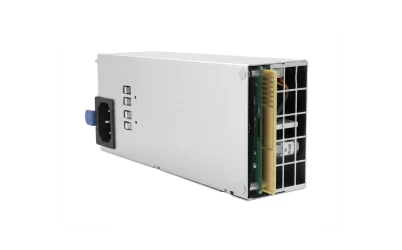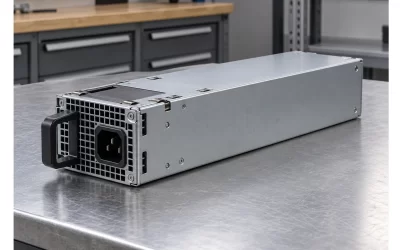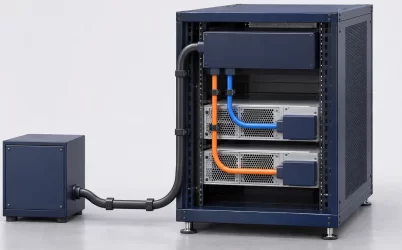
A request for a “50W 80 PLUS Platinum hot-swap server PSU” may describe a real low-power module, but the phrase alone is not enough to identify one. It joins an output rating, an efficiency certification tier, and a service method that refer to different properties. In a normal rack server, 50W is unusually small for the whole compute supply; in an embedded controller or specialized appliance it might be plausible. The number might instead describe an auxiliary load, a subsystem rail, or a missing digit in a larger PSU rating. None of those possibilities should be silently substituted for another when a spare is ordered.
What would a true 50W output rating mean?
A 50W supply can deliver no more than 50W of rated DC output under its documented conditions. If it has only a 12V output, that corresponds to about 4.17A at 12V before considering any auxiliary rails or combined-load restrictions. Four amperes can power a control board, network appliance, or other modest electronics, but it is not the same capacity class as the removable supplies used to run an ordinary processor-and-drive server. A compact device can still be installed in a rack or sold as a server-related module, so the physical setting does not prove that the 50W number is wrong.
One useful distinction is between a PSU for the entire host and a PSU for a function inside it. A server enclosure may contain small auxiliary converters for management logic, fan controls, storage backplanes, or other subsystems. A parts list can place such a module under “power supply” even though it never carried the compute load. Replacing that part with a large server PSU would be nonsensical; replacing the main server PSU with the 50W auxiliary part could be destructive. The surrounding assembly and output path decide which interpretation applies.
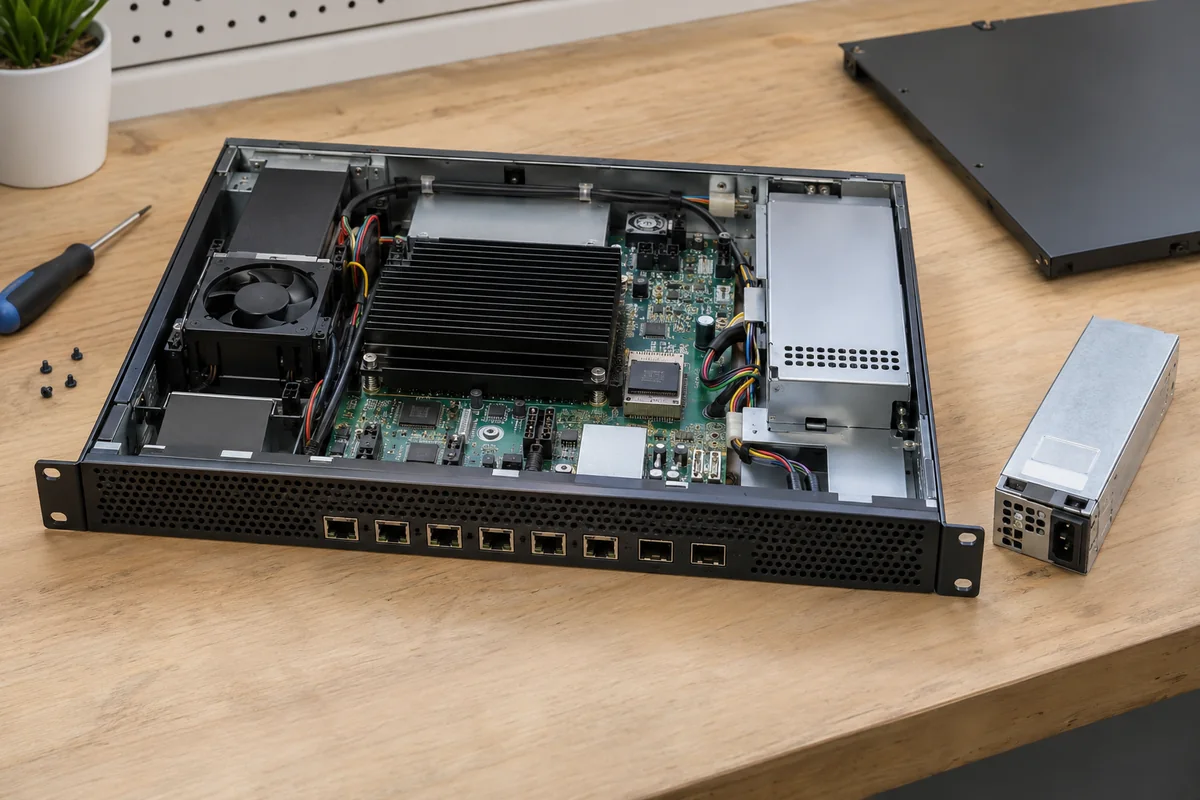
Voltage changes the current implied by 50W. A 5V output would carry 10A at 50W; a 48V output would carry roughly 1.04A. Therefore “50W” alone does not tell an integrator what connector, wire gauge, or downstream converter is involved. Nor does a printed 50W peak necessarily equal a continuous rating at the installed temperature. Read the rated output and any separate peak or temperature-limited conditions from the exact model’s documentation. Do not infer a universal current from the wattage without first knowing the rail voltage.
The size can also refer to a workload rather than a PSU. A monitoring controller might draw 50W while the host PSU has hundreds of watts of rated capacity. A small laboratory meter may show about 50W of AC input while an unloaded larger PSU is operating. Those statements describe a measured state, not the PSU nameplate. If a procurement line was copied from a test note, it can accidentally turn an operating point into a part specification.
Hot-swap is a system behavior, not a shape
A removable handle does not by itself establish that a power module can be changed while the system is running. Hot-swap requires a host designed to keep the protected load supplied while one module disengages, as well as suitable contacts, isolation, control sequencing, and service access. Some power systems have a single removable cartridge but still require equipment shutdown before replacement. Others use multiple supplies and a distribution board that prevents an unpowered or failed module from dragging down the common DC bus.
A true 50W hot-swappable source is technically possible in a small modular system. The service claim would still have to be tied to the particular host. If two 50W modules are arranged as 1+1 redundancy, each must be able to sustain the required load on its own. A system drawing 70W DC cannot remain at that load on a surviving 50W module merely because two modules normally share it. If the design is N+1 with several modules, the available capacity depends on the module count, load-sharing method, and failure policy—not on a generic “hot-swap” label.
The mating interface matters even more at low power because the module may belong to a proprietary controller, a telecom shelf, or a small industrial rack rather than a standard server PSU cage. Similar-looking cartridges can use different output voltages, standby contacts, keying, or bus arrangements. A replacement that slides into a bay is not necessarily electrically correct. The host’s part number and interface documentation carry more meaning than an online listing’s generic product type.
Serviceability also has a physical boundary. If the module is buried behind a panel that requires the host to be powered down, the module’s plug-in form factor offers no live replacement benefit. If a cartridge can be withdrawn, the remaining converter, input feed, distribution board, and downstream load must still be able to operate through the transition. The word “hot-swap” describes that whole arrangement. It should not be used as a synonym for “easy to remove.”
Platinum applies to a tested model and category
80 PLUS Platinum identifies a certification tier for a particular tested PSU, not a general claim of quality or a guarantee at every load. The official 80 PLUS FAQ says the unit label supplies the rated output used to set test loading; a peak-wattage figure is not substituted for that rating. The program records the submitted model and form-factor information and uses defined test conditions. A seller phrase combining “50W,” “Platinum,” and “hot-swap” is not evidence that the exact offered module has a matching certificate.
It is especially risky to borrow the certification of a neighboring product. An enclosure may be sold with several power module options; only some might have a listed 80 PLUS result. A platform may include a large certified AC-DC front end and a separate 50W downstream converter. The front end’s Platinum designation does not automatically transfer to the small converter. Equally, a 50W load served by a Platinum-rated 550W module does not transform the module into a 50W-certified product.
At 50W of DC output, efficiency math is straightforward but not enough to establish certification. If a particular converter delivered 50W at an assumed 90% efficiency, AC input would be about 55.6W and loss about 5.6W. That is an arithmetic example only. It does not show whether a Platinum category applies, whether the module was tested at that load, or what it does at other points. A 50W output rating and a 50W output operating point on a much larger supply produce entirely different percentages of rated load and may land in different regions of the efficiency curve.
The absolute loads are revealing. On a genuinely 50W-rated device, 20% of nameplate output is just 10W and 50% is 25W. On a 550W supply, those same percentages are 110W and 275W. A report that says “92% at 50% load” refers to a very different quantity of delivered power in each case. Moreover, fixed control and cooling consumption can be a meaningful share of a ten-watt operating point. This is why a single efficiency percentage copied from a larger family member would not establish the small module’s behavior, even if the product bodies looked alike.
Certification data are most useful when the model identity is stable. A report for one manufacturer and model number should be compared with the actual module label, not a reseller’s broad description. Input category matters too: a non-redundant internal supply tested at one nominal voltage is not interchangeable as evidence for a redundant data-center module tested under another category. The key point is not to demand a particular efficiency percentage from every small PSU; it is to avoid claiming an independently unverified Platinum credential for an unidentified 50W cartridge.
Could the intended number be 550W?
A missing digit is plausible because server power modules are also sold in much larger capacity classes. Powernexu lists G1136-0550WNA as a 550W hot-pluggable CRPS module; Gospower identifies that exact model within its P185 Platinum family but the public summary does not establish the seller-listed 550W rating or main current. Treat the Powernexu numbers as unverified until the exact revision datasheet is obtained. More generally, confusing a genuinely rated 50W part with a genuinely rated 550W part changes the capacity class and likely the intended load and interface.
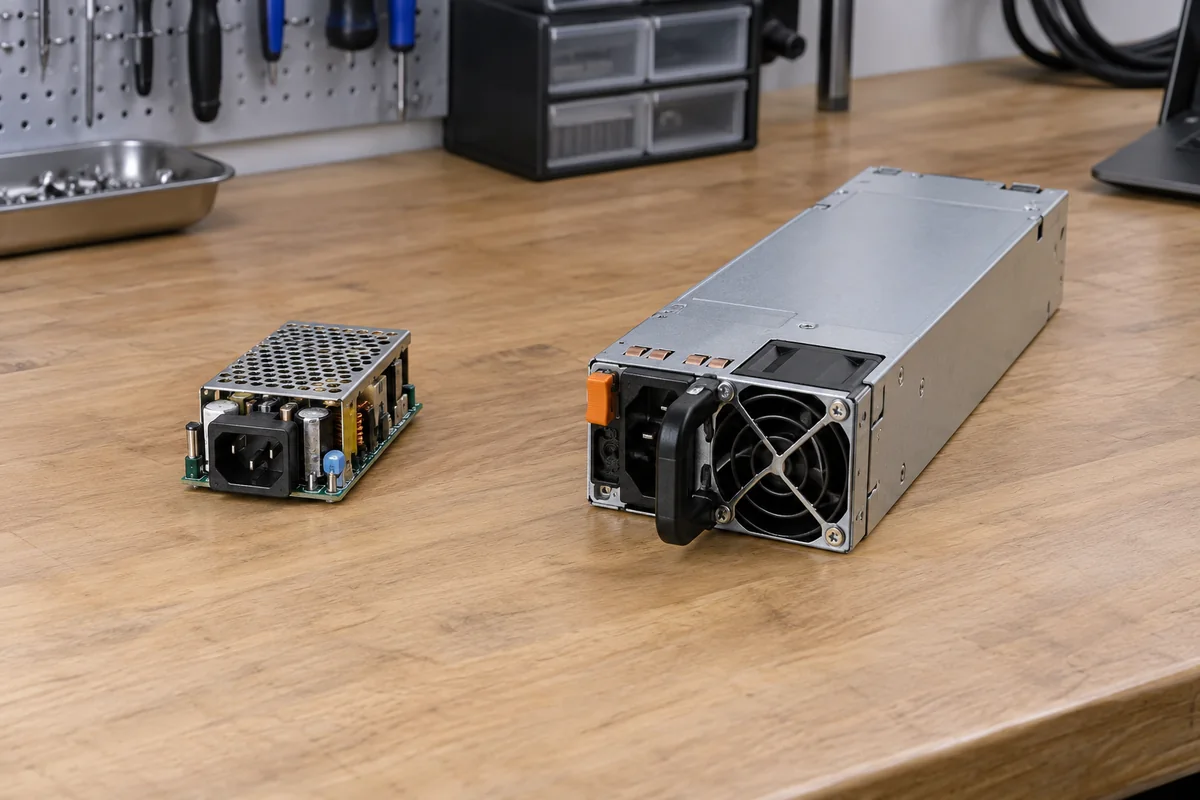
But plausible is not certain. A part request for 50W could correctly refer to a small auxiliary power cartridge, while a 550W module would be unrelated. The presence of a 550W product page does not authorize replacing a 50W part with that model, even if both are described as hot-swappable. Conversely, if the original module label and server service manual identify a 550W main PSU, a 50W entry in a spreadsheet should be corrected at the source rather than turned into a new product category.
Hypothetical arithmetic makes the magnitude clear without assigning a specification to G1136-0550WNA. At 12V, a 50W output corresponds to about 4.17A; a separately verified 550W output at the same voltage would correspond to about 45.83A, roughly eleven times greater. The actual module may use a different nominal rail voltage and have standby, input, temperature, and host-control conditions. Obtain its rating table before converting those examples into a purchase specification. A 50W main supply for a host with processors, drives, fans and networking would require a specific low-power design.
Two different repair paths follow from the same phrase
If 50W is truly the module’s rated output, the next useful information is the exact host and module identity. The design may be a low-power appliance or an auxiliary cartridge; its voltage, connector, hot-swap mechanism, and efficiency evidence must be read as properties of that system. The article’s broader “server PSU” wording should then be narrowed to the real application, rather than presenting a small converter as a universal server supply.
For that genuine low-power application, normal operation and the removal interval are separate electrical states. A controller that draws 35W continuously might appear comfortable on a 50W module, but another supply or stored-energy path must keep it alive when the cartridge is removed. If no such path exists, the cartridge may be field-replaceable yet not hot-swappable under load. That distinction affects maintenance planning more than the advertised efficiency tier does.
If the original host instead uses a several-hundred-watt main PSU, the task is to recover the correct number before any technical comparison. A label photo, chassis service document, old module part number, or manufacturer drawing can resolve whether the order line lost a digit or mixed up a measured load with a nameplate rating. Only after that distinction is settled do wattage, input voltage, form factor, airflow direction, certification category, and spare availability become meaningful in the same conversation.
These are not two branches of a generic purchasing checklist; they lead to different hardware. A 50W auxiliary module may keep management electronics alive, while a 550W CRPS module can supply a host’s main 12V bus. A certification report may apply to one module, the other, or neither. The correct answer to “50W Platinum hot-swap server PSU” is therefore not an invented product match. It is a precise interpretation of what the 50W describes, followed by the documentation for the actual module and host.