A search for a 1000 watt server power supply does not identify one interchangeable kind of hardware. The number is an output-power class; the server or cabinet still determines the required DC voltage, auxiliary rails, physical module, mating connector, and control behavior. A 12V hot-plug cartridge for a compute server cannot replace a 56V supply intended for a distributed-power cabinet simply because both are rated at 1000W. Start with the host’s electrical architecture and approved part family, then use the wattage rating to decide whether the particular unit has enough capacity under its stated input and cooling conditions.
A thousand watts can be delivered on very different DC buses
Output power is voltage multiplied by current. At a nominal 1000W, an idealized 12V output corresponds to about 83.3A, whereas a 56V output corresponds to about 17.9A. Those figures are arithmetic, not a claim that two particular products are rated for exactly those currents. Standby rails, internal limits, operating conditions, and the manufacturer’s output specification still govern an actual module. The calculation does show why a 1000W label cannot tell a buyer what the server expects at its power-distribution board.
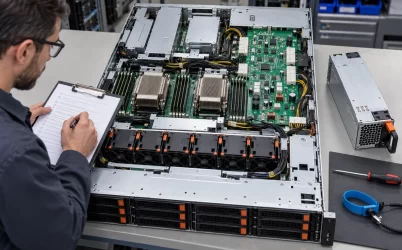
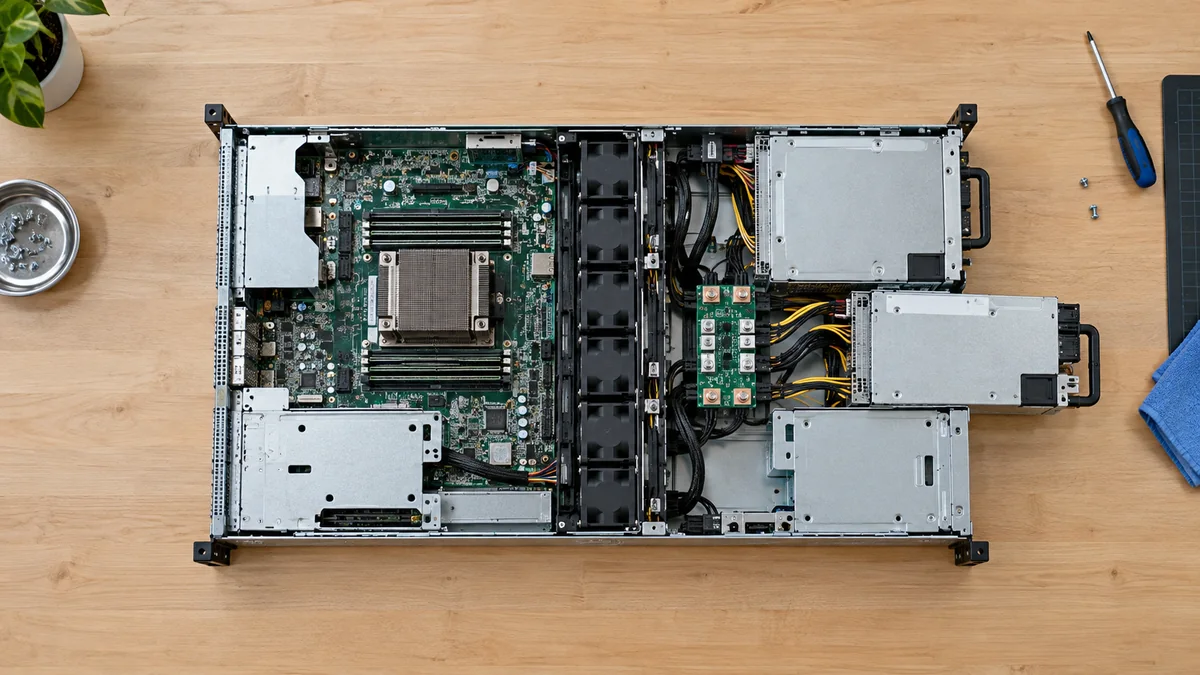
Many rack servers use a 12V distribution path from removable AC–DC modules. The chassis PDB or midplane accepts the cartridge, routes high current toward processors, memory, storage, and expansion loads, and manages the signals that make the module usable in that particular host. The motherboard or downstream converters then derive the lower voltages used by components. A 1000W-class 12V module belongs to this arrangement only if its mechanical and electrical interface matches the platform.
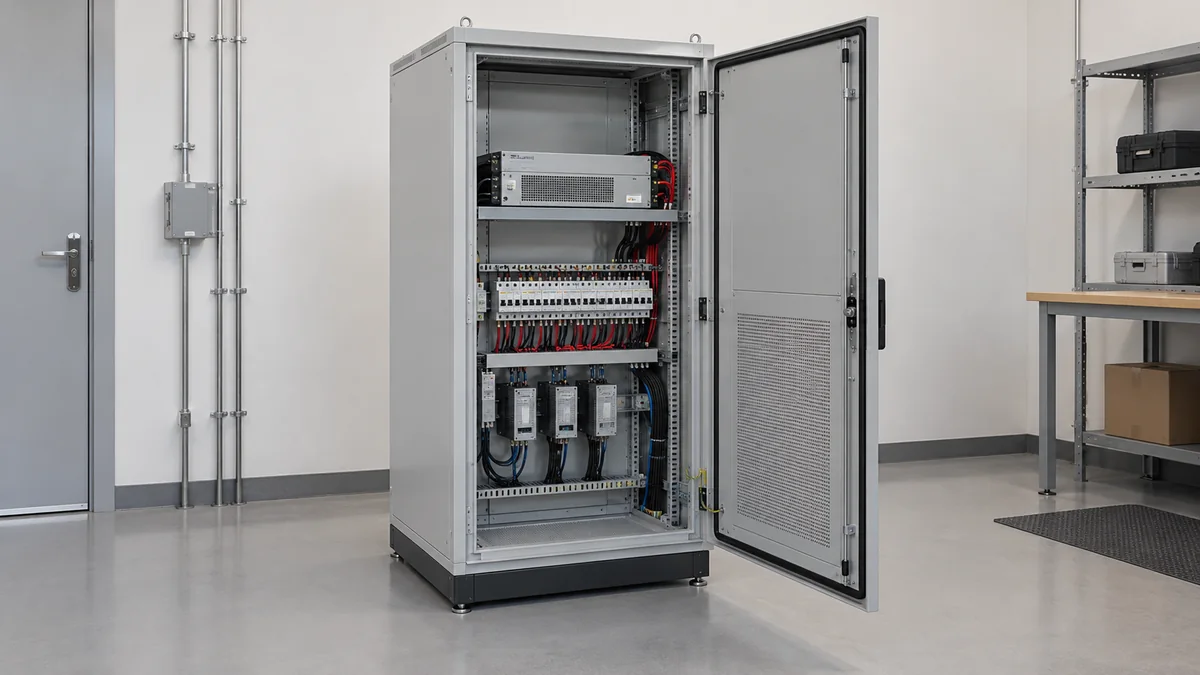
Other equipment distributes power at a higher DC voltage and performs conversion closer to the load. Powernexu lists the GW-PA1000I-P-F 1000W hot-swap supply with a 56V output and positions it for telecom, communications, and distributed-power cabinets. That verified product fact is useful because it exposes the category ambiguity: the same wattage can describe an infrastructure source that is not a direct 12V server-bay replacement. Whether any given server can use a 56V source depends on its designed input architecture and downstream conversion, not on a product’s placement under a broad “server power supply” menu.
The current difference changes physical design. A high-current 12V path makes contact resistance, copper cross-section, busbar construction, and connector temperature particularly important. A higher-voltage distribution path carries less current for the same nominal power, but it requires appropriately rated insulation, protection, connectors, and point-of-load converters. Neither architecture wins by itself. The equipment was designed around one of them, and a substitute has to respect that design.
The 56V figure also belongs at the distribution boundary, not automatically at a CPU or drive connector. Local converters consume some of the bus power and deliver the voltages required by their loads. Thus, 1000W at a cabinet supply’s output is not necessarily 1000W available after every conversion stage and branch limit. The system designer needs to identify which boundary the capacity requirement describes.
The rear power bay is an electrical interface, not an empty slot
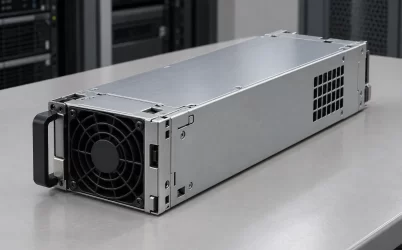
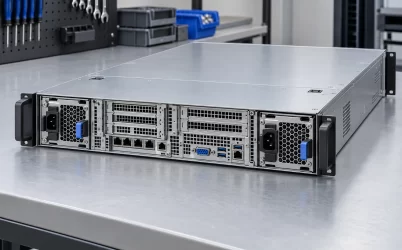
Two metal cartridges can appear similar in a search-result photograph and still be incompatible. Length, height, width, guide rails, latch position, extraction direction, fan location, and airflow orientation decide whether a module can be installed without mechanical conflict. A cartridge that slides into a bay but does not seat against its intended connector is not a near fit; it is the wrong part. For a live server, the PDB and its mating contacts are part of the power-supply system.
The rear connector may carry more than bulk DC output. Depending on the platform, it may include standby power, module-present indication, enable control, power-good status, current-share signaling, and management communications. These functions are not interchangeable merely because two modules both advertise PMBus or hot swap. Their connector geometry, signal assignments, timing, and host firmware expectations belong to a qualified assembly. Do not infer a pinout from a picture or from another product in the same wattage class.
For a custom chassis, the question changes from “Will this replacement fit?” to “Which supply-and-board interface will the chassis be built around?” The design team needs an actual drawing and electrical interface specification for the selected module, along with its inlet and exhaust direction and the board or harness that receives its output. A generic 1000W listing cannot supply those details. For an established OEM server, the approved spare list and the installed module identifier are usually more decisive than a fresh category search.
A different output architecture can also hide behind a familiar shape. A 56V supply may feed a distribution bus and local conversion stages rather than the server’s 12V PDB. Plugging it into a 12V host is not an efficiency upgrade or a harmless source substitution. It changes the voltage presented to the downstream system. The reverse substitution—a 12V cartridge for a cabinet designed around a 56V bus—would leave the intended bus and its converters without their specified input. This is an architecture mismatch, not a capacity shortfall.
Read the 1000W rating with its input condition
A second ambiguity appears even after the output rail is identified: the full advertised rating may apply only at a specified mains voltage. For example, Supermicro’s PWS-1K05A-1R specification states 800W at 100–127Vac and 1000W at 200–240Vac. That is a fact about that particular module, not a rule for every 1000W PSU. The useful lesson is to read the rating table instead of treating the largest number in a product title as universally available.
AC input and DC output are different quantities. A 1000W output rating is not a statement that the unit always draws 1000W from the wall; input power also includes conversion losses and depends on the actual DC load. Nor is 1000W a promise of unrestricted output at every ambient temperature, altitude, or airflow condition. The manufacturer’s operating limits may reduce permitted output or require a particular cooling arrangement. For a replacement, the site voltage and installed chassis matter because they define the conditions under which the original system was qualified.
Regional deployment creates a practical trap. A supply selected around high-line AC service can be moved, along with the server, to a location using lower input voltage. If the exact model has a lower output ceiling there, a configuration that previously had comfortable margin may no longer meet its intended load or redundancy policy. The correct response is not to assume all 1000W modules derate the same way; it is to read the exact module’s input/output table and the host’s supported configuration. A different SKU may be required, or the supported workload may need to change.
Do not confuse this electrical condition with 80 PLUS certification. An efficiency class describes measured conversion efficiency for an exact model under defined test conditions. It does not certify a 1000W output level at every site voltage, nor does it certify a module for an unrelated chassis. An efficient but incompatible cartridge is still incompatible. When a listing mixes its wattage, efficiency badge, and hot-swap claim in one headline, separate those attributes before drawing an engineering conclusion.
Three buyers can mean three different things by the same search
A service technician with a failed server module is looking for an approved replacement. The decisive information is the host model and revision, the installed PSU part number, and any documented alternative spare numbers. A matched rating is necessary only after the host interface and supported configuration are established. The technician should also understand whether the healthy companion module and its input feed can support the service state. That operational issue matters, but it is not a reason to treat any 1000W unit as a compatible spare.
An integrator designing a new 12V compute platform is searching for a power module and its surrounding system. The output rating must be considered with the PDB contacts, motherboard power path, standby behavior, firmware communications, and the cooling available at the PSU inlet. One 1000W cartridge might meet the target under a particular input range and airflow envelope while another cannot be integrated because its connector or control scheme differs. At this stage, detailed interface documentation is worth more than a reseller’s “server PSU” category label.
A telecom or network-infrastructure designer may instead need a 56V source for a cabinet bus. That buyer cares about the bus voltage, input service, hot-swap arrangement, output distribution, and the local converters or loads downstream. The Powernexu 56V product belongs in this discussion, whereas a 12V server cartridge would not be a direct replacement. If the equipment actually calls for 48V or 54V rather than 56V, even a close-looking high-voltage supply requires an explicit compatibility decision; the nominal values should not be treated as synonyms.
These buyers should not receive the same generic answer. One needs a supported spare, one needs a compatible new chassis interface, and one needs the right distribution voltage. A useful 1000W product search narrows the equipment context before it narrows the price or efficiency tier. That order saves the reader from comparing products that solve different electrical problems.
The system rating may refer to one module or an assembly
Listings also differ in what the number describes. Some identify the maximum DC output of one removable module. Others describe a server power subsystem that contains two modules, a shelf with several plug-in converters, or the capacity available in a particular configured state. A photograph of two cartridges does not establish whether the equipment has 1+1 redundancy, operates both for a higher nonredundant load, or follows another power policy. The host documentation defines that behavior.
In a 1+1 system, two modules may normally share load, but loss of one leaves a single module to support the protected operating state. A server whose load is below 1000W under one condition may still exceed a module’s permitted output in another condition, especially if the input range changes its rating. Some hosts respond by limiting performance rather than shutting off; others may not support the proposed configuration at all. These behaviors are model-specific. The electrical and product boundary must be established before a protected-load calculation has a meaningful subject.
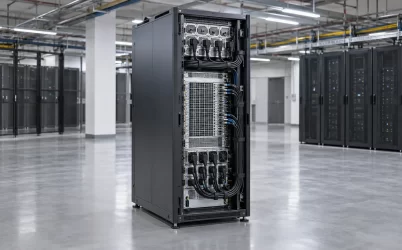
On a 56V distribution shelf, multiple sources and output paths can be arranged differently from an ordinary server PDB. The useful unit of comparison may be a complete shelf, cabinet bus, or set of local converters, not one removable PSU. A buyer who compares the shelf’s total rating with a single server cartridge’s rating is comparing unlike boundaries. Specify whether the requested power is per module, per redundant pair, at the common DC bus, or at the final equipment load.
Where a 12V replacement search should stop
Once the host is known to require a particular 12V hot-plug cartridge, the search should stop treating “1000 watt server power supply” as a product identity. Move to the approved part family and its service documentation. Another 12V unit with the same nominal output might have a different card-edge connector, standby rail, fan direction, firmware behavior, or low-line rating. A 56V infrastructure unit is outside that replacement class altogether.
Conversely, when the design calls for a 56V distributed bus, a conventional 12V server cartridge is not a cheaper route to the same thousand watts. The bus voltage and local conversion chain are central to how the equipment works. The wattage number becomes meaningful only inside the architecture that consumes it. That is the distinction a broad 1000W search should uncover before any model is ordered.