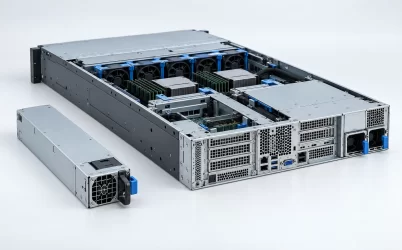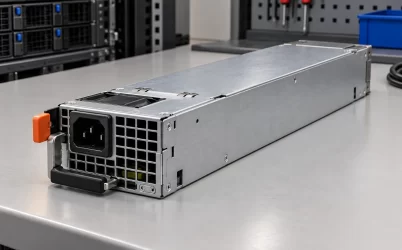
A “240V server power supply” may mean a module supplied by 240 V AC from a rack PDU, a module rated for 240 V DC from a dedicated distribution system, or a specific mixed-mode module documented for both. The number alone does not identify which source is permitted. Before a server is connected, establish whether the label says VAC or VDC, the accepted range for that input, the output available under that condition, and the approved server and cord arrangement. A 240 V AC rating is not permission to connect 240 V DC, even when the plug appears familiar.
Two 240 V labels can specify different electrical products
On an AC rack, 240 V commonly describes the nominal alternating voltage available at a PDU outlet. The PSU’s input stage rectifies that waveform and regulates a DC output for the host. A 240 V DC system supplies direct current to equipment expressly designed for that feed. The voltage magnitude may look similar on a purchase order, but the waveform, fault behavior, source controls, input protection, and permitted connection can differ. The server’s internal 12 V or other regulated bus is a third quantity; it is not the 240 V source.
The distinction is easy to lose because sales listings often compress a complete input table into a phrase such as “240 V PSU.” Even an accurate line reading “100–240 VAC” says nothing about DC acceptance. Conversely, “240 VDC input” does not imply that the module can run from an AC outlet. Some server modules do have both modes. That is an explicit capability of the named hardware, with separate conditions, not a property inferred from similar voltage numbers or a family photograph.
Modern manufacturer documentation demonstrates why the qualifier matters. The Dell PowerEdge R7725xd technical guide lists AC and DC rows separately for its mixed-mode PSU options. It also shows that output capability can change within the AC input band for a particular option. Those are platform-specific facts, not generic ratings for all server power supplies. They illustrate a better way to read a specification: identify the exact input mode before transferring any wattage or cord information to a deployment plan.
The AC rack path has its own input envelope
For a conventional high-line rack, the 240 V figure is normally an AC source condition at the PSU inlet. The module may state a nominal 200–240 VAC band, a broader 100–240 VAC band, or a separate maximum and operating range. These labels are not interchangeable. A model that accepts low-line input might deliver less output there, while a high-line-only module may not start on 120 V at all. The server PSU input-voltage discussion covers the general rack-source matching problem; the narrower issue here is whether “240 V” names AC, DC, or both on the specific module.
Frequency is relevant to AC equipment. A nameplate may specify 50/60 Hz and an allowable range; neither should be assumed from the voltage value. The PDU and cord must also provide the intended outlet-to-inlet arrangement. A connector shape that happens to fit is not a substitute for an approved voltage and current rating. Local electrical design must establish the upstream circuit, protective device, grounding arrangement, and rack distribution. The server procurement team can then match the named PDU outlet and approved cord to the server vendor’s PSU option.
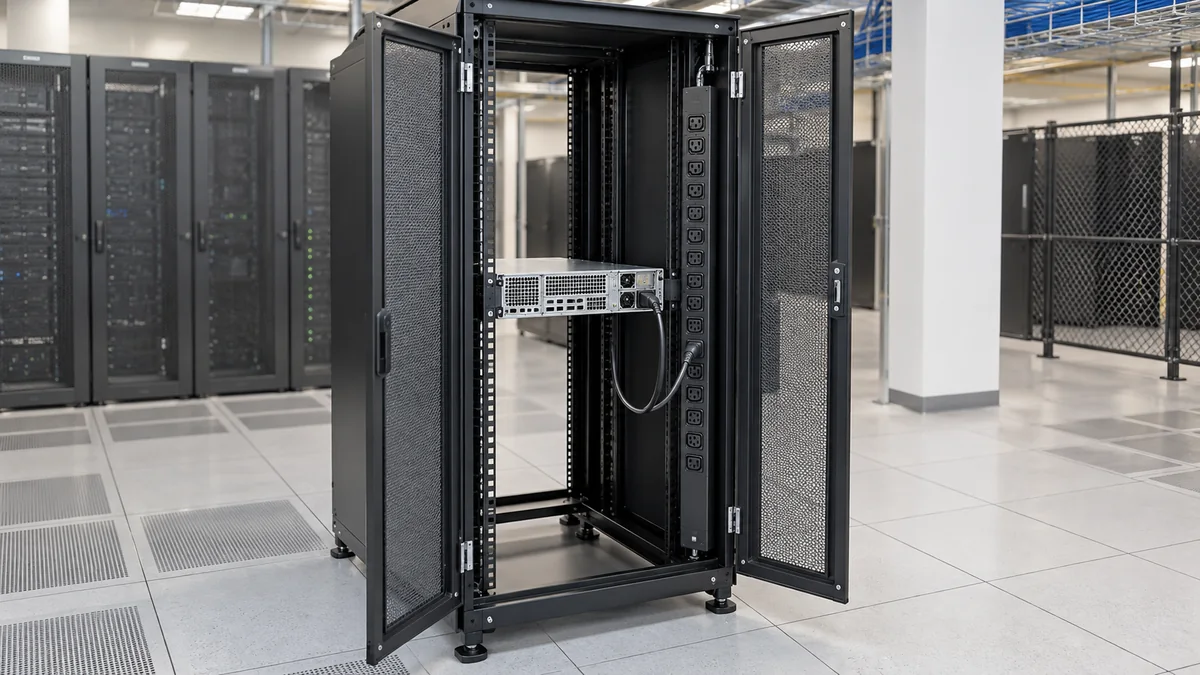
The AC nameplate should be read as an operating envelope, not merely as a promise at one ideal point. “240 V nominal” at the rack is not an exact, unvarying measurement under every load and source state. The equipment documentation defines what variation it tolerates and whether a different output ceiling applies to part of that band. A site near the edge of a stated range cannot use a marketing label in place of the published limits. Nor should a purchaser copy a wattage from the same module family if the chosen host has a different approved configuration.
Current is another reason input mode and actual output matter. At a fixed real-power demand, a higher AC input voltage generally requires less current than a lower AC voltage, subject to efficiency and power factor. That relationship can help explain why dense servers often use high-line rack distribution. It does not create additional output capacity by itself. The supplier’s conditional output table, the host’s load policy, and the surviving-feed arrangement determine whether the server can carry its intended workload. A 240 V outlet is not a universal capacity upgrade.
A 240 VDC source is not an AC outlet without a waveform
Direct-current distribution can be used for particular server platforms and facilities, but the server must have a DC-capable option. A DC feed does not periodically cross zero current as AC does. Switching or interrupting a fault can therefore demand different equipment and procedures. The source may be battery-backed and can present a sustained fault-current condition. Disconnects, fuses, contactors, input connectors, and service instructions must be designed for the documented DC system, not borrowed from an AC installation because both carry a “240 V” label.
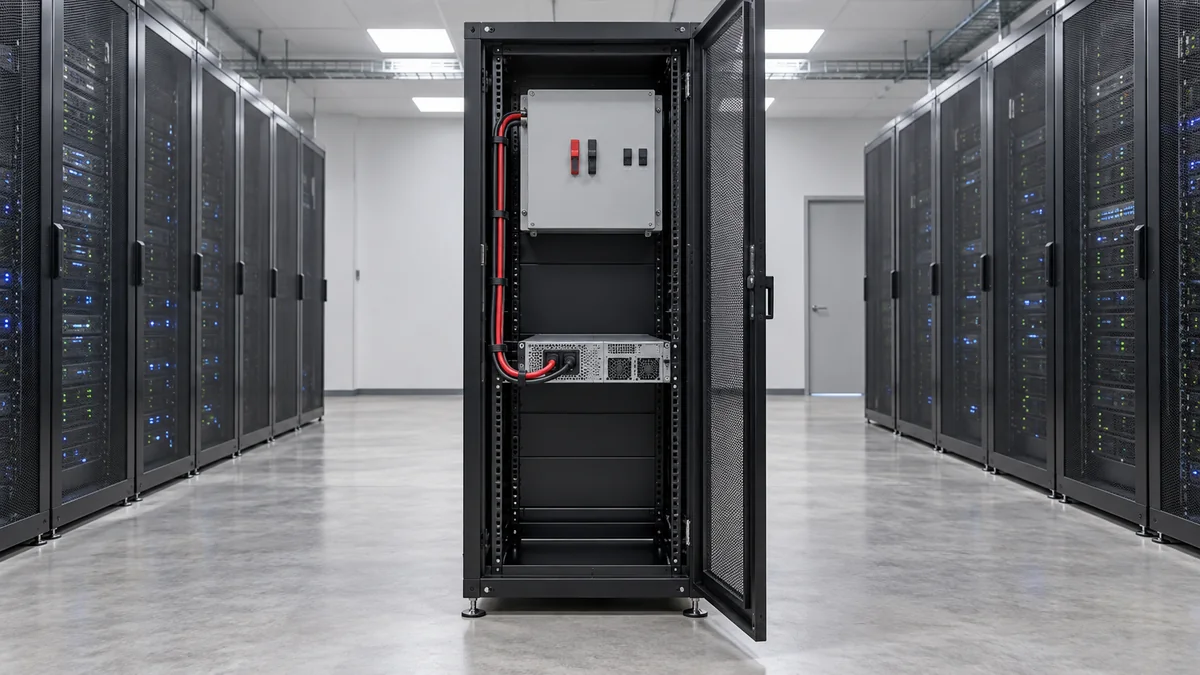
DC documentation needs more than a nominal value. The accepted input range, polarity, return arrangement, protective earth or bonding scheme, transient limits, and startup behavior matter. Battery float and discharge may move the source away from nominal. An exact 240 VDC figure on a rack schedule cannot prove that the source stays within the module’s allowed window. Nor does a DC-capable module necessarily support every high-voltage DC architecture: some facilities distribute a different voltage or convert DC at a rack shelf before it reaches the server.
Never infer AC/DC interchangeability from rectification theory. An AC front end may internally create a high-voltage DC bus, but its external inlet, protection, filtering, safety approval, and control sequence were designed for the inputs the manufacturer specified. Applying DC to the AC inlet can bypass assumptions in that design, and a unit that briefly powers up is not proof of compliant or reliable operation. The decisive evidence is an explicit DC input rating for the exact module and installation.
Mixed-mode does not mean identical output in every condition
An OEM mixed-mode table can contain several output ceilings for what appears to be one PSU family. In Dell’s R7725xd guide, the 1500 W mixed-mode option is listed at 1500 W on high-line AC but at 1050 W on low-line AC. Its DC entry is a separately listed 240 VDC condition. A different, 3200 W mixed-mode option has a stated 2900 W AC ceiling over 200–220 VAC and 3200 W over 220.1–240 VAC; the guide also lists a 240 VDC operating entry. These figures belong to those specific options in that specific platform. They demonstrate why neither “supports 240 V” nor “3200 W PSU” is enough to specify a server’s available power.
In particular, a server designed around the higher output condition may still be physically connected to a lower part of its supported AC range. The module can be electrically compatible with the source yet unable to deliver the output assumed in a configuration plan. Conversely, a documented DC operating point may have its own current, cable, and installation conditions. The buyer should pair each output value with its input row instead of treating the highest number in a table as universal. This is a reading problem, not a recommendation that every rack move to 240 V.
Some guides list a module’s input current alongside output power. Do not compare those two numbers without noting whether one is AC input and the other is regulated DC output. AC real input power includes conversion losses, while power factor also affects RMS input current and apparent power. A DC input may have a different current for a similar delivered output, depending on the converter design and input voltage. For branch planning, use the manufacturer’s maximum input-current data and installation instructions rather than dividing a rounded output wattage by 240 V and declaring the circuit sufficient.
Nominal voltage also differs from source type during failure. A server with two mixed-mode modules does not automatically support one AC cord and one DC cord as an approved redundant pair. Even if each module can accept either mode individually, simultaneous source mixing, failover behavior, current sharing, alarm interpretation, and service operation are system-level features. The host manual and module specification must say whether the arrangement is supported. Otherwise, the safe design assumption is only that the documented configurations are valid, not every theoretically possible combination.
At the rack boundary, the connector and service method change
An AC rack path usually runs from a branch circuit through a rack PDU outlet and an approved cordset to the server PSU. A DC rack may include dedicated feeders, branch protection, terminal or specialized plug arrangements, polarity controls, and procedures for isolation. The physical layout can be similar—the module still slides into a server bay—while the upstream electrical interface is materially different. Cable labeling and service records must therefore name AC or DC, not merely “240 V feed.”
Consider a mixed fleet being consolidated into one row. Existing servers may support ordinary 200–240 VAC rack power; a new high-density server may offer a 240 VDC option; networking gear may have its own input rules. It is tempting to assume that a single 240 V distribution scheme serves all three. It might not. A dedicated DC-capable PSU is necessary for the second system, and the other equipment may require conversion or a separate AC path. Buying the DC module first and resolving the distribution later can leave a server with no approved inlet path.
The reverse situation also occurs: a spare labeled “240 V” is ordered for an installed DC-fed server, but the replacement supports only 200–240 VAC. Matching the output wattage and outer dimensions will not rescue that error. The spare list should identify the input mode and exact approved part as prominently as it identifies wattage. Where an OEM has different AC and DC options, store both orderable part numbers separately, with the corresponding cords or feed hardware. A mixed-mode option should still retain its documented host restrictions and revision.
The purchase description needs one unambiguous electrical sentence
A request for a “240V server power supply” is incomplete. A usable description names the host, exact approved PSU option, source waveform, accepted input range, available output at the planned input, and the inlet or distribution arrangement. It also states whether the rack’s A and B paths use the same source type and what load must remain supported after one source or module is lost. That information belongs in the purchasing description because the buyer cannot infer it reliably from “240 V” and a wattage.
If the rack uses 240 VAC, specify the AC model and the site’s PDU and cord conditions. If the rack distributes 240 VDC, specify the DC-capable model, source envelope, polarity and protection arrangement, and approved host interface. If both are required, demand a named mixed-mode option and the exact supported operating configurations. These are three different procurement statements even though all contain the same nominal number. The distinction prevents a voltage label from being mistaken for proof that a power module, a server, and a rack were designed to operate together.