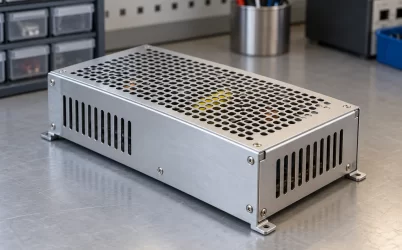
The highest current 80 PLUS efficiency certification tier for server power supplies is Ruby. That does not identify one universally “most efficient server PSU.” A Ruby badge says an exact certified model met thresholds in a specified test category; the lowest electrical input for a particular server depends on which approved module can power that host and how efficiently it operates at the host’s actual input voltage and DC load.
The distinction is more than wordplay. A certificate ranks performance against a defined floor. A server draws power through a specific cartridge, at a moving load, in a chassis with its own cooling and redundancy behavior. Those are different measurement questions. Treating one badge as a universal winner can obscure both a real opportunity to reduce conversion loss and a module that cannot be installed in the intended machine.
Ruby is the highest badge; it is not a world-record list
The 80 PLUS program currently displays Ruby above Titanium. In its 230 V internal, redundant-data-center category, the published Ruby minimum efficiencies are 90% at 5% load, 91% at 10%, 95% at 20%, 96.5% at 50%, and 92% at 100%. These are category thresholds, not the measured curve of every Ruby PSU and not a specification for every input-voltage category. The 50% point is particularly demanding, but the 5% requirement also matters to redundant equipment whose active modules may spend substantial time lightly loaded.
“Highest tier” describes the certification system. “Highest measured efficiency” would require defining a test category and load point, then comparing results for specific models under equivalent conditions. “Least electricity used by my server” requires yet another answer: a compatible product’s measured performance across that server’s actual operating states. The first question can be answered from the ratings chart. Neither of the others can be answered from the badge alone.
A certification threshold is a floor for entry, not a ceiling on the performance of lower-tier models. A Titanium unit can exceed the Ruby 50% threshold yet miss Ruby because it does not meet another required point or condition. Conversely, a Ruby unit that just meets its floor at one point need not beat every other certified unit at every load. This is a logical consequence of multipoint qualification, not a claim that a particular commercial model performs that way. Even two Ruby products need not have identical curves.
Nor does a higher tier mean a higher wattage rating. Efficiency is the ratio of useful DC output to electrical input; capacity is the maximum supported DC output under specified conditions. A 5,500 W supply can have an excellent percentage while drawing much more electricity than a 1,000 W supply if it is feeding a much larger load. The products are doing different jobs. Comparing their absolute input watts without holding useful output constant is meaningless.
The category printed above the percentages changes the answer
The five Ruby numbers above belong to the 230 V internal redundant-data-center classification. A result reported for a different input regime, or for a desktop and nonredundant-server category, should not be placed beside it as though both measurements came from one laboratory condition. The 80 PLUS program separates these applications for a reason. The reader first needs to know which certified category corresponds to the proposed module and the site’s electrical feed.
A facility description such as “208 V rack” or “high-voltage data center” is insufficient to select a report category. A server PSU may receive single-phase AC through a rack PDU, whereas a rack power shelf may take a different input and distribute DC to equipment designed for it. A product’s broad input-voltage label also does not prove that its published efficiency result was measured at every voltage in that range. Compare the actual source applied at the PSU input, not merely the upstream service voltage.
The same care applies to “server PSU” as a product label. The program distinguishes redundant-data-center applications from other PSU classes. A certified retail unit and a blind-mate server cartridge can carry the same badge while solving different installation problems. Their certificates should not be collapsed into a single league table to make a purchasing claim. Establish the relevant category, input and rated-output basis before a percentage difference is used in an argument.
Suppose an integrator sees 96.7% in one report and 96.4% in another. The first number is larger, but the comparison remains unresolved if one was measured at 230 V AC and the other at a different input, or if the reports refer to different fractions of each module’s rating. The percentage-point difference may be smaller than the change caused by moving either module to the installation’s operating point. Calling the first unit “most efficient” would assign a ranking that the two records do not establish.
A redundant pair may live far below its attractive half-load point
Consider a hypothetical server whose components require 400 W DC and whose approved power assembly has two 2,000 W modules. If its controller shares output equally in the normal state, each module supplies about 200 W, or 10% of its own rating. The Ruby threshold at 50% load describes a 1,000 W DC output from each such module, not the server’s normal 200 W per module. Substituting 96.5% into the normal-state energy calculation would select the wrong point on the curve.
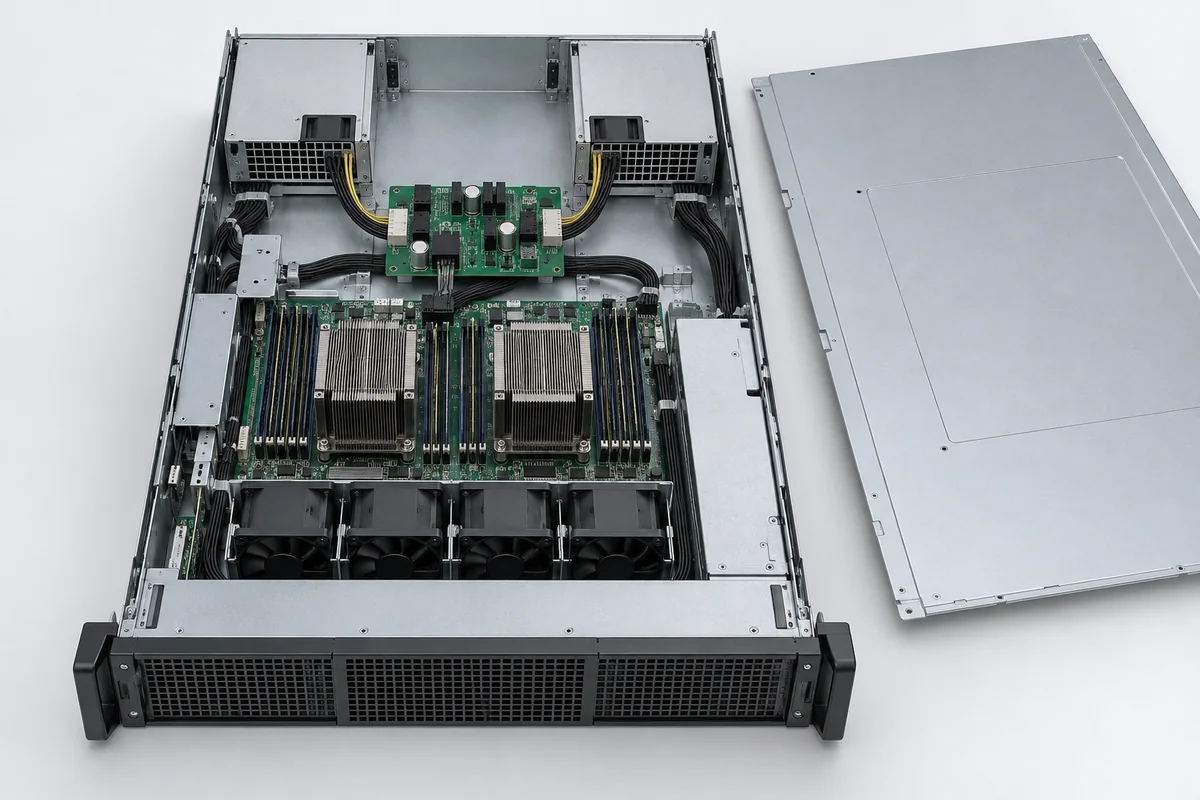
If one module fails, the survivor may supply the full 400 W, roughly 20% of its rating. The electrical load seen by that module has doubled, though the server’s useful DC demand has not. Its conversion efficiency can therefore change after the failure. A supported standby or power-saving mode would create a different normal-state split again. These are possible host behaviors, not universal modes of redundant supplies; the particular server’s control policy determines which state actually occurs.
The 5% and 10% Ruby requirements make sense in this context. At 10% output, fixed control, standby and fan-related input can represent a larger fraction of useful power than it does near half load. A badge that requires performance at light load offers information that a single peak-efficiency figure omits. It still does not tell us the exact input watts of the proposed pair at 200 W each. The published category limit says what a certified unit must clear; it does not replace that model’s measured values.
Translate a percentage into input watts before calling it a saving
A small efficiency gap can be stated precisely without pretending it predicts every workload. Imagine two hypothetical, mechanically compatible 2,000 W supplies, both evaluated at the same 230 V input and each delivering 1,000 W DC. If one operates at 96.5% efficiency and the other at 96.0%, the corresponding AC inputs are about 1,036.3 W and 1,041.7 W. Their conversion losses are about 36.3 W and 41.7 W. The difference is approximately 5.4 W for that one module at that one operating point.

The 96.5% and 96.0% values coincide with published Ruby and Titanium minimums at the 50% point in the specified 230 V redundant category. The imagined products are not real model measurements. Actual certified units may exceed their floors by different amounts; one cannot convert the threshold gap into a guaranteed procurement saving. The arithmetic illustrates why a half-percentage-point difference should be expressed as watts of loss before anyone treats it as a dramatic thermal or energy result.
Under a purely hypothetical constant 1,000 W DC load for 8,760 hours, that 5.4 W input difference would amount to roughly 47 kWh for one module over a year. Real server loads are not normally fixed for all 8,760 hours, and a redundant system may use two active modules. If both modules operate at a different load fraction, the efficiencies in this example no longer apply. Multiplying 47 kWh by a rack count without reconstructing those conditions would convert a transparent example into an unsupported forecast.
There is also a thermal interpretation. The difference between AC input and DC output is electrical loss within the PSU boundary and largely appears as heat. At the hypothetical half-load point above, the thermal difference is the same approximate 5.4 W per module. That is worth considering in a dense fleet, but it does not establish a lower component temperature or reduced fan speed in a specific chassis. Airflow controls, module placement and other heat sources determine the installed response.
The comparison can reverse if the modules spend most of their lives elsewhere on their curves. Imagine two fully supported candidates whose measured reports show Candidate A ahead around half load but Candidate B ahead near 10% load. In the 400 W redundant-server example, normal sharing could favor B even though a 1,000 W laboratory comparison favors A. The example makes no claim about any real product; it explains why “most efficient” needs a denominator and an operating state. A badge is an efficient first filter, not a universal ordering of annual input energy.
A model can win electrically and still lose eligibility
Suppose the strongest efficiency report belongs to a cartridge the server cannot accept. It has the wrong blind-mate interface, incompatible management behavior, unsuitable airflow direction or an unsupported part identity. Its conversion number cannot reduce the server’s energy use because it cannot safely be used in that host. A server manufacturer’s approved module list and the assembly’s interface documentation answer a different question from the 80 PLUS certificate, but eligibility must precede any claimed installation benefit.
The boundary is especially important when the highest-rated supply is offered at a much larger output capacity. A server may run it at a light-load point where the percentage advantage is smaller than the badge suggests. Conversely, a smaller module might have a favorable operating point but fail to carry the defined peak or surviving-module load. Neither outcome follows automatically from wattage. They are constraints that can exclude an otherwise appealing efficiency comparison.
A seller’s efficiency description needs an exact-model manufacturer specification and the corresponding certification or test report before it can support a comparison. Match the offered revision, input conditions and measured operating points to the host-approved module. A product listing alone cannot establish either the lowest input power or compatibility with an arbitrary server.
What a defensible “most efficient” claim sounds like
A specific claim names the comparison set and conditions: “Among these host-approved modules, Model A drew the least AC input while delivering this DC load at this input voltage.” The wording is narrower than a global superlative, but it tells an operator something usable. If measurements span several load states, the claim can instead refer to the lowest weighted input energy for a stated workload. A tier label may support the shortlist; the final sentence should not pretend that the shortlist is a world ranking.
There may be no single winner even within one approved pair of models. One can draw fewer watts at a light normal load while the other draws fewer after a module loss or during a sustained heavy workload. A platform that spends nearly all its time in one state will weight that difference differently from a platform with variable load. The strongest answer is a condition-bound comparison, not a manufactured universal champion.
As of the current 80 PLUS program, Ruby is the top certification tier. For an actual server, “most efficient” is the compatible module or assembly that uses the least input energy for the stated DC work and operating pattern, supported by comparable model data or measurement. Those two answers should be kept side by side: the badge tells us how demanding the certification class is; the installation tells us which electrical losses will actually be paid for.