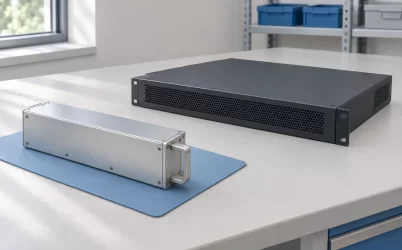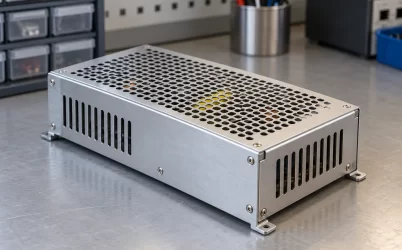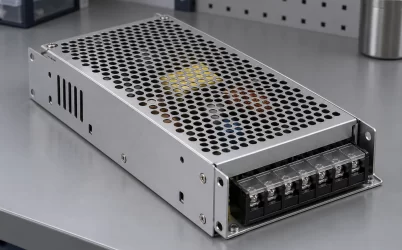
“1U power supply” and “Flex ATX power supply” are not opposing standards. A one-rack-unit server can contain a Flex ATX unit, a longer cabled supply, or a removable server cartridge. The first expression usually locates the power system in a low rack chassis; the second describes a particular compact PSU family. Confusing the two is easy when product listings put “1U” next to “Flex ATX,” but a shared height does not make two supplies interchangeable. The useful question is which mechanical bay, electrical interface, cooling path, and service arrangement the actual case provides.
One rack height does not prescribe one PSU outline
A 1U enclosure occupies one unit of rack height. That is a constraint on the whole assembled server, including its lid, board, cables, risers, and fans. It is not a drawing of the power supply inside. A PSU must leave room for its mount, inlet, fan opening, and wiring while the cover closes, and it must have the particular shape the chassis designer reserved for it. Two supplies can both be low enough for 1U yet differ substantially in width, depth, fastening pattern, and the position of their AC inlet.
Flex ATX is much more specific. For example, FSP identifies its FlexGURU Pro FSP500-50FDB as a Flex ATX supply with a 150 × 40.5 × 81.5 mm body and a 40 mm fan. That is the manufacturer’s specification for that model, not a promise that every Flex ATX product has identical cable reach, mounting holes, fan location, or clearance. The unit carries an ATX-style output harness rather than presenting a blind-mate server cartridge. Its specification lists a 20+4-pin motherboard lead, CPU-power leads, SATA and other peripheral connections.
A chassis maker may explicitly pair a 1U case with this family. Chenbro describes its compact RM14300 as a 1U chassis that supports a Flex ATX PSU. That is meaningful because the case has a defined power-supply space, not because all 1U cases accept a Flex ATX unit. The chassis SKU and its power option still determine whether a separate PSU is supplied, what bracket is present, and where the cable bundle runs. “Supports Flex ATX” is a starting point for this particular case; it cannot be carried over to another 1U enclosure by analogy.
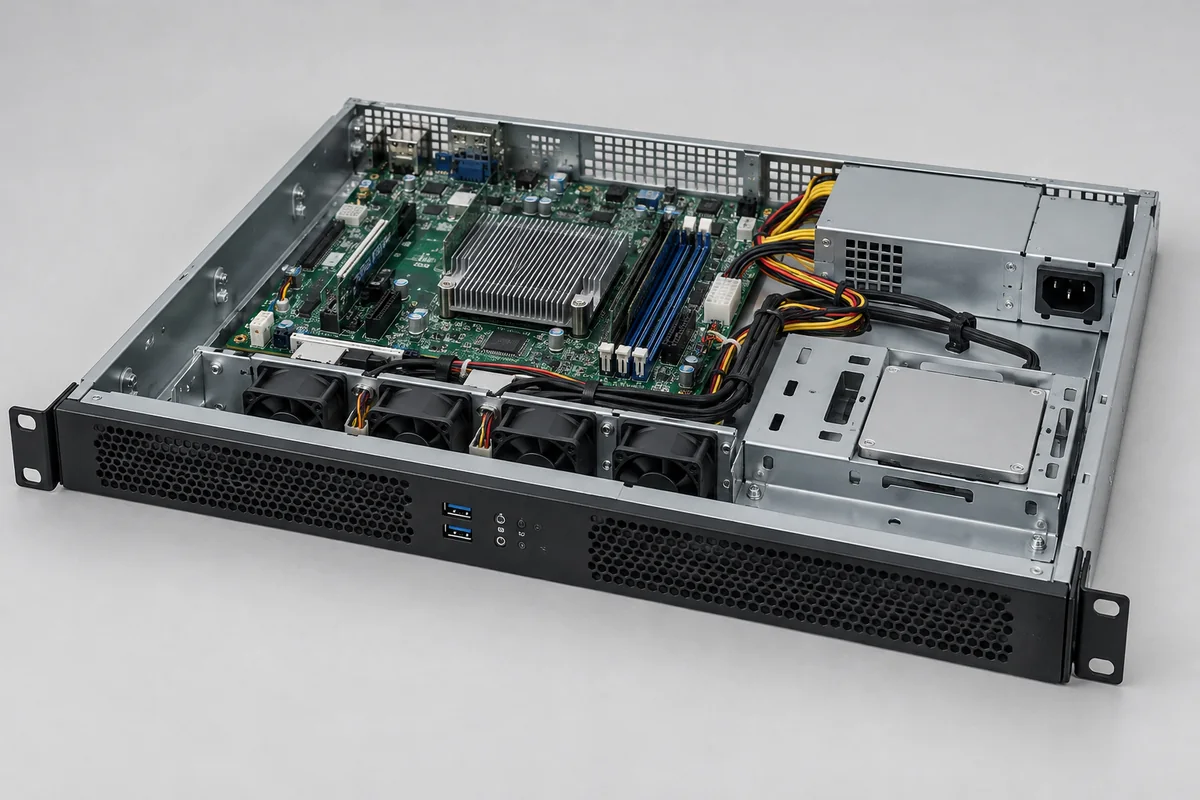
The 1U figure belongs to the rack enclosure, not the metal can inside it. Other 1U power arrangements may occupy a long narrow strip, a pair of slots at the back, or a cage that bridges the rear wall and an internal distribution board. These arrangements require their own controlled mechanical drawings; a rack-height description does not define their depth or mating system. A buyer who reads only “1U” and wattage can miss the extra length or the second-module architecture altogether.
The rear opening reveals the service model
Stand behind the case before looking at its advertised wattage. A typical cabled Flex ATX installation exposes the AC inlet and exhaust area at a fixed rear opening. Screws or a retaining bracket hold the supply in place, and its output leads travel inside to the motherboard and devices. Removing it may require opening the chassis and disconnecting those leads. Nothing about its low height alone gives it hot-swap capability.
The rear opening makes the difference visible. A removable CRPS-style module normally belongs to a dedicated bay or cage with a mating interface and power-distribution board. The cartridge can be reached from the service side, but the cage, connector, board, controller behavior, and host power design determine whether replacement can occur while the machine is running. A single-slot module in an incompatible host is not a redundant system; a second empty opening is not evidence that the remaining module can carry the whole load. These distinctions are architectural, not vocabulary preferences.
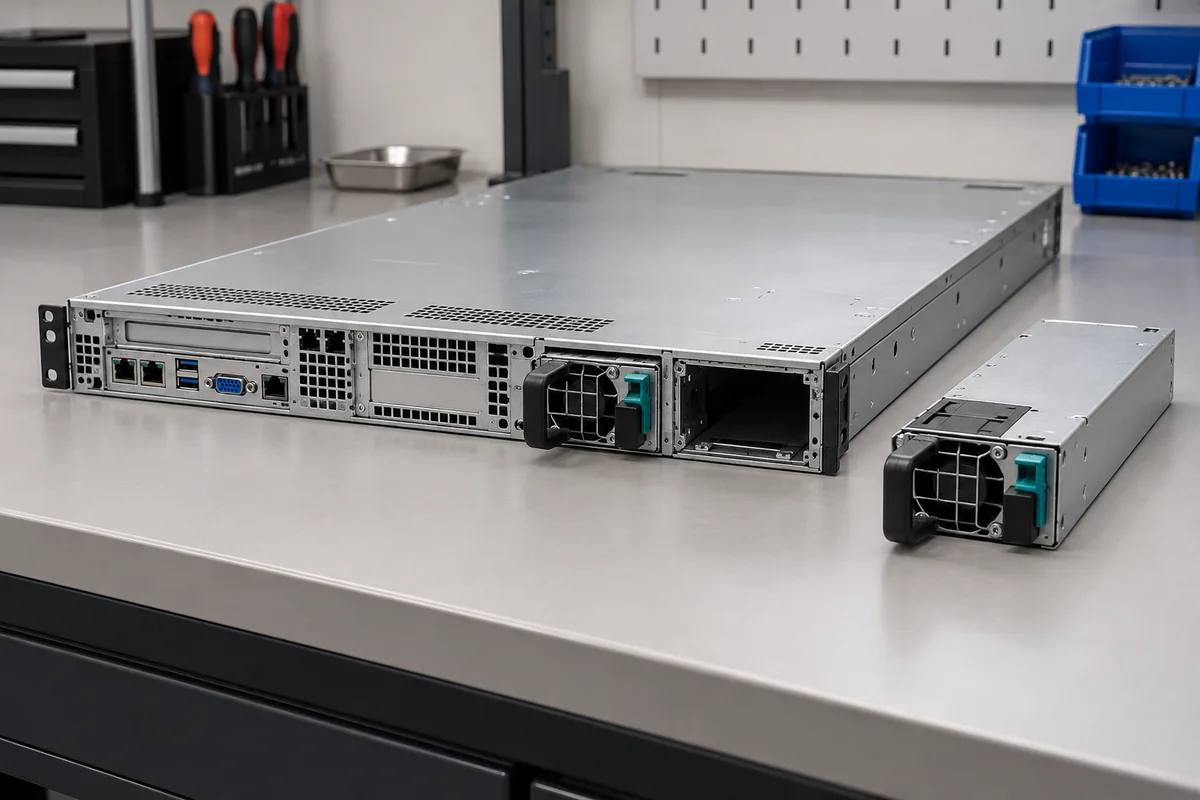
A cartridge-based server power system requires a host-defined cage and mating connection. Its documented envelope must be compared with that host, including connector location and latch travel. A low-profile cartridge and a Flex ATX enclosure can both be considered for 1U equipment while requiring different mounting, wiring and control arrangements. No dimensions alone establish interchangeability with a Flex ATX bay.
A third arrangement is a longer fixed 1U supply with a cable harness. It can be neither a standard Flex ATX body nor a blind-mate CRPS cartridge. In a shallow case, its length could compete with drive cages or fans; in a deeper case, the mount and cables may be specifically designed for it. This is why photos of a low rectangular PSU are insufficient evidence. The view must show the label and all sides relevant to the mounting position, particularly the rear flange, DC output end, fan, and AC connector.
The power connection is not a shape issue
After the metalwork comes the load connection. A Flex ATX supply often serves a system wired much like a compact PC: motherboard connector, processor-power connector, and peripheral cables. FSP’s cited model is one documented example. The server builder must still verify the exact connector pinout, cable lengths, rail limits, and standby behavior against the board and devices. A cable with a familiar shell is not proof that every OEM board accepts its pinout or sequencing.
Many hot-plug server cartridges instead deliver their main output through a card edge or another blind-mate connector into a PDB. The board distributes power to the motherboard and other loads and may provide ORing, current sharing, status, or management connections as the host requires. This can make a high-current 12 V module look physically compact while moving part of the integration work into the cage and distribution assembly. It does not mean that the module itself exposes a universal 24-pin ATX cable. If the host expects a PDB and the replacement has flying leads, a bracket alone cannot close that interface gap.
The converse is just as important. Installing a CRPS cartridge into the volume formerly occupied by a Flex ATX unit would still leave its card edge, standby rail, enable behavior, sense and management signals without a confirmed mating design. A loose adapter assembled from connector appearance or pin count is not an approved server power system. Output voltage labels are only one layer; the host must support the source’s current path, start-up order, protection behavior, and load transients. The 600 W Flex PSU fit example shows why even a named Flex unit must be judged against its actual 1U host rather than a generic photograph.
It is therefore possible for both candidates to deliver nominally similar DC power and for neither to be a substitute for the other. This is not a subtle difference that can be solved by comparing efficiency badges. Electrical efficiency affects wall draw and heat, but it does not change the bay shape or supply a missing PDB. Similarly, a higher wattage rating cannot repair an incorrect pinout. Start with the host’s specified PSU family; only then compare ratings within that mechanically and electrically compatible family.
Cooling can disqualify an apparently fitting unit
Low-profile power supplies work near the height limit of a 1U enclosure, so their fans and vents are closely tied to the case airflow path. A Flex ATX model may pull air through its own casing while nearby chassis fans cool the processor and drives. A server cartridge may rely on a defined front-to-rear pressure path or use its integrated fan as part of the chassis airflow plan. The location of one 40 mm fan tells you little unless its intake and exhaust communicate with the intended zones after the lid, cable bundle, and neighboring modules are installed.
An apparently fitting replacement can reverse that path or block it with its exhaust grille against a solid rear panel. Even a few millimeters of clearance around a connector or fan may matter in a densely occupied bay. Hot air returning to the PSU inlet raises its component temperature; a harness laid across the fan entrance can reduce delivered airflow. A server with a redundant pair introduces another state: once one module stops contributing, the remaining module may carry more load and reject more heat into the same constrained space. The case airflow design and the surviving PSU’s rating under installed conditions then matter together.
The thermal comparison is not “Flex ATX runs cool” versus “1U runs hot.” Neither label specifies inlet temperature, fan control, acoustics, derating, or continuous output under the complete host’s pressure resistance. The manufacturer’s operating conditions and the chassis vendor’s supported configuration are the relevant evidence. For a retrofit, the physical question is whether intake, exhaust, wiring, and service access remain unobstructed in the closed server, not whether an isolated unit seems cool on a bench.
A shallow case and a redundant case lead to different answers
Consider a compact edge server whose case documentation explicitly calls for a Flex ATX PSU, with one fixed rear AC opening and a cabled motherboard connection. In that design the term “1U” says where the assembled computer fits in a rack; “Flex ATX” narrows the replaceable power-supply family. The sensible candidate is a supply whose actual dimensions, bracket, cable set, input rating, thermal requirements, and electrical output match that case and board. A CRPS cartridge with a similar height is not the same class of spare.
Now consider a different 1U server with two rear PSU handles, a cage, and a PDB documented by its system manufacturer. Its replacement path is likely through approved cartridge part numbers or a fully specified compatible assembly. The unit may have a low-profile housing, but a cabled Flex ATX supply is not a direct repair part. The important property of the two-slot case is not simply that it is “1U”; it is the whole redundant power subsystem, including what happens after one module is lost. A candidate cartridge needs to mate with that exact subsystem.
If the case is still being selected, either architecture might be considered subject to service and capacity objectives. If the server already exists, its bay largely settles the choice. Converting between families can require a new rear cutout, cage, PDB, harness, airflow plan, and host-control behavior. That is a system redesign, not a PSU replacement.
One misleading shortcut is to treat a motherboard’s ATX connector as proof that the case accepts a Flex ATX PSU. A redundant server may use a PDB with a downstream motherboard harness that ends in familiar connectors. That connector is on the load side of the distribution system; it does not describe the upstream PSU bay. Another shortcut is to assume a server cartridge is replaceable under power because a handle is visible. Hot-swap service requires a system designed for it and an approved procedure. The case manual, not the shape of the handle, sets that boundary.
What the two labels actually tell you
“1U” can establish the intended rack height of a host or market the low profile of a PSU, but it leaves its mechanical and electrical standard unresolved. “Flex ATX” gives a more useful PSU-family description, yet it still does not certify fit in every 1U enclosure or compatibility with every board. The words can be true at the same time: a 1U server may intentionally use a Flex ATX supply. They can also describe different products that cannot replace one another.
For a documented cartridge example, the Intel R1000BB Technical Product Specification, Revision 2.0, section 3.3.1 shows a 2×25 card-edge interface mating to the server board for one PSU and to the PDB for the other. Its table includes power, standby, enable, sense and management contacts. These assignments describe that system; they are not a universal cartridge pinout.