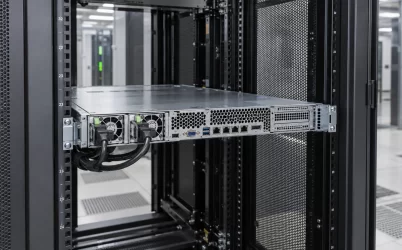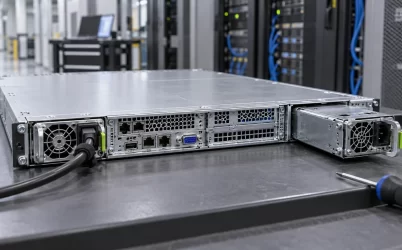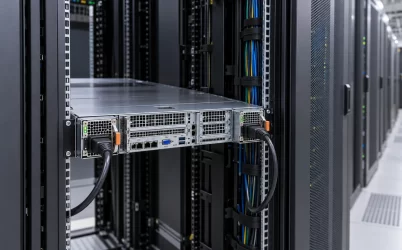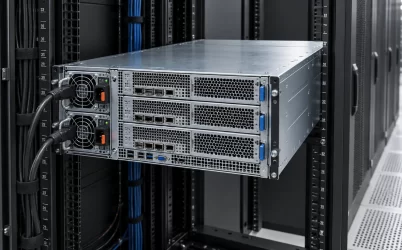
A 600W 80 PLUS Platinum Flex 1U server PSU is usually sought for a narrow enclosure that cannot accommodate a larger power supply. The word “Flex” matters more to the mechanical design than the efficiency badge: it points to a slim, cabled supply format, not a universal hot-swap server cartridge. Before selecting one, establish the chassis mounting pattern and available depth, the output rails and connector set required by the board and drives, the route for the cable bundle, and the air entering the PSU fan. Platinum certification describes conversion efficiency under a defined test condition; it cannot prove that the supply fits, cools, or powers a particular 1U system.
Flex 1U describes a narrow supply, not a complete server interface
In product searches, “1U” may refer to the server height, a slim PSU housing, or a seller’s informal size category. Flex ATX describes a recognizable narrow supply family, but actual products still have model-specific lengths, mounting holes, fan positions, and cables. It is not interchangeable with a CRPS module or a proprietary removable PSU simply because all can appear in a 1U chassis. A cabled Flex supply normally mounts within an enclosure and feeds loads through harness connectors. A hot-plug server module typically mates to a defined cage or power distribution board. Those are different physical and service architectures.
The original manufacturer’s data gives a useful concrete example. Enhance lists its ENP-7660B as a 600W Flex1U unit, with a body approximately 40.5 mm high, 81.5 mm wide, and 150 mm long. Those values describe that model, not a guaranteed envelope for every unit advertised as Flex 1U. A chassis drawing must leave additional space for the AC inlet, cable exit, bend radius, fasteners, and airflow. The nominal metal box dimension alone cannot tell an integrator whether the assembly will install cleanly.
Start with a section view of the actual chassis. Mark the PSU body, mounting plane, motherboard edge, front fan or drive cage, rear panel, and the path by which each cable reaches its load. A supply may fit on a desk but force a tight cable bend against a cover once installed. A cable bundle can also block the only air path through a shallow server. If the chassis was designed around another supply length or outlet orientation, a supposedly compatible replacement may move the connector cluster into the wrong space.
Depth deserves a separate drawing check because space behind the supply is rarely unused. A rear-mounted AC socket can compete with a rack rail, cable-management arm, or wall of a shallow enclosure. At the opposite end, fixed output leads may emerge directly into a drive cage. Measure the usable installed envelope, not just the distance between two empty panels. Leave enough clearance for the connector and a natural cable curve rather than planning to compress insulation against a sharp sheet-metal edge.
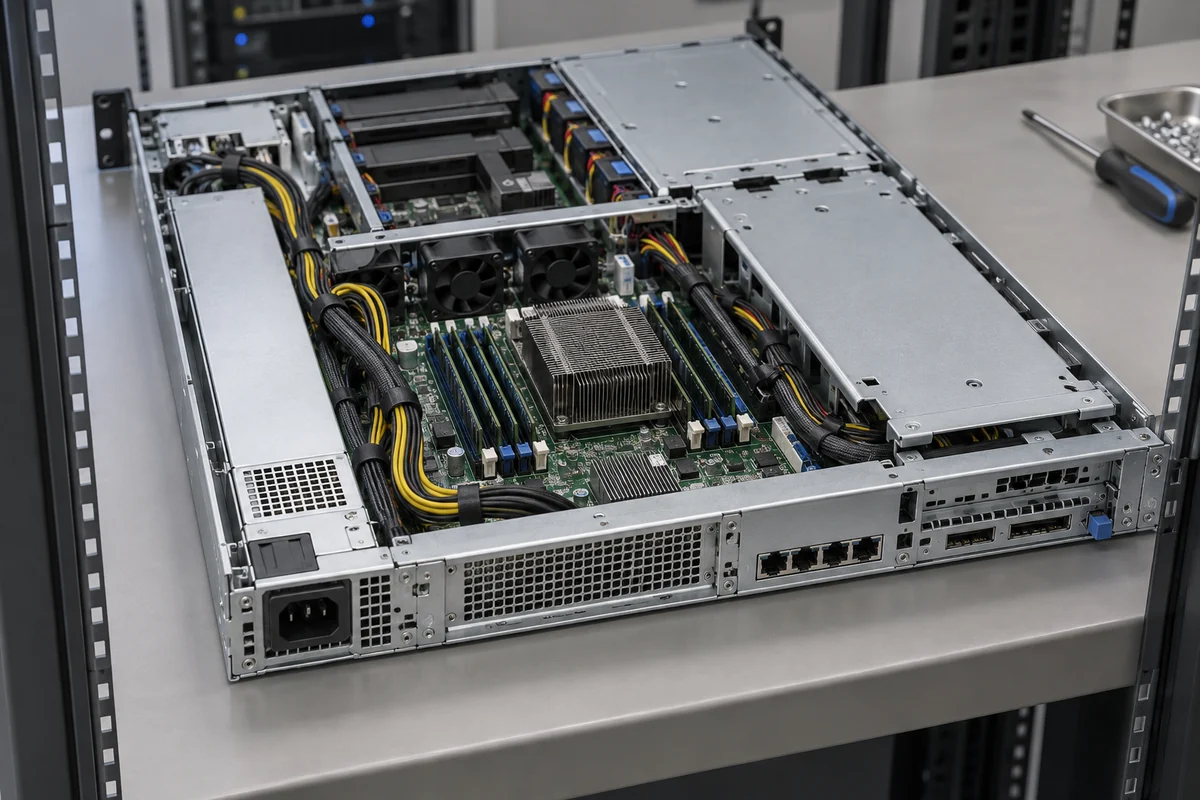
For a spare, compare the old and proposed harnesses as complete assemblies. Connector shapes, pin functions, wire count, cable length, and branch placement are relevant. An ATX-style 24-pin plug does not establish that every auxiliary or processor-power connection is present, and a familiar connector shape does not excuse checking a proprietary board pinout. For a new design, the harness can be planned with the board and storage layout; for an existing host, only a documented compatible part should be treated as a direct replacement.
The output rails and harness can limit a nominal 600W build
“600W” is a total-output rating under the manufacturer’s stated conditions. It does not mean every rail can deliver the full value independently. Flex supplies often support a mixture of 12V, 5V, 3.3V, standby, and sometimes negative-voltage outputs. The actual combination differs by model. Processor and accelerator loads commonly concentrate on 12V, while storage devices and control circuits can use other rails. The chosen supply must meet both the total limit and each rail’s individual and combined limits.
Enhance’s published ENP-7660B listing, for instance, identifies 12V and auxiliary outputs and gives a combined limit for 3.3V and 5V. That is a reason to read a rail table rather than infer the distribution from 600W on the product title. Do not copy that rail distribution into a different 600W Flex product. A board with high 12V demand and modest minor-rail demand presents a different fit from a storage appliance with several drive spin-up loads and many peripheral connectors.
Some apparent power problems are connector problems. A harness might provide enough total wattage but not enough correctly rated branches at the right locations. Combining adapters can concentrate current in a connector or lengthen a cable path in a confined enclosure; it is not a substitute for a supported harness. Processor power, drive power, and any accelerator connection should be checked against the host’s actual bill of materials. If the design depends on adapters or unusual routing, specify the connector and wire ratings instead of relying on generic “600W PSU” compatibility language.
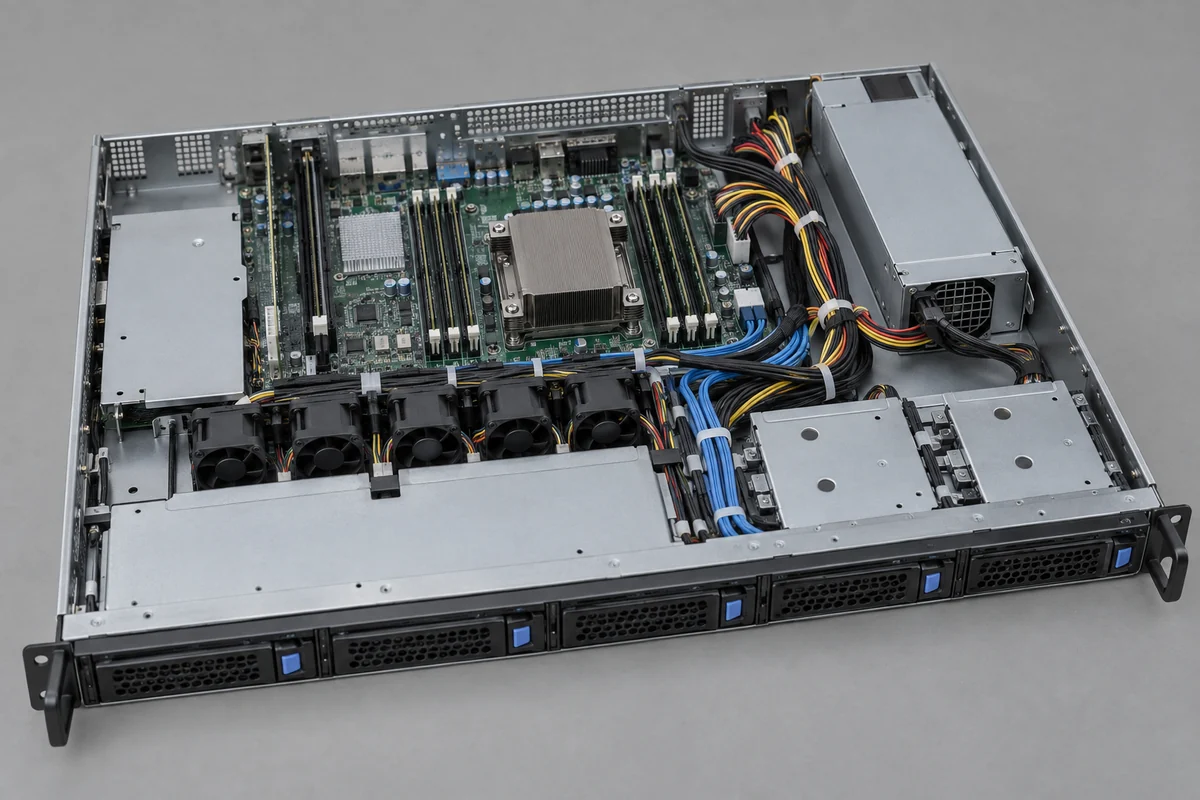
Peak behavior is another separate consideration. A server’s steady DC load may be below 600W while simultaneous drive spin-up or workload transitions impose short demands on particular outputs. The PSU and host can respond to such events in different ways. Use the manufacturer’s documented transient and protection behavior when available; do not infer it from the 80 PLUS tier. If no adequate data is published, the integration claim should remain conditional until the actual system is observed under representative startup and peak-load conditions.
The Flex fan has little room to compensate for blocked air
A narrow supply places the fan and heat-producing components close together. It also has little freedom to bypass a restricted inlet or a cable bundle pressed against its outlet. Platinum-level conversion efficiency can reduce heat for a given output compared with a less efficient candidate at the same conditions, but the remaining loss still has to cross the PSU’s internal airflow path. Efficiency and airflow are related yet distinct. A thermally unfavorable installation can defeat the practical benefit of a lower electrical loss.
Trace where the PSU receives cool air and where its exhaust goes inside the specific 1U host. A rear panel that almost covers the exhaust, a storage cage tight against the inlet, or cables folded over a fan grille can reduce the air available to the converter. The host’s fans may create positive or negative pressure at that location; the effect depends on the actual enclosure. Fan direction, clearance, and the presence of baffles should be evaluated in the assembled system, not inferred from a product photograph showing the PSU in open air.
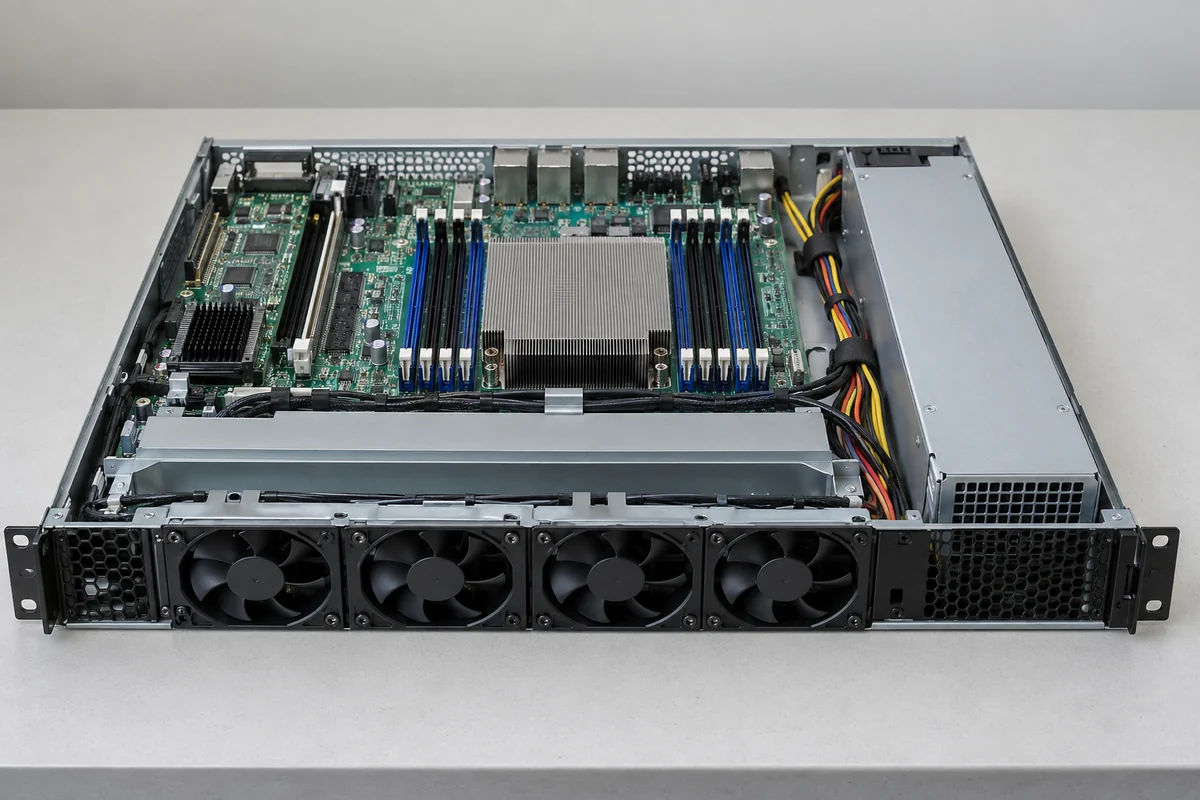
Noise can be a practical constraint when a Flex unit is used in an edge server or an office-adjacent appliance. A small fan may need to turn quickly when inlet air is warm or output power is high. Platinum certification does not include a sound-level promise, and one model’s fan curve cannot be assigned to another. If acoustic behavior matters, request the specific model’s documentation or measure it in the intended enclosure and workload. A fan modification that reduces noise can also alter cooling and product support, so it should not be treated as a harmless compatibility adjustment.
Thermal assessment also changes with where the server sits. A shallow edge rack with poor ventilation, a dense data-center rack with established airflow, and a compact storage chassis with front drive bays can expose the same PSU to different inlet conditions. The relevant temperature is the air at the supply’s inlet, not merely the room set point. A chassis can be within room specifications while a local recirculation path raises the PSU inlet temperature. The manufacturer’s output rating and temperature conditions should therefore be read together.
What the Platinum report can establish for one exact Flex model
Efficiency evidence becomes useful when tied to an identifiable device. The official 80 PLUS test report for Enhance ENP-7660B identifies a 600W Flex ATX model and measurements at 115V nominal. It reports 91.75% efficiency at 20% load, 92.97% at 50%, and 90.80% at full load for the tested sample. These measured values are evidence for that model under that report’s conditions. They are not guaranteed field results for another Flex PSU, another input voltage, a modified fan, or a warmer enclosed server.
The report also shows why “Platinum” should not be translated into a fixed loss number. At the 50% test point, output was approximately 303W and input approximately 325W, a difference of roughly 23W under the reported bench condition. At the full-load point, measured output and input were much higher, so absolute loss rose even though efficiency remained high. The fan and chassis must handle watts of heat, not an adjective. These report figures should be used only as a model-specific example, not as a universal thermal prediction for 600W Flex hardware.
Certification does not establish maximum continuous output at every input voltage and temperature. The manufacturer’s current product documentation should supply those operating limits, along with electrical outputs, connector details, and environmental conditions. A reseller may use “Platinum” in a model name, marketing copy, or a different certification program. Match the exact manufacturer model against the 80 PLUS record before claiming an 80 PLUS Platinum certification. Similar-looking Flex units can differ in rails, fan design, cable set, and official rating even when the enclosure shape is familiar.
Nor does a bench efficiency test certify the entire server. The power supply is only one source of heat and loss. Distribution wiring, motherboard voltage regulators, fans, and storage each affect facility power and temperature. The PSU’s measured efficiency is valuable because it isolates the AC-to-DC conversion stage; it is not a substitute for evaluating the assembled system’s airflow or total wall power. Keep those boundaries clear when comparing proposed 1U builds.
When a Flex supply is appropriate for the 1U host
A Flex unit is a sensible candidate when the chassis was designed for its mechanical family, the mounting points and cable route are known, the connector set matches the board and drives, and the actual load falls within the model’s documented rail and total-output limits. It is especially useful where a narrow, self-contained cabled supply leaves space for other components in a compact server or industrial computing enclosure. The advantage is not that “Flex” guarantees universal compatibility; it is that the form can be integrated deliberately around a constrained layout.
Another architecture may be preferable when the host requires tool-less live replacement, a defined redundant midplane, or tightly managed module sharing. A single cabled Flex supply does not become a redundant system because a seller describes it as server-grade, and two independent units cannot simply be wired together to create safe redundancy. The distribution and control architecture would have to support that arrangement. Equally, a CRPS module that suits a redundant server cage is not a drop-in substitute for a Flex unit mounted by brackets and cables.
For the buyer evaluating an existing 1U server, the most productive evidence is a mechanical drawing or approved spare list, the host connector map, and the manufacturer’s rail and temperature specifications. The Platinum report then adds a bounded efficiency fact for the exact certified model. That order reflects the search’s practical purpose: find a 600W supply that can live inside this slim host and power its actual loads. A superb efficiency figure cannot repair a cable collision, an absent board connector, or an obstructed cooling path.