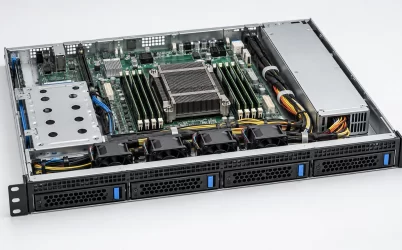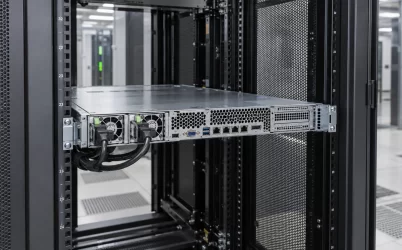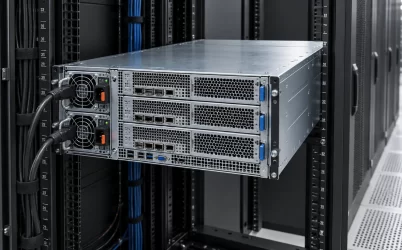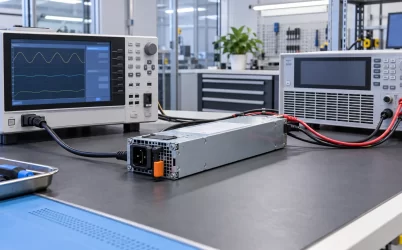
The difference between a redundant and a non-redundant server PSU is what happens after a defined power-path failure. With a single supply, loss of that converter normally removes the server’s DC power and interrupts the workload. A properly designed redundant arrangement can keep the host operating after one PSU or one supported input path fails, provided the remaining path can carry the full load. Two installed modules alone do not prove that result: some platforms use all installed capacity in a non-redundant mode. The useful comparison is therefore not simply one box versus two. It is the behavior of the host, its power distribution, and its workload during the failure the design is supposed to survive.
At the moment a converter fails, the two architectures diverge
In a single-PSU server, the converter is the only source feeding the internal DC rails. If it stops delivering power and no separate mechanism maintains those rails, the machine loses power. Recovery may require a replacement part, a shutdown investigation, and a restart. A UPS upstream of the server can cover a facility interruption, but it does not replace the failed converter inside the server. This is why facility backup and server-level PSU redundancy solve different problems.
In a 1+1 server, two suitable modules connect through a host-supported distribution arrangement. During normal operation they may share current or operate according to another documented control policy. When one path fails, the other must assume the protected load without the DC bus leaving the host’s acceptable range. The missing module is then a fault to be repaired rather than an immediate shutdown, assuming the system actually remains inside its supported degraded mode. The surviving converter, the mating assembly, and the distribution board all participate in that outcome.
A failure need not be dramatic. A fan fault or overtemperature event may cause a PSU to stop, reduce output, or report an alarm depending on its design. Loss of AC at one inlet can look similar from the server’s perspective, but it points to a different repair. A redundant host can stay online in either case only if the remaining path is healthy and supplied. The alarm still matters: once one module is lost, a 1+1 platform has no second module left to absorb another comparable failure.
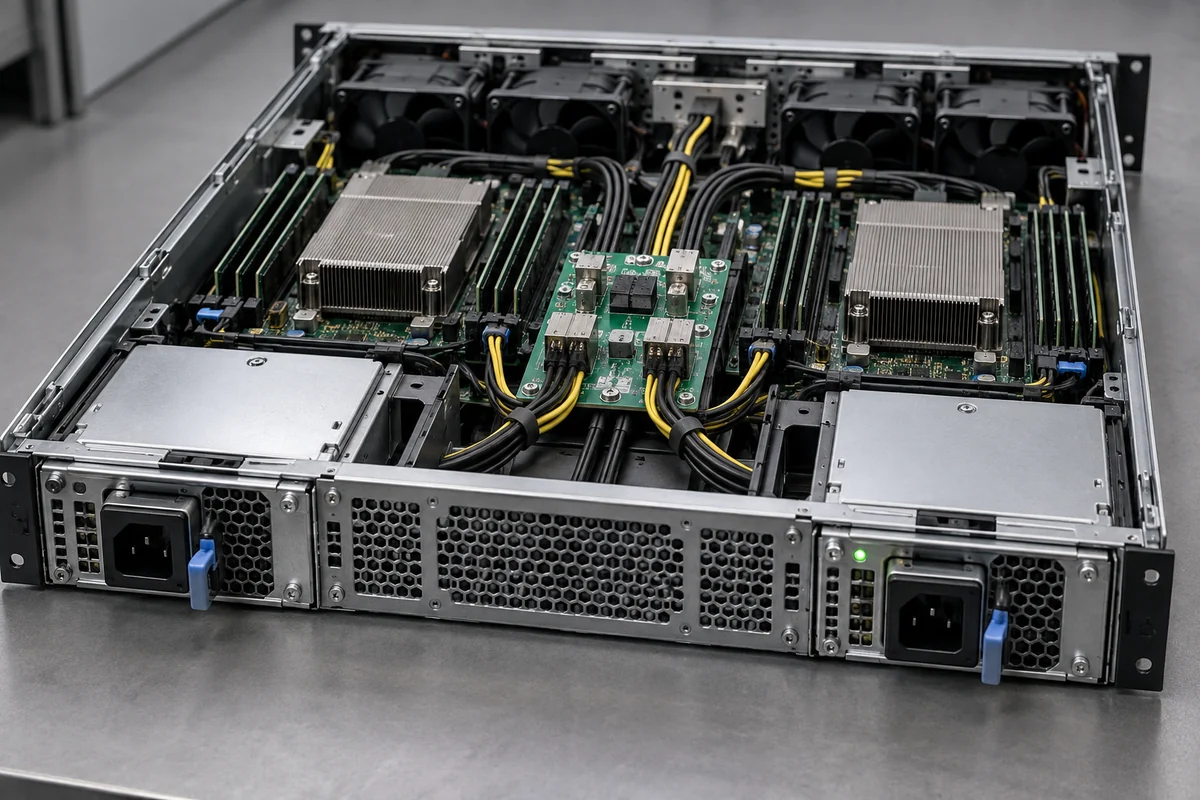
The feature is not a universal uptime guarantee. A fault in a shared power distribution board, motherboard rail, or common upstream supply can affect both modules. A server with two PSUs attached to the same PDU may survive failure of one converter yet remain vulnerable to that PDU’s loss. An independent A/B feed may remove that common upstream point, but only if the host supports the arrangement and each surviving feed has sufficient capacity. Redundancy has a specific boundary; it does not make every component in the power chain redundant.
Two installed PSUs can still operate without redundancy
A photograph of two rear PSU handles says little about capacity policy. A system may install two modules because their combined output is needed for the configured processors, accelerators, or storage. If the workload exceeds what either module can provide alone, failure of one leaves insufficient power. Some hosts may cap performance or shut down under that condition; the behavior must come from the platform documentation. Calling the hardware “dual PSU” would be accurate, while calling the current operating configuration “1+1 redundant” would not.
Cisco’s server management documentation explicitly distinguishes N+1, grid, and non-redundant power policies. In its non-redundant policy, usable capacity includes all installed PSUs and failure of a PSU is not supported. Its N+1 policy reserves capacity for one PSU failure, while its grid policy addresses a different input-feed condition. These definitions apply to the Cisco platform described by the document; they illustrate why module count and power policy must be read separately on any server.
Take a hypothetical host with two 800W modules and a maximum required DC load of 1,100W. Both modules together may have enough nominal output in an allowed combined-capacity mode, but one 800W survivor cannot supply 1,100W. The pair is not 1+1 redundant at that load. If the same host has a protected load below one module’s usable output under the actual voltage and temperature conditions, 1+1 may be possible, subject to platform support. The wattage arithmetic is simple; the difficult part is knowing the valid module rating and the host’s behavior during a transfer.
The distinction can change over a server’s life. Adding drives or an accelerator may raise peak demand above the single-module limit even though the chassis and PSU count stay unchanged. A power cap might keep a platform within the redundant envelope, but only if that host’s policy is configured and documented for the workload. A previously healthy redundancy indicator should not be assumed to remain meaningful after a major configuration change. The most useful question is whether the present server, not an earlier empty configuration, is protected.
Failure-state capacity can be constrained by the AC side as well as the DC nameplate. A module may have different supported output at different input voltages, and a surviving cord or PDU outlet must carry the input current required when that module assumes the full load. A 1+1 label on a quotation does not describe the facility feed to which the delivered server will be connected. This is why the protected workload must be compared with the lower of the relevant host and module limits under the installation conditions, not with an optimistic sum of both faceplate ratings.
Maintenance feels different from a sudden failure
Non-redundant does not mean every service action is difficult. A small edge server with one supply may be easy to turn off during a planned window, replace, and return to service. Where the application has another node or can tolerate a brief interruption, this can be a sensible architecture. It uses fewer converter modules and may simplify packaging. Its limitation is that an unexpected PSU fault creates an outage until the host can be repaired or recovered elsewhere.
A server designed for redundant hot-swap operation can often replace one failed module while the other continues feeding the load. That capability is valuable when the workload should remain on the same host and a shutdown has real cost. It still imposes a service sequence: identify the failed position, confirm the surviving unit is healthy, install a supported replacement, and observe restoration of redundancy. “Hot swap” refers to a supported live operation, not permission to remove any module in an already degraded or overloaded server.
Redundancy also buys time, not indefinite immunity. The host is operating with one less layer of protection while the spare is obtained and installed. Sites with remote racks or restricted access need a realistic repair interval. If a single spare can serve a fleet of identical hosts, local inventory and part compatibility may be more useful than adding a second PSU to every low-impact machine. Conversely, for a service whose interruption is expensive, module redundancy and a stocked replacement can reduce both the probability of an outage from one PSU failure and the time spent in a degraded state.
There is a subtle diagnostic benefit as well. On a supported redundant platform, management may report one missing or failed module while the workload continues. That creates an opportunity to investigate whether the problem is the converter, cord, inlet, or upstream feed before the next fault. On a single-supply host, the same failure may remove power before the system can report much locally. Neither arrangement makes logs infallible; the distinction is that continued operation can leave a wider window for diagnosis.
The reliability gain has costs and limits
Two modules, a shared cage or PDB, control circuitry, and extra space cost more than a single converter design. They can also add another fan and another component capable of reporting a fault. Whether a redundant pair consumes more AC energy than one equally suitable supply depends on the exact models and how the host operates them. With both converters active, each may run at a lower percentage of its rating; that can move them to a different point on their efficiency curves. The efficiency tier printed on a module cannot establish the energy penalty or benefit of the complete server architecture.
The physical trade-off matters in compact systems. A second PSU bay occupies rear-panel and internal volume that could otherwise support I/O, airflow, drives, or cabling. In a dense rack server this may be a worthwhile exchange. In a shallow appliance with modest power demand and a redundant application tier, a single PSU can leave a simpler airflow channel and easier cable service. Neither outcome is universal. The host’s mechanical design and the service it runs determine whether the reserved hardware path earns its space.
Upstream design can dominate the remaining risk. Two server modules connected to one UPS may protect against one converter failing, yet not against that UPS failing. Two feeds from independent PDUs can improve feed resilience, but if both PDUs ultimately rely on a single maintenance domain, an upstream common failure remains. Similarly, a dual-cord server does not automatically make the network, storage, cooling, or application redundant. PSU redundancy is one layer in an availability plan, and the scope of that layer should be stated precisely.
There is also a support boundary. Mixing physically similar modules or installing a second PSU not approved for the host can produce an alarm, unstable sharing, or an unsupported configuration. An unused bay does not prove that a second module may simply be added. The server’s validated parts and power policy determine whether the pair can operate in the intended mode. This is especially important when an older server is upgraded with higher-demand components or when secondhand equipment arrives with mismatched PSUs.
The application can sometimes provide the redundancy instead
Power continuity can be achieved at more than one level. A pair of application servers, each with a single PSU and supplied from separate infrastructure, may keep the service available after one host fails if failover is actually configured and tested. In that design, a PSU fault still shuts down one machine, but it need not shut down the service. This is not equivalent to a redundant PSU inside one host: failover time, session state, storage dependencies, and software behavior all become part of the outcome.
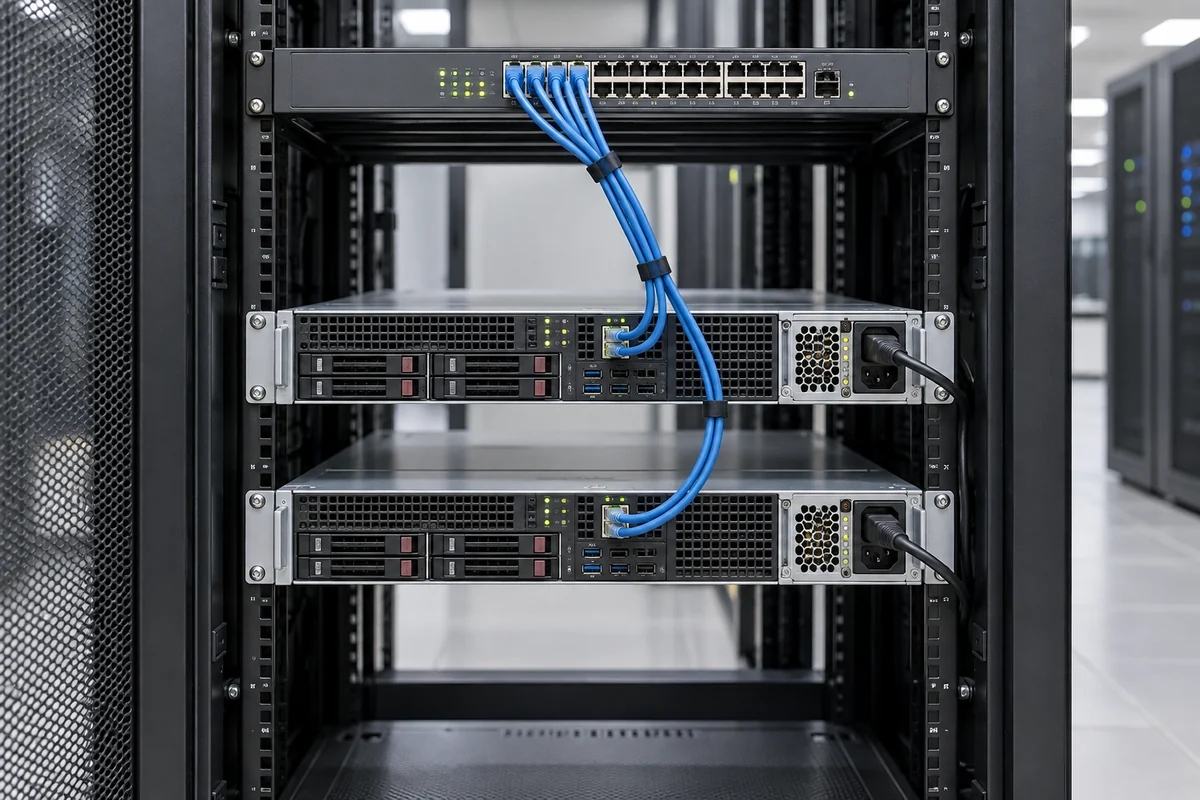
For a single physical host holding state that cannot move quickly, internal PSU redundancy can be particularly valuable. For a replicated web tier where nodes are disposable and replacement is routine, spending the same budget on an extra host or stronger upstream design may produce more useful resilience. The appropriate comparison is the service consequence of a server outage, not a blanket claim that redundant hardware is always superior. Planned maintenance requirements also matter: some organizations can drain a node before replacing a PSU, while others need the machine to remain active.
A non-redundant server is therefore not inherently a poor server, and a redundant one is not inherently fault tolerant end to end. The former accepts interruption after its sole converter fails unless another system carries the service. The latter can preserve that host through a defined single power-path loss when its remaining module, distribution hardware, input feed, and configured load all support the transition. State which failure matters, which layer absorbs it, and how long the system can remain in the resulting degraded condition. That is the real difference between the two architectures.