HK2200R-S1 is listed by Huntkey as a 2200 W slot-style, multi-output server power supply, distinct from its HK2400B-S1 CRPS module and the HKS family. The public specification, however, contains an unresolved electrical contradiction: an 11.4–12.6 Vdc input at no more than 14 A cannot supply 2200 W of output. The useful way to read this record is to separate the clearly identified model and output architecture from an input field that needs manufacturer clarification. Do not use that field to design an upstream feed or approve a replacement.
What the exact model record establishes
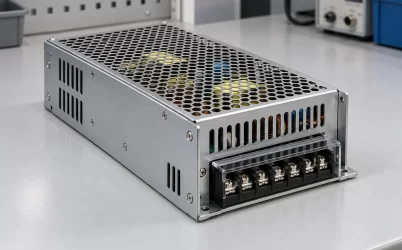
Huntkey’s HK2200R-S1 page identifies a slot-style supply intended for servers, with a 2200 W rated-power entry and a 265 × 77 × 84 mm exterior. The output table names +12V1, +12V2, +5 V, +3.3 V, +5VSB, and −12 V rails. It lists current entries of 145 A, 108 A, 50 A, 24 A, 3 A, and 0.5 A in that order. The page also names I²C communication, forced-air cooling, IP20, a 0–55 °C air-temperature range, and output overvoltage, undervoltage, overcurrent, short-circuit, and overtemperature protection. These are published entries for this exact suffix, not a host-system approval.
The full suffix matters. HK2200R-S1 is the long slot-style multi-output entry; HK2400B-S1 is a different 2400 W CRPS unit with a published AC-input and main 12 V output table. A neighboring HKS model may also have a similar wattage, but its output architecture, envelope, input conditions, and host interface must be read from its own documentation. Substituting an HKS or HK2400B specification into the HK2200R-S1 record would conceal precisely the electrical question that this listing raises.
The Powernexu HK2200R-S1 product listing presents the catalog identity and its published rail entries. It should be used as a starting point for an exact-model inquiry, not as a source for a pin map or an independently verified operating envelope.
The published input numbers fail a power-balance check
The Huntkey HK2200R-S1 manufacturer page says “11.4–12.6 Vdc” for input voltage and “≤14 A” for input current while listing 2200 W rated power. Even the highest listed input voltage multiplied by the current ceiling yields only 176.4 W of input power. At 11.4 V, the corresponding arithmetic is 159.6 W. A converter cannot continuously deliver 2200 W from either figure; conversion losses would leave less, not more, output power. The contradiction is over an order of magnitude, so ordinary rounding or efficiency variation cannot reconcile it.
This calculation does not identify which field is wrong. The published 12 V range might refer to a different circuit, the current limit might be incomplete, or one or both rows might have been transcribed incorrectly. Those are hypotheses, not specifications. The public page gives no separate connection drawing that would justify selecting one explanation. An engineer should request a current revision of the datasheet, a readable module label, and a manufacturer explanation of the input terminals before assigning an AC or DC feeder to this product.
It would also be misleading to state that the unit accepts a 12 V, 14 A source merely because those words appear in the table. Such a supply could provide at most 176.4 W before distribution losses, nowhere near the listed output rating. Conversely, assuming an AC input from the 80 PLUS wording would invent an AC range that the exact-model page does not publish. The safe conclusion from the public evidence is narrower: the exact input power path remains unresolved.
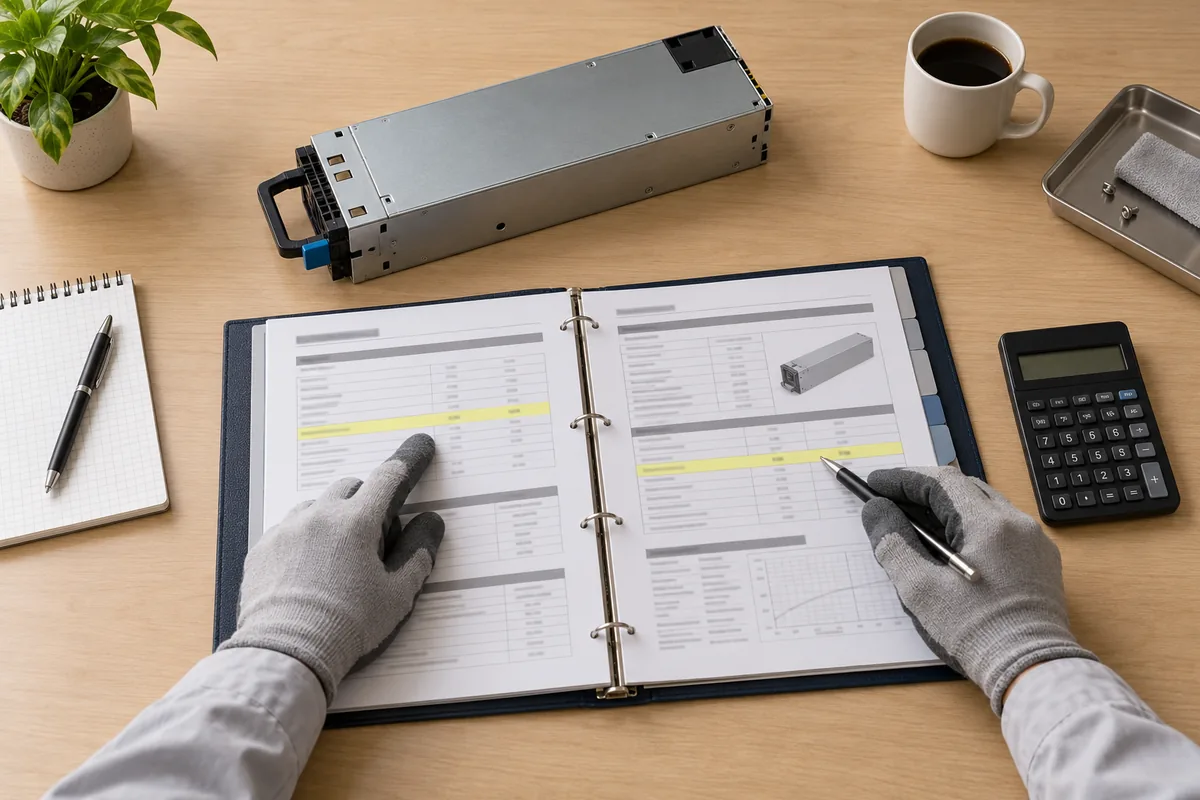
The illustration places a generic unplugged module beside highlighted specification rows and a calculator. It represents an input-power consistency check, not a wiring diagram or a tested HK2200R-S1 unit.
Six named outputs do not create six independent budgets
The rail table is useful, but its current figures cannot simply be multiplied and added as if every maximum were available at once. At nominal voltage, +12V1 at 145 A alone represents 1740 W. +12V2 at 108 A represents another 1296 W. Their sum is 3036 W before including any 5 V, 3.3 V, standby, or negative-rail load. That already exceeds the stated 2200 W total. Therefore the two 12 V current entries are not a simultaneous 2200 W operating recipe. The table does not provide the combined-rail limit or cross-load envelope needed to turn those maxima into an allowed load distribution.
The auxiliary entries create the same concern. A 50 A, 5 V branch is a 250 W nominal load; a 24 A, 3.3 V branch is 79.2 W. Those values may represent individual rail limits under particular conditions, but the public table does not describe the conditions or permissible combinations. A platform designer must know how the main and auxiliary rails share the total-power ceiling, whether there are minimum-load conditions, and whether one rail’s maximum requires others to be lightly loaded.
The two 12 V designations also should not be interpreted as two independently isolated 12 V converters without a circuit document. They could be separately protected channels, branches from a common bus, or another arrangement. Each possibility changes what happens if one load group faults or one connector overheats. A server board expecting a single high-current 12 V feed cannot be assumed compatible merely because the sum of the two listed current values appears large enough. The return arrangement, sense points, current limiting, and mating contacts all matter.
For procurement, ask for a combined-output table with example load combinations rather than only a repetition of the maximum-current row. The answer should state continuous output at specified input and inlet air conditions. If a supplier provides a drawing or an electrical test report, ensure that it names HK2200R-S1 and the offered hardware revision; a result for HK1200R-S1, HK1600R-S1, or an HKS unit cannot close this question.
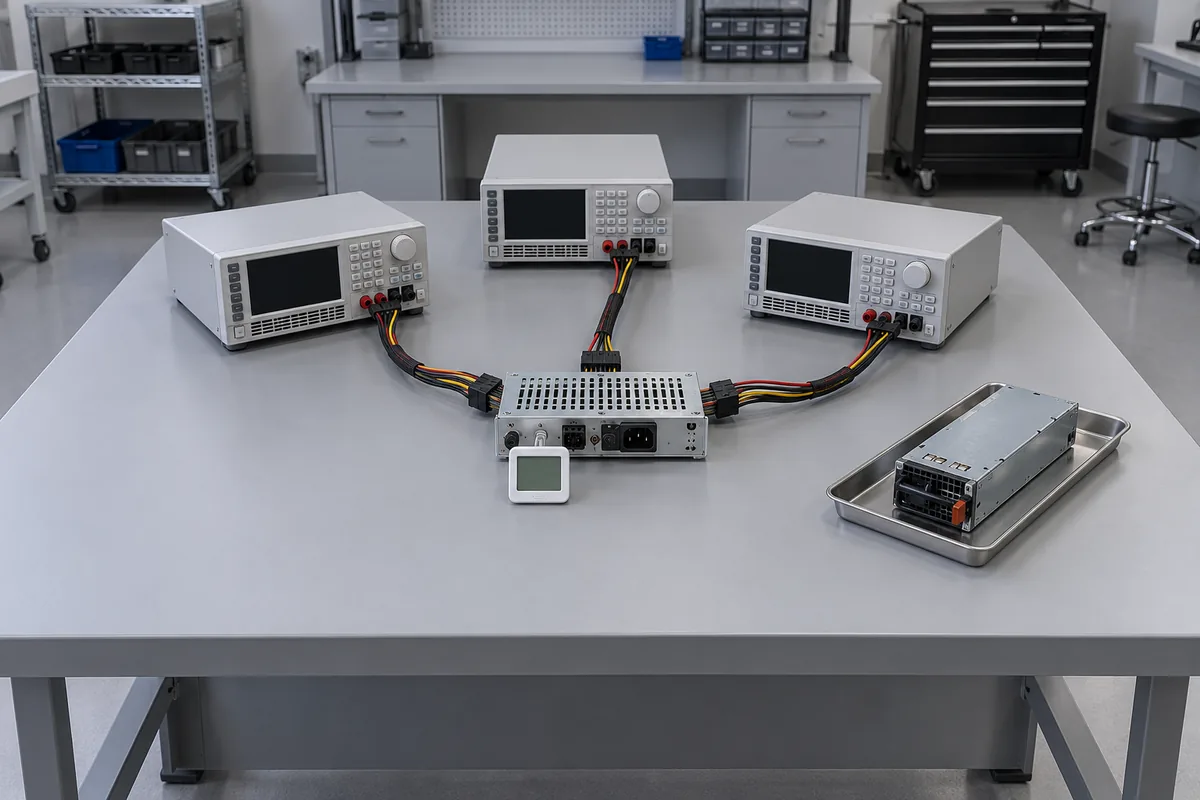
The illustrative programmable-load fixture represents the combined-output qualification that the public rail table does not provide. It does not depict a validated HK2200R-S1 load curve or a Powernexu test.
Slot dimensions describe an envelope, not a mating interface
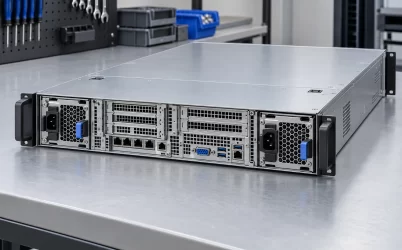
The published 265 × 77 × 84 mm dimensions help distinguish this long slot-style supply from compact CRPS modules. They do not reveal where the power and signal contacts sit relative to the chassis guides, how the latch retains the unit, or how far it travels before mating. The server enclosure must leave enough rear clearance for insertion and extraction, including any handle movement and cable obstruction. A visual resemblance to another server PSU is weak evidence because two supplies can share outside dimensions yet use incompatible connectors.
The exact mating boundary matters especially for a multi-output device. The host may distribute six named rails directly, route some through a backplane, or use a different standby and control sequence. A photograph cannot establish pin numbering, keying, contact ratings, return pins, or whether a precharge contact exists. The public HK2200R-S1 page does not publish a pinout or module-to-host mechanical drawing, so a prospective replacement needs a server approved-parts record or engineering drawings for both sides of the connection.
Forced-air cooling is stated, but the public page does not give a fan curve, an airflow direction diagram, or a pressure requirement. In a dense chassis the airflow path depends on neighboring boards, baffles, and fan control. The 0–55 °C air-temperature entry must be interpreted using the manufacturer’s specified measurement location when that documentation becomes available; rack-room temperature alone may be lower than the air entering a buried supply bay. Thermal observations from one host do not automatically transfer to a second chassis.
IP20 indicates limited protection from contact with larger solid objects, not weatherproofing or immunity to dust buildup in server intake air. It also says nothing about the exposed mating interface during service. An installation must still follow the server’s enclosure, safety, and service design. Without a host-specific approval, the model should remain a candidate rather than a drop-in spare.
Efficiency and monitoring claims need operating conditions
Huntkey describes the series as 80 PLUS Platinum with a peak efficiency of 94.5%, and the specification table lists efficiency of at least 94%. The public entry does not connect that latter number to a stated load fraction, input voltage, or measurement method. A peak value is a point on an efficiency curve, not the result at idle, full output, every input condition, or elevated inlet temperature. Because the input field itself is contradictory, an engineer should not calculate continuous input current or cooling heat for HK2200R-S1 from the published efficiency claim.
Conversion loss is still relevant once the correct operating data arrives. For example, a hypothetical 2200 W DC output at 94% efficiency would require about 2340 W input and reject roughly 140 W as heat. That is a mathematical illustration only; the public page does not verify a 94% operating point at 2200 W for this exact unit. Applying the same calculation to the stated 12.6 V, 14 A input would expose the inconsistency again rather than resolve it.
The I²C entry indicates a communication interface, but it does not establish a PMBus implementation, command set, addressing scheme, or a host BMC’s ability to read useful telemetry. I²C is the bus, not the application protocol. A server with a prescribed PSU management contract may reject a module that physically supplies power but lacks the expected identification, fault, or control behavior. Obtain the interface specification and test it with the target BMC before describing any monitoring function as supported by that host.
Likewise, the listed protection categories do not reveal thresholds, delays, restart behavior, or which rails are shut down together. A short on an auxiliary rail might have a different system consequence from an overload on a 12 V branch. Fault coordination needs the exact electrical behavior and server distribution design. Public labels such as “overcurrent” and “overtemperature” are valuable pointers for inquiry, but not enough to set fusing or write recovery procedures.
How to resolve the record for an actual server
The first useful document is a corrected, revision-controlled manufacturer specification that names HK2200R-S1 and states the true input type, range, current at rated output, total output rating, and simultaneous rail limits. The second is the mechanical and connector drawing for the same revision. An existing server also needs its approved spare list or original PSU label; a new integration needs a host-side drawing and defined power-up, standby, fault, and management behavior. These are not generic paperwork requests. Each closes a specific gap left by the publicly accessible page.
A practical clarification question can include the contradictory lines verbatim: “Your HK2200R-S1 page lists 2200 W rated output but 11.4–12.6 Vdc and ≤14 A input. Which input terminals and operating condition do those numbers describe?” Asking that question directly is preferable to silently changing a number in an internal requirements sheet. Keep the manufacturer’s written response with the revision and offer documentation so another engineer can trace the assumption later.
Until the input and combined-output evidence is corrected, the model’s public data supports a category description but not a credible 2200 W integration calculation. Its long slot body and six named rails make it a different engineering problem from the compact, predominantly 12 V HK2400B-S1 CRPS article. That distinction is also the reason to preserve the exact HK2200R-S1 suffix in inquiries, drawings, and purchase records. The next meaningful step is a corrected source document, not an inferred feeder or an unverified interchange claim.