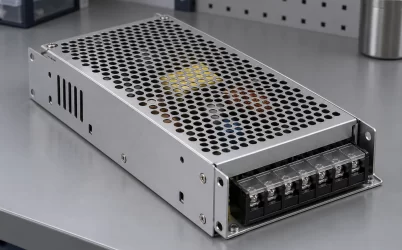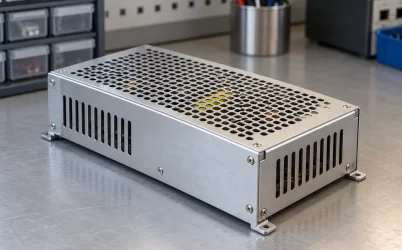
HKS3600D1 appears in Huntkey’s public catalog as a CRPS server power module, but the page does not presently provide an internally consistent exact-model specification. Its heading names HKS3600D1 while the specification table names HKS3200D1. The page also uses both Platinum and Titanium efficiency wording. Before using its current table to size a server, resolve which complete model and revision those rows describe. A manufacturer page is the right starting source, yet a conflict within that source cannot be resolved by choosing the more attractive figure.
For a replacement buyer, the immediate task is to establish an approved electrical identity. For a system designer, it is to obtain an input-dependent output rating tied to that identity. Neither task is completed by matching a wattage in a product name. The discussion below explains how to make that distinction useful when assessing a high-current server power path, without treating the disputed table as confirmed HKS3600D1 performance.
Resolve the heading and table before using the current rows
The Huntkey product page headed HKS3600D1 contains the conflicting identifiers in the same record. Its narrative efficiency description and efficiency-class field also disagree. These are observable documentation problems; they are not evidence that one particular line is a typographical error. The public record does not establish whether its table belongs to another module, a different revision, or the named product with an incorrect label.
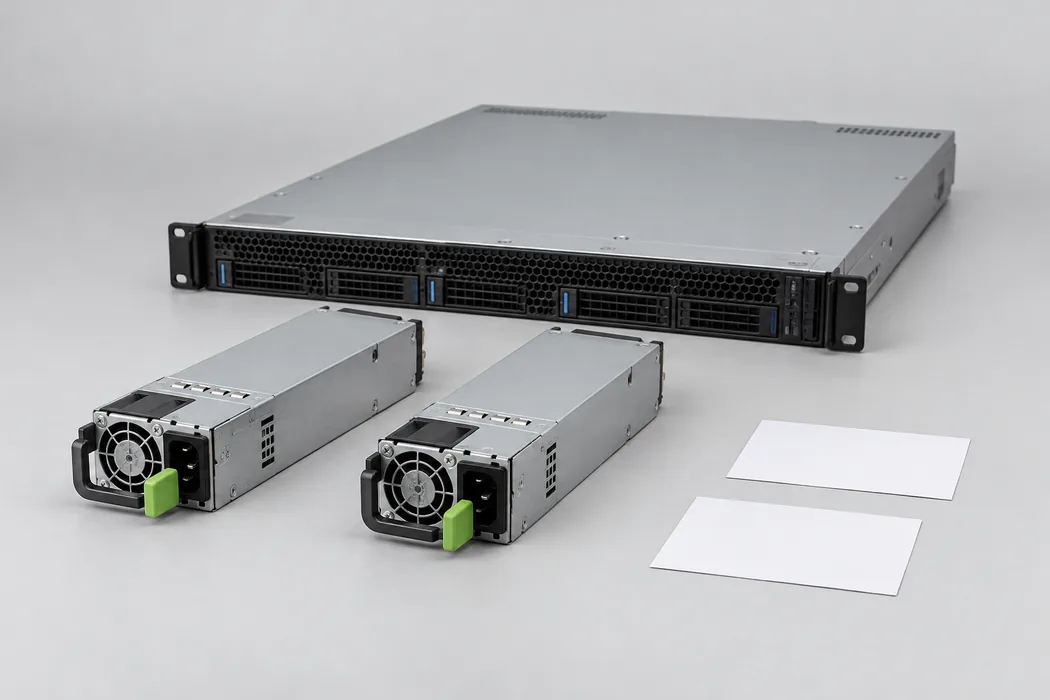
The Powernexu HKS3600D1 listing is a seller reference that must be checked against controlled manufacturer documentation. It cannot decide which part of Huntkey’s conflicting page is correct. A photograph, matching dimensions, or a familiar series name likewise cannot resolve the electrical identity of the offered revision.
Ask for a document that names the complete offered part number and revision, states its issue date, and identifies the applicable operating conditions. Compare that identifier with the physical module label and the server’s approved spare number. If the supplier provides only a family brochure, ask where it maps that family to the exact unit being supplied. Preserve this cross-reference in the purchasing record so a later delivery cannot silently substitute a similar-looking module.
Input acceptance and available output require separate evidence
The conflicting public table includes current entries associated with several AC input conditions and a DC input condition. Because the table’s model identity is unresolved, this article does not reproduce those entries as HKS3600D1 ratings or use them to calculate its usable power. Their engineering relevance is the question they raise: what output is actually permitted at the input delivered to the selected module?
A supply can accept an input voltage while supporting less than its headline output at that voltage. Input acceptance describes where operation is allowed; an output-versus-input specification describes the permitted load. Temperature, airflow, load duration and revision may impose additional limits. Obtain these conditions together instead of treating one broad input interval as proof of full-power operation throughout it.
A discrete row at one input voltage also does not establish a threshold between that voltage and the next row. Without a stated interpolation rule or a continuous curve, a designer cannot infer the allowed current at an intermediate voltage. In particular, a nominal rack-feed label does not guarantee that the PSU inlet remains at that exact value across normal variation and distribution drop.
For procurement, request the permitted continuous output over the site’s intended inlet-voltage range, along with any separately documented peak envelope. Record the relevant AC or DC mode. DC acceptance does not establish a connection method, polarity, protection scheme or automatic transfer between sources. Those details must come from the exact product and host documentation.
Qualify the distribution path independently of the PSU label
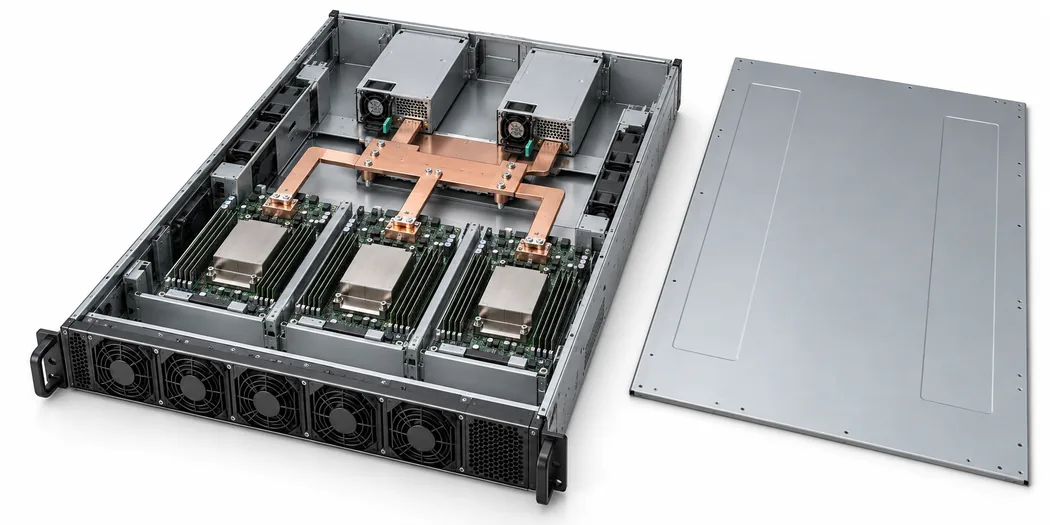
Once an exact-model output rating is verified, follow the power through the mating connector, distribution board, branch conductors and returns to the load. A total PSU rating cannot establish the capacity of every downstream branch. One connector or localized copper path can be overloaded while total server demand remains below the module’s permitted output.
For a clearly hypothetical example, a 200 A current through a combined forward-and-return resistance of 1 milliohm creates a 0.2 V drop and 40 W of dissipation. These follow from V = IR and P = I²R. They are not measured HKS3600D1 results, a proposed connector rating, or permission to operate any particular interface at that current. The example shows why contact resistance and current distribution deserve explicit attention in high-current equipment.
Evaluate the approved connector assembly as a system: both mating halves, contact engagement, board copper, mechanical support, operating temperature and the vendor’s rating conditions. Counting visible contacts is insufficient. Parallel contacts may not share current evenly, and a partially engaged interface can concentrate heat. Remote sensing, where documented, may correct voltage regulation at a specified point; it does not remove resistive heating or qualify an overloaded connection.
The return path belongs in the same analysis. Do not substitute an assumed chassis or protective-earth path for a documented output return. Confirm the actual host connection and grounding arrangement from its controlled drawings. The appropriate service boundary is the complete approved module and receiving assembly.
Check redundancy at the surviving input condition
A redundancy plan needs verified capacity after the defined failure, rather than the sum of installed labels. In a hypothetical two-module 1+1 system, each surviving power path must support the allowed server demand under its own input and thermal conditions. The architecture must also provide the required isolation, control and distribution behavior. These are system requirements, not a claim that a particular HKS3600D1 pairing has been qualified.
Consider two feeds with different permitted inlet conditions. A server might operate normally while both modules contribute, yet lack sufficient verified capacity after one feed is lost. The review therefore needs the worst applicable survivor condition, the host’s permitted load after failure, and any documented power cap or shutdown policy. A successful idle boot cannot demonstrate performance at maximum workload or during a redundant-path loss.
Likewise, a standby output supports a different power state from the main load path. Its voltage, allowed load and sequencing must match the host. Until the exact-model documentation is reconciled, the public table cannot establish those details for the offered revision. Do not infer firmware compatibility, management commands or startup timing from a shared CRPS description.
Mechanical fit and certification remain separate decisions
A cartridge that enters a bay has passed only an initial mechanical observation. Connector location, latch geometry, insertion travel, airflow direction and host support remain relevant. Match a controlled drawing and approved spare number to the delivered module rather than using outer dimensions alone. Hot-swap capability requires a supported host procedure and electrical system; the term does not authorize arbitrary live replacement.
The conflicting Platinum and Titanium wording also prevents choosing a confirmed efficiency class from this page. Request the official certification or test record that matches the complete model and applicable input category. A measured efficiency point, a marketing claim and a certification level answer different questions. None establishes the interface or replacement approval of the host.
Keep the unresolved items visible in the evaluation record: model mapping, applicable revision, input-dependent continuous output, peak conditions, cooling limits, connector drawing, standby behavior and host approval. Useful public information can guide the questions without becoming a released operating specification.
What makes an HKS3600D1 purchase decision defensible
The present public evidence supports a documentation warning and a verification process. It does not support assigning the conflicting table’s current entries to HKS3600D1 or declaring a specific voltage boundary for its capacity. Obtain the manufacturer’s corrected record or controlled exact-model specification before setting a current limit, approving a substitute or sizing the host around that table.
A defensible spare record links the target server and its revision, approved spare identity, complete module label, manufacturer document issue and intended inlet conditions. It also identifies the permitted operating load and service procedure. If those records do not agree, keep the component selection unresolved rather than selecting a convenient number. This preserves the engineering purpose of the product search: finding a power module that the actual host can use within documented limits.