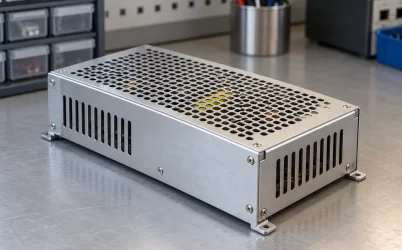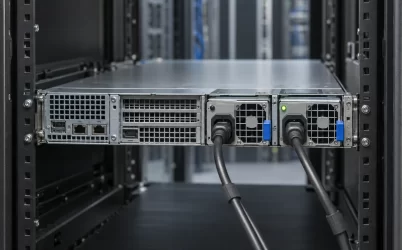
An industrial redundant power supply can keep a control bus healthy after one source path becomes unavailable. That is the purpose of the arrangement, but it creates a monitoring problem: the controller can continue running while the reserve that protected it has disappeared. A normal voltage at the common DC output therefore does not establish that both intended source paths remain available.
The useful question is what each status observation actually covers. A supply’s output indication, a redundancy module’s monitoring function, and the voltage received by a controller can describe different locations and conditions. Keeping those observations separate makes it possible to recognize a degraded arrangement before another relevant failure stops the load, without treating every unequal current reading as a failed power supply.
The load can stay powered while the protection changes
Imagine a control cabinet whose documented redundant arrangement has two source paths feeding essential electronics. Assume either path is qualified to carry the required load under the installed conditions. If one path stops supplying energy and the other maintains the bus, the load can remain within its voltage requirements. The cabinet’s production process might show no immediate outward change.
Two different findings now coexist: output continuity was maintained, and one intended source path is unavailable. Reporting only the first finding makes the redundant arrangement look healthier than it is. Reporting only the second can make a successful continuity mechanism look like an immediate loss of control power. The operational record needs both.
This is why redundancy status is not another name for output voltage. The former concerns the ability of the remaining arrangement to meet a stated failure requirement. The latter concerns an electrical quantity at an observed point. Voltage is necessary evidence for the load, but it cannot count every healthy source path upstream.
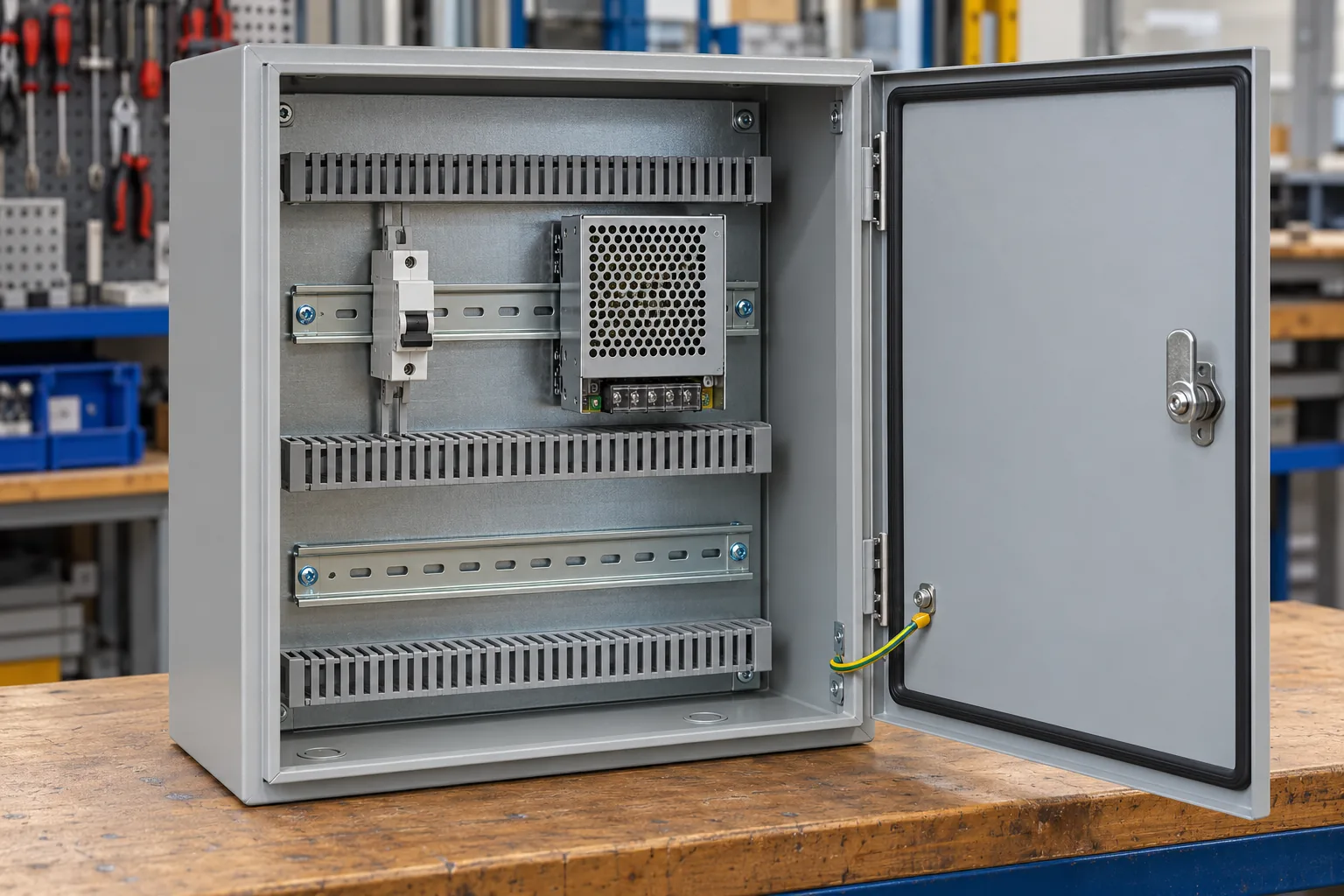
A cabinet can contain complete power and control assemblies while concealing their actual source relationships. Their physical grouping identifies the equipment boundary, not the independence or availability of its electrical paths. Those claims need the documented source, decoupling, distribution, and load arrangement.
Put every observation at its own boundary
Begin with the actual power path and mark the locations represented by available status signals. One observation may describe a converter’s own output. Another may observe the input presented to a redundancy module. A common-bus measurement sits after the paths have converged. A controller’s input measurement includes the downstream conductors as well.
A generic “DC OK” label is insufficient to merge those meanings. Its threshold, delay, contact or interface behavior, and response to disabled or unpowered states belong to the exact product documentation. Without that information, a positive indication says only what its documented observation establishes. It should not be promoted into a promise about every component before and after it.
Phoenix Contact provides a bounded example in its active redundancy-module description. For a system comprising two QUINT POWER supplies and one QUINT ORING, it states that input voltage, output current, and the decoupling section are monitored to highlight lost redundancy. Separately, its QUINT S-ORING description specifies input-voltage and decoupling monitoring in combination with the stated QUINT POWER generation. These descriptions should remain attached to their named combinations; they are not a universal feature set shared by all redundancy modules.
The example establishes the value of observing more than the final output. It does not provide a wiring diagram, an alarm threshold, or a status interface for an unidentified installation. Nor should the functions of QUINT ORING and S-ORING be combined into an imagined third product. For a real cabinet, identify the installed model and use its applicable documentation.
A separate supply and controller illustrate two physical assemblies with different observation responsibilities. The supply can establish a local electrical output while the controller receives power through other devices and conductors. Their proximity does not reveal the status signal’s reference point, prove a redundant connection, or establish that an alarm reaches the controller.
Source readiness and present contribution are different questions
One source carrying less current does not automatically mean that it is unavailable. The normal sharing behavior depends on the supported supply combination, output settings, path impedances, and any documented balancing or reserve policy. A momentary current comparison needs that context before it becomes evidence of a fault.
Conversely, a small positive current does not prove that a source could carry the required load alone. Present contribution is an operating-point observation. Available capacity under a defined source loss is a separate requirement involving the supply, path, installation conditions, and permitted load. Monitoring should support that requirement without pretending to replace its qualification evidence.
Consider two hypothetical cabinets that both show a regulated common bus. In the first, both source paths are available but contribution is intentionally unequal under a documented arrangement. In the second, one input path is absent and the remaining source carries the load. The common output can look similar in both cases. Source-specific observations are needed to distinguish them.
There is another possibility: the source voltage is present at an observed input, while another portion of its intended path is unavailable. That is why observing voltage alone and observing the decoupling function answer different questions. The exact failure coverage depends on the implemented monitoring design; this article assigns no universal diagnostic ability to a generic ORing component.
A useful status description therefore states what is known and what remains inferred. “The common bus is in range” is a direct observation when measured appropriately. “Both sources are ready” requires additional applicable evidence. “The arrangement meets its redundancy requirement” also needs the supported load and fault boundary. These statements should not collapse into one green symbol without a defined meaning.
Load growth can change the status conclusion without any component failing. A cabinet expansion can increase the demand that one surviving source would have to carry, even while both sources maintain a normal output together. Reviewing the supported redundancy envelope after that change is separate from checking whether all monitored devices currently report healthy. Hardware health and sufficient reserve capacity are related requirements, not synonyms.
This is particularly important when the essential load is smaller than the cabinet’s entire load. The redundancy requirement might preserve controllers and communications while other functions follow a defined shutdown or process policy. Monitoring should identify the scope of that promise. A healthy essential bus does not establish continued power for every actuator, and an actuator stopped by design does not independently establish that the redundant control supply failed.
Keep the required service outcome beside the electrical observations. That association lets maintenance prioritize a degraded source arrangement without inventing either an immediate outage or a guarantee that another fault can be tolerated.
An alarm has to survive the event it reports
A detected condition is operationally useful only if it becomes an actionable indication. Follow the information path from the observing device through its interface to the receiving controller, maintenance system, or other intended destination. The power required along that path belongs in the architecture too.
If a local controller remains powered by the surviving source, it may be able to preserve the degraded-state report. If the reporting interface depends on the failed source or loses communication for another reason, the observation may not arrive as expected. Neither behavior can be inferred from the fact that the machine’s main control bus stayed up.
The receiving system must also distinguish the meanings its interface can actually express. An unavailable status channel, a reported unhealthy path, and an intentionally inhibited source are not necessarily the same state. Where the equipment exposes only a combined signal, retain that limited scope. Software cannot recover detail the interface never supplied.
For the same reason, absence of an alarm is weaker evidence when the alarm path has not been established as available. The device may report health, the channel may be unavailable, or the receiving application may not be processing the event. A clear status model makes uncertainty visible instead of presenting missing information as confirmed redundancy.
The related industrial control-power branch-fault discussion explains why preserving the controller and its diagnostics matters when a downstream feeder fails. Here, the event is different: the load can remain supplied while an upstream source path loses availability. The reporting path should preserve that distinction.
Record the degraded state before calling it a repair decision
A loss-of-redundancy indication identifies a condition requiring attention; it does not necessarily identify the component to replace. The originating problem could concern an input source, a converter, a connection, or another monitored portion of the path. Interpret the device’s documented status with the cabinet’s actual source arrangement.
Event order can narrow the investigation. A source-side disturbance followed by changed path status differs from a common-output problem with both inputs still reported present. However, unrelated device clocks, sampling intervals, and delayed reports can obscure that order. Preserve timestamps and their limitations rather than declaring causality from matching display times.
Current and voltage records have similar limits. A low-resolution trend can show that contribution moved without resolving the electrical transition. A steady output measurement after the event does not establish the transient seen by the controller during it. Keep the evidence needed for continuity separate from the evidence needed for current source readiness.
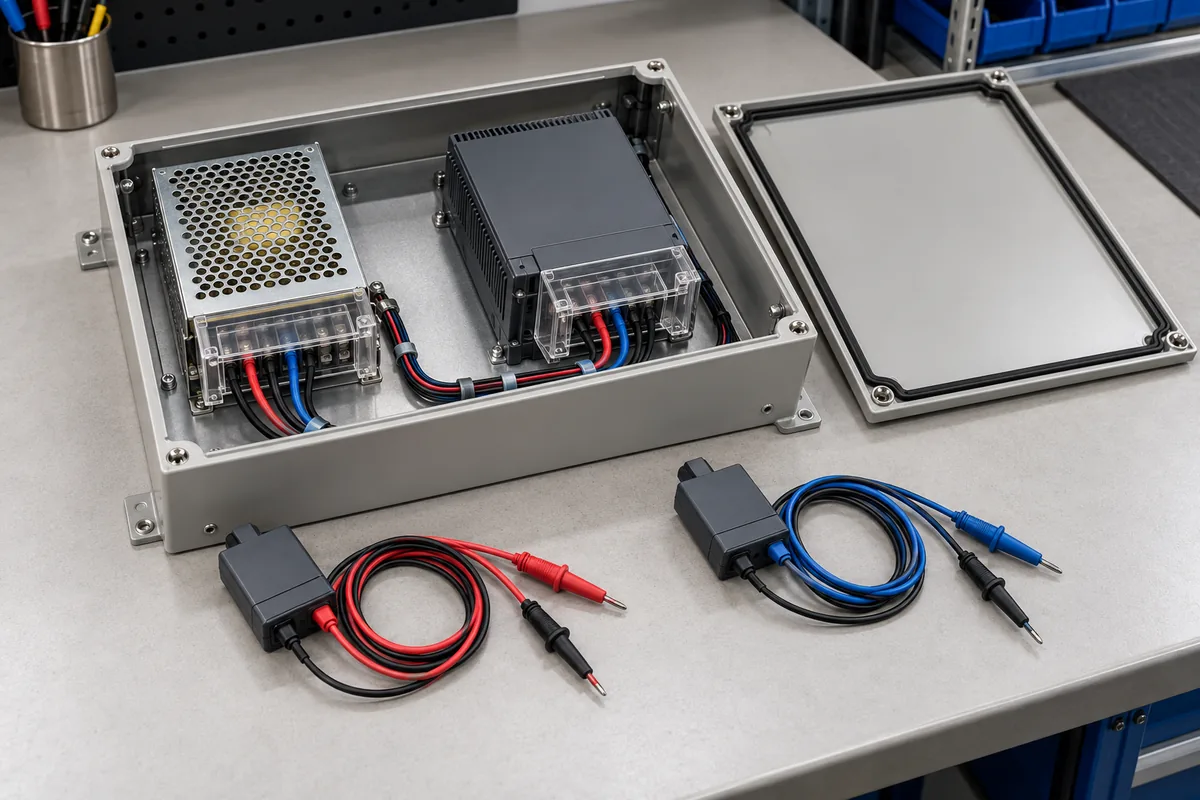
A measurement-preparation scene can identify the supply and instruments involved without demonstrating an energized configuration or a successful failure test. Observation points, instrument suitability, reference relationships, and safe access must come from the actual assessment plan. This explanation does not prescribe live source disconnection, induced faults, or access inside a mains-powered supply.
The response should match the supported condition. A cabinet operating with one unavailable path may need prioritized service while remaining within its documented load and thermal envelope. Another arrangement may require a controlled process response. Those decisions follow the machine’s availability and safety requirements, not a universal instruction to continue production because the DC voltage is normal.
Restoration is more than seeing the bus remain normal
If the common bus never fell, its continuing normal voltage cannot demonstrate that redundancy has been restored. The missing capability must be re-established at the boundary where it was lost. A physically installed replacement or a reconnected source is a change to inspect, not proof by itself that the intended path is available.
Use the applicable equipment indications to establish what returned. The input condition, converter status, decoupling status, and receiving-system report may change at different points in the documented recovery process. Their exact timing and meaning are model-specific. Do not invent a universal reset delay or assume that clearing a controller alarm repairs the electrical path.
A concise restoration record identifies the original condition, the service action under the approved procedure, the resulting supported status, and the configuration to which it applies. If an observation remains unavailable, retain that uncertainty. An acknowledged alarm is an administrative event; restored redundancy is an engineering conclusion supported by the relevant evidence.
Finally, monitoring cannot eliminate a shared source or common distribution dependency. Two available converters can still depend on one upstream circuit, and a common downstream fault can still affect the load. The monitoring claim should stay attached to the failure boundary it actually observes. An industrial redundant power supply is most useful when the load’s healthy state and the remaining reserve are both visible, so successful continuity does not conceal the next vulnerability.