The Juniper JPSU-650W-AC-AFI is a specific 650W redundant AC power supply module, not a generic replacement for any server using 650W. In Juniper’s QFX5110 documentation, AFI identifies FRU-to-port airflow; the corresponding AFO version moves air from the ports toward the field-replaceable units. Both appear in the same power range, but the airflow choice must match the chassis configuration. Buying the correct wattage with the wrong suffix can therefore produce an unsupported mixed-airflow installation.
This is a network-switch power-module example. Its value for an equipment buyer is the precise boundary between a catalog description and a supported spare. It does not establish compatibility with an unrelated rack server, another Juniper platform, or another manufacturer’s removable supply.
The suffix describes a direction through a particular chassis
Juniper’s QFX5110 power-system documentation lists JPSU-650W-AC-AFI as FRU-to-port airflow with a Juniper Azure Blue handle. It lists JPSU-650W-AC-AFO as port-to-FRU airflow with a Juniper Gold handle. These are manufacturer-defined identities for the documented QFX5110 power system. The color is useful corroborating information, but it should remain attached to the complete part number and host configuration.
FRU-to-port names the physical endpoints. Air travels from the side containing the replaceable power and fan units toward the side containing the network ports. Port-to-FRU reverses those endpoints. This terminology is more useful than an unexplained front-to-back description because a network operator may call the port side the front while a rack installation drawing uses another orientation convention.
The manufacturer explicitly notes that legacy switches or switches with an LCD may use back-to-front and front-to-back language for these directions. A purchase request copied from an older service record can therefore use different words for the same physical relationship. Reconcile the endpoints before assuming that two descriptions disagree or that a familiar front/rear label identifies the required suffix.
A clear record could say which face contains the ports, which contains the FRUs, and where intake and exhaust belong in the rack. The AFI or AFO designation then maps onto that physical record. This avoids deciding the order from a seller’s photograph taken from an unknown side or from a rack label that describes cabinet orientation rather than device airflow.
Two 650W modules can belong to different cooling configurations
The QFX5110 source instructs the reader to select the correct power supply for the chassis product SKU. It warns against mixing supplies with different airflow and states that a different-airflow or different-wattage supply inserted in the chassis produces an alarm. Matching the 650W number answers neither of those configuration questions. The module identity must agree with the intended cooling arrangement.
Imagine a hypothetical spare request for an installed AFI-configured QFX5110. A seller offers a JPSU-650W-AC-AFO because it has the same advertised power rating and resembles the removed unit. That offer has changed a documented property: its airflow direction. Nothing in the matching wattage establishes that the change is acceptable. The difference cannot be dismissed as cosmetic because it concerns the direction of air through the assembly.
Likewise, an inlet, latch, handle, and removable housing do not establish a common replacement interface across manufacturers. A 650W module advertised for another device can differ electrically and mechanically even if the photograph looks familiar. The QFX5110 table supports the named Juniper options in its stated system; it supplies no approval relationship to an arbitrary server power bay.
The useful distinction is between identifying a candidate and authorizing a substitution. A marketplace listing can help locate stock carrying the desired number. The chassis documentation determines whether that number and airflow configuration are the supported target. If a seller shortens both AFI and AFO to one generic 650W AC description, the shortened description has discarded information needed to complete the order.
An airflow conversion changes the fan population as well
Juniper requires the installed supplies to have the same airflow direction as the chassis. Its power-system guidance further states that converting the chassis airflow pattern requires changing all fans and power supplies at one time to the new direction. This is a system configuration change, rather than a way to use whichever spare supply is available.
The distinction is easy to overlook when only one failed module is being replaced. An ordinary spare restores the existing configuration. An airflow conversion deliberately changes it and must account for every affected fan and power supply, as well as the installation’s intake and exhaust arrangement. A single different-direction replacement does not perform that conversion.
This does not mean that a buyer should attempt to modify a power module internally. The documented options are named FRUs with their own identities. Reversing a fan inside a closed module, changing a handle, or relabeling a supply is not established by the manufacturer’s conversion statement. Such changes would create an unidentified assembly rather than an approved AFI or AFO replacement.
A proposed rack rearrangement can expose the same issue even when no component has failed. Turning a device around changes where its port and FRU faces sit in the rack, but it does not change its internal airflow direction. The installation team needs to reconcile the intended cold-air entry and warm-air exit with the supported chassis population. Reusing the original suffix without considering the new physical arrangement can leave the order technically precise but unsuitable for the proposed placement.
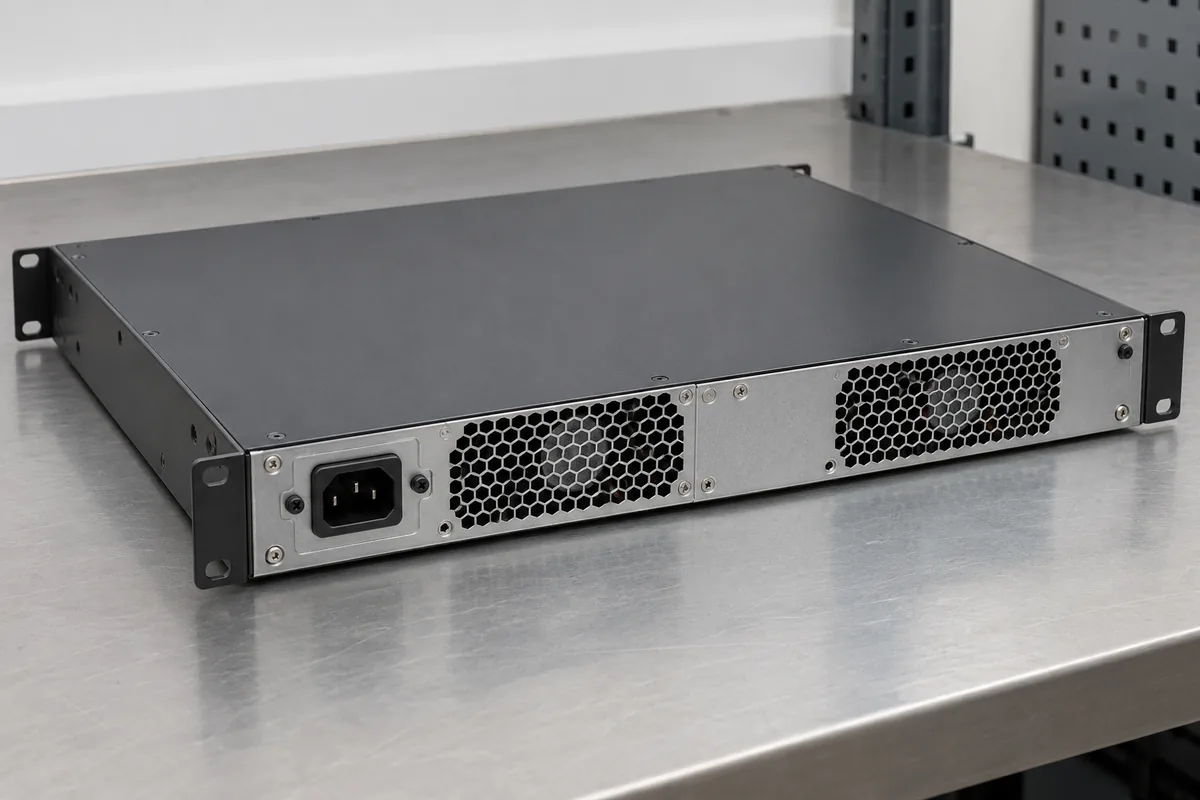
Hot replacement depends on the other supply actually running
In the QFX5110 description, the AC supplies are fully redundant, load-sharing, hot-removable, and hot-insertable when the second supply is installed and running. That condition matters. Two modules physically occupying their slots are not the same observation as two modules operating correctly. One can be present while its AC source is absent or its output is unavailable.
The document also identifies an exception to the ordinary factory-shipped configuration: QFX5110-32Q-CHAS. A statement that QFX5110 switches normally ship with two supplies should retain that exception. It cannot be used as evidence that a particular bare-chassis purchase already includes a redundant pair or that every delivered unit is populated exactly as expected.
The relevant operating state is therefore part of the replacement boundary. The supported hot-replacement claim applies with the second supply installed and running in the documented system. It does not authorize withdrawing the only working source, treating a failed peer as reserve capacity, or transferring the procedure to another chassis. The exact device’s maintenance instructions govern the physical work.
Nor should the two 650W labels be presented as a promise of 1300W protected capacity. Redundancy concerns continued supply after a defined source is unavailable. Here Juniper provides the supported system-level description; it is unnecessary to invent a new power-budget limit by adding labels. A generic capacity calculation would not replace the manufacturer’s host qualification or the required replacement conditions.
A failed module can still occupy an important place in the air path
The QFX5110 AC power-supply LED section gives a specific instruction for a detected supply fault: to maintain proper airflow through the chassis, leave the power supply installed until ready to replace it. A failed converter and an empty opening are different physical states. Removing a module early can change the chassis air path before the spare has arrived.
This is a useful distinction for remote operations. A team might correctly identify a failed FRU and immediately remove it to prepare for delivery. The documented guidance instead links removal to readiness for replacement. Stocking the exact airflow variant can consequently affect the service sequence, even where the surviving source keeps switching functions available.
The statement belongs to the ordinary fault-and-replacement context described by the manufacturer. It should not be generalized into an instruction to leave smoking, arcing, or physically hazardous equipment in service. Those conditions require the site’s emergency and electrical-safety response. The airflow guidance explains routine supported maintenance, not permission to disregard a destructive incident.
For a spare purchase, completeness matters at this boundary too. An empty slot, a failed installed module, and a correctly populated running pair are different configurations. Photographs showing two handles do not prove the operating state, while a photograph of an empty bay does not reveal how long the device has been left that way or whether its cooling requirements have been preserved.
Read the three indications as separate observations
Juniper describes AC OK, DC OK, and Fault indications for the QFX5110 AC supplies. A steadily green AC OK indication means input power is reaching the supply. A steadily green DC OK indication means it is delivering output correctly. An amber Fault indication means an error has been detected. These statements have different observation boundaries, even though the indicators appear on the same module.
An input indication alone therefore does not establish that the source is providing usable output to the host. Conversely, an unlit input indication is not by itself proof of a failed converter: the documented possibilities include disconnection from power or absence of incoming power. The service interpretation must follow the exact manufacturer’s definitions rather than a universal rule that any dark PSU is defective.
Those observations also help keep ordering and diagnosis separate. A unit can have the correct part number yet be unavailable because its source is disconnected. Another can receive input but fail to deliver output. Purchasing a different airflow variant solves neither distinction. Confirming the intended spare identity does not remove the need to establish what the existing module and feed are actually doing.
No indicator replaces the chassis configuration record. A recognized output state does not demonstrate that an unrelated module is approved, that both upstream feeds are independent, or that the airflow population matches the intended installation. The point is to preserve each observation’s meaning instead of combining them into an unexplained claim that the entire redundant system is healthy.
The orderable spare preserves the host and airflow identity
A useful spare description names JPSU-650W-AC-AFI or JPSU-650W-AC-AFO in full, the QFX5110 chassis SKU, and the established airflow direction through that chassis. It distinguishes the AC module from a similarly rated DC option and identifies whether the purchase is one replacement FRU or a complete supply population. The description should not expand the approved host list beyond the documentation supporting the transaction.
If the offered item differs from the installed number, ask which controlled manufacturer relationship supports the alternative. Similar wattage, color, handle shape, or a seller’s use of server module is insufficient. An exact part photograph and label can help receiving inspection, while the documented host relationship resolves the larger compatibility claim. These forms of evidence complement each other rather than substituting for one another.
The Juniper example makes the search phrase concrete: 650W identifies the power class, AC identifies the source type, and AFI or AFO identifies a cooling configuration that must agree with the host. Redundant and hot-removable describe supported system behavior under stated conditions. Keeping those details together allows the spare to restore the intended configuration instead of merely filling a slot with another 650W object.