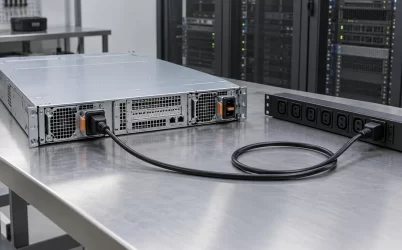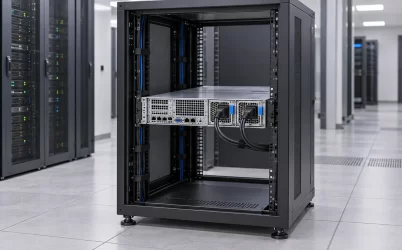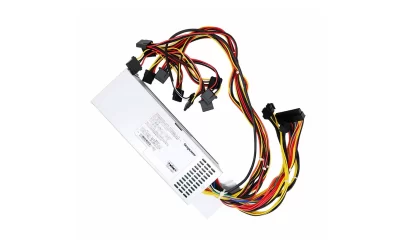
A 750 watt server power supply is not automatically a suitable replacement for another 750W module, even within one manufacturer’s product listings. For Dell’s PowerEdge R730, the owner’s manual requires AC supplies with the Extended Power Performance, or EPP, label. It also warns that supplies from previous system generations can cause a mismatch or prevent startup. The wattage is therefore one part of the replacement identity, rather than a complete interchangeability rule.
The practical question is whether the offered module belongs in the specific R730 configuration and can form the supported pair with the supply that remains installed. This article follows that identification problem. It does not provide a cross-generation spare list, authorize an unidentified 750W cartridge, or describe modifications for using a server supply outside its host.
The R730 documentation places conditions beside the 750W option
Dell’s R730 power-supply description includes a 750W AC option and separately lists mixed-mode supplies. Its accompanying notes require the EPP label for AC modules and matching maximum output power when two supplies are used. These statements belong to the named platform. They do not establish that every module marketed as Dell 750W has the same input type or approved host relationship.
It helps to separate three questions hidden inside a short listing. What can the converter deliver under its rating conditions? Which host recognizes and supports that item? Which other supply can operate alongside it? A wattage entry contributes to the first answer. A host part record and the applicable pairing requirements address the other two.
This is why a broad seller statement such as fits multiple PowerEdge generations needs a documented relationship behind it. The statement may refer to a particular approved part, or it may have compressed unrelated variants into one listing. The R730 warning about previous-generation supplies prevents treating the family name and 750W rating as sufficient evidence. It does not prove that every broadly worded advertisement is wrong.
For an actual replacement, preserve the complete system identity and the offered module identity. The seller should be able to explain the supported relationship for that exact item. The manual’s general category is useful for screening, but this article does not infer a Dell spare-part number from it.
An EPP label is a required identifier, not a universal compatibility mark
The R730 requirement makes the EPP label relevant during a spare search. A listing photograph that hides the rear label has omitted information the buyer may need. The image should allow the actual supplied item to be identified, rather than presenting a generic photograph of a visually similar cartridge.
However, the presence of EPP does not prove every remaining requirement. A required property can be necessary without being sufficient. Two items can share that label while still needing verification of their host eligibility, input configuration, maximum output, and other applicable conditions. The correct reasoning is to retain the label check alongside the full replacement record, rather than promote it into a new universal interchangeability key.
Consider a hypothetical warehouse containing several 750W supplies taken from different server generations. Sorting them only by wattage leaves the generation question unresolved. Sorting them by an EPP marking alone still does not create an approved R730 spare pool. Each accepted identity needs an applicable host relationship; an unidentified item remains unidentified even if one visible property matches.
The label also does not increase the 750W rating arithmetically. Nothing in this R730 identification requirement authorizes adding a percentage to the output number or operating a pair beyond its documented configuration. Read EPP in the context where the manual uses it: as part of the supported AC supply requirement.
A two-module configuration has a relationship to preserve
A one-module order can change a two-module system. The replacement is purchased individually, but its suitability depends on what remains in the other bay. An accurate order therefore needs more than a photograph of the failed unit. The surviving unit’s identity and the intended final configuration can be equally important.
Dell’s R730 indicator guidance requires two installed supplies to have the same type and maximum output power. It also prohibits combining AC and DC units. These are pairing conditions, not suggestions that any two modules satisfying those broad descriptions are approved. The host-supported identities must still be established independently.
A hypothetical 750W replacement that meets the host requirement by itself can still be the wrong item for an unresolved mixed installation. Conversely, two mutually similar supplies do not become host-approved simply because they match each other. Pair matching and host matching are separate relationships. A procurement record should make both visible instead of allowing one to stand for the other.
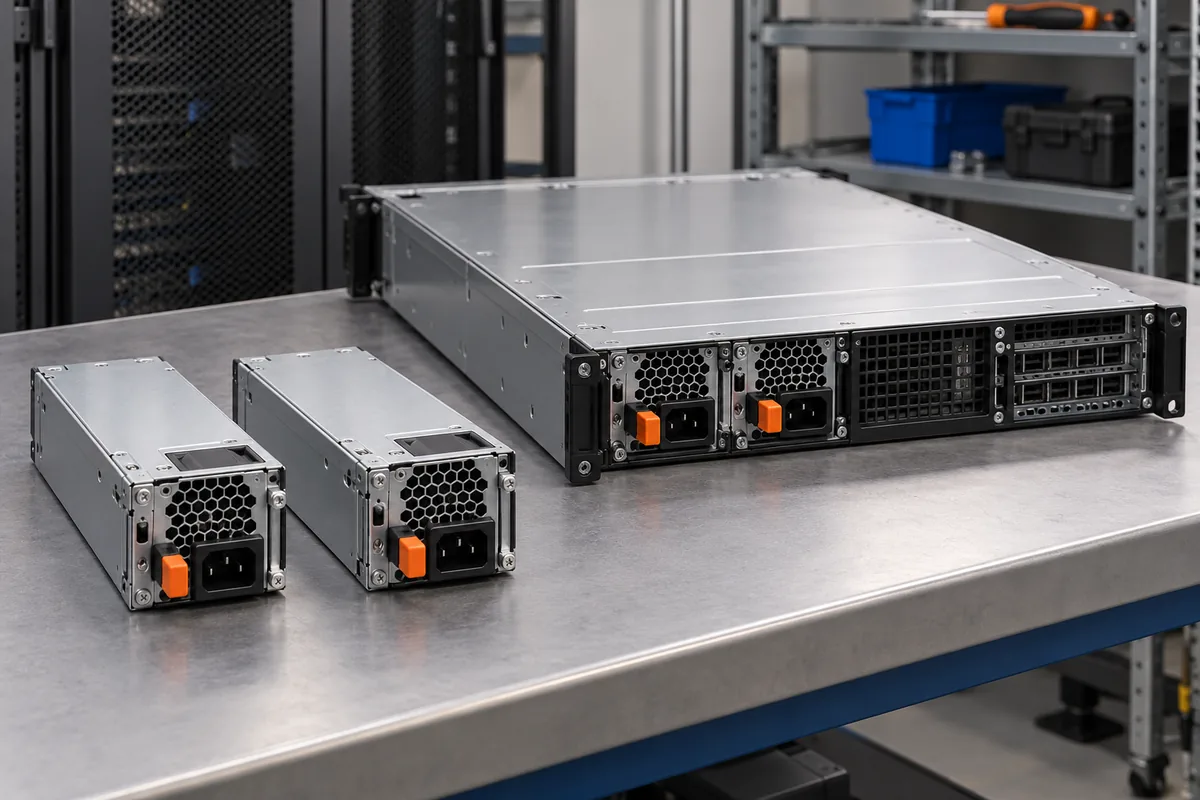
This becomes particularly useful with refurbished equipment. A chassis might have been delivered without modules, repaired with an undocumented substitute, or photographed before a later component change. Its model name describes the platform, while the present supply population describes the actual object being serviced. Neither a catalog image nor a historic configuration should silently replace that current identity.
A mismatch indication does not mean the server needs more watts
Dell describes a particular green flashing-then-off indication during addition of an AC supply as a mismatch involving properties such as efficiency, feature set, health, or supported voltage. The same indicator documentation assigns flashing green another meaning during supply firmware updating. Context and sequence therefore belong with the observation; color by itself is an incomplete description.
For an operator, that distinction separates an interpretation problem from an output-capacity problem. A warning appearing when a module is introduced can concern its relationship to the system or peer. Ordering a higher-rated replacement without identifying that relationship can change the part while leaving the actual issue unresolved.
The observation should say which bay was involved, what action preceded it, and what state the host reported. A note saying green light flashed cannot preserve the difference between an insertion event and firmware activity. The relevant management history can add context, but it should be interpreted using the exact platform documentation rather than a universal PSU light chart.
This does not mean every alarm should be dismissed as incompatibility. A real hardware or input fault can also require attention. The useful discipline is to keep the observed event separate from the proposed cause. A label comparison, host record, and diagnostic message contribute different evidence; none should be replaced by the assumption that a fan turning or one supply appearing online proves the complete pair is correct.
Input type and efficiency designation remain separate checks
The R730 manual identifies its Titanium supply as nominally rated for 200–240VAC input. That statement must remain attached to that option. A generic 750W AC search result does not tell the buyer which input boundary applies, and a familiar efficiency badge does not establish the supply conditions at the actual installation.
A server moved from a production rack to a staging bench can encounter a different source. The module identity may be unchanged while the available input has changed. If the selected option is high-line-only, a low-line staging circuit is not a valid substitute merely because the intended server load is small. Capacity and accepted input voltage answer different questions.
Likewise, a mixed-mode description in a platform document is not permission to connect an arbitrary source to another module. The exact input-capable variant and its instructions determine the supported arrangement. This article provides no AC-to-DC adaptation method and no basis for treating all R730 supply options as electrically identical at their inlets.
For a pair, record both source arrangements alongside the supplies rather than assume that matching module labels establish matching input conditions. An A/B installation may preserve availability against a defined feed failure, but its two physical paths still need to deliver the input each module accepts. The existence of two cords does not resolve a voltage or supply-type mismatch.
Correcting a mismatch differs from changing the power configuration
Restoring a supported pair after a module failure aims to return the server to an established configuration. Changing from one output class to another changes that configuration. Those tasks can require different operating states and service instructions even when both involve removable cartridges.
The R730 guidance warns that correcting a mismatch by swapping supplies indiscriminately can cause an error and unexpected shutdown. It also calls for powering down when changing between high- and low-output configurations. These constraints explain why a matching-pair purchase does not automatically imply a live two-module conversion procedure. The maintenance action must come from the applicable server instructions.
A hypothetical replacement order can make that distinction explicit. One transaction requests the approved spare for an existing 750W pair. Another proposes replacing the power population as part of a revised server configuration. Both may involve ordering modules, but the latter also needs a supported plan for the changed population and service state. Treating them as the same quick swap hides the broader work.
No online service is authorized merely because a product page says hot-plug. The condition of the remaining supply, the host’s current operating state, and the applicable instructions determine what can proceed. This explanation gives no handling sequence and does not recommend withdrawing a module to discover which one the server prefers.
The spare record should identify what the next repair will restore
After a supported replacement has been selected, retain the relationship that justified it. The useful record connects the R730 identity, accepted module part or approved alternate, relevant label information, peer supply, input arrangement, and intended final power configuration. That is more durable than a stock description containing only Dell 750W.
Receiving inspection can compare the delivered label and physical item with that record before service begins. A different part or suffix is a question to resolve, rather than an equivalence to infer after unpacking. If the seller supplied a family photograph, confirm that the delivered identity is the accepted one. An attractive condition description cannot replace that identity check.
The scope of the warranty and the condition of a used module remain commercial questions alongside compatibility. A supported model can still arrive damaged or with an unreadable label. A clean-looking module can still lack evidence of the required relationship. Those distinctions help the buyer ask for the missing fact instead of assuming that a stronger adjective in the listing settles it.
Keep the intended service outcome visible as well. A server continuing to run after a replacement arrives is not the same documented outcome as restoring its accepted power configuration. The relevant host status should describe the installed pair after the authorized work, with any remaining mismatch or degraded condition resolved through the supported service route. A purchase record that preserves that endpoint is more useful during the next incident than a receipt stating only that a replacement powered on.
The resulting 750W purchase has a precise purpose: restore the documented host and peer relationship under the intended input conditions. The EPP marking is useful because Dell explicitly requires it for the R730 AC supply. It remains one condition within that relationship, not a shortcut around generation, type, output, and supported-part evidence.