A gaming-PC recommendation can identify a real 650W 80 PLUS Gold power supply without answering whether it belongs in your server. For a new tower or edge host designed around a fixed ATX supply, that recommendation may provide a useful candidate. For an existing server with an approved hot-plug cartridge, it may describe an entirely different purchase. The best 650W Gold server PSU is therefore an exact, supported unit whose operating behavior and service arrangement suit the intended host. There is no defensible universal winner from the wattage and badge alone.
The useful way to read a PC-oriented shortlist is to ask which of its selling points survive the move into a continuously running server. Quiet operation, modular cables, and a long warranty can matter, but cable access, unattended recovery, and replacement time may change their value. This article follows that translation for a fixed-supply tower rather than ranking unrelated modules or recommending a consumer unit as an OEM replacement.
Start with the purchase that a PC shortlist can actually support
A tower server assembled from a motherboard and enclosure that explicitly accept an ATX power supply is a plausible place to investigate a 650W Gold ATX candidate. The enclosure instructions, motherboard requirements, and complete component load schedule establish that starting point. A tower shape by itself does not: an OEM tower may use a proprietary supply, wiring arrangement, or supported spare. An ordinary desktop replacement recommendation does not override those requirements.
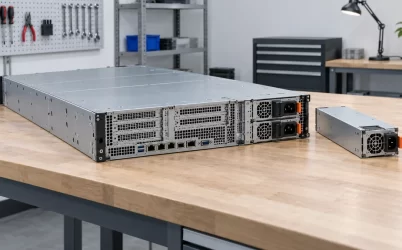
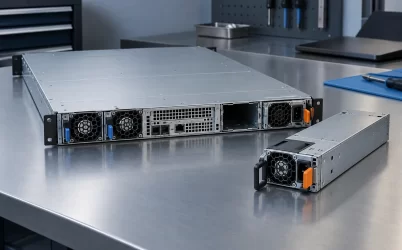
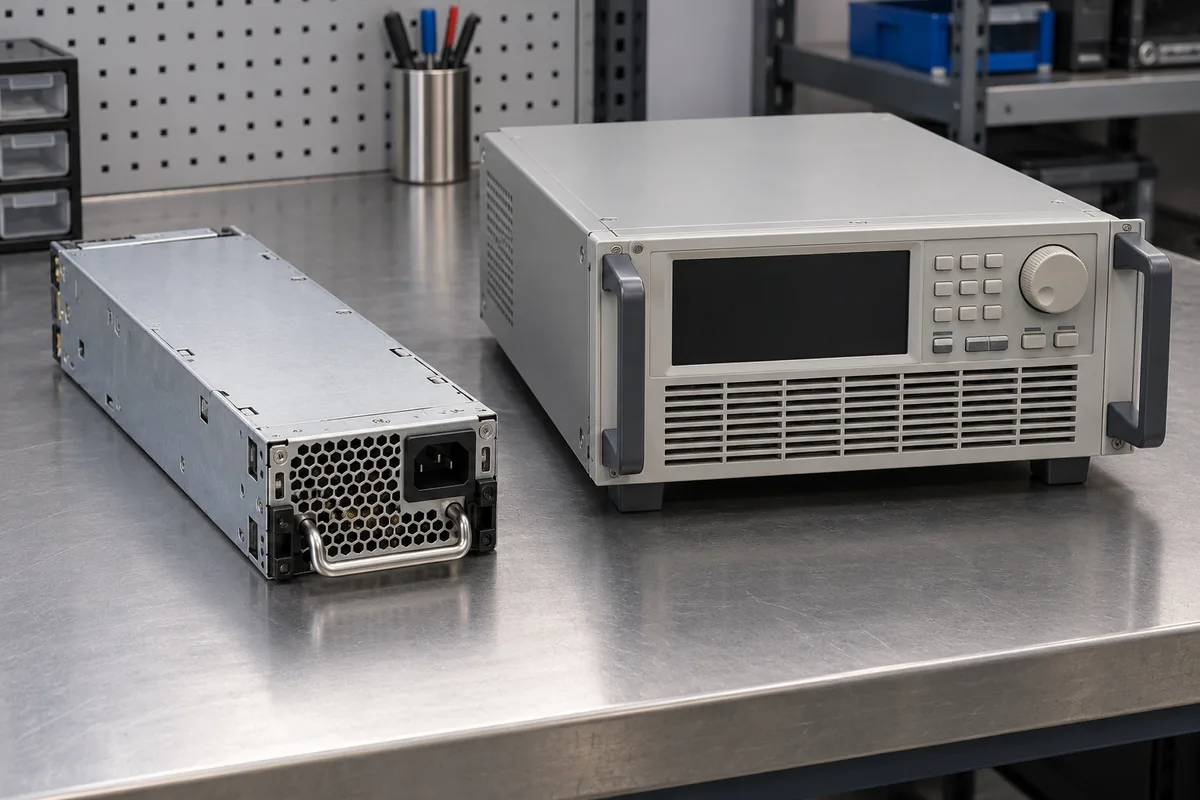
A redundant rack server is a different purchase route. Its supported module is selected through the host manufacturer’s parts documentation, including any cage or power-distribution requirements. Searching for a 650W Gold desktop unit cannot establish that replacement. Keep a service order for an existing OEM server on its supported-parts route even when an attractive ATX product costs less or carries the same efficiency tier.
For the fixed ATX host, first establish why 650W is in the shortlist. The required DC load includes the motherboard, processor supply losses, memory, storage startup, cards, and fans under the operating states the system must support. Processor advertised power and GPU advertised power do not account for every load. Nor is a UPS reading directly comparable with a DC output rating. If capacity has not been established, a 650W search filter is a provisional preference rather than a completed sizing result.
This keeps the comparison useful: compare candidates capable of powering the same defined tower configuration, rather than a low-price PC product against a redundant server assembly. The remaining questions concern how well each candidate serves that fixed host during normal work, idle periods, and repair.
Use one exact 650W Gold example without turning it into a winner
Corsair’s manufacturer page identifies the RM650x, SKU CP-9020198-NA, as a fully modular ATX PSU with 650W continuous power and an 80 PLUS Gold efficiency designation. Its technical specifications list a 150 × 86 × 160mm enclosure, ATX12V v2.4 and EPS 2.92 compatibility, and a continuous-output rated temperature of 50°C. These facts make it a concrete example of what a PC result can establish. They do not identify an approved server, prove suitability for a particular motherboard, or establish current purchasing availability.
The distinction between a family name and the exact item matters here. “RM650” in a search title, an RM650x product page, and another generation with a similar name are not interchangeable records. Retain the complete SKU when comparing documentation and the offered unit. Do not transfer cable compatibility, connector inventory, dimensions, or thermal conditions from another family member because the wattage is the same.
The RM650x example also shows why a manufacturer page needs careful reading. A top-level rating is only part of the electrical description. A server designer still needs reliable individual and combined output limits, connector assignments, and startup behavior for the intended configuration. If an output table contains inconsistent values, obtain clarification before relying on the disputed rail. Multiplying a convenient current by its voltage does not resolve conflicting official specifications.
Use this product as an evidence-reading example, not as a recommendation to buy it for a named host. A shortlist becomes useful when each entry can be traced to a complete item and its supported use. The presence of a recognizable retail brand cannot fill a missing motherboard approval or an unresolved electrical requirement.
Read Gold in its non-redundant test category
The official 80 PLUS rating tables separate desktop, workstation, and non-redundant server applications from redundant data-center applications. They also distinguish input categories. That separation is important for a fixed tower: a Gold result for a non-redundant ATX product should be interpreted in its own category, rather than borrowing the criteria for a redundant server module.
Certification assesses conversion efficiency at defined test conditions and load points. It does not mean that a 650W PSU consumes 650W whenever the server is on, or that Gold supplies deliver one constant efficiency. The output demand determines the operating point; actual input power includes conversion losses. A Gold badge also does not certify a server’s uptime, the correctness of its cable wiring, or communication with a baseboard management controller.
For a tower that waits for work overnight, request efficiency information in the output region where it spends those hours. A mid-load headline says little about a much lighter idle condition. Compare real input measurements on the same host and workload when available, keeping peripherals and power-management settings consistent. Otherwise, preserve the uncertainty instead of promising an annual saving from the badge.
There is no requirement to target half of the PSU’s rating simply because a certification table includes a half-load point. Capacity must cover the workload, while energy evaluation should reflect how that workload actually runs. Increasing server activity to reach a favorable efficiency percentage would defeat the energy objective. Likewise, selecting inadequate output capacity to move idle demand farther up a curve is a poor exchange.
Modular cables change the tower comparison
Modularity can reduce unused harnesses in a crowded enclosure. In a tower server, however, the useful question is whether the necessary harnesses reach their destinations without occupying drive-service space or blocking a fan inlet. The nominal metal enclosure dimensions do not include every installed cable bend or the space needed to disconnect a modular plug. Reserve space beyond the cable exit when checking a candidate against the chassis drawing.
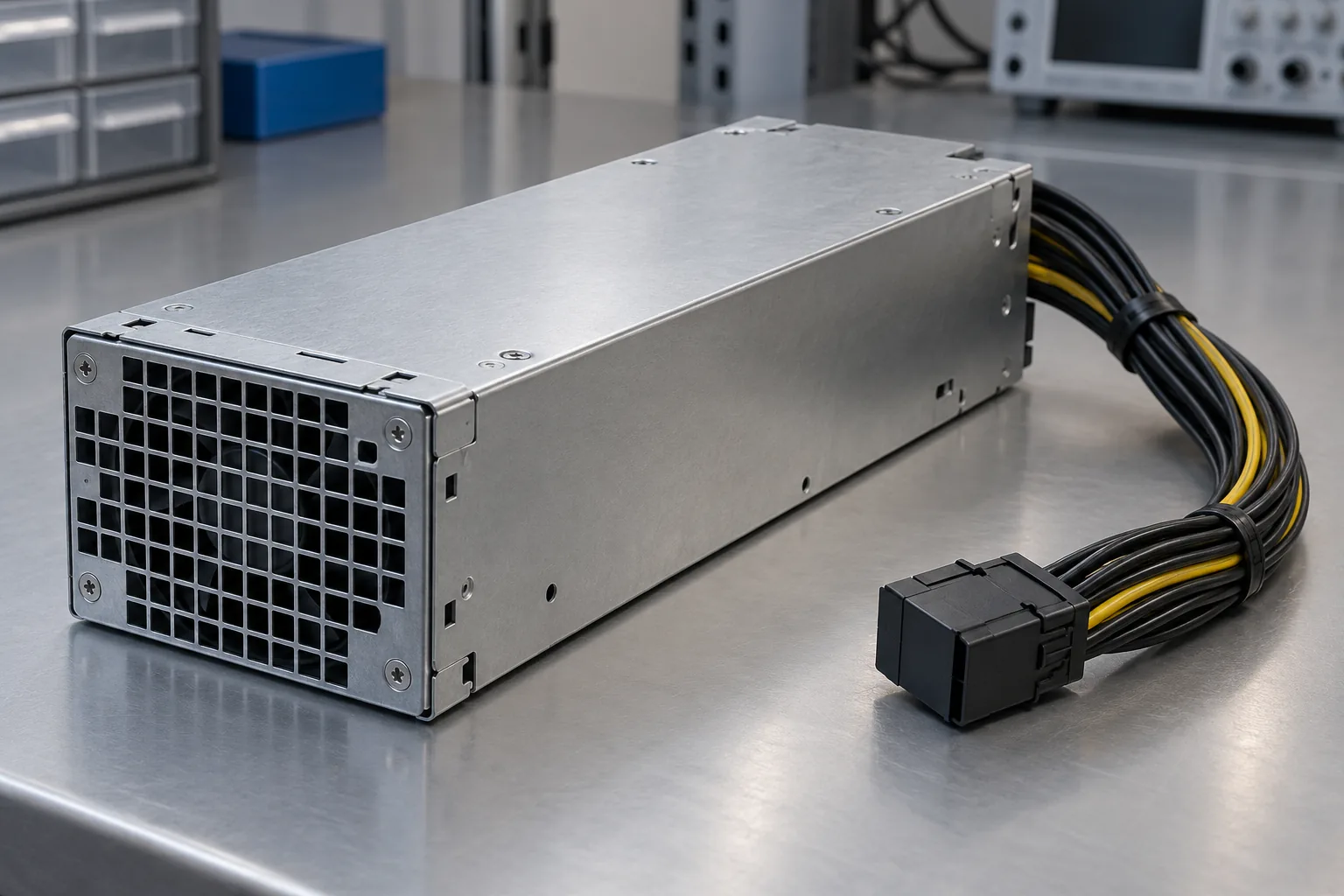
CPU power is a frequent source of misleading comparisons. Count the motherboard’s required power connections and identify their electrical purpose from its manual. A visually similar graphics-card connector does not become a processor connector. The retail claim “multiple connectors” is less informative than the exact bundled cable inventory, plug type, and cable length required to reach a socket near the top of a tower motherboard.
Storage introduces another distinction. Several drives may share one harness even though a listing advertises enough individual SATA plugs. Connector count does not describe the allowed current through the upstream wires and modular connection, nor does it prove that simultaneous drive startup is supported. A storage backplane may need a different connection altogether. Obtain its input requirements and the supply manufacturer’s permitted harness arrangement rather than solving a shortage with unspecified adapters.
Keep the PSU-side cable assignment model-specific. A cable that physically enters a modular socket may have a different electrical mapping from the required cable. The RM650x page identifies its cable type as Type 4; that is a manufacturer-specific compatibility detail, not a universal modular standard. Preserve the approved harness with the spare supply or verify any reused cable against explicit manufacturer guidance. This can matter more during a hurried repair than the convenience of removing unused wires during the original build.
Quiet PC behavior needs a different reading in an unattended host
The RM650x page describes a Zero RPM mode in which the cooling fan stops at low and medium loads. In an office tower, that can be attractive. It also means a stationary PSU fan is not, by itself, evidence that this example supply has failed. A technician who expects every server PSU fan to spin continuously could misdiagnose normal behavior. Check the model’s operating description before using fan motion as a health indicator.
The chassis must provide its own supported cooling arrangement. If a design informally relies on the PSU fan to move air past drives or motherboard components, a fan-stop operating mode changes that assumption. A larger PSU does not necessarily improve that situation. Verify the enclosure’s air path with the actual selected supply and the expected low-load condition, especially when the host spends long periods idle in a warm equipment room.
Similarly, an operating-temperature entry is a rating condition, not permission to run the room at that temperature or proof that every component in the tower will remain cool. The supply inlet may receive warmer air than the room sensor measures. The motherboard, storage devices, and expansion cards have their own limits. Compare these conditions with the installed orientation and ventilation rather than using one product’s temperature figure as a whole-server approval.
Unattended operation adds questions that a gaming recommendation may barely address. Does the assembled server recover correctly after AC power returns? Do shutdown and wake functions behave as required? Is a PSU fault visible to the operator through a documented mechanism? These are platform behaviors. A Gold designation and an EPS compatibility entry do not establish BMC telemetry or remote fault reporting. If those functions are required, obtain host-level evidence instead of assuming that a working power connection includes a reporting path.
The spare has to restore the service you bought
A warranty concerns the manufacturer’s remedies under its terms; it does not state how quickly a failed tower will return to production. Replacing a fixed ATX supply normally involves a planned power-off, access to the enclosure, and harness work under the equipment’s service procedure. An efficient unit can still be a poor operational match if the application cannot tolerate that interruption. A UPS can support operation during an upstream outage, but it does not replace a failed internal converter.
For a modest office file server or local edge application, scheduled downtime and a complete on-site spare may be acceptable. Include the correct cable set and accessible service instructions with that spare. For a remote site, consider who can open the host, identify the harnesses, and restore it without improvising a cable substitution. Those practical differences can justify choosing an alternative supported supply even when efficiency and nominal output are similar.
If the service requirement instead calls for module replacement while the workload stays online, return to the server architecture rather than stretching a fixed ATX shortlist to cover it. Supported redundant hardware and its host arrangement address that requirement. Within a genuinely suitable fixed tower, the strongest 650W Gold candidate is the exact documented unit that powers the required configuration, fits with its approved harnesses, behaves properly during unattended operation, and can be replaced within the service window. That is a more useful meaning of “best” than its position in a gaming roundup.