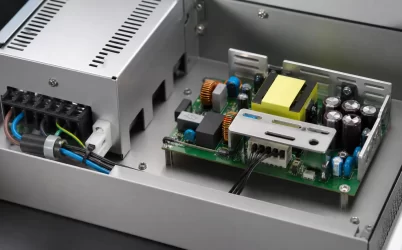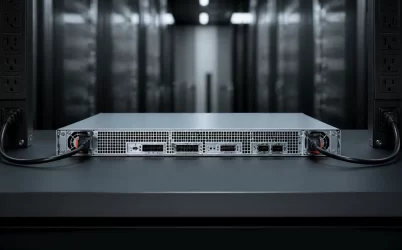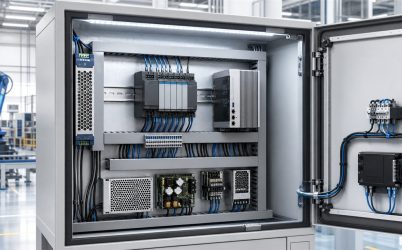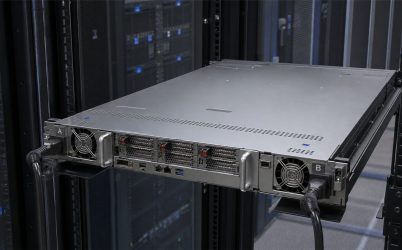
Data center server power supplies form the last major AC-to-DC conversion stage before power reaches processors, accelerators, memory, storage, and fans. Their selection affects server availability, rack capacity, electrical losses, cooling demand, telemetry, and maintenance. A suitable PSU must carry the server load after the defined module or feed failure, operate efficiently across the real utilization range, tolerate transients, and integrate with rack PDUs, A/B distribution, the server PDB, BMC, and facility monitoring.
Quick Answer
Select data center server PSUs as part of an end-to-end power chain. Determine the peak sustained and transient server load, apply configuration and environmental margins, and size the surviving modules for the required redundancy state. Verify both A and B paths can carry the transferred load. Compare efficiency at representative loads, not only at the best point. Confirm input-voltage limits, derating, power factor, telemetry, hot-swap behavior, connector temperature, airflow, and service procedures before fleet deployment.
Map the Power Chain Before Selecting a PSU
The chain may include utility or generator sources, switchgear, UPS equipment, room or row distribution, rack PDUs, cords, server PSUs, a PDB or busbar, and point-of-load converters. Redundancy at one stage cannot compensate for an undocumented common point elsewhere. For example, dual server PSUs connected to the same rack PDU protect against a PSU failure but not the loss of that PDU.
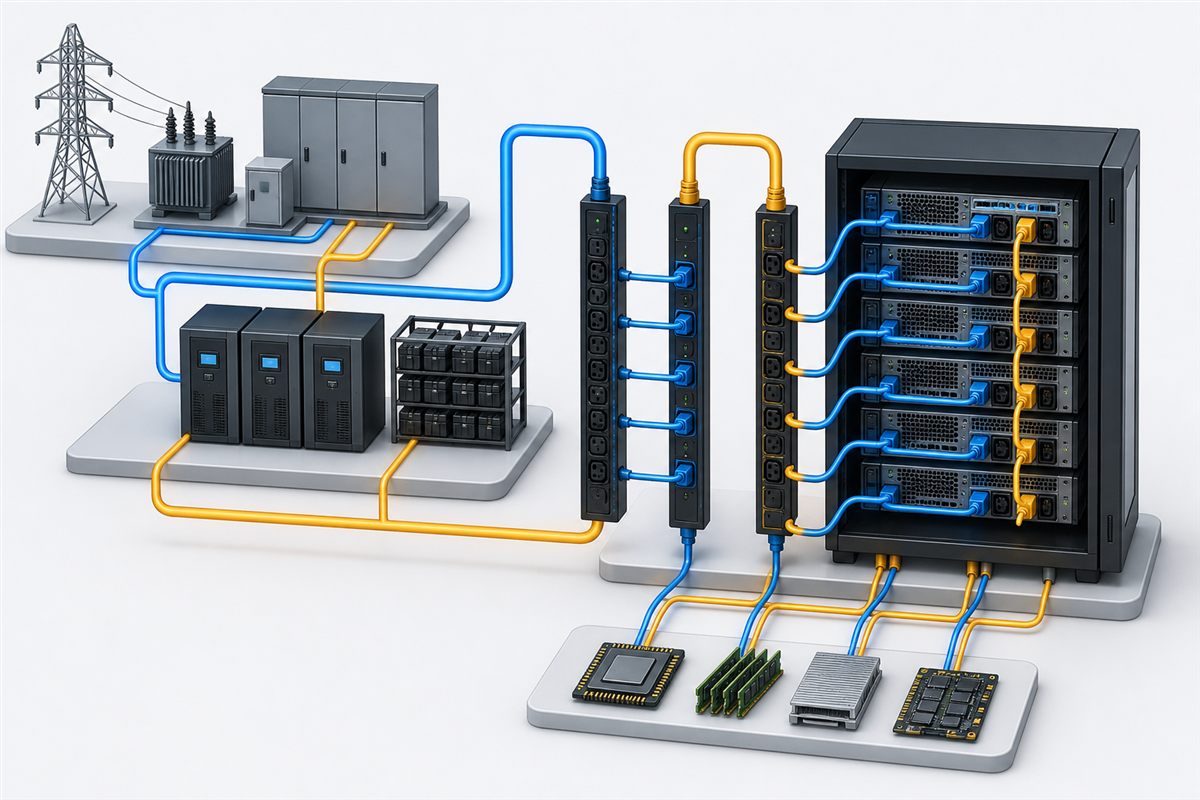
An A/B design normally expects each path to support the required load after the other path is unavailable. Operators should document where paths are independent, where they share infrastructure, and how maintenance changes the available capacity.
Convert Server Demand into Rack and Facility Demand
Consider a hypothetical rack with twenty servers, each delivering 1,200 W DC at maximum sustained load. The IT output is 24 kW. At an average PSU efficiency of 94% at that condition, the rack draws about 25.53 kW AC:
24 kW ÷ 0.94 = 25.53 kW.
The PSUs release about 1.53 kW as conversion heat. At 90% efficiency, the rack would draw about 26.67 kW and PSU loss would rise to about 2.67 kW. That additional 1.14 kW affects branch loading, UPS capacity, generator demand, and cooling.
This example does not include motherboard conversion loss, fan power variation, UPS/PDU loss, or cooling energy. Capacity planning must avoid mixing DC nameplate output with AC facility input.
Redundancy and Loading Policy
| Decision | Engineering question | Operational consequence |
|---|---|---|
| 1+1 or N+1 | Can surviving modules carry the full qualified load? | Determines usable capacity after failure |
| A/B feeds | Can either feed and PDU branch carry the transferred load? | Prevents overload during a source event |
| Load sharing | Is current balanced across modules and conditions? | Affects temperature, reliability, and efficiency |
| Cold redundancy | Does the platform support rapid, validated activation? | May improve light-load efficiency but changes failure behavior |
| Maintenance state | What redundancy remains during planned work? | Defines temporary risk and capacity limits |
Efficiency Is a System-Level Thermal Variable
Current server criteria and procurement programs emphasize efficient power supplies, power management, and real-time measurement. Those features are useful only when enabled and integrated. A high-efficiency PSU reduces both input energy and the heat discharged into the rack, but the deployed result depends on load level, input voltage, fan operation, and redundancy policy.
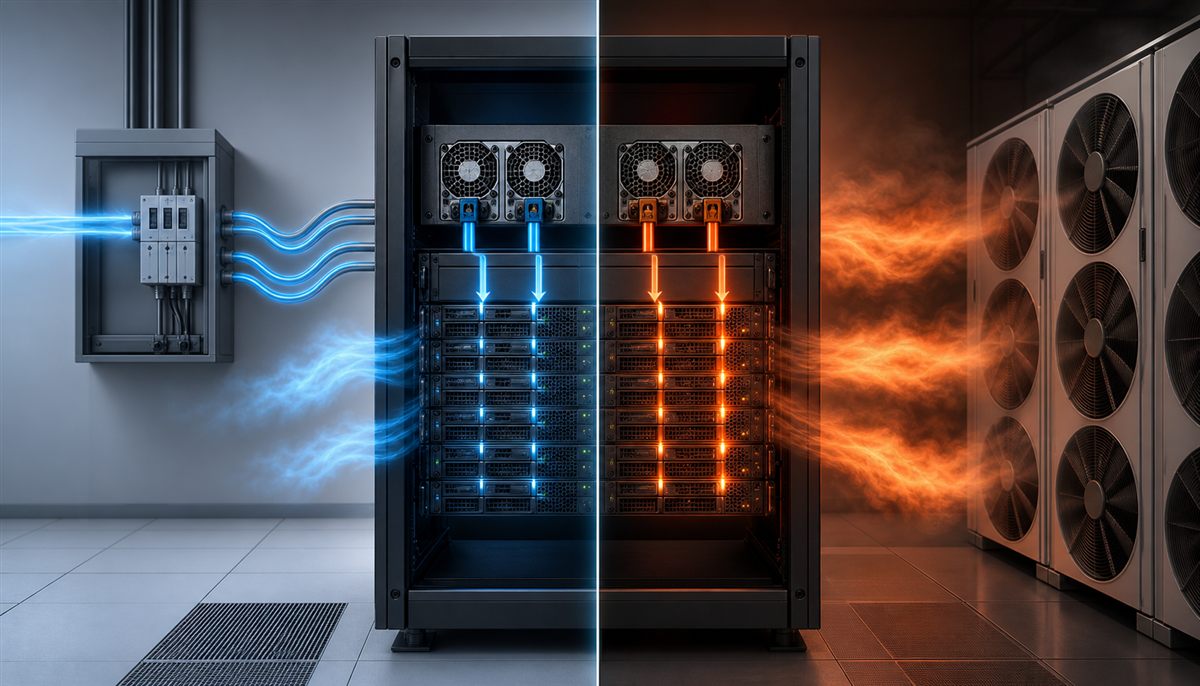
Procurement should request the efficiency curve or qualified test data for expected loads. Comparing only a peak value can favor a PSU that performs less efficiently during the facility’s dominant operating hours.
Telemetry Supports Capacity and Fault Management
Useful PSU telemetry can include input power, output power, voltage, current, temperature, fan speed, status words, and fault history. The BMC can expose that data to fleet tools for capacity analysis and early fault detection. Accuracy, update rate, command support, units, and behavior during standby or faults should be verified.
Telemetry should complement branch and rack measurements, not replace them. PSU readings describe the server conversion stage; rack PDU data describes upstream consumption and can reveal imbalances between A and B feeds.
Fleet Qualification Before Rollout
- Define representative and worst-case server configurations.
- Measure idle, typical, maximum sustained, and transient behavior.
- Test one-PSU and one-feed loss at the highest qualified load.
- Confirm rack PDU and branch capacity after A/B load transfer.
- Validate PMBus/BMC telemetry, alarms, and inventory identification.
- Run thermal tests at expected inlet temperatures and airflow conditions.
- Verify cord, inlet, connector, and PDB temperatures.
- Document approved parts, firmware, replacement procedure, and spare policy.
Procurement Questions
Is the highest wattage always the safest choice?
No. Oversizing can move normal operation to a less favorable efficiency point and does not solve connector, thermal, transient, or compatibility limits.
Can PSU efficiency be used directly as data center PUE?
No. PSU efficiency describes one conversion stage. PUE includes the total facility energy relative to IT equipment energy.
What should be tested after a firmware update?
At minimum, inventory identification, telemetry, alarms, current sharing, redundancy transitions, fan control, startup, shutdown, and recovery from faults should be rechecked.
Power-supply approval should be tied to the rack’s complete electrical and thermal envelope. That turns an individual component choice into a repeatable data center operating standard.